Nissan Leaf Insurance Cost: Cheapest EV to Insure?
The honest answer to the headline question: the Leaf is genuinely one of the cheapest EVs to insure, but not literally the cheapest, and it’s only middle-of-the-pack once you compare it against gas hatchbacks rather than other EVs. Both facts are true at once, and understanding why explains a lot about how EV insurance pricing actually works. This guide covers the real numbers and exactly where the Leaf ranks.
Key takeaways:
- Full coverage on a Leaf typically runs $1,600 to $2,400 a year across most 2026 sources, with $2,056 to $2,064 as the most commonly cited average, genuinely near the cheap end of the EV market.
- Among EVs specifically, the Leaf lands just outside the very cheapest tier, behind the Chevrolet Silverado EV ($1,947), Hyundai Ioniq 5 ($1,962 in this particular ranking), and Subaru Solterra ($1,973), but still comfortably below $2,500.
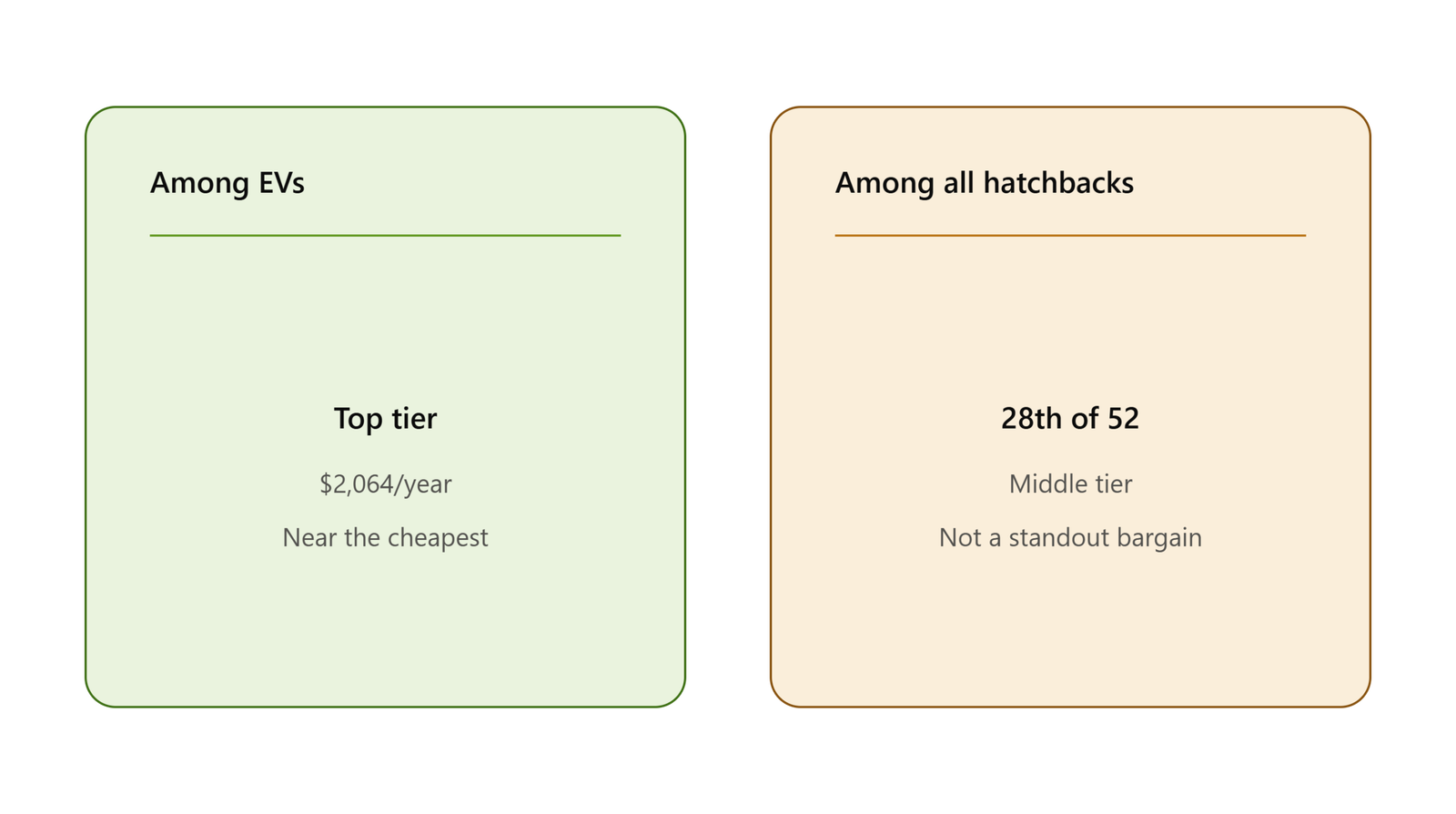
- Within its own vehicle class, hatchbacks generally, the Leaf ranks 28th out of 52 for affordability, a genuinely middle-tier position, not a standout bargain.
- GEICO and USAA consistently rank as the cheapest insurers, with USAA quoting as low as $89 a month in one direct comparison.
The real numbers
Pulling together multiple 2026 sources gives a genuinely tight, consistent range for the Leaf, tighter than we’ve seen for several other models covered throughout this site:
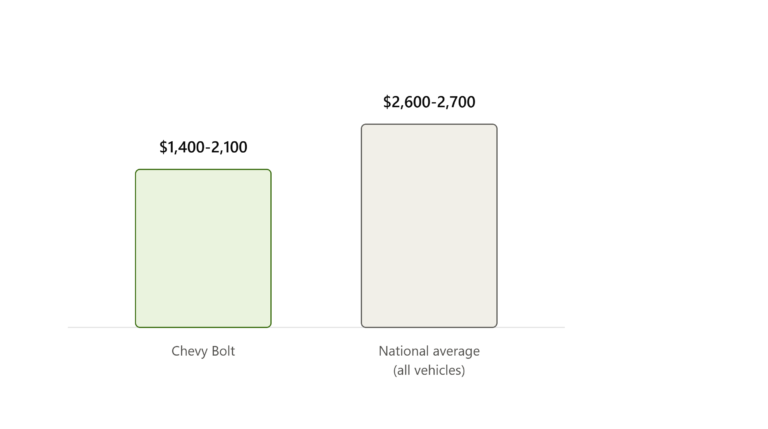
- One comprehensive guide finds $1,600 to $2,100 a year as realistic for many drivers, with a safe 40-year-old in a low-cost state potentially seeing quotes near $1,200.
- MoneyGeek’s detailed analysis finds $2,056 a year for full coverage, with GEICO offering the cheapest average at $171 a month.
- Compare.com finds $170 a month ($2,040 a year), with USAA offering the cheapest rate at $89 a month.
- A separate source finds a lower figure for the newest model year specifically: around $1,400 a year ($117 a month) for a 2025 Leaf.
- MoneyGeek’s broader cross-EV comparison lists the Leaf at $2,064 for full coverage, placing it in a cluster of models all below $2,500.
Bringing this together: budget roughly $1,600 to $2,400 a year for full coverage as a realistic planning range, with $2,000 to $2,100 as a reasonable single-number estimate if you need one figure for budgeting.
Is it actually the cheapest EV to insure? The honest answer
This is worth answering directly rather than just implying. According to MoneyGeek’s detailed cross-EV comparison, the Chevrolet Silverado EV holds the title of cheapest EV to insure at $1,947 a year for full coverage, with the Hyundai Ioniq 5 and Subaru Solterra following close behind at $1,962 and $1,973 respectively in that specific analysis. The Leaf comes in just after this leading cluster at $2,064, alongside other affordable models like the Cadillac Lyriq ($2,039), VW ID. Buzz ($2,088), and Chevrolet Equinox EV ($2,137).
So the Leaf isn’t literally the single cheapest EV to insure, but it’s genuinely part of the same affordable tier as the true cheapest options, all separated by well under $200 a year from each other. Worth noting: this ranking differs somewhat from our own cheapest-EVs-to-insure guide, which highlighted the Fiat 500e and different specific figures for the Silverado EV, a reminder consistent with the pattern covered throughout this site that different studies, using different methodologies and sample profiles, will produce somewhat different exact rankings even when the broader conclusion, mainstream, established-automaker EVs cost less to insure, holds consistently across all of them.
The more interesting finding: middle-tier within its own vehicle class
This is the genuinely useful nuance most «cheapest EV» framing misses. While the Leaf ranks near the top of the EV category specifically, it ranks 28th out of 52 hatchbacks for insurance affordability when compared against its actual broader vehicle class, including gas-powered hatchbacks. That’s a solidly middle-tier position, not a standout bargain, with 27 other hatchbacks, most of them gas-powered, costing less to insure than the Leaf.
This distinction matters for how you should actually think about EV insurance cost: «cheapest EV» and «cheap car generally» are different claims. The Leaf earns the first label genuinely, but the second one only partially, EV-specific cost factors, battery replacement risk, specialized repair requirements, still apply to the Leaf, just to a smaller degree than they do to a Tesla or Rivian, rather than not applying at all.
Why the Leaf costs less than most EVs
The underlying reasons track closely with the pattern covered in our broader cheapest-EVs-to-insure guide, and the Leaf is a clean example of nearly every favorable factor at once:
Low purchase price directly reduces total-loss exposure. The 2026 Leaf starts at $29,990 MSRP, with trims ranging up to $40,485, genuinely modest by EV standards and well below the Tesla, Rivian, and luxury EV pricing covered elsewhere on this site.
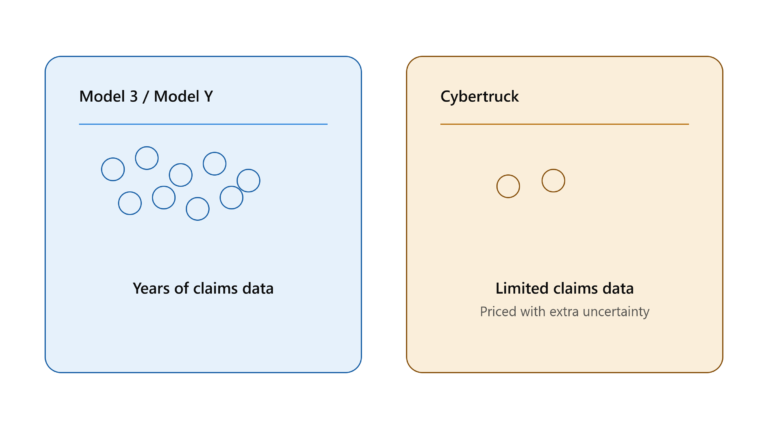
A long production history means mature parts availability and claims data. As covered in our cheapest-EVs-to-insure guide, the Leaf’s status as one of the longest-running EV nameplates in the U.S. market gives insurers years of accumulated claims history to price against, reducing the uncertainty premium that newer or less-established EVs, like the Cybertruck covered elsewhere on this site, still carry.
Strong safety ratings support lower premiums. The Leaf holds a 5-star overall NHTSA rating and comes standard with lane-departure warning and blind-spot monitoring, features that can qualify for a safety discount on top of the vehicle’s already-modest baseline cost.
Modest power output keeps claim severity down. Unlike the performance-oriented EVs covered in our Tesla Model S and Cybertruck guides, the Leaf’s unremarkable acceleration doesn’t carry the same performance-related risk premium.
It generally costs about 8% more to insure than comparable gas cars, according to one detailed comparison, a genuinely small EV premium next to the 32% to 42% gaps documented for other vehicles covered throughout this site.
How model year moves the number
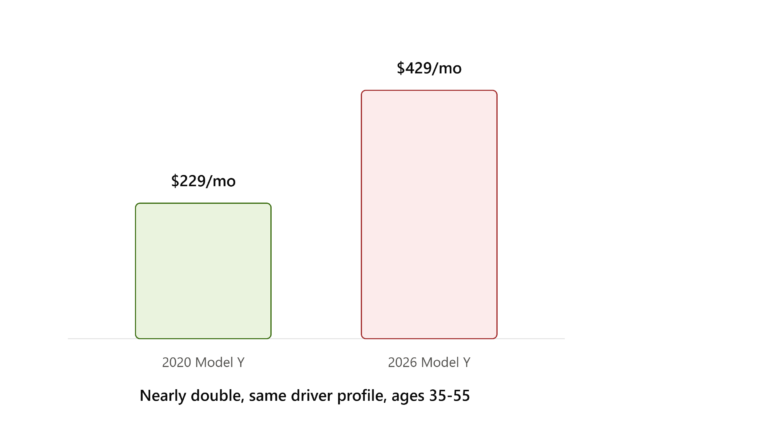
Newer Leaf models cost meaningfully more to insure than older ones: about $200 a month for a 2025 Leaf compared to roughly $94 a month for older models, more than double, driven by the same higher-current-value logic covered throughout our GAP insurance and used-EV guides. One detailed year-by-year breakdown shows this pattern clearly: a 2022 Leaf averaging $1,344 a year, a 2021 model at $1,603, a 2020 model at $1,111, and a 2019 model at just $888, illustrating how meaningfully an older Leaf can undercut a new one on insurance cost specifically.
Best insurers for a Leaf
USAA posts the cheapest rate in direct comparison at $89 a month, consistent with USAA’s broader strength covered throughout this site for eligible military-affiliated drivers.
GEICO shows up repeatedly as the cheapest non-military option, averaging $171 a month in one source.
Travelers offers the cheapest full-coverage rate in a separate model-year-specific comparison, at $129 a month, against AIG’s notably higher $299 a month for the identical vehicle, a spread worth taking seriously when shopping.
Allstate stands out specifically for EV-focused support, offering charger protection plans covering mechanical failure or accidental damage, plus discounts on home chargers and installation, similar to the EV perk package we found for the Hyundai Ioniq 5 in our dedicated guide.
How to get the cheapest possible Leaf insurance
Get quotes from at least three insurers, given the documented spread between USAA’s $89 a month and AIG’s $299 a month for comparable coverage.
Consider an older model year if minimizing cost is the priority, given the roughly 2x spread documented between new and older Leaf models above.
Raise your deductible on an older, lower-value Leaf. As covered in our broader deductible guide, moving from $500 to $1,000 can meaningfully cut premiums, particularly sensible on a Leaf whose lower overall value means less absolute dollar risk from a higher deductible.
Ask Allstate specifically about its charger protection and home-charging discounts if those EV-specific perks matter to your situation, weighing them against the potentially lower base rates from USAA or GEICO.
The bottom line
The Nissan Leaf earns its reputation as one of the most insurance-friendly EVs on the market, genuinely near the cheapest tier among electric vehicles, though not literally the single cheapest by every ranking. The more useful nuance is remembering that «cheap for an EV» and «cheap overall» are different claims, the Leaf ranks solidly mid-tier once compared against the broader hatchback class it actually competes in. USAA and GEICO consistently offer the strongest rates, and choosing an older model year remains one of the most reliable ways to push your specific Leaf premium toward the lower end of the range documented throughout this guide.
This article is for informational purposes only and does not constitute financial or insurance advice. Insurance rates vary by insurer, state, model year, trim, and individual driver profile, and change frequently. Always get a personalized quote before making a purchasing decision.