Electric Car Insurance in New Jersey
New Jersey just completed a phased increase to its minimum liability requirements, the second step of a plan that began in 2023, and the state remains one of only three in the country where drivers get to choose between a no-fault and a tort-based insurance system entirely. Layer on some of the highest baseline premiums in the nation, and New Jersey EV owners are navigating a genuinely complex, genuinely expensive insurance landscape. This guide breaks it all down.
Key takeaways:
- New Jersey’s minimum bodily injury and property damage liability increased from 25/50/25 to 35/70/25, effective January 1, 2026, the second phase of a plan enacted in 2022 that first raised limits in 2023.
- New Jersey is a «choice no-fault» state, one of only three in the country, letting drivers choose between a limited-coverage Basic Policy, a Standard no-fault policy, or full tort coverage that preserves the right to sue.
- Full coverage in New Jersey averages $2,781 to $3,018 a year statewide, 28% to 50% above the national average depending on the source, driven by extreme population density, high accident frequency, and significant litigation.
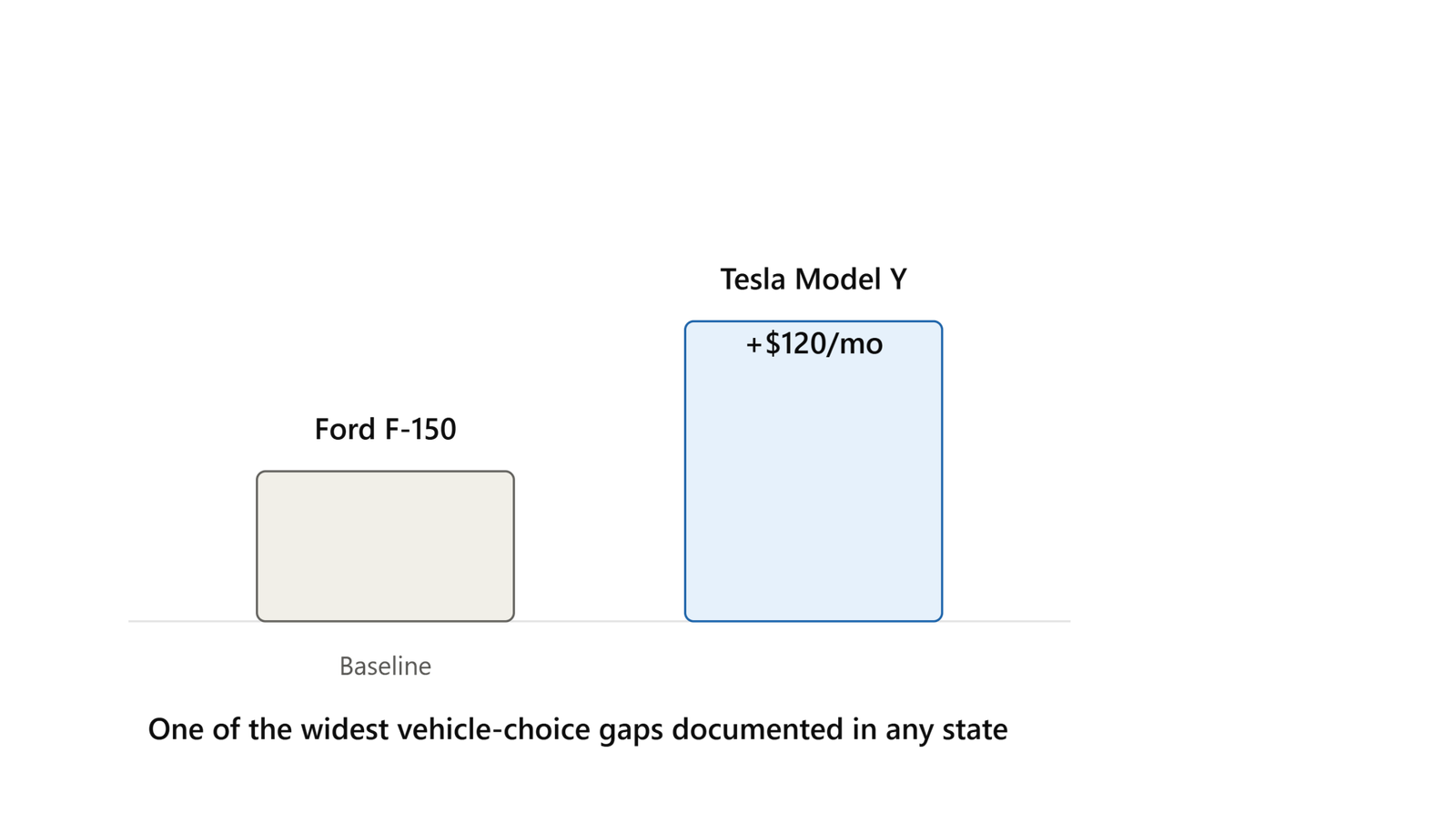
- A Tesla Model 3 costs about $279 a month to insure in New Jersey versus $254 for a comparable Toyota Camry, and vehicle choice alone creates a $120 monthly spread between a Ford F-150 and a Tesla Model Y.
The recent minimum coverage increase
New Jersey’s minimum bodily injury/property damage liability increased from 25/50/25 to 35/70/25, effective January 1, 2026, under P.L.2022 c.87, a phased increase with its first raise in 2023 and this second raise completing the plan. This mirrors the pattern documented in our California and Texas guides, states progressively updating decades-old or recently-set minimums to better reflect real accident costs, though New Jersey’s timeline moved faster than some, completing its full increase within about three years of the law’s enactment.
Personal injury protection (PIP) remains set at $15,000 per person or accident under the Basic Policy, a comparatively modest figure worth understanding alongside the broader coverage-level guidance covered throughout this article.
New Jersey’s unique «choice no-fault» system
This is genuinely distinct among the states covered throughout our broader research. New Jersey is one of only three states where drivers can choose between no-fault and tort auto insurance, rather than the state mandating one system outright, as California (tort/at-fault) or Florida and Texas (no-fault) do, all covered in our dedicated guides. When purchasing coverage, New Jersey drivers select either a Limited Right to Sue option, which offers lower premiums but restricts lawsuit rights, or an Unlimited Right to Sue (full tort) option, which costs more but preserves your ability to seek full compensation.
There’s also a genuinely low-cost Basic Policy available as an alternative, providing only $15,000 in PIP and no liability coverage beyond $5,000 in property damage, a minimal option that most insurance advisors specifically recommend evaluating carefully against your personal health insurance situation before selecting, given how thin that protection runs, especially for an EV owner given the elevated repair costs documented throughout this site.
Regardless of which no-fault option you select, New Jersey’s no-fault framework restricts your right to sue the at-fault driver for pain and suffering unless your injuries meet the state’s «serious injury threshold,» typically defined as permanent injury, significant disfigurement, or fractures, a structural feature similar to New York’s serious-injury threshold covered in our dedicated New York guide.
The real cost numbers, among the highest in the country
New Jersey is consistently described as one of the most expensive states for auto insurance nationally. Full coverage averages $2,781 to $3,018 a year statewide across the sources reviewed for this guide, with one source specifically describing New Jersey premiums as routinely 40% to 50% above the national average, while another calculates a more conservative but still substantial 28% premium over the national average of $2,356. Minimum coverage runs $1,124 to $1,431 a year depending on the source. This elevated baseline, driven by extreme population density, high accident frequency, significant litigation, and the state’s complex no-fault system, applies before any EV-specific factors are even layered on top.
The specific EV cost data for New Jersey
This is where the state-specific EV numbers become genuinely useful. A Tesla Model 3 costs about $279 a month to insure in New Jersey, compared to $254 for a Toyota Camry, a $25 monthly gap that adds up to about $300 a year, making the step from a conventional sedan to an EV a meaningful, quantifiable cost even at the more affordable end of the EV spectrum covered throughout our dedicated Tesla guides.
More strikingly, vehicle choice alone creates a $120 monthly spread between a Ford F-150 and a Tesla Model Y in New Jersey specifically, and when combined with the state’s credit-score-driven variance (a separate $114 monthly spread from good to poor credit), these two factors together account for $234 a month of rate variation before city, insurer, or driving record even come into play. This is one of the more dramatic illustrations documented across our state-level research of how much vehicle choice and personal financial factors compound in a single state’s rating system.
For context on the hybrid alternative: a Toyota Prius runs $241 a month in New Jersey, $86 less than a Tesla Model Y, worth knowing if you’re weighing a hybrid against a full EV specifically for cost reasons, consistent with the broader hybrid-versus-EV cost comparison covered in our dedicated guide.
Age and gender create dramatic gaps in New Jersey specifically
Following the age-based pattern covered throughout our broader EV-by-age guide, New Jersey shows particularly stark figures at the youngest ages: a 16-year-old male pays $533 a month on a family plan with full coverage, 3.2 times what a 40-year-old pays on the identical plan, dropping to $288 a month by age 25. New Jersey’s mandatory no-fault medical coverage specifically pushes teen rates higher than in most states, since every driver carries that mandatory coverage regardless of who caused an accident. Worth noting separately: the $54 monthly gender gap at age 16 in New Jersey actually exceeds the entire spread between the state’s cheapest and most expensive insurer, a genuinely unusual finding suggesting age and gender matter more to New Jersey’s youngest-driver pricing than carrier choice does.
Why the state minimum falls short, especially for an EV
A single serious accident, especially one involving hospitalization, surgery, or multiple vehicles, can easily generate costs of $100,000 or more in New Jersey. If your liability limits sit below the total damages, you’re personally responsible for paying the difference out of pocket. A common recommendation from insurance advisors is at least 100/300/100 coverage, or higher if you have significant assets to protect, advice that applies with particular force given how much more expensive an EV-involved accident’s property damage component specifically tends to run, as covered throughout this site’s broader model and coverage guides.
It’s also worth remembering, consistent with the guidance in our other no-fault state guides: even in New Jersey’s no-fault system, your PIP coverage does not cover vehicle repairs, meaning uninsured/underinsured motorist coverage remains genuinely important protection for your own EV specifically if an uninsured or underinsured driver causes the damage.
Best insurers for New Jersey EV owners
GEICO is repeatedly identified as offering some of the cheapest minimum coverage in New Jersey, averaging $774 annually in one source.
NJM (New Jersey Manufacturers Insurance) shows up consistently as among the cheapest options for both minimum and full coverage across multiple sources, averaging $125 a month for liability-only coverage in one comparison, and specifically noted as the cheapest insurer in certain New Jersey cities like Bloomfield.
Plymouth Rock rounds out the group of consistently affordable options for minimum coverage in New Jersey according to at least one comprehensive source.
Practical steps for New Jersey EV owners
- Understand which no-fault option genuinely fits your situation before defaulting to the cheapest Basic Policy, given how thin that protection runs specifically for an EV given elevated repair costs documented throughout this site.
- Consider coverage well above the new 35/70/25 minimum, given how easily a serious accident’s costs can exceed $100,000 in New Jersey specifically.
- Budget for the real, quantified EV premium documented above, roughly $300 a year more for a Model 3 than a comparable Camry, and a genuinely large $120 monthly gap between an F-150 and a Model Y.
- Get quotes from GEICO, NJM, and Plymouth Rock as a starting comparison set, given their consistent strength across the sources reviewed for this guide.
- Work on your credit score if it’s a factor in your specific policy, given the documented $114 monthly spread between good and poor credit in New Jersey specifically, one of the more actionable levers covered throughout our broader savings guides.
The bottom line
New Jersey combines a uniquely flexible but genuinely complex «choice no-fault» system, a just-completed minimum coverage increase to 35/70/25, and some of the highest baseline insurance costs in the country, 28% to 50% above the national average depending on the source. Layer real, quantified EV-specific premiums on top, roughly $300 a year more for a Model 3 than a comparable gas sedan, and a $120 monthly spread purely from choosing a Model Y over an F-150, and New Jersey EV owners face a genuinely demanding cost environment. Understanding your no-fault option choice carefully, carrying coverage well above the new minimum given how easily serious accidents exceed it, and comparison shopping among GEICO, NJM, and Plymouth Rock give New Jersey EV owners the most realistic path to managing these elevated costs.
This article is for informational purposes only and does not constitute financial or insurance advice. Insurance requirements, rates, and regulations change frequently. Always confirm current requirements directly with the New Jersey Department of Banking and Insurance and a licensed insurance agent.