EV Insurance in Nevada: Rates and Providers
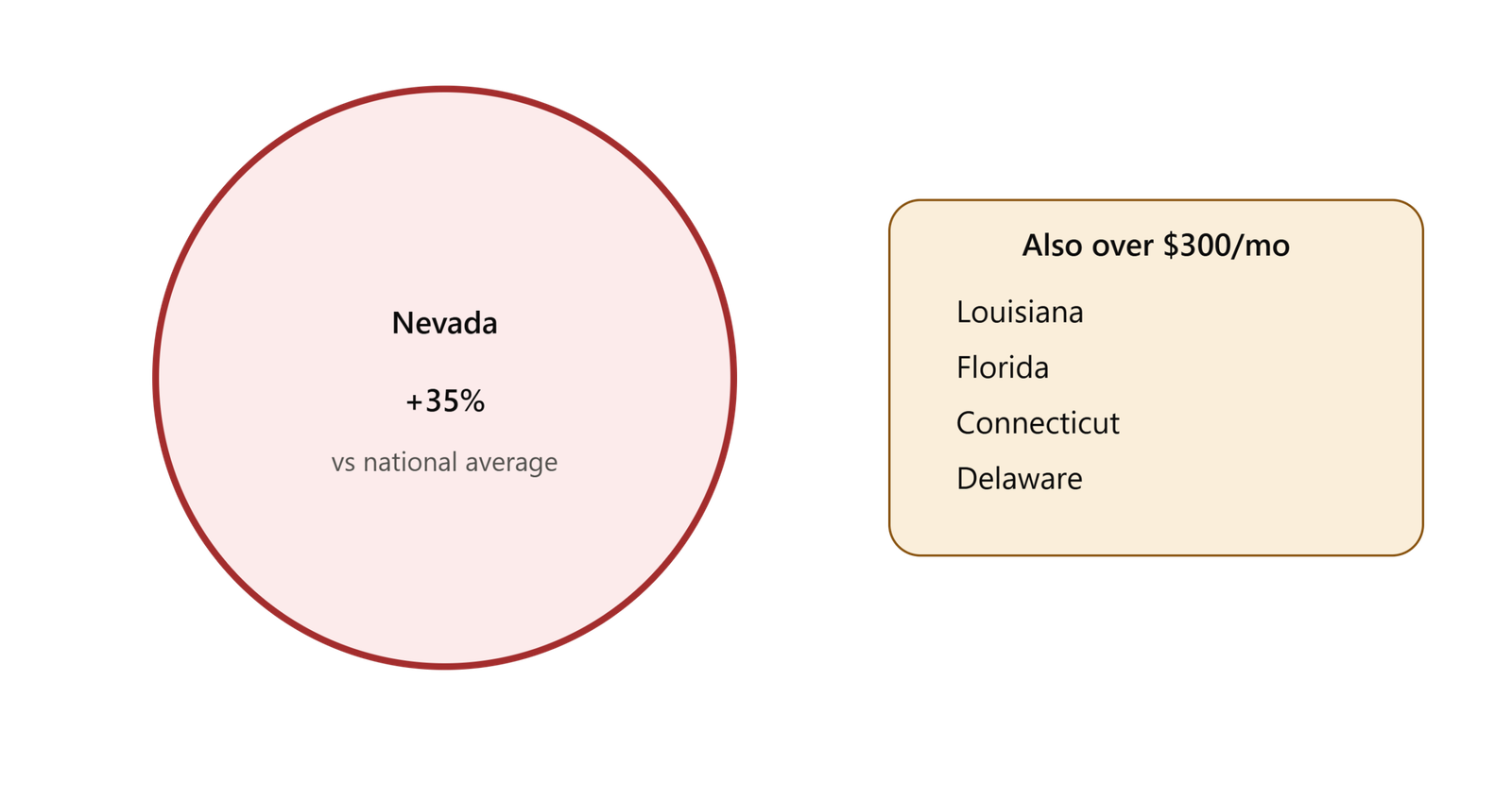
Nevada currently tops the nation for the highest auto insurance rates, running roughly 35% above the national average, with major insurers approving statewide rate hikes of 6.4% to 6.5% in 2026 alone, following an even steeper 13.7% increase in 2025. For EV owners specifically, that already-difficult baseline compounds directly with the standard EV cost factors documented throughout this site. This guide covers what’s actually driving Nevada’s rates and where to find the best coverage anyway.
Key takeaways:
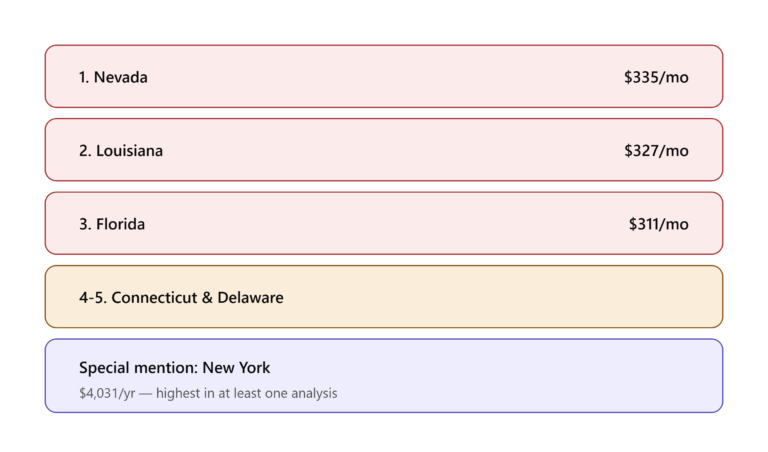
- Nevada requires 25/50/20 liability coverage, but the state’s overall rates rank among the five most expensive in the country, alongside Louisiana, Florida, Connecticut, and Delaware, all averaging over $300 a month for full coverage.
- Over 500,000 Nevadans have already seen or will see 2026 rate hikes, with some facing $40 to $80 monthly jumps even without filing any claims.
- Clark County reports over 20,000 crashes annually, driven by tourism, distracted driving, and heavy traffic on the Las Vegas Strip and I-15, a genuinely specific regional risk factor shaping statewide averages.
- Nevada allows credit-based insurance scoring, and the gap is dramatic: good-credit drivers pay $151 a month for full coverage while bad-credit drivers pay $271, a $1,440 annual difference purely from credit history.
Nevada’s actual requirements
Nevada requires minimum liability coverage of 25/50/20: $25,000 in bodily injury per person, $50,000 per accident, and $20,000 in property damage. Nevada has no grace period for a coverage lapse, going without insurance even for a single day can trigger vehicle registration and license suspension, with fees and fines ranging up to $1,750, a notably strict enforcement standard compared to several other states covered throughout our broader research.
Why Nevada leads the nation in insurance cost
This is worth understanding in detail, since it explains why Nevada’s baseline is so much higher than nearly every other state covered throughout this site. Nevada tops the nation for the highest auto insurance rates in 2026, running approximately 35% above the national average. Several concrete factors drive this:
Clark County’s traffic and accident volume is genuinely extreme. Clark County, home to Las Vegas, reports over 20,000 crashes annually, exacerbated by tourism, distracted driving, and heavy traffic concentrated on the Las Vegas Strip and I-15, a regional risk concentration that pulls the entire state’s average upward.
Escalating repair costs compound with EV-specific factors already documented throughout this site. Advanced vehicle technology, sensors, cameras, and driver-assistance systems, has driven up parts and labor expenses by 20% to 30% in recent years, the exact same recalibration and specialized-repair pattern covered throughout our broader Tesla and comprehensive-coverage guides, just layered on top of Nevada’s already-elevated baseline.
Medical cost inflation adds further pressure. Hospital and rehabilitation bills for serious injuries often exceed $50,000 in current Nevada claims, a genuinely large figure that directly shapes liability pricing statewide.
The scale of the 2026 rate increases
Major insurers have approved statewide rate hikes of 6.4% to 6.5% in 2026, following an even steeper 13.7% increase in 2025. Over 500,000 Nevadans have already seen or will see these hikes, with some facing $40 to $80 monthly jumps even without filing any claims, a genuinely significant, broad-based increase worth being aware of if you’re currently insured in Nevada or considering a move to the state.
The real cost numbers
Pulling together multiple 2026 sources gives a consistent, elevated picture:
- One source finds full coverage at $253 a month, with liability-only starting at $160.
- A separate source finds coverage ranging from $84 a month for minimum liability up to $195 a month for a 300/500/300 policy with a $1,500 deductible, with standard full coverage (100/300/100, $1,000 deductible) at $158 a month.
- Experian’s data finds a notably higher $269 a month ($3,229 a year) as the overall average.
- Bankrate finds full coverage averaging $3,568 a year, among the highest figures across sources reviewed.
- The Zebra’s broader national comparison specifically names Nevada, alongside Louisiana, Florida, Connecticut, and Delaware, as one of the five most expensive states in the country, all averaging over $300 a month for full coverage.
Bringing this together: budget roughly $250 to $300 a month for full coverage as a realistic planning range in Nevada, among the highest baselines documented across our state-by-state research, before any EV-specific factors are layered on top.
Nevada’s credit-scoring impact is genuinely dramatic
Unlike Massachusetts, California, Hawaii, and Michigan, covered in our dedicated guides as the four states that ban credit-based pricing entirely, Nevada allows insurers to use credit-based insurance scores when setting premiums, and the impact is substantial: good-credit drivers pay $151 a month for full coverage, while bad-credit drivers pay $271 a month, a $120 monthly gap totaling $1,440 a year, purely from credit history. This tracks the broader national pattern covered in our dedicated bad-credit EV insurance guide, but Nevada’s specific gap is worth knowing directly if credit is a factor in your situation, since improving your credit score is specifically identified as one of the few rate factors that works genuinely in your favor here.
Other factors that move Nevada rates significantly
Not-at-fault accidents are penalized. A clean-record driver who’s hit by another driver pays $175 a month, $17 more than the $158 baseline, a $204 annual surcharge that applies even when the driver bears zero responsibility for the crash, a notably unforgiving structure compared to some other states covered throughout this site.
A DUI adds a severe premium. A DUI increases full coverage by 55%, to $245 a month ($2,945 a year), nearly matching the increase from an at-fault accident, which raises premiums to $241 a month.
Deductible choice moves the number meaningfully. Dropping from a $1,000 deductible to $250 adds $35 a month, while adding comprehensive and collision to minimum liability at a $1,000 deductible costs just $9 more a month, one of the cheapest ways documented across our research to add meaningful protection for your own vehicle.
Nevada’s uninsured driver problem, worth factoring in
Nevada’s uninsured driver rate runs at approximately 11%, a meaningful risk factor worth addressing directly through matched uninsured/underinsured motorist coverage, especially given how expensive an EV specifically is to repair or replace if an uninsured driver causes the damage, as covered throughout this site’s broader coverage guides.
Recommended coverage upgrades for 2026
Given the rate environment and risk factors documented above, insurance professionals specifically recommend for Nevada drivers in 2026: boosting liability to at least 100/300/100, matching UM/UIM limits to your liability coverage to address Nevada’s uninsured driver problem, and adding Medical Payments (MedPay) coverage of $5,000 to $10,000 for immediate no-fault medical expenses. While these enhancements can add $50 to $100 to your monthly premium, they deliver meaningfully better protection given Nevada’s elevated accident risk and medical cost environment documented throughout this guide.
Best insurers for Nevada EV owners
Liberty Mutual offers the cheapest minimum coverage in one detailed comparison, at $114 a month, consistent with Liberty Mutual’s broader EV-specific strengths covered in our guide on which insurers actually cover EV battery replacement.
Given how significantly Nevada rates vary by insurer, and how substantial the 2026 statewide increases have been, comparison shopping specifically matters more here than in many other states, with one source specifically noting that shopping around can save up to 20%.
Practical steps for Nevada EV owners
- Shop your policy now given the documented 2026 rate hikes, even without any claims, since over 500,000 Nevadans are already seeing $40 to $80 monthly increases.
- Work on your credit score if it’s a factor, given Nevada’s documented $1,440 annual gap between good and bad credit, one of the largest credit-driven gaps covered anywhere on this site.
- Never let your coverage lapse, even briefly, given Nevada’s strict no-grace-period policy and fines up to $1,750.
- Consider the recommended 100/300/100 upgrade with matched UM/UIM, given Nevada’s elevated accident rates and 11% uninsured driver rate.
- Get a Liberty Mutual quote specifically, given its standout showing for minimum coverage affordability in the state.
The bottom line
Nevada’s position as the most expensive state for auto insurance in the country shapes everything about EV ownership costs there, layering the standard EV-specific factors documented throughout this site on top of an already-elevated baseline driven by Clark County’s extreme traffic volume, rising repair costs, and medical cost inflation. With statewide rates increasing another 6.4% to 6.5% in 2026 after a steep 13.7% jump in 2025, and a dramatic $1,440 annual credit-score-driven gap given Nevada’s permissive credit-scoring rules, Nevada EV owners have real, actionable levers, credit improvement, careful comparison shopping, and appropriate coverage upgrades, to manage what is otherwise one of the most expensive insurance environments documented anywhere in this site’s state-by-state research.
This article is for informational purposes only and does not constitute financial or insurance advice. Insurance requirements, rates, and market conditions change frequently. Always confirm current requirements directly with the Nevada Division of Insurance and a licensed insurance agent.