Most Expensive States to Insure an EV
The mirror image of our cheapest-states ranking is just as striking: Nevada, Louisiana, and Florida all average over $300 a month for full coverage, more than 50% above the national average, and layering standard EV-specific cost factors on top of that baseline pushes some EV owners in these states well past $4,000 a year. This guide ranks the most expensive states and explains exactly what’s driving the cost in each one.
Key takeaways:
- Nevada, Louisiana, and Florida consistently rank as the three most expensive states for full coverage insurance, each averaging over $300 a month, at least 50% above the national average.
- Connecticut and Delaware round out the top five most expensive states nationally, while New York posts the single highest average full-coverage rate in at least one detailed 2026 analysis, at $4,031 a year.
- Each expensive state has a distinct, identifiable driver: Nevada’s Las Vegas traffic congestion, Louisiana’s high accident and litigation rates, Florida’s hurricane exposure and uninsured drivers, all compounding with the standard EV-specific repair and value factors documented throughout this site.
- New Jersey, California, and Washington are the states seeing the sharpest year-over-year increases, meaning today’s mid-cost states could be tomorrow’s expensive ones.
The top five most expensive states
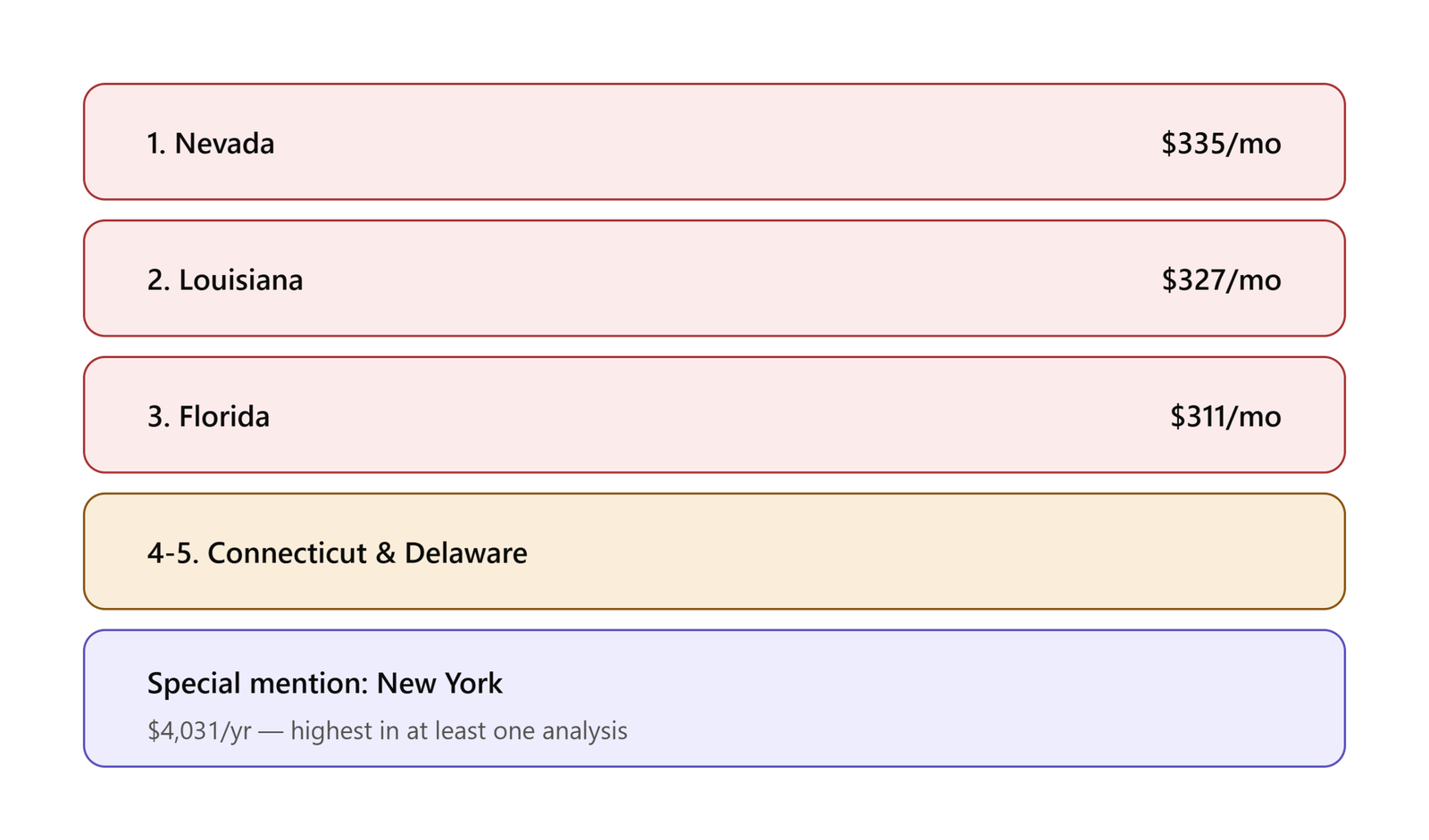
Nevada consistently ranks as the single most expensive state in most 2026 analyses, running approximately 35% above the national average, at $335 a month in one detailed source. As covered in our dedicated Nevada guide, this is driven specifically by Clark County’s extreme traffic congestion around Las Vegas and Reno, where much of the state’s population and tourism activity concentrates, alongside escalating repair costs and medical cost inflation.
Louisiana follows closely at $327 a month in the same comparison, and holds the single highest average annual premium in a separate detailed analysis at $2,883 a year. Louisiana’s elevated costs trace to a very high accident rate compared to other states, combined with a demanding litigation environment and genuine hurricane and flood exposure that drives comprehensive claims costs upward, consistent with the weather-driven risk factors covered throughout our broader state research.
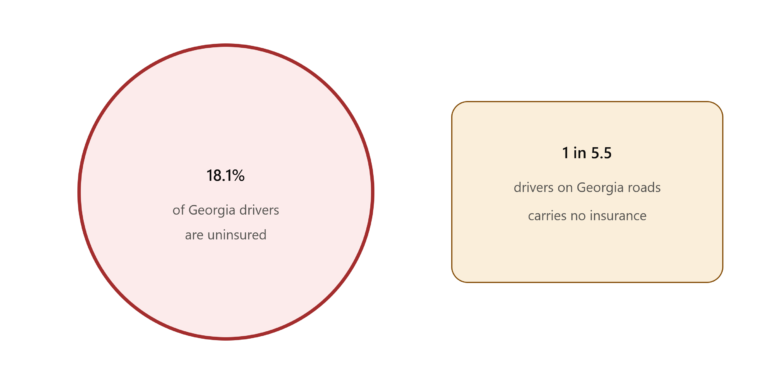
Florida rounds out the traditional top three at $311 a month, driven by heavy traffic congestion, a high rate of uninsured drivers, and significant hurricane exposure, as covered in detail in our dedicated Florida guide, where we also addressed the genuine, documented confusion around the state’s no-fault system status.
Connecticut and Delaware complete the top five most expensive states nationally in at least one comprehensive 2026 comparison, both joining Nevada, Louisiana, and Florida above the $300-a-month threshold, though the specific drivers behind their elevated costs (dense Northeast population centers and correspondingly high accident and litigation rates) differ somewhat from the weather-driven risk profile of Louisiana and Florida specifically.
New York deserves special mention: one detailed 2026 analysis found New York posting the single highest average annual full-coverage rate of any state at $4,031, even above Nevada, Louisiana, and Florida in that specific dataset, consistent with the elevated costs documented in our dedicated New York guide, driven by the state’s dense population, no-fault system, and outdated 1995-era liability minimums.
Why the same handful of factors keep showing up
Across every expensive state covered throughout this site’s broader research, a consistent set of drivers repeats:
No-fault PIP requirements consistently push baseline costs upward. Every state in this expensive-states ranking, Florida, New Jersey, New York, and others covered in our dedicated guides, operates under some form of mandatory personal injury protection, the same structural factor we identified as consistently absent from every state in our cheapest-states ranking.
Dense urban population centers drive accident frequency and theft rates. Whether it’s Las Vegas in Nevada, the Northeast corridor in Connecticut and New York, or South Florida’s tourism-heavy metro areas, concentrated population and traffic consistently correlates with the states topping this list.
Weather and catastrophe exposure adds comprehensive-claim risk. Louisiana and Florida specifically carry genuine hurricane and flood risk that directly inflates comprehensive coverage costs, a factor entirely absent from the rural, inland states topping our cheapest-states ranking.
Elevated litigation environments raise claim payouts. States with more permissive or aggressive litigation cultures around auto claims consistently see higher average payouts, which insurers price directly into every policy in that state, not just the specific claims that go to court.
How EV-specific costs compound in these expensive states
This is the part genuinely worth understanding for EV owners specifically, since it isn’t just about the state baseline. As covered throughout this site’s model-specific guides, EV repair costs run meaningfully higher due to specialized parts, sensor recalibration, and elevated total-loss risk. Layer that directly on top of an already-expensive state baseline, and the combined effect is significant. A driver in Louisiana or Florida choosing a premium EV like a Tesla Model X or Rivian, both covered in our dedicated model guides as carrying elevated baseline premiums nationally, could realistically see costs well above $5,000 a year, combining the worst of both factors documented throughout this site’s broader research.
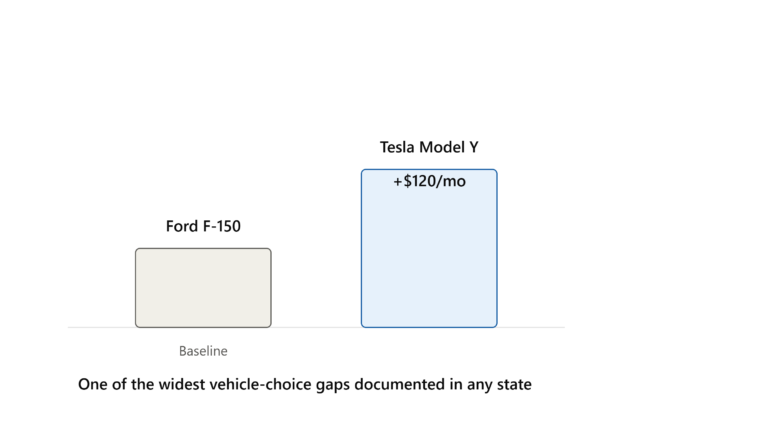
Conversely, an EV owner in one of these expensive states can meaningfully offset the state-level disadvantage by choosing a model with a minimal EV-to-gas premium, like the Ford F-150 Lightning (just 4% above its gas sibling nationally) or a mainstream model from an established automaker, as covered in our cheapest-EVs-to-insure guide, since vehicle choice remains a powerful lever regardless of which state you’re in.
The states worth watching: today’s mid-cost markets, tomorrow’s expensive ones
This is a genuinely important forward-looking point worth understanding. The most expensive states aren’t always the fastest-moving ones, Florida actually fell 0.5% in 2025 and Louisiana rose just 1.5%, despite both sitting near the top of the rankings. Instead, the sharpest increases are happening in mid-cost markets where carriers are actively catching up: New Jersey rose 15.8% in 2025, California rose 12.4%, and Washington rose 11.7%, all states that started the year well below the Florida and Louisiana price level but moved significantly in a single year.
This matters directly for EV owners in these specific states, covered in our dedicated California, New Jersey, and Washington guides, since it suggests the gap between these mid-cost markets and the traditionally expensive states may continue narrowing, making today’s moderate-cost state potentially tomorrow’s expensive one.
Practical steps if you live in, or are moving to, an expensive state
Prioritize vehicle choice as your biggest controllable lever. As covered throughout our broader model guides, the gap between an expensive-to-insure EV and an affordable one can exceed several thousand dollars a year, a factor entirely within your control regardless of which expensive state you’re in.
Get quotes from the state-specific standout insurers covered in our dedicated guides. Our Nevada, Florida, and New York guides each identify specific carriers, Liberty Mutual, GEICO, Progressive, and others, that consistently outperform state averages, worth prioritizing over assuming any single national insurer is your best option everywhere.
Consider whether your specific city or metro area is driving the bulk of your state’s elevated cost. As covered throughout this site, urban centers within expensive states (Las Vegas within Nevada, NYC within New York) often carry a further premium above even their already-elevated state average, meaning your specific location within the state matters as much as the state itself.
Layer every applicable discount aggressively, given how much a percentage discount is worth in absolute dollars when your baseline premium already runs high, following the broader savings guidance covered throughout our discount and telematics guides.
The bottom line
Nevada, Louisiana, Florida, Connecticut, and Delaware consistently rank among the most expensive states for auto insurance nationally, with New York posting the single highest figure in at least one detailed 2026 analysis. Each state’s elevated cost traces to an identifiable combination of no-fault requirements, dense urban population, weather exposure, or aggressive litigation environments, factors that compound directly with the standard EV-specific repair and value premiums documented throughout this site’s broader model research. For EV owners in these states, vehicle choice remains the most powerful controllable lever, potentially offsetting a meaningful share of the state-level disadvantage, while keeping an eye on fast-rising mid-cost states like New Jersey, California, and Washington matters for anyone considering a move, since today’s moderate market could look very different within just a year or two.
This article is for informational purposes only and does not constitute financial or insurance advice. Insurance rates vary by insurer, specific location, model, and individual driver profile, and change frequently. Always get a personalized quote before making a purchasing decision.