Electric Car Insurance in Washington State
Washington presents a genuinely confusing research picture: some sources describe it as a no-fault state requiring PIP, others describe it as an at-fault «tort» state where PIP is merely offered, not mandatory. Sources similarly disagree on whether the state permits or prohibits credit-based insurance pricing. This guide presents what’s confirmed, flags where sources conflict, and covers the real EV-specific numbers that are consistently documented.
Key takeaways:
- Washington requires 25/50/10 liability coverage, a limit set years ago that hasn’t kept pace with costs, sources consistently agree on this specific requirement.
- Sources disagree on Washington’s fault system and its credit-scoring rules, worth confirming directly with the Washington Office of the Insurance Commissioner rather than relying on any single source, including this one.
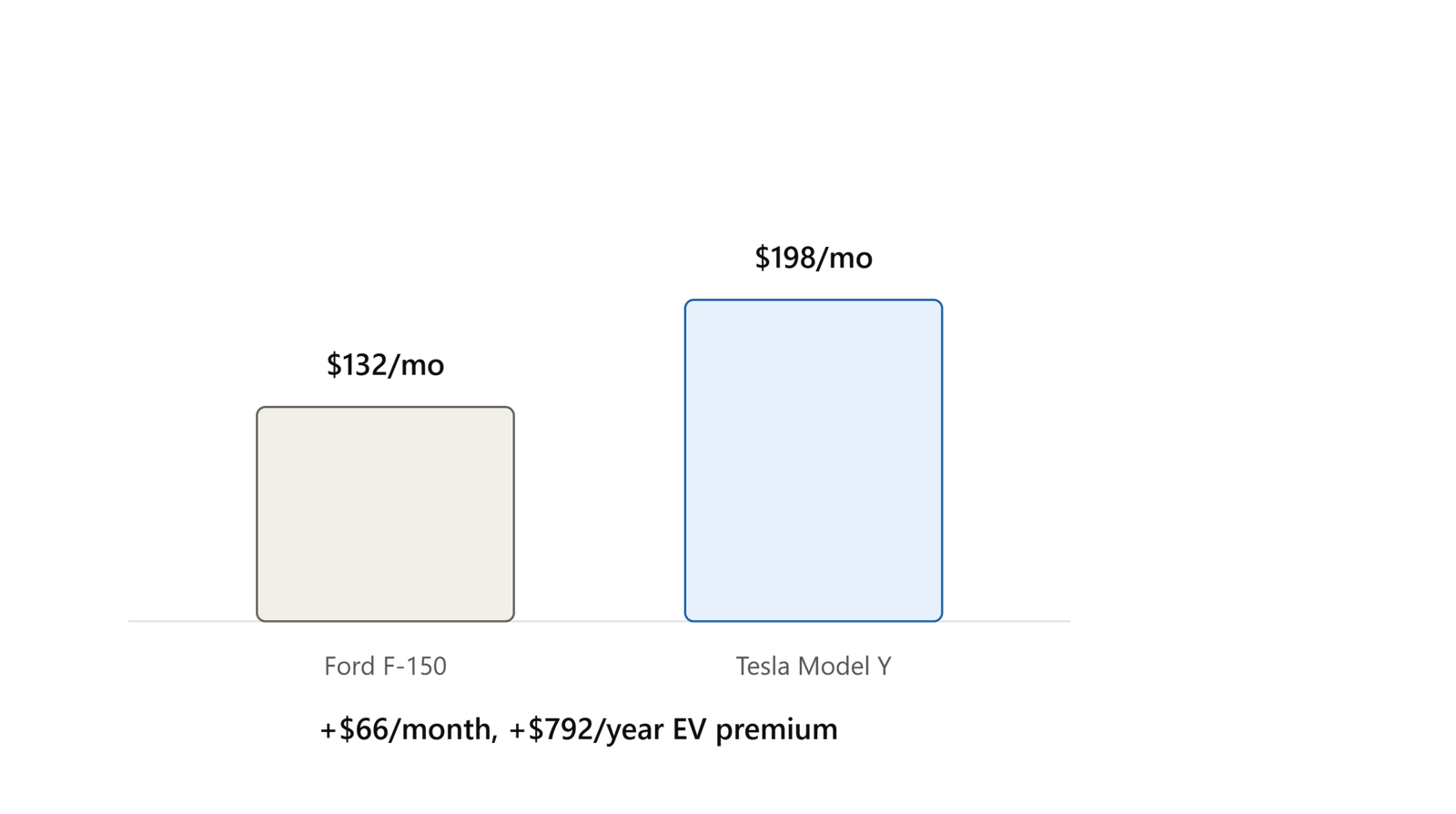
- A Tesla Model Y costs $198 a month for full coverage in Washington, $66 more than a Ford F-150’s $132 a month, an EV premium attributed specifically to specialized parts, battery systems, and sensor technology, with the state’s wet climate additionally cited as a factor that can accelerate corrosion in EV components.
- Washington’s overall insurance costs run below the national average, with full-coverage estimates across sources ranging from about $1,512 to $2,433 a year, a genuinely wide spread depending on methodology and year of data.
What’s consistently confirmed: the 25/50/10 minimum
Every source reviewed for this guide agrees on Washington’s core liability requirement: 25/50/10, meaning $25,000 per person and $50,000 per accident for bodily injury, plus $10,000 per accident for property damage. This limit was set years ago and, according to multiple sources, hasn’t kept pace with current costs. A concrete illustration: if you cause a collision injuring four people with medical bills totaling $80,000, your insurance pays a maximum of $50,000, leaving you personally responsible for the remaining $30,000. Similarly, given that the average new vehicle now costs over $48,000, and a moderate-damage collision often exceeds $15,000 in repairs, Washington’s $10,000 property damage minimum barely covers one fender-bender, a genuinely serious gap for any EV owner given the elevated repair costs documented throughout this site.
Most insurance professionals suggest at least 100/300/100 for Washington drivers, especially in high-traffic areas like Seattle and Tacoma, advice that applies with particular force to EV owners given how much more expensive an EV-involved accident’s costs can run compared to the state’s outdated minimum.
Where sources genuinely disagree: fault system and PIP requirements
This is worth addressing directly rather than picking a side without evidence. Some sources describe Washington as a no-fault state, stating the law requires drivers to carry personal injury protection (PIP) to pay medical costs. Other sources describe Washington as an at-fault, or «tort,» state, where the at-fault driver’s insurance assumes primary responsibility for the victim’s injuries, a structurally different system than true no-fault states like Florida and New York covered in our dedicated guides. A third source specifically frames PIP as something Washington law requires insurers to offer, with drivers able to decline it in writing, a meaningfully different arrangement than PIP being a mandatory purchase.
Given this genuine conflict, the responsible guidance is the same as we’ve applied to similarly confusing situations in our Florida guide: confirm your specific PIP status and requirements directly with the Washington Office of the Insurance Commissioner or a licensed agent rather than relying on any single online source. What’s worth noting regardless of which framework applies: if PIP is offered rather than mandatory in Washington, declining it removes a layer of protection for your own medical costs after an accident, worth weighing carefully given the elevated stakes of any EV-involved accident covered throughout this site.
A second area of disagreement: credit-based pricing
Sources also conflict on whether Washington permits insurers to use credit-based scoring when setting premiums. One source states directly that Washington permits this practice, specifically noting that improving your credit score is one action that reduces your premium without changing your coverage at all. A separate source states the opposite, that the state prohibits credit-based pricing entirely, similar to the restrictions covered in our California and other state guides. Given this direct conflict, and given how much this affects the practical advice worth following (whether improving your credit is a genuinely useful lever in Washington specifically), confirm this directly with your insurer before assuming either claim applies to your situation.
The real EV cost numbers, consistently documented
Despite the disagreements above, the EV-specific cost data is more consistent across sources. Full coverage on a Tesla Model Y costs $198 a month in Washington, $66 more per month than a Ford F-150’s $132, adding $792 a year in EV-specific premium. The explanation given is consistent with the broader EV cost factors covered throughout this site: EV repair costs run higher because parts, battery systems, and advanced sensors require specialized technicians. Worth noting as a genuinely Washington-specific detail: the state’s wet climate can accelerate corrosion in EV components, a regional factor that doesn’t come up in drier states covered elsewhere in our state-by-state research.
Washington’s overall cost positioning
Washington’s overall insurance costs are described consistently as relatively affordable compared to the national average, though the exact figures vary meaningfully by source and data vintage: estimates range from $1,512 a year in one source to $2,433 a year in another, with figures in between from several additional sources ($1,548, $1,919, $2,154, $2,196 annually). This spread is wider than the fault-system and credit-scoring disagreements above might suggest is typical, likely reflecting different data collection periods and methodologies within 2025-2026, consistent with the general pattern of source disagreement covered throughout our broader model and state guides. The lower-than-national-average positioning is attributed to Washington’s relatively low population density and drivers covering fewer miles than the national average, reducing overall accident exposure.
How driving record affects Washington rates specifically
Washington drivers with a clean record pay an average of $1,913 annually, but a single moving violation can push that to $2,757, according to one detailed source, a jump of over $800. A DUI pushes full coverage to $164 a month, a $658 annual increase over the clean-record rate. Notably, Washington does penalize not-at-fault accidents, with a $52 annual increase even when a driver bears no responsibility for the incident, worth knowing since it isn’t universal across every state’s rating system. Violations affect rates for three to five years in Washington, making the three-year mark a good checkpoint for re-shopping, similar to the annual re-shopping guidance covered throughout this site but specifically timed around Washington’s violation-aging window.
Best insurers for Washington EV owners
PEMCO is specifically identified as offering the cheapest minimum coverage in Washington in one source, at an average of $316 annually, consistent with PEMCO’s broader strength as a regional Pacific Northwest insurer covered in our dedicated pay-per-mile and Chevrolet Bolt guides. State Farm is separately identified among the best overall auto insurance companies in Washington in another source. Given the rate spread documented throughout this guide, and the genuine confusion around state-specific rules covered above, getting multiple quotes and asking each insurer directly about PIP requirements and credit-scoring practices is worth prioritizing over relying on general online guidance alone.
Practical steps for Washington EV owners
- Confirm your actual PIP status and fault-system classification directly with the Washington OIC, given the genuine conflict documented above between sources describing the state as no-fault versus at-fault.
- Ask your specific insurer whether they use credit-based scoring, given the direct disagreement between sources on whether this is even permitted in Washington.
- Seriously consider coverage above the 25/50/10 minimum, given how clearly documented the gap is between that limit and real accident costs, especially for an EV.
- Budget for the real EV premium documented above, roughly $792 a year more for a Model Y versus a comparable gas truck, when comparing total ownership costs.
- Re-shop around the three-year mark after any violation, given Washington’s specific three-to-five-year violation-aging window documented above.
The bottom line
Washington’s core liability requirement, 25/50/10, is consistently confirmed across sources and, like many states covered throughout this site, widely considered outdated relative to real accident and vehicle costs. Beyond that baseline, this guide surfaced genuine, unresolved disagreement between sources on two meaningful questions, whether Washington operates as a no-fault or at-fault state, and whether it permits credit-based insurance pricing, both worth confirming directly with the Washington Office of the Insurance Commissioner rather than assuming any single source, including this one, has it right. What is consistently documented: Washington EV owners pay a real, specific premium over gas-vehicle owners, with a Tesla Model Y running about $792 a year more than a comparable Ford F-150, driven by the same specialized-repair factors covered throughout this site, plus a genuinely Washington-specific consideration, the state’s wet climate accelerating component corrosion, worth factoring into your total ownership picture.
This article is for informational purposes only and does not constitute financial or insurance advice. Insurance requirements and regulations are subject to genuine conflicting information in publicly available sources. Always confirm current requirements directly with the Washington Office of the Insurance Commissioner and a licensed insurance agent.