Cheapest States for Electric Car Insurance (Ranked)
The gap between the cheapest and most expensive state for car insurance is genuinely staggering: full coverage in Nevada, the most expensive state, costs more than two and a half times what the same policy runs in Vermont, the cheapest. This guide ranks the states where EV insurance costs the least, and explains the consistent pattern behind why they’re so affordable.
Key takeaways:
- Vermont, Maine, and Wyoming consistently rank as the three cheapest states for full coverage insurance across nearly every 2026 source, each averaging under $800 a year and at least 37% below the national average.
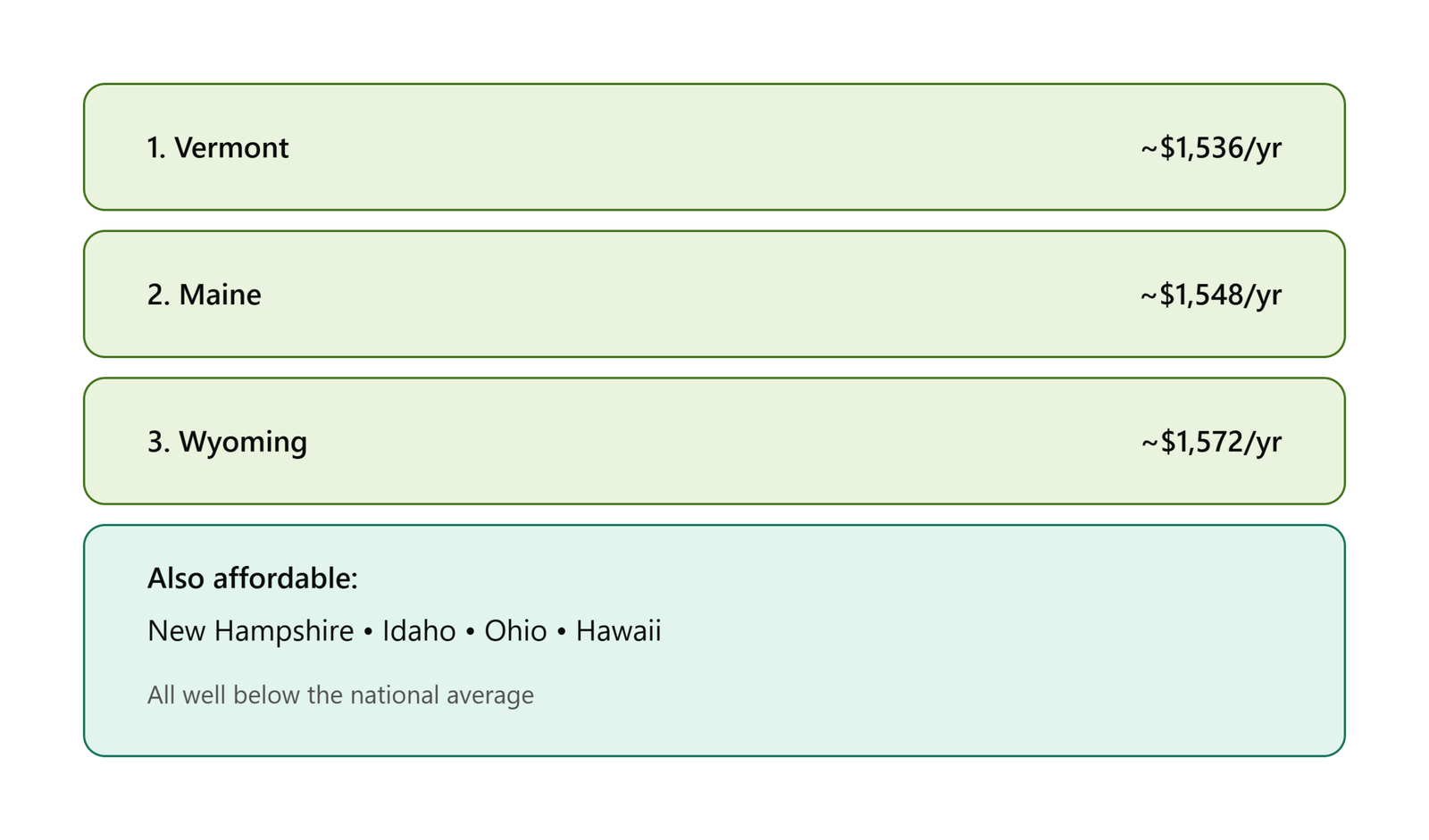
- New Hampshire, Idaho, Ohio, and Hawaii round out the broader group of consistently affordable states, all landing well below the roughly $2,500 to $2,637 national average.
- The cheapest states share a consistent profile: rural roads, low population density, low uninsured driver rates, limited litigation activity, and importantly, none operate under a no-fault PIP system.
- Even in the cheapest states, EV-specific costs still apply on top of the favorable state baseline, though the gap between EV and gas pricing has been narrowing nationally, down to about 18% in 2026 from 23% the year before.
The top three: Vermont, Maine, and Wyoming
These three states show up at or near the top of essentially every ranking reviewed for this guide, and the figures are remarkably consistent across sources:
Vermont consistently ranks as the single cheapest state, with figures ranging from $731 a year in one source to $1,347 to $1,660 in others, and $128 a month ($1,536 a year) in a separate detailed analysis, a range reflecting different data years and methodologies but consistently landing at or near the bottom nationally. Burlington, Vermont specifically ranks as the cheapest city in one detailed city-level comparison, at just $1,408 a year ($117 a month), with two additional Vermont cities also making a top-five cheapest-cities list.
Maine follows closely, with figures from $773 a year up to $1,808 depending on source and year, and $129 a month in one detailed comparison. Maine also holds one of the lowest uninsured driver rates in the country at 5.7%, compared to a national average of roughly 14%, a genuinely strong safety-net factor covered in more detail in our broader state comparison research.
Wyoming rounds out the top three at $685 a year in one source (the cheapest figure of any state reviewed for this guide) up to $1,669 in another, and $131 a month in a third. Wyoming’s premium runs 54% cheaper than the national average specifically for minimum coverage in one detailed analysis.
The next tier: New Hampshire, Idaho, Ohio, and Hawaii
New Hampshire consistently places just behind the top three, at $1,520 to $1,689 a year depending on source, with Progressive specifically offering the lowest average premium in the state in one detailed comparison, at $986 a year.
Idaho shows up prominently in several 2026 analyses, with one source specifically naming it the single cheapest state in its dataset at $1,443 to $1,476 a year, and $375 a year for minimum coverage alone, genuinely the lowest minimum-coverage figure documented across any source reviewed for this guide.
Ohio and Hawaii both round out the broader affordable tier, with Ohio ranging from $1,783 a year in one source, and Hawaii at $1,757 in another, both comfortably below the national average despite Hawaii’s reputation, covered in our broader research, for having some of the highest electricity costs in the country, a reminder that electricity price and insurance cost are separate, unrelated factors.
Why these specific states stay so cheap
The pattern is remarkably consistent across every source reviewed for this guide, and it’s worth understanding the full list of contributing factors rather than just the ranking itself:
Low population density directly reduces accident frequency. All of the cheapest states, Vermont, Maine, Wyoming, New Hampshire, and Idaho, are largely rural, with low-volume roads and minimal urban congestion, directly reducing the accident frequency that drives claims and, in turn, premiums.
Low uninsured driver rates reduce the uninsured motorist cost embedded in every policy. All of these states have fewer uninsured drivers than the U.S. average, a factor we’ve seen work in the opposite direction throughout our Texas, Florida, and Georgia guides, where elevated uninsured driver rates directly inflate statewide averages.
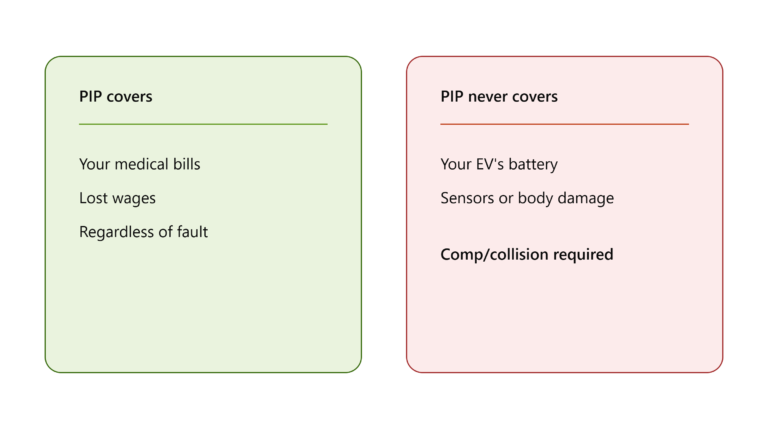
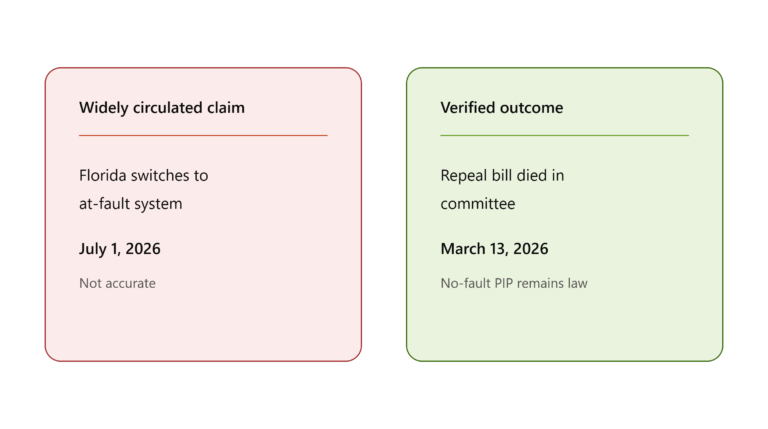
None of the cheapest states operate under a no-fault PIP system. This is a genuinely important structural factor worth understanding: no-fault states requiring mandatory personal injury protection, Florida, New York, New Jersey, Massachusetts, and others covered throughout our broader state research, consistently show higher baseline premiums than at-fault states, and every state in this cheapest-states ranking avoids that structure entirely.
Limited litigation activity keeps claim payouts more predictable. Reduced litigation exposure, a factor that specifically drives up costs in states like Louisiana and Florida covered in our broader research, gives insurers more pricing confidence in these lower-litigation states.
Strong carrier competition supports aggressive pricing. The low volume of drivers and lack of large metropolitan areas in states like Idaho and New Hampshire specifically lets insurers price more aggressively than they would in a market with unpredictable, concentrated urban risk.
What this means specifically for EV owners in these states
This is worth addressing directly, since a favorable state baseline doesn’t eliminate the EV-specific cost factors documented throughout this site, it simply applies on top of a much lower starting point. The broader national EV cost picture has been improving: the top nine EVs average $309 a month for full coverage nationally in 2026, 18% more than a comparable gas vehicle, a gap that’s narrowed from 23% in 2025, consistent with the market-maturation trend covered in our guide on whether EV insurance rates drop over time.
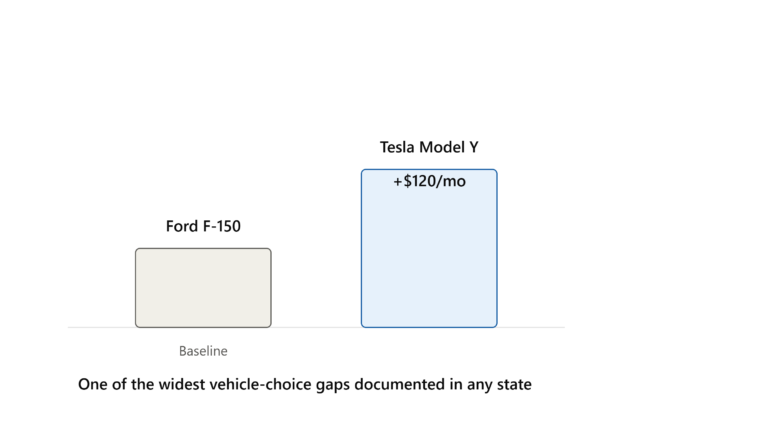
Specific model examples worth knowing: the Ford F-150 Lightning costs just 4% more than the gas F-150 nationally ($269 versus $258 a month), one of the smallest EV-to-gas gaps documented anywhere on this site, as covered in detail in our dedicated Lightning guide, while the Chevrolet Equinox EV is specifically named as the cheapest new EV model to insure nationally at $226 a month. An EV owner in Vermont, Maine, or Wyoming choosing a model like the Equinox EV or Lightning specifically would likely be combining two of the most favorable factors documented across this entire site, a low-cost state and a low-EV-premium model, for a genuinely affordable total outcome.
A caution: even cheap states are rising
It’s worth being direct about a trend worth watching. Vermont, the second-cheapest state in one detailed dataset at $731 a year, still saw rates climb 9.8% in 2025, the largest increase among the cheapest states that year, reflecting carrier repricing after years of below-average increases. Maine rose 6.3% in the same period. The broader takeaway: even the most affordable states aren’t immune to the general rate pressure documented throughout this site, they’re simply rising from a much lower base, and the relative ranking has remained stable even as absolute dollar figures climb.
How to use this ranking practically
If you have genuine flexibility about where you live, and cost is a major factor, these states represent your best structural starting point. This won’t be the deciding factor for most people’s relocation decisions, but it’s worth knowing as one input among many.
If you already live in one of these states, you’re starting from a favorable position, layer smart model choice on top. As covered above, combining a low-cost state with a model like the F-150 Lightning or Chevrolet Equinox EV, both documented as having minimal EV-to-gas premiums, compounds your advantage further.
If you live in an expensive state and can’t relocate, focus on the levers you do control. As covered throughout our broader savings guides, insurer comparison shopping, deductible choice, and telematics enrollment all remain available regardless of which state you’re in, even if they can’t fully close the gap to a state like Vermont or Wyoming.
The bottom line
Vermont, Maine, and Wyoming consistently rank as the three cheapest states for car insurance nationally, each running at least 37% below the national average and sharing a consistent profile: rural, low-density, low-uninsured-rate, low-litigation, and critically, none using a no-fault PIP structure. New Hampshire, Idaho, Ohio, and Hawaii round out a broader affordable tier. For EV owners specifically, these favorable state baselines compound well with the narrowing national EV-to-gas insurance gap and with specific model choices like the F-150 Lightning or Chevrolet Equinox EV that carry minimal EV-specific premiums of their own, offering a genuinely favorable combination for cost-conscious EV shoppers with any flexibility in where they live or what they drive.
This article is for informational purposes only and does not constitute financial or insurance advice. Insurance rates vary by insurer, specific location, model, and individual driver profile, and change frequently. Always get a personalized quote before making a purchasing decision.