No-Fault States and EV Insurance: What Changes
Twelve states operate under a no-fault insurance system, and throughout this site’s state-by-state research, Florida, New York, New Jersey, Massachusetts, Texas, and Washington have all come up as no-fault or PIP-requiring states, each with genuinely different rules. This final guide in our state series pulls the whole picture together: exactly which states are no-fault, how the system fundamentally changes your EV insurance, and the one state whose no-fault history explains more about EV-relevant cost risk than almost anywhere else in the country.
Key takeaways:
- Twelve states operate mandatory or choice no-fault systems: Florida, Hawaii, Kansas, Massachusetts, Michigan, Minnesota, New York, North Dakota, and Utah require no-fault coverage outright, while Kentucky, New Jersey, and Pennsylvania let drivers choose between no-fault and traditional tort coverage.
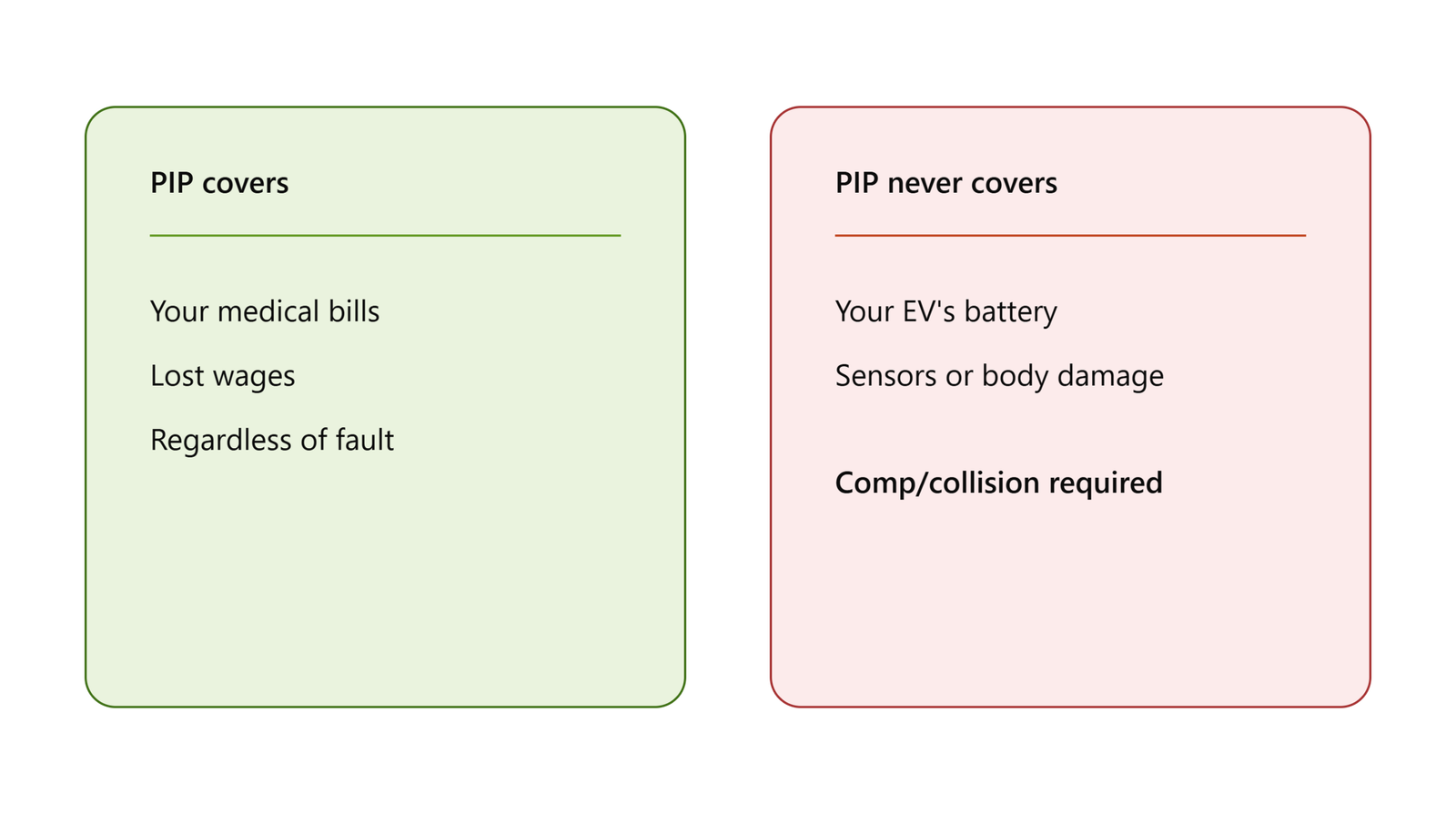
- No-fault states require Personal Injury Protection (PIP), which pays your own medical bills and lost wages regardless of fault, but critically, PIP never covers damage to your own vehicle, a distinction that matters enormously for EV owners specifically.
- Michigan’s history offers the starkest illustration of no-fault cost risk: the state once required unlimited lifetime medical benefits under PIP with no cap, making it the most expensive state in the nation for auto insurance for years before a 2019 reform introduced tiered limits.
- No-fault claims typically process within 30 days since fault doesn’t need to be determined first, a genuine speed advantage over at-fault states, where disputed liability investigations can take 30 to 90 days.
The complete list of no-fault states
Twelve states plus Puerto Rico operate no-fault auto insurance systems. Nine states mandate no-fault coverage for every driver: Florida, Hawaii, Kansas, Massachusetts, Michigan, Minnesota, New York, North Dakota, and Utah. Three additional states, Kentucky, New Jersey, and Pennsylvania, operate as «choice no-fault» states, letting drivers select between no-fault coverage and traditional tort-based liability coverage, a structure covered in detail in our dedicated New Jersey guide.
Beyond these twelve, several additional states offer «add-on no-fault» as an optional purchase within an otherwise fault-based system, including Arkansas, Delaware, Maryland, New Hampshire, Oregon, South Dakota, Texas, Virginia, Washington, Wisconsin, and Washington, D.C., a meaningfully different, optional structure worth distinguishing from true mandatory no-fault, covered in our dedicated Texas and Washington guides.
The fundamental mechanics, and why they matter specifically for EVs
In true no-fault states, your own insurer pays for your medical bills and lost wages after an accident, through your required PIP coverage, regardless of who caused the crash. This is fundamentally different from the traditional tort system, where the at-fault driver’s liability insurance pays for the other party’s damages, and fault must typically be determined before any payout occurs.
Here’s the critical distinction worth understanding, one we’ve repeated throughout nearly every no-fault state guide on this site: PIP covers your medical expenses, never your vehicle. This means in every no-fault state, comprehensive and collision coverage remain entirely separate purchases, not folded into your mandatory PIP requirement, and given how much more expensive EV repairs run throughout this site’s broader coverage research, this gap matters more for an EV owner than for almost any other vehicle category. As covered in our dedicated New York and Massachusetts guides specifically, an EV owner relying solely on mandatory no-fault coverage has literally zero protection for their own vehicle’s battery, sensors, or bodywork, regardless of how comprehensive their PIP limit is.
Michigan: the cautionary tale worth understanding in full
This is genuinely the most instructive example in the entire no-fault category, even though we haven’t covered Michigan in its own dedicated state guide elsewhere on this site. Michigan historically required unlimited lifetime medical benefits under PIP, meaning insurers paid all accident-related medical costs forever, with no cap whatsoever. This made Michigan’s auto insurance the most expensive in the nation by a significant margin for years. A 2019 reform finally introduced tiered PIP limit options, unlimited, $500,000, $250,000, or $50,000 for drivers with qualifying health insurance, giving Michigan drivers genuine choice for the first time. Even post-reform, Detroit drivers still pay among the highest auto insurance rates in the country.
The lesson for EV owners specifically: a state’s no-fault PIP structure can single-handedly define its entire insurance cost environment, independent of any vehicle-specific factor. An EV owner moving to or from Michigan needs to understand this history isn’t just background trivia, it’s actively still shaping the state’s current pricing environment years after the reform.
New York’s position at the top of the PIP requirement scale
As covered in our dedicated New York guide, New York requires the highest fixed PIP minimum of any no-fault state at $50,000 per person, combined with the state’s mandatory uninsured motorist requirements and generally high cost of living, contributing directly to New York consistently ranking among the most expensive states for auto insurance nationally, a pattern that compounds specifically with the EV sensor-recalibration and repair costs documented throughout our broader Tesla and comprehensive-coverage research.
The choice states: a genuinely different decision to make
Kentucky, New Jersey, and Pennsylvania let drivers choose between limited tort (lower premium, restricted right to sue except for serious injuries) and full tort (higher premium, full right to sue for pain and suffering from any accident). In Pennsylvania specifically, nearly 60% of drivers choose limited tort because the premium savings are substantial, sometimes $300 to $800 a year, though attorneys consistently advise full tort for anyone with significant assets or health conditions, since limited tort can bar claims for real injuries that don’t meet the statutory threshold. This same fundamental tradeoff applies in New Jersey, covered in our dedicated guide, where we specifically recommended evaluating your personal health insurance situation carefully before selecting the lower-cost option.
The genuine speed advantage of no-fault systems
It’s worth balancing the cost picture above with a real practical benefit. No-fault claims typically process within 30 days, since fault doesn’t need to be determined before payment, meaning if your medical bills fall within your PIP limit, you receive payment quickly regardless of who caused the accident. Compare this to at-fault states, where third-party liability claims require a fault determination first, and in disputed accidents, that investigation can take 30 to 90 days before any payment occurs. This speed advantage applies to your medical claims specifically, though as covered throughout this guide, it says nothing about how quickly your vehicle damage claim, handled separately under comprehensive and collision, will resolve.
What actually changes for an EV owner specifically in a no-fault state
Pulling together everything covered throughout this site’s individual no-fault state guides, a few consistent themes emerge:
Comprehensive and collision become genuinely non-negotiable, not optional add-ons. Since PIP never touches your vehicle, and EV repairs run meaningfully more expensive throughout this site’s broader research, skipping comprehensive and collision in a no-fault state leaves your EV’s most expensive components, battery, sensors, specialized body panels, entirely unprotected.
Uninsured/underinsured motorist coverage matters just as much as in at-fault states. As covered in our Florida and New York guides specifically, PIP doesn’t cover an uninsured driver hitting your vehicle either, meaning this coverage remains essential protection for your EV regardless of the state’s fault system.
PIP limits vary enormously and directly affect your total protection. From New York’s $50,000 minimum down to more modest requirements in other no-fault states, understanding your specific state’s PIP floor, and whether it’s genuinely adequate given real medical costs, matters as much as understanding your vehicle-specific coverage needs.
No-fault states as a group don’t correlate cleanly with either cheap or expensive overall insurance. Our own state-by-state research found no-fault states scattered across both our cheapest-states and most-expensive-states rankings, meaning the fault system alone doesn’t determine your total cost, it’s one factor among the many state-specific drivers covered throughout this site’s broader research.
Practical steps if you live in, or are moving to, a no-fault state
- Confirm your specific state’s exact PIP minimum and whether it’s genuinely adequate, given how much real accident costs can exceed decades-old minimums, as documented throughout our California, Texas, and New Jersey guides.
- Never treat comprehensive and collision as optional in a no-fault state, given that PIP provides zero protection for your EV’s battery, sensors, or bodywork regardless of your PIP limit.
- If you’re in a choice no-fault state (Kentucky, New Jersey, Pennsylvania), evaluate your personal health insurance and asset situation carefully before selecting limited versus full tort coverage.
- Prioritize uninsured/underinsured motorist coverage regardless of your state’s fault system, since no-fault PIP doesn’t substitute for this protection.
- If you’re specifically moving between a no-fault and at-fault state, understand that your PIP coverage generally still applies to your own medical expenses if you’re in an accident in a different state, but that state’s own laws govern liability determination and who can be sued.
The bottom line
Twelve states, plus Puerto Rico, operate no-fault auto insurance systems, with nine mandating it outright and three offering drivers a choice. Every no-fault state shares the same fundamental structure worth understanding deeply if you’re an EV owner: PIP protects your medical costs, never your vehicle, meaning comprehensive and collision coverage remain essential, not optional, purchases given how expensive EV repairs run throughout this site’s broader research. Michigan’s history of unlimited lifetime PIP benefits, and New York’s $50,000 minimum, illustrate just how much a state’s specific no-fault structure alone can define its entire cost environment, independent of any vehicle-specific factor. Whatever no-fault state you call home, covered in detail across this site’s individual state guides, the core lesson remains consistent: your PIP requirement handles your medical bills, and everything else, your actual EV, still depends entirely on the comprehensive and collision coverage you choose to carry on top of it.
This article is for informational purposes only and does not constitute financial or insurance advice. No-fault requirements, PIP minimums, and state regulations change frequently. Always confirm current requirements directly with your state’s department of insurance and a licensed insurance agent.