My EV Was Totaled Because of Battery Damage: What Now?
It feels like a $1,500 repair, maybe $2,000. You file the claim, the shop puts the car on a lift, and a few days later the adjuster calls to tell you it’s a total loss. If you drive an EV, this isn’t a hypothetical scenario, it’s a well-documented pattern, and total loss frequency across all vehicles just hit a record 23.1% in 2025. This guide walks through exactly what to do next, step by step, from the moment you get that call.
Key takeaways:
- Total loss frequency across all vehicle types hit a record 23.1% in 2025, and EVs are part of this trend for a distinct reason: battery sensitivity to even minor damage, not just rising repair costs generally.
- Your insurer’s Actual Cash Value (ACV) offer is a starting point for negotiation, not a final number, and it can be challenged with evidence like recent comparable listings, maintenance records, and upgrade receipts.
- Over 300,000 leased EVs are returning to the market in 2026, flooding used-EV supply and pushing values down, meaning your settlement may already reflect a market correction that benefits buyers but punishes claimants right now.
- A compromised lithium-ion battery pack is treated as a genuine fire risk, insurers won’t sign off on a vehicle with flagged battery damage without either a full battery replacement or a total-loss declaration, no middle ground.
Step 1: Understand why this happened, even if it feels unfair
Before anything else, it helps to understand the actual mechanism, since it changes how you approach every subsequent step. Battery damage after a minor collision can push repair costs past the total loss threshold on any EV, a pattern covered throughout our broader battery cost and comprehensive-coverage research. This isn’t your insurer being unreasonable, it’s a documented, industry-wide pattern: the battery pack is one of an EV’s most valuable and expensive components, and even in relatively minor accidents, it’s sensitive enough that replacement, not repair, frequently becomes the only safe option. A compromised lithium-ion battery is treated as a genuine fire risk, and no insurer will sign off on returning a vehicle to the road with flagged battery damage left unresolved, meaning your car either gets a new battery pack or gets totaled, with no real middle ground.
Step 2: Understand exactly what your payout will represent
Your insurer pays your car’s Actual Cash Value (ACV) minus your deductible. ACV represents what your car was worth immediately before the damage, based on its age, mileage, condition, and comparable vehicles in your area, not what you paid for it, and not what a replacement would cost today. If you weren’t at fault, you can file with the at-fault driver’s insurance instead, which typically means receiving the full ACV without paying your own deductible, worth confirming with your specific claim before accepting your own insurer’s offer if fault clearly rests with another driver.
Step 3: Know about the 2026 market condition working against you right now
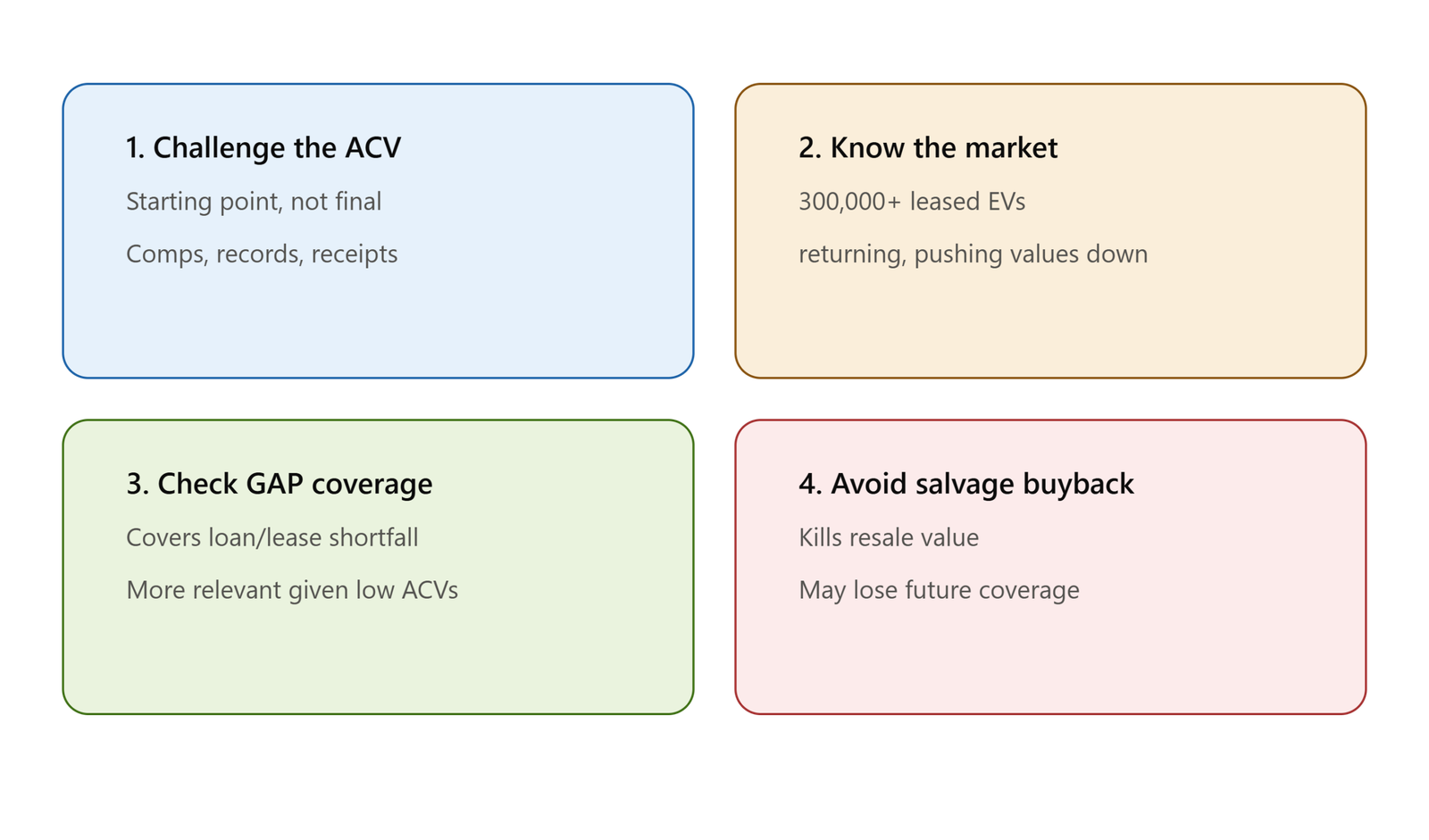
This is a genuinely important, current factor worth understanding before you accept any settlement. Over 300,000 EVs are returning from lease in 2026, and this flood of supply is pushing used EV values down fast. If your EV was just declared a total loss, your settlement may already reflect this market correction, one that benefits buyers shopping for a used EV right now, but directly punishes claimants whose ACV is being calculated against that same softening market. This is separate from, and compounds with, the general rapid depreciation pattern EVs already show compared to gas vehicles, covered in detail in our dedicated GAP insurance guide.
Step 4: Don’t accept the first ACV number without checking it
This is the step where money is routinely left on the table, according to total-loss specialists. The insurer’s ACV figure is a starting point for negotiation, not a final verified number. If it reads too low, you can challenge it with:
Recent comparable listings. Pull your own comps from the same general market, the insurer’s software pulls comparisons from a search radius around your ZIP code, and that radius can expand into markets that have nothing to do with your car’s actual local value, a specific, documented flaw worth checking directly against your own research.
Maintenance records. A well-documented service history supports a higher valuation than a car with no paper trail, the same logic that applies to any used vehicle sale.
Upgrade receipts. Any aftermarket additions, upgraded wheels, enhanced trim packages, or documented option additions beyond the base configuration, should be reflected in your ACV if you can document them.
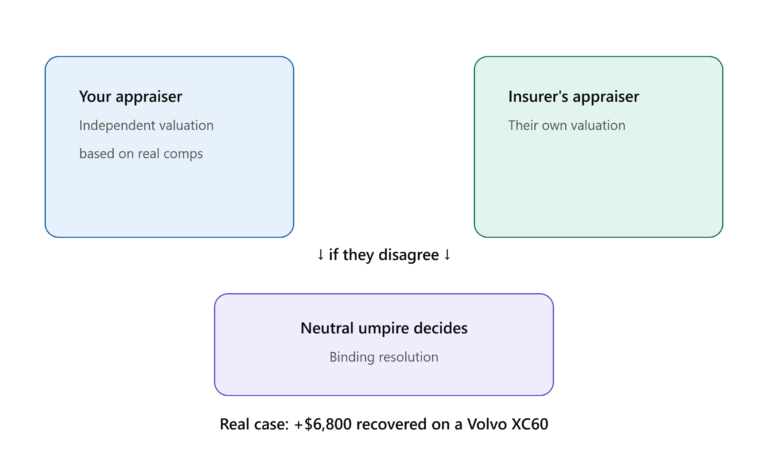
An independent appraisal. For a genuinely disputed valuation, a professional appraisal or independent repair estimate carries real weight in a negotiation, and it’s worth the cost if the gap between your own research and the insurer’s offer is substantial.
If you believe the repair costs actually fall below your state’s total-loss threshold, evidence supporting that can prompt the insurer to reconsider the total-loss declaration entirely, though given the battery-specific safety concerns covered in Step 1, this is a harder case to make successfully for genuine battery damage specifically.
Step 5: Understand the realistic timeline
Two to four weeks from the initial damage assessment is the typical window most insurers settle within. Three things stretch or shrink that window: how fast you turn in your documentation, whether the settlement gets negotiated (which naturally extends the process), and what your specific state’s claims processing requirements demand. Filing goes more smoothly when you already know whether you’re carrying collision or comprehensive coverage and whether GAP insurance applies to your specific situation, covered in detail below.
Step 6: Confirm whether GAP insurance applies to you
If you owe more on your loan or lease than the ACV payout covers, GAP coverage pays the difference, covered in extensive detail in our dedicated GAP insurance guide. Given the depreciation pressure documented in Step 3 above, specifically the 300,000-plus leased EVs currently flooding the used market and pushing values down, GAP coverage is more likely to actually matter right now than it might have been a year or two ago, since a lower ACV payout widens the exact gap GAP insurance is designed to close. If you’re not sure whether you have GAP coverage, check your loan or lease paperwork directly, or ask your lender, before assuming either way.
Step 7: Check whether you have rental reimbursement coverage
If you have rental reimbursement coverage, it typically pays for a rental car for a limited time, commonly around 30 days, after your car is declared a total loss, giving you time to arrange a replacement vehicle. As covered in our dedicated rental reimbursement guide, this coverage has real limits worth understanding, both a daily rate cap and a total-day allowance, so confirm both before assuming you have unlimited time to shop for a replacement.
Step 8: Understand how this affects your future rates
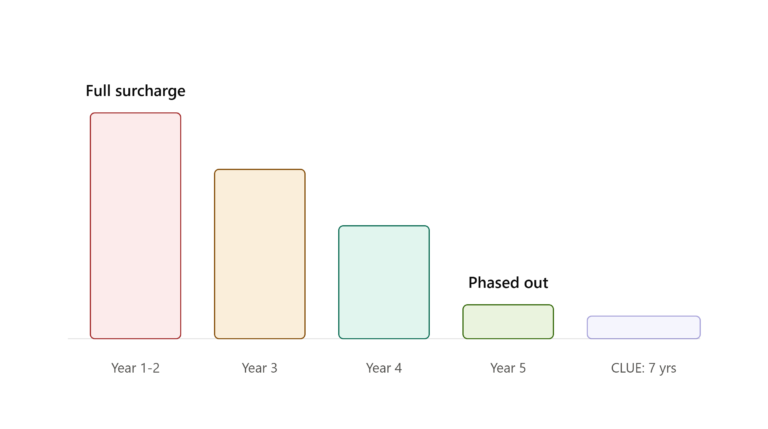
Whether your premium rises depends specifically on fault. If you caused the accident, your rates will likely increase. If you weren’t at fault, or your car was totaled by theft, weather, or vandalism, your rates typically won’t change, though this varies somewhat by insurer and state, worth confirming directly with your specific carrier rather than assuming either outcome.
What to specifically avoid: buying back a salvage title
If you’re offered the option to buy back your totaled EV on a salvage title rather than accepting the full payout, think carefully before saying yes. A buyback on a salvage title means driving a car with documented battery damage, a title designation that significantly reduces resale value, and potentially limited or refused comprehensive coverage from some insurers going forward, since many carriers restrict or decline comprehensive coverage on salvage-titled vehicles entirely. This is a meaningfully worse position than it might first appear, worth weighing carefully against simply accepting the ACV payout and moving on to a clean-titled replacement vehicle.
If you’re shopping for a replacement EV right now
Given the specific market conditions documented in Step 3, a large wave of returning lease vehicles pushing used EV values down, this may actually be a reasonably favorable moment to shop for a replacement, even though it worked against your settlement. If you’re considering a used EV specifically, our dedicated used-versus-new EV insurance guide and used-EV cost research are worth reviewing, and if you’re looking at a specific salvage-titled vehicle for a lower price, confirm directly with any insurer you’re considering whether they’ll even offer comprehensive coverage before committing, given the restriction covered above.
The bottom line
Having your EV totaled over battery damage that initially looked minor is a well-documented, industry-wide pattern, not a sign that something went uniquely wrong with your specific claim. The practical path forward: understand that your ACV offer is a negotiation starting point, not a final number, gather your own comparable listings and documentation to challenge a low offer, confirm whether GAP insurance applies given the current market conditions pushing used EV values down, and avoid a salvage-title buyback unless you’ve fully understood the resale and future-coverage consequences. With total-loss frequency at a record 23.1% in 2025 and continuing to affect EVs specifically due to battery sensitivity, this experience is unfortunately common enough that a clear, informed process, rather than simply accepting the first number offered, genuinely matters for your final outcome.
This article is for informational purposes only and does not constitute financial or insurance advice. Claims processes, valuation methods, and coverage details vary significantly by insurer, state, and individual circumstances. Consider consulting an independent appraiser or your state’s insurance department if you believe your settlement is inaccurate.