Electric Car Insurance in Georgia
If you’re a State Farm customer in Georgia, a 2026 policy structure change could quietly reduce how much underinsured motorist protection you actually have, even if your premium looks unchanged at renewal. Combine that with Georgia’s notably high uninsured driver rate and above-average statewide premiums, and Georgia EV owners face a genuinely important set of state-specific factors worth understanding before your next renewal. This guide covers all of it.
Key takeaways:
- Georgia requires 25/50/25 liability coverage, but a 2026 structural change to State Farm policies could reduce available underinsured motorist coverage without an obvious premium change, worth confirming directly if you’re a State Farm customer.
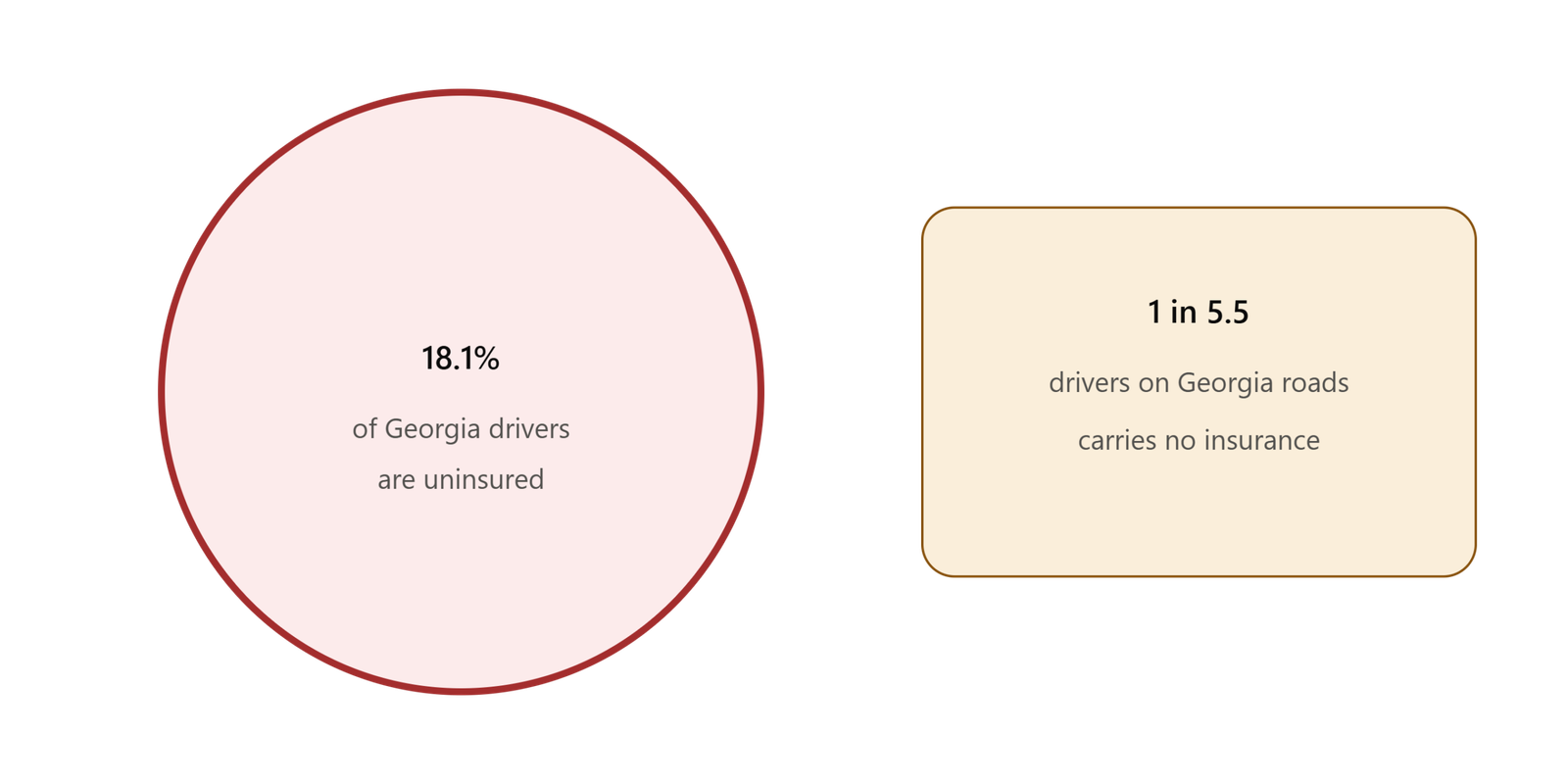
- Georgia’s uninsured driver rate sits at approximately 18.1%, one of the highest in the country, meaning roughly 1 in 5.5 drivers on Georgia roads carries no insurance at all.
- Full coverage in Georgia runs meaningfully above the national average across every source reviewed, from $142 to $220 a month depending on location and methodology, with Atlanta specifically running 21% above the statewide average.
- Georgia uses an electronic insurance verification system (GEICS) rather than accepting paper insurance cards as proof, and a coverage lapse of 10 or more days triggers an automatic $25 pending-suspension fee.
The State Farm structural change worth knowing about directly
This is a genuinely current, specific development worth flagging clearly if it applies to you. Georgia drivers insured by State Farm face changes in 2026 that could significantly affect how much protection they actually have after a serious crash, even if their premium looks similar at renewal. Specifically, the structure of the policy may reduce the amount of underinsured motorist coverage available, a change that isn’t necessarily obvious from the premium alone. Given how important underinsured motorist coverage is in a state with Georgia’s notably high uninsured driver rate, covered in detail below, this is worth a direct conversation with your State Farm agent or a comparison quote from another carrier if you’re currently insured with them in Georgia.
Georgia’s actual requirements
Georgia law requires drivers to carry minimum liability coverage of 25/50/25: $25,000 per person and $50,000 per accident for bodily injury, plus $25,000 for property damage. In a serious collision, these limits are often nowhere near enough to cover medical bills, lost wages, and long-term care, a gap that compounds directly with the elevated repair costs of an EV specifically, as covered throughout this site’s broader coverage guides. Most insurance experts recommend buying coverage of at least $100,000 per person and $300,000 per accident for bodily injuries, and $100,000 for property damage, a substantially higher standard than Georgia’s legal floor.
Why Georgia’s uninsured driver rate matters so much
This is arguably the single most important state-specific factor for Georgia EV owners to understand. Georgia’s uninsured driver rate sits at approximately 18.1%, one of the highest nationally, meaning roughly 1 in 5.5 drivers on Georgia roads carries no insurance at all. One source specifically attributes much of Georgia’s elevated liability rates directly to this factor: Georgia drivers pay an average of $157 a month for liability insurance, well above the national average of $98, despite the state’s minimum liability requirements not being unusually high, with the state’s high number of uninsured drivers cited as one of the main drivers of that gap.
Given this, uninsured/underinsured motorist coverage is genuinely essential in Georgia, not just a nice-to-have, especially for an EV owner given how much more expensive it is to replace or repair an EV specifically if an uninsured driver causes the damage, as covered throughout our broader model and coverage guides.
The real cost numbers
Pulling together multiple 2026 sources gives a genuinely wide range, but a consistent above-national-average pattern:
- One source finds $142 a month for full coverage statewide, 15% above the national average, ranking Georgia 38th out of 50 states and D.C. for affordability.
- A separate source finds a higher $182 a month, 21% above the national average, with Atlanta specifically running $220 a month, 21% above even that statewide figure.
- A third source finds $2,909 a year annually, well above a cited national average of roughly $1,771.
- Experian’s data finds minimum coverage averaging $2,362 annually ($197 a month), with the cheapest minimum coverage from Root at $2,101 a year ($175 a month), and the cheapest full coverage from Travelers at $2,234 a year ($186 a month).
Bringing this together: budget roughly $150 to $220 a month for full coverage as a realistic planning range, with Atlanta specifically running toward the higher end given its documented urban premium.
Age variance in Georgia
Following the pattern covered throughout our broader age-based EV insurance guide, Georgia shows dramatic age-based swings: teen drivers (16-19) average $684 a month ($8,210 a year), young adults (20-25) average $285 a month ($3,416 a year), the core adult baseline (30-60) averages $161 a month ($1,933 a year), and seniors (65+) average $225 a month ($2,701 a year), a modest but real uptick consistent with the broader U-shaped age curve documented throughout our research.
The insurer spread is genuinely dramatic in Georgia
Georgia car insurance rates vary by more than $670 a month depending on which company you choose, one of the widest insurer-to-insurer spreads documented across our state-level research. Minimum coverage alone runs from $41 a month at GEICO to $138 at Farmers, a more than 3x difference for the identical legal coverage. Given how wide this spread runs, comparison shopping in Georgia specifically delivers outsized value compared to many other states covered throughout this site.
Georgia’s electronic verification system, worth knowing
Georgia uses the Georgia Electronic Insurance Compliance System (GEICS) to electronically verify coverage, meaning paper insurance cards alone aren’t accepted as proof, insurers must report policies to GEICS within 30 days. A coverage lapse of 10 or more days triggers an automatic $25 pending-suspension fee, a genuinely fast and automated enforcement mechanism worth understanding if you’re ever between policies or switching insurers, connecting directly to the coverage-gap guidance covered in our dedicated guide on switching EV insurance companies without losing coverage.
Georgia also operates under a modified comparative fault system, meaning you can only recover damages if you’re less than 50% at fault in an accident, a legal structure worth understanding alongside the coverage-level guidance throughout this article.
City-level variance within Georgia
Atlanta is described as the clear outlier within Georgia specifically, with metro Atlanta’s heavy traffic, high accident rates, and elevated vehicle theft pushing rates well above the state average, while rural Georgia drivers often pay meaningfully less than the statewide average. This tracks the broader urban-versus-rural pattern documented throughout our state-by-state research, though Georgia’s specific 21% Atlanta premium is worth confirming directly if you’re relocating within the state.
Best insurers for Georgia EV owners
Root offers the cheapest minimum coverage in one detailed comparison, at $175 a month.
Travelers offers the cheapest full coverage in that same comparison, at $186 a month, consistent with Travelers’ broader strength for EV owners covered throughout this site, including its dedicated EV discount referenced in our broader insurer comparison guide.
GEICO offers the cheapest minimum coverage in a separate comparison at $41 a month, and is specifically identified as providing the lowest minimum coverage rates broadly in Georgia.
Practical steps for Georgia EV owners
- If you’re a State Farm customer, confirm directly whether the 2026 policy changes affect your underinsured motorist coverage, given how important that protection is in a state with Georgia’s uninsured driver rate.
- Prioritize uninsured/underinsured motorist coverage above the state minimum, given the documented 18.1% uninsured driver rate, one of the more important coverage decisions for any Georgia driver, EV owner or not.
- Get quotes from Root, Travelers, and GEICO as a starting comparison set, given the documented $670-plus monthly spread between insurers in Georgia.
- Confirm your specific city’s rate positioning, given Atlanta’s documented 21% premium over the statewide average.
- Avoid any coverage lapse, even briefly, given Georgia’s automated GEICS enforcement and the $25 pending-suspension fee triggered after just 10 days.
The bottom line
Georgia combines above-national-average insurance costs, a notably high 18.1% uninsured driver rate that makes uninsured motorist coverage genuinely essential, and a currently unfolding State Farm policy structure change worth confirming directly if it applies to you. With insurer-to-insurer rates varying by more than $670 a month for identical coverage, comparison shopping delivers outsized value in Georgia specifically, and given the state’s automated GEICS verification system, maintaining continuous coverage without any lapse matters more here than in states with less automated enforcement. Whatever EV model you drive, covered in detail across our dedicated model guides, layering that vehicle-specific cost picture on top of Georgia’s distinct state-level factors covered in this guide gives the most accurate sense of your actual total cost.
This article is for informational purposes only and does not constitute financial or insurance advice. Insurance requirements, rates, and specific policy structures change frequently. Always confirm current requirements and policy details directly with the Georgia Office of Insurance and Safety Fire Commissioner and your specific insurer.