Age is one of the single biggest factors in what you pay for car insurance, full stop, and that effect doesn’t disappear when the car happens to be electric. If anything, it compounds. A young driver in a Tesla Model Y isn’t just paying the «young driver tax,» they’re paying it on top of the «EV tax,» and the combination can be genuinely startling the first time you see the quote. This guide breaks down exactly how much age changes your EV insurance bill, and what you can actually do about it at either end of the age spectrum.
Key takeaways:
- A 16-year-old pays roughly four times what a 50-year-old pays for the same coverage on a standard vehicle, and that gap widens further once you’re insuring an EV.
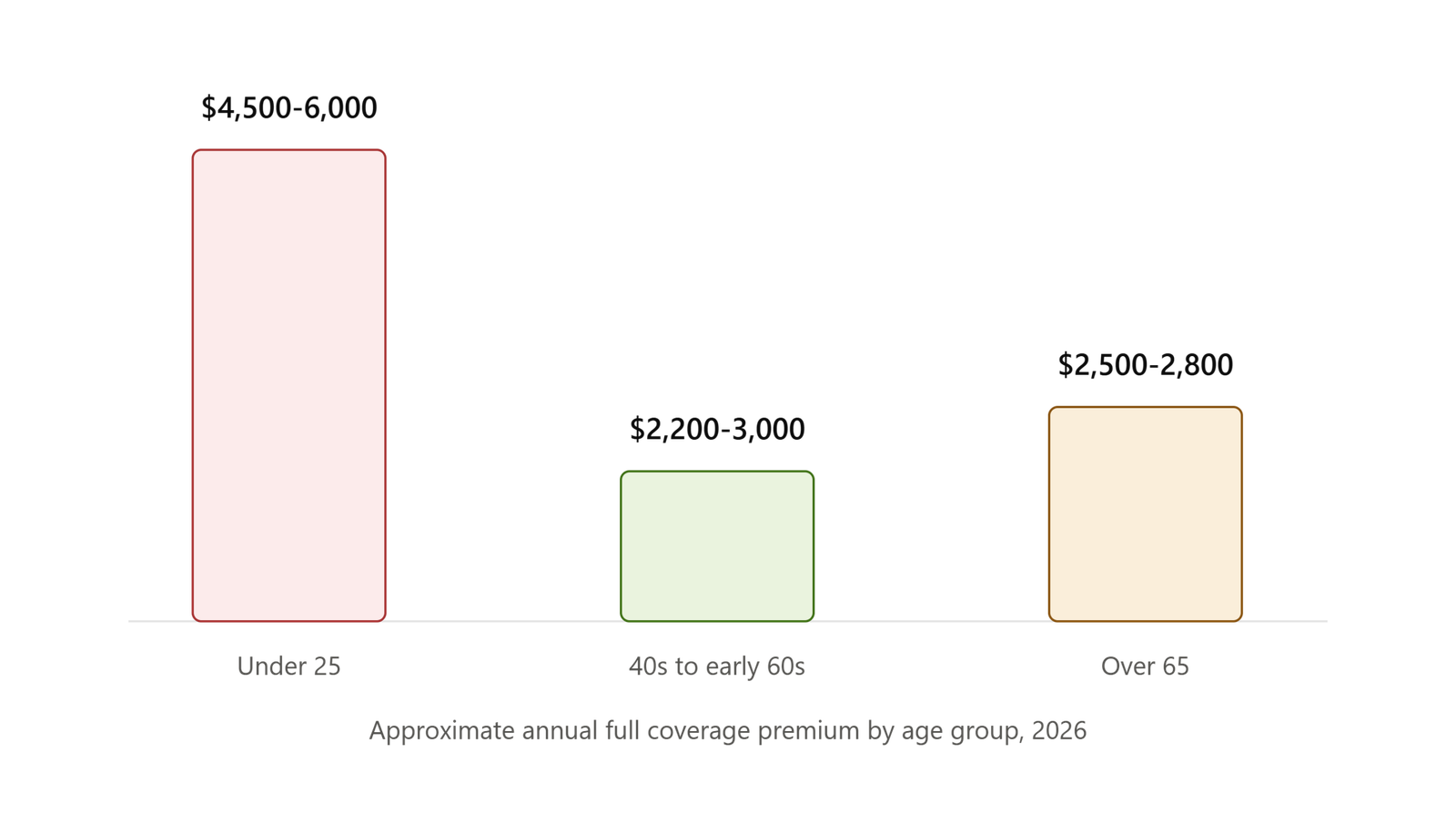
- Under-25 drivers insuring a Tesla Model Y commonly see quotes between $4,500 and $6,000-plus a year, while drivers in their 40s through early 60s often land between $2,200 and $3,000 for the same car.
- Rates bottom out around age 60, then start climbing again for older drivers, though the increase after 60 is far smaller than the drop between the teen years and the mid-20s.
- The EV premium (the extra cost of insuring an EV over a gas car) stays roughly proportional across age groups, meaning a young EV driver pays both penalties at once.
The general age curve, before you add EVs into the picture
Before looking at EV-specific numbers, it helps to understand the baseline pattern insurers use for every driver, regardless of what they drive. Car insurance follows what’s often called a U-shaped curve across a lifetime: expensive in the teens and early 20s, cheapest through the 30s, 40s, and into the early 60s, then gradually rising again for senior drivers.
The dollar figures are dramatic. A 16-year-old pays an average of roughly $10,387 a year for full coverage on a standard vehicle, more than four times what a 50-year-old pays for the same policy, which averages around $2,421. Rates decline steadily through the early-to-mid 20s: by age 25, the average full-coverage premium has dropped to around $3,044. They continue declining gradually until bottoming out around age 60, at roughly $2,312, the cheapest point in a driver’s lifetime. After 60, premiums begin climbing again, reaching about $2,498 by 70 and $2,742 by 75, reflecting insurers’ view that reaction time and vision-related risk factors increase with advanced age.
That’s the baseline curve for any car. Now layer an EV on top of it.
What happens when you add an EV to a young driver’s policy
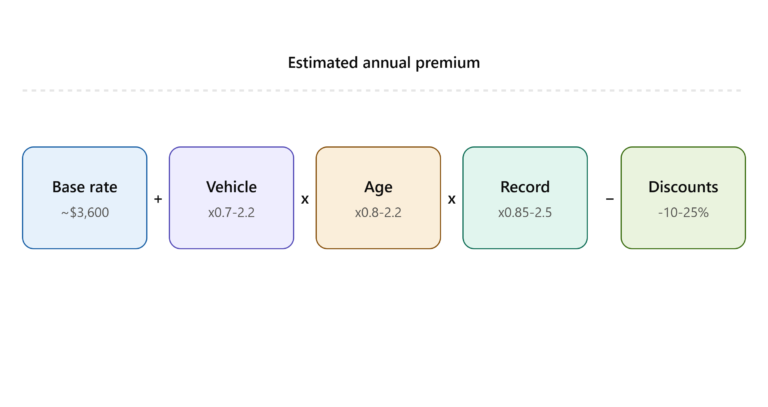
The under-25 penalty and the EV penalty don’t cancel each other out or average together, they stack. A young driver already sits in the highest-risk pricing tier insurers use, and putting that same driver behind the wheel of a vehicle that’s inherently more expensive to repair and replace pushes the number even higher.
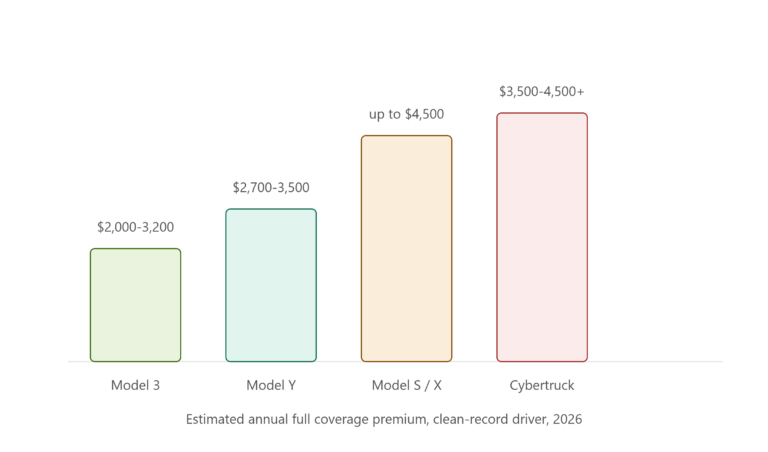
Real-world quote patterns make this concrete. For a Tesla Model Y specifically, teen and early-20s drivers commonly see full-coverage quotes in the $4,500 to $6,000-plus range annually, sometimes higher for solo policies without any family discount or shared policy history. Compare that to drivers in their 40s through 60s, who often land in the $2,200 to $3,000 range for the exact same vehicle. That’s a gap of roughly double, sometimes more, driven entirely by age and experience rather than anything about the driver’s actual habits behind the wheel.
Part of the reason the gap is so pronounced for EVs specifically comes down to how insurers weigh risk. Young drivers are statistically over-represented in serious crashes and file claims of all types, collision, glass damage, vandalism, more frequently than experienced drivers. When that elevated claim frequency lands on a vehicle that’s already expensive to repair per incident, the total cost multiplies rather than simply adding together.
Why turning 25 matters more than it seems like it should
There’s a reason the age-25 milestone gets so much attention in insurance pricing, and it isn’t arbitrary. By your mid-20s, several things insurers care about tend to line up at once: you’ve typically built several years of driving history without major incidents, you likely have a longer continuous insurance history (which some carriers specifically reward), and you’ve statistically aged out of the highest-risk crash-rate bracket that dominates the teens and early 20s.
For EV owners specifically, this milestone can be worth checking even if you got a discouraging quote a year or two earlier. If EV insurance quotes felt unaffordable at 21 or 22, it’s genuinely worth re-shopping at 25, since age alone can shave hundreds of dollars off your premium, which can meaningfully offset the extra cost of insuring an EV over a gas car in the first place.
What EV insurance looks like for drivers over 50
The picture flips for older drivers, and this is where owning an EV becomes noticeably more manageable from a cost standpoint. Drivers in their 40s, 50s, and into their early 60s consistently see the lowest rates of any age group, EV or otherwise, since they combine decades of driving experience with the statistically lowest crash-frequency bracket insurers track.
For a Tesla Model 3 or Model Y, that typically means annual full-coverage premiums in the $2,200 to $3,000 range for a driver in this bracket with a clean record, dramatically lower than the under-25 figures above. The EV-specific cost premium (the extra amount you pay compared to insuring a similar gas car) doesn’t disappear at this age, it’s still real, but it’s applied on top of a much lower baseline, so the total dollar impact feels far less dramatic.
What happens after 60 or 65. Rates do begin ticking back upward for senior drivers, though the increase is modest compared to the drop from the teen years. A 70-year-old pays somewhat more than a 60-year-old, and a 75-year-old somewhat more still, reflecting insurers’ data on slower reaction times and vision changes that come with advanced age. Even with that uptick, though, a senior driver’s EV premium typically remains well below what a driver under 25 would pay for the identical vehicle.
Does gender factor into the age gap for EVs?
In most states, yes, though the effect narrows significantly with age and disappears entirely in a handful of states. Male drivers under 25 typically pay more than female drivers of the same age in states where gender is used as a rating factor, though this gap shrinks substantially once drivers reach their mid-to-late 20s. Eight states, including California, Massachusetts, Michigan, and Pennsylvania, prohibit insurers from using gender as a pricing factor at all, meaning drivers in those states see the age effect in isolation without a separate gender adjustment layered on top.
Practical steps for young EV drivers to lower the cost
If you’re under 25 and looking at a discouraging EV insurance quote, a few levers actually move the number:
- Stay on a parent’s policy if you can. Being added to an existing policy with an experienced driver is almost always cheaper than starting a standalone policy from scratch.
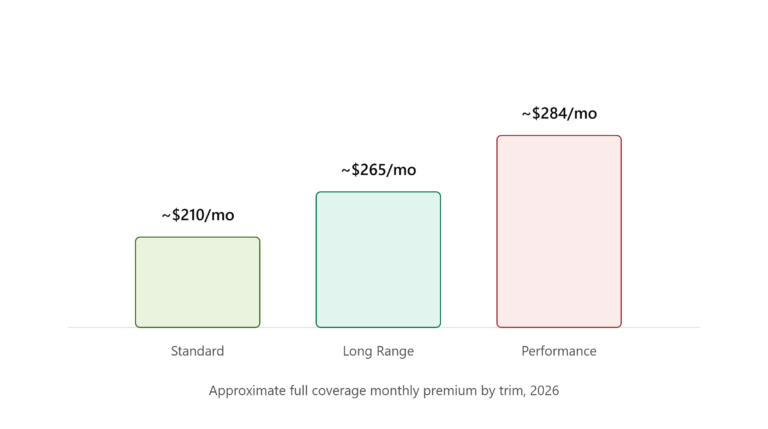
- Choose the cheaper Tesla or EV model within a lineup. As covered in other cost breakdowns, a Model 3 insures meaningfully cheaper than a Model Y or Model X, and that gap matters even more when you’re already paying a young-driver premium on top of it.
- Ask about student and good-driver discounts. Many insurers offer meaningful discounts for maintained good grades (if you’re a student) or for completing a defensive driving course, and these apply on top of any EV-specific discounts.
- Consider a higher deductible if you can absorb it. This lowers your monthly premium in exchange for paying more out of pocket in the rare event you do file a claim.
- Re-shop every year, and definitely at 25. Given how steep the age curve is in your early 20s, a quote that felt unaffordable at 21 may look meaningfully different by 24 or 25, even before you actively try to lower it.
Practical notes for older EV drivers
If you’re over 50 or approaching 60, you’re already in the best pricing window of your driving lifetime, but a few things are still worth doing:
- Bundle with homeowners or renters insurance, which remains one of the most reliable ways to shave 15% to 20% off your total cost at any age.
- Watch for the post-65 uptick and re-shop if your rate jumps unexpectedly. Since the increase for senior drivers is gradual rather than sudden, a large jump may reflect a specific insurer’s pricing model rather than a universal industry shift, and it’s worth comparing quotes if that happens.
- Ask about mature driver discounts. Some insurers offer specific discounts for completing a mature driver safety course, which can offset some of the age-related increase that begins after 60 or 65.
The bottom line
Age changes your EV insurance bill more dramatically than almost any other factor you control. A driver under 25 can pay two to three times what a driver in their 40s or 50s pays for the exact same electric vehicle, and that gap is wider for EVs than it is for comparable gas cars because the underlying repair and replacement costs are higher to begin with. The good news is that the age penalty is temporary. Every year that passes between your late teens and your mid-20s moves you meaningfully down the cost curve, and by the time you reach your 30s, the age factor largely stops working against you, leaving the EV-specific premium as the main cost consideration rather than a compounding one.
This article is for informational purposes only and does not constitute financial or insurance advice. Insurance rates vary by insurer, individual driving history, location, and specific vehicle, and change frequently. Always get a personalized quote before making a purchasing decision.