Everything else about EV insurance pricing, repair networks, sensor recalibration, proprietary parts, ultimately traces back to one component more than any other: the battery. It’s typically 30% to 40% of the vehicle’s total value, and when it’s damaged, the financial stakes for an insurer jump dramatically. This guide breaks down exactly how battery replacement cost gets factored into your premium, what the real numbers look like by battery size, and what you can actually do about it.
Key takeaways:
- Out-of-warranty battery replacement typically costs $4,000 to $22,000 or more depending on pack size and vehicle, with flagship performance packs running even higher.
- Because the battery represents such a large share of total vehicle value, damage to it often pushes an accident toward a total-loss declaration rather than a standard repair, even for damage that would be routine on a gas car.
- Standard comprehensive and collision coverage generally does cover battery damage from a covered event (collision, fire, theft, flood), but gradual capacity loss from normal aging is never covered by insurance, only by the manufacturer’s warranty.
- The battery’s contribution to your premium is roughly proportional to its size and value, meaning a small commuter EV’s battery risk and a flagship performance EV’s battery risk are priced very differently.
The real cost of battery replacement, by pack size
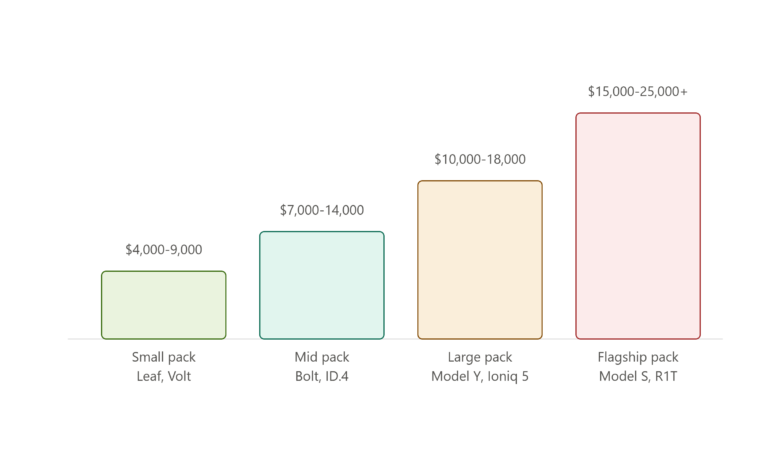
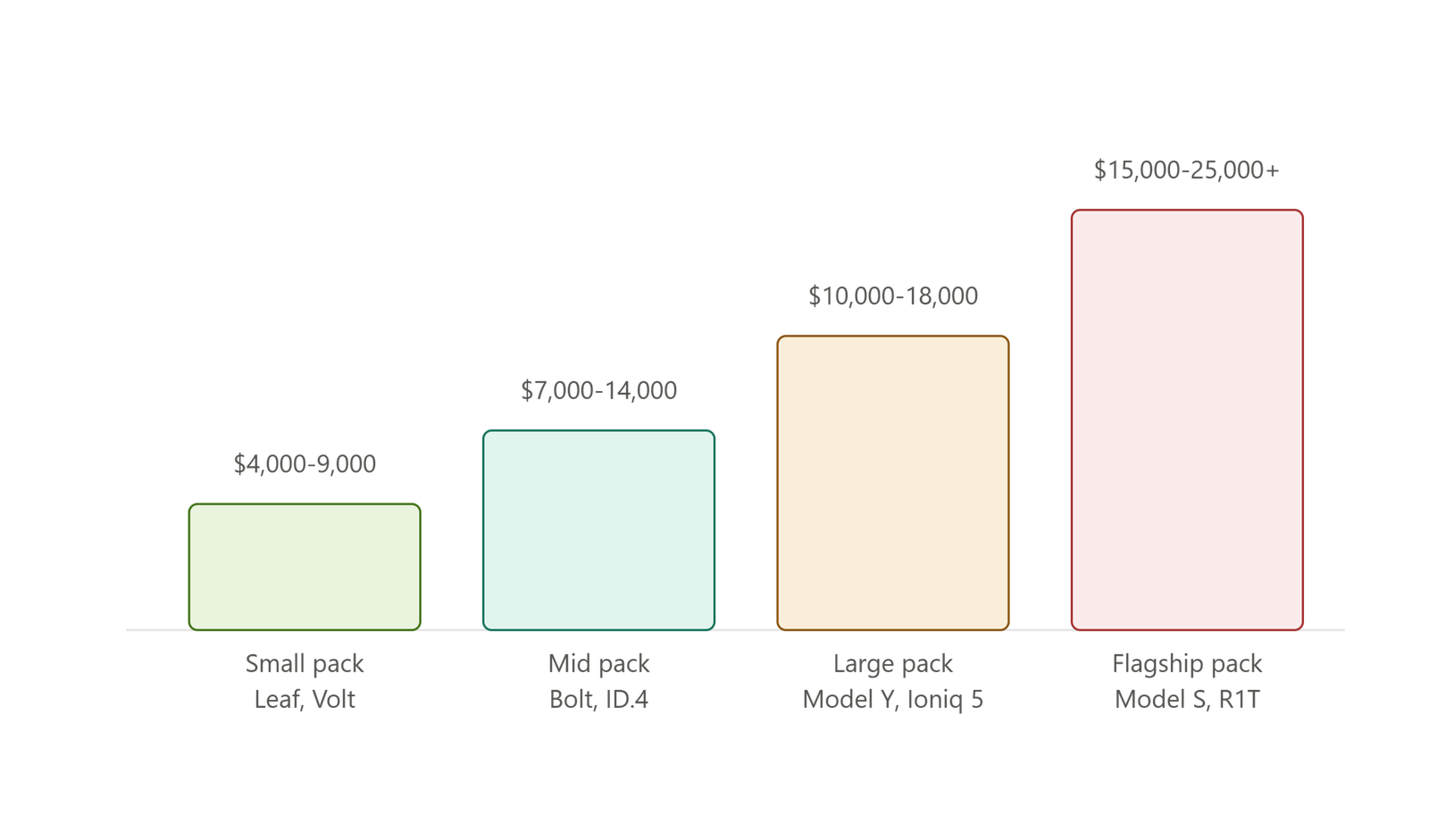
Replacement cost scales fairly predictably with battery pack size, and knowing where your specific EV falls on this scale explains a lot about your premium:
- Small packs (20-30 kWh), found in vehicles like the Nissan Leaf or Chevy Volt: roughly $4,000 to $9,000 installed.
- Mid-size packs (40-60 kWh), found in vehicles like the Chevy Bolt, base VW ID.4, or early Model 3: roughly $7,000 to $14,000 installed.
- Large packs (75-100 kWh), found in vehicles like the Model 3 Long Range, Model Y, Ioniq 5, or Mustang Mach-E: roughly $10,000 to $18,000 installed.
- Flagship and performance packs (100+ kWh), found in vehicles like the Model S Plaid, Rivian R1T, or Lucid Air: roughly $15,000 to $25,000 or more.
For context, that installed cost includes not just the battery itself but $1,000 to $3,000 in specialized labor, since technicians qualified for high-voltage battery work typically charge $150 to $250 an hour, well above standard auto repair labor rates. The Tesla Model 3 is notably the most commonly replaced non-warranty EV battery in the U.S. simply because of its sales volume, giving insurers an unusually large real-world dataset to price against for that specific model.
Why battery risk pushes premiums up more than the dollar figure alone suggests
It’s not just that a battery replacement is expensive in isolation, it’s what that expense does to how an insurer handles a claim.
Battery damage often means total loss, even for damage that would be repairable on a gas car. Because the battery represents such a large share of a vehicle’s total value, sometimes 30% to 40% of what the car is worth, even moderate structural damage to the battery housing can push the total repair cost past the threshold where an insurer declares the vehicle a total loss rather than authorizing repair. An equivalent collision on a gas car, with a mechanically simpler and cheaper-to-replace engine, might be a routine repair rather than a total-loss event.
Insurers price the tail risk, not just the average claim. Even though most EV owners will never experience a battery-related claim, insurers have to account for the relatively rare but extremely expensive scenario when they set premiums across their entire pool of policyholders. A $20,000 potential payout, even if it only happens to a small percentage of drivers, meaningfully raises what everyone in that risk pool pays.
One quantitative model estimates battery risk specifically adds 6% to 10% of a vehicle’s insured value to the premium. In a worked example using this approach, a Tesla Model 3 in California with a $45,000 insured value saw roughly $540 of its total annual premium attributable to battery risk alone, out of a total premium of about $1,842. That’s a useful illustration of just how much of your bill traces back to this single component, even though it’s rarely broken out as a separate line item on your actual policy.
What’s actually covered, and what isn’t
This is a distinction worth understanding clearly, since it shapes both your premium and your expectations if something does go wrong:
Covered under standard comprehensive and collision: Battery damage resulting from a covered event, meaning a collision, fire, theft, vandalism, or a comprehensive-covered event like flooding, is generally covered under your standard auto policy, subject to your deductible and policy limits.
Not covered by insurance, ever: Gradual capacity loss from normal aging and use. This is the single most common reason EV batteries eventually need replacement, and it’s handled exclusively by the manufacturer’s warranty, typically running 8 to 10 years, not by your auto insurance policy under any circumstances. If your battery degrades naturally over time and needs replacement after your warranty expires, that cost falls entirely on you, not your insurer.
Sometimes available as an add-on: Some insurers offer EV-specific coverage that explicitly addresses battery protection beyond the standard collision and comprehensive framework, though these policies typically cost 10% to 15% more than standard coverage. It’s worth asking your insurer directly whether this kind of endorsement is available and what specifically it adds beyond your existing coverage.
Does warranty coverage change how insurance thinks about your battery?
Indirectly, yes. Most EV battery warranties cover 8 to 10 years and guarantee retention of a minimum percentage of original capacity, commonly around 70%, during that period. California has pushed this further, requiring 2026-model-year vehicles sold in the state to retain at least 70% of range for 10 years or 150,000 miles. While your auto insurance premium isn’t calculated directly from your warranty terms, a vehicle still well within its battery warranty period represents somewhat less financial uncertainty to an insurer than one approaching or past that window, since a warranty-covered degradation issue doesn’t become an insurance claim in the first place.
Practical steps to manage the battery’s impact on your premium
A few concrete things you can actually do, rather than simply accepting the battery-driven premium as fixed:
- Choose a smaller-pack vehicle if minimizing insurance cost is a real priority. As the pack-size breakdown above shows, the difference between a small-pack commuter EV and a flagship performance pack can mean a battery replacement cost gap of $15,000 or more, and that difference shows up in your premium.
- Consider a higher deductible specifically because of battery risk. Given how much of your premium traces back to a single high-cost, relatively rare event, a higher deductible can meaningfully lower your ongoing premium in exchange for more out-of-pocket exposure if that rare event happens. One estimate suggests each $250 increase in deductible reduces premium by roughly 2.5%, though your actual savings will vary by insurer.
- Ask specifically whether EV-specific battery coverage makes sense for your situation. If you’re driving a high-value, large-pack EV where a battery claim would be especially painful, the 10% to 15% premium increase for dedicated battery coverage may be worth the added protection, particularly once you’re outside the manufacturer’s warranty window.
- Understand your warranty timeline and factor it into your ownership planning. As you approach the end of your battery warranty, it’s worth reassessing your coverage and considering whether a used-EV purchase decision, or eventually a replacement vehicle decision, makes more sense than absorbing full battery replacement risk entirely on your own.
- Document battery condition if you’re ever in an accident. If your battery is damaged in a covered event, insurance adjusters may initially propose repair rather than full replacement. Getting a professional inspection specifically addressing thermal management system integrity and cell voltage balance, and documenting the battery’s condition with photos, helps ensure you get a full and accurate assessment rather than an underpowered repair on a safety-critical component.
The bottom line
The battery is the single biggest reason EV insurance costs what it does, contributing an estimated 6% to 10% of your vehicle’s insured value to your premium and driving the elevated total-loss risk that shows up throughout every other EV insurance cost factor covered on this site. Replacement costs range from roughly $4,000 for a small commuter EV’s battery up to $25,000 or more for a flagship performance pack, and understanding where your specific vehicle falls on that spectrum explains a meaningful share of why your premium looks the way it does. The good news: pack size is a choice you make at purchase, deductible level is a choice you can adjust anytime, and understanding what is and isn’t covered helps you avoid surprises if you ever need to file a claim.
This article is for informational purposes only and does not constitute financial or insurance advice. Battery replacement costs, warranty terms, and insurance coverage details vary by manufacturer, insurer, state, and specific vehicle, and change frequently. Always confirm specific coverage and warranty terms directly with your manufacturer and insurer.