Best EV Insurance for High-Mileage Drivers
If you’re racking up 15,000, 20,000, or more miles a year in your EV, whether from a long commute, rideshare driving, or just genuinely loving road trips, you’re in a different insurance category than the average owner. Mileage is one of the more significant rating factors insurers use, and it interacts with the EV-specific cost factors covered throughout this site in ways that are worth understanding before you shop. This guide covers which insurers and coverage structures actually work best when you’re putting serious miles on your EV.
Key takeaways:
- High mileage raises your premium because it directly increases claim frequency risk, not because of anything specific to EVs, but the effect compounds with EV-specific repair costs already covered elsewhere on this site.
- State Farm’s Drive Safe & Save and Nationwide’s SmartRide both offer meaningful discounts, up to 30%, for safe driving even at higher mileage levels, a better fit than pure mileage-based programs once you’re above roughly 12,000 to 13,000 miles a year.
- Pay-per-mile and usage-based programs built around low mileage, like Metromile-style options, lose their advantage and can become more expensive than standard policies once you cross that same 12,000-to-13,000-mile threshold.
- Nationwide specifically stands out for offering strong rates at both ends of the spectrum, with SmartMiles for low-mileage drivers and separately excellent rates for higher-mileage drivers around 13,000 to 16,000 miles a year.
Why mileage matters so much to insurers
The logic is straightforward: more time on the road statistically means more exposure to accidents, full stop, regardless of what you drive. High-mileage drivers face higher premiums, a greater statistical chance of accidents, and insurers pay closer attention to whether reported mileage is accurate. For EV owners specifically, this factor doesn’t operate in isolation, it stacks on top of the repair-cost and battery-risk factors covered throughout our other cost guides, meaning a high-mileage EV driver is combining two separate risk premiums rather than facing either one alone.
The threshold that changes your best strategy
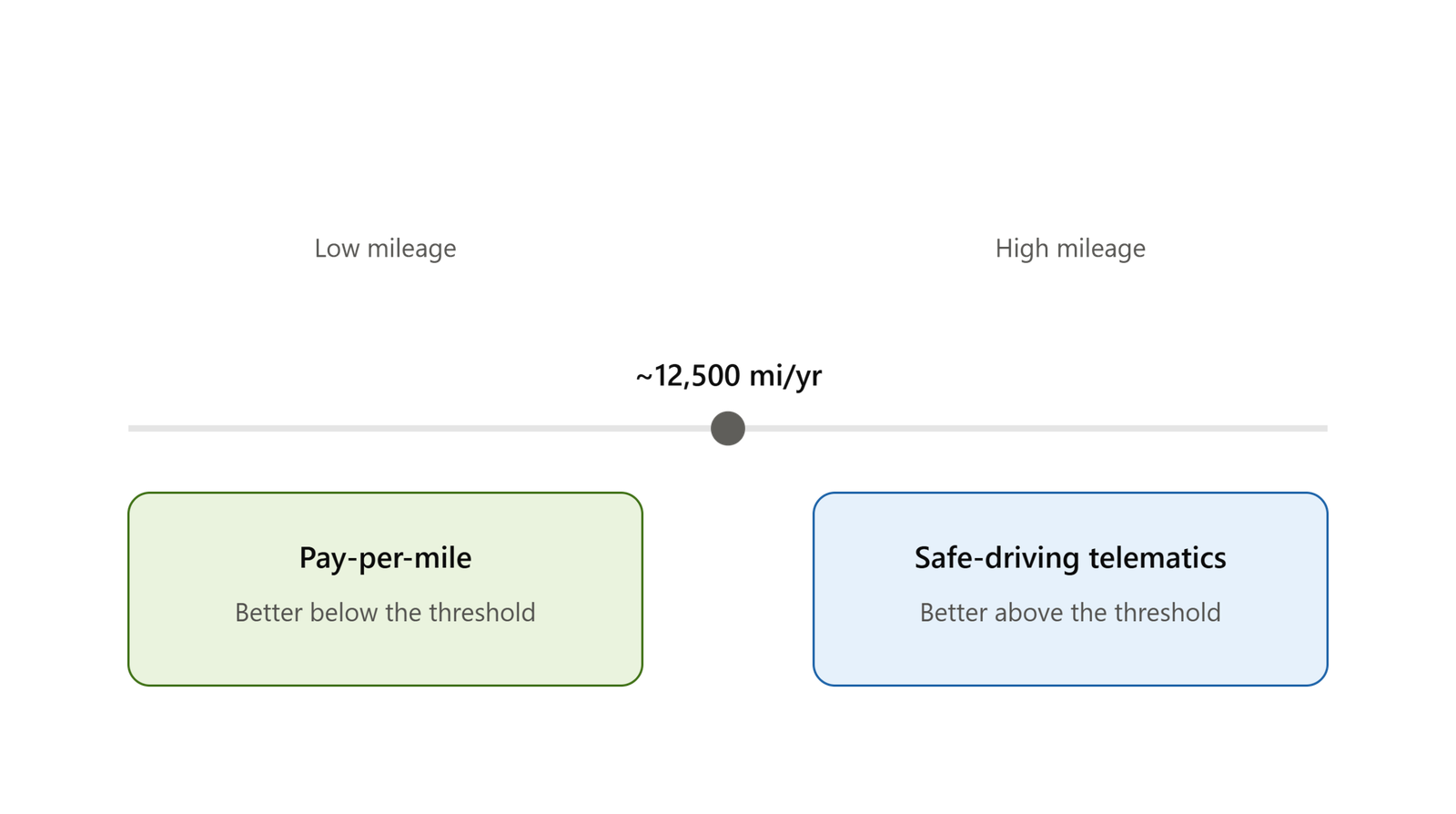
This is the single most useful thing to understand before shopping: your ideal insurance structure changes depending on which side of roughly 12,000 to 13,000 annual miles you fall on.
Below that threshold, mileage-based and pay-per-mile programs, designed specifically to reward low usage, tend to offer the best value, since they’re pricing you close to your actual (low) exposure rather than an average assumption.
At or above that threshold, those same programs stop being advantageous and can become more expensive than a standard policy, since you’re now paying per mile at a rate that assumes you’ll keep driving less, an assumption that no longer matches your actual usage. At this point, your better strategy shifts toward standard usage-based programs that reward safe driving behavior regardless of total mileage, rather than programs built around minimizing miles specifically.
Best options if you’re a genuinely high-mileage EV driver
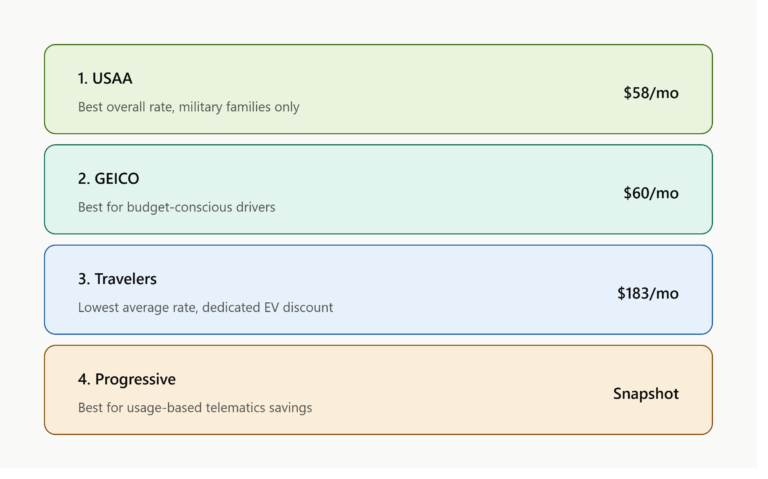
State Farm — Drive Safe & Save State Farm’s telematics program offers up to 30% off specifically for a combination of lower relative mileage and safe driving habits, but unlike a pure pay-per-mile structure, it doesn’t penalize you as sharply for higher mileage if your driving behavior itself is strong. Combined with State Farm’s broad agent network and family-friendly discount stack covered in our full insurer ranking, this is a strong first quote for a high-mileage EV driver who wants safe-driving credit without being punished purely for the odometer number.
Nationwide — SmartRide Nationwide is specifically called out as offering excellent rates for drivers logging 13,000 to 16,000 miles a year, an unusually direct fit for the higher-mileage bracket most insurers don’t optimize for. Nationwide also offers accident forgiveness, new car replacement, and a vanishing deductible, options worth layering on top of the base rate if you’re putting serious miles on a relatively new EV specifically. Worth noting: Nationwide’s claims-handling grade from collision specialists is rated only average (a C), so weigh that against the strong mileage-specific pricing if a smooth claims process is a top priority for you.
Progressive — Snapshot As covered in our broader insurer comparison, Progressive’s Snapshot program rewards safe driving behavior directly, and it’s specifically well-suited to EV owners whose driving patterns, even at higher mileage, tend to score favorably due to smoother acceleration and consistent regenerative braking patterns common in EV driving.
Why pay-per-mile programs work against you at this mileage level
It’s worth being specific about why programs like Metromile-style pay-per-mile insurance stop making sense once you’re a genuinely high-mileage driver. These programs charge a low base rate (commonly a small daily fee) plus a per-mile charge, structured to reward drivers who log meaningfully fewer miles than average. Most pay-per-mile insurers cap daily charges around 250 miles to prevent runaway costs on road trip days, but the underlying math is built around low total annual mileage. Once your annual mileage crosses into the 12,000-to-13,000-mile range, roughly where average U.S. driving sits, the per-mile charges accumulate to a total that typically exceeds what a standard policy or a safe-driving telematics program would cost for the same coverage.
If you’re currently on a pay-per-mile plan and your mileage has crept up over time, whether from a longer commute, a new job, or simply driving your EV more because charging at home makes it cheap to do so, it’s worth specifically re-checking whether that program still makes financial sense for you, since drivers sometimes stay enrolled out of habit well past the point where it’s still the better deal.
Additional EV-specific considerations for high-mileage owners
Battery wear and mileage aren’t the same risk factor to insurers, but they’re related. As covered in our detailed guide to battery replacement costs, insurers price battery risk based heavily on pack value and total-loss exposure, not directly on your odometer reading. However, higher mileage does correlate with more accumulated charge cycles, and while this doesn’t typically show up as a distinct line item on your premium, it’s worth factoring into your own sense of when a battery health check might become relevant, particularly if you’re planning to keep the vehicle long-term.
Rideshare and commercial use requires different coverage entirely. If your high mileage comes specifically from driving for Uber, Lyft, or similar platforms, standard personal auto insurance, even a high-mileage-friendly policy from any insurer on this list, typically doesn’t cover you while a ride is active. This requires a separate rideshare endorsement or commercial policy, a different product from what’s covered in this general high-mileage guide.
Consider a higher deductible to offset the higher base premium. Since high mileage already raises your baseline cost, and EV repairs are expensive as covered throughout this site, a deductible increase from $500 to $1,000 can meaningfully soften the combined effect of both factors stacking on your premium.
A practical shopping checklist for high-mileage EV owners
- Calculate your actual annual mileage honestly, not an estimate from years ago. This single number determines which strategy, pay-per-mile versus standard safe-driving telematics, actually favors you.
- Get quotes specifically from State Farm, Nationwide, and Progressive, the three options that most directly address higher-mileage driving profiles among mainstream insurers.
- Ask each insurer directly how their program treats mileage above 13,000 miles a year. Some telematics programs quietly reduce their discount ceiling at higher mileage levels, a detail worth confirming rather than assuming.
- If you’re currently on a pay-per-mile plan, run the math on whether it’s still your best option given your current, not historical, mileage.
- Confirm whether any rideshare or commercial driving needs separate coverage, since this is a common gap high-mileage drivers overlook until a claim exposes it.
The bottom line
High-mileage EV drivers face a compounding cost picture: the general mileage penalty every insurer applies, layered on top of the EV-specific repair and battery cost factors covered throughout this site. State Farm’s Drive Safe & Save and Nationwide’s SmartRide consistently stand out as the strongest options once you’re above roughly 12,000 to 13,000 miles a year, since they reward safe driving behavior without punishing you purely for total mileage the way a pay-per-mile structure would. If you’re currently enrolled in a low-mileage program and your driving has crept upward over time, it’s worth a direct re-shop to confirm you’re still on the right side of that math.
This article is for informational purposes only and does not constitute financial or insurance advice. Insurance rates, program availability, and mileage thresholds vary by insurer and state, and change frequently. Always get a personalized quote before making a purchasing decision.