Best Electric Car Insurance Companies in 2026 (Ranked)
There’s no single «best» EV insurance company for everyone, the right pick depends on your specific vehicle, your state, your age, and what you value most, cheap rates, strong claims service, or EV-specific perks like charger coverage. That said, clear patterns emerge across multiple independent 2026 studies. This ranking pulls those patterns together so you can shortlist the right insurers to actually quote, rather than guessing.
Key takeaways:
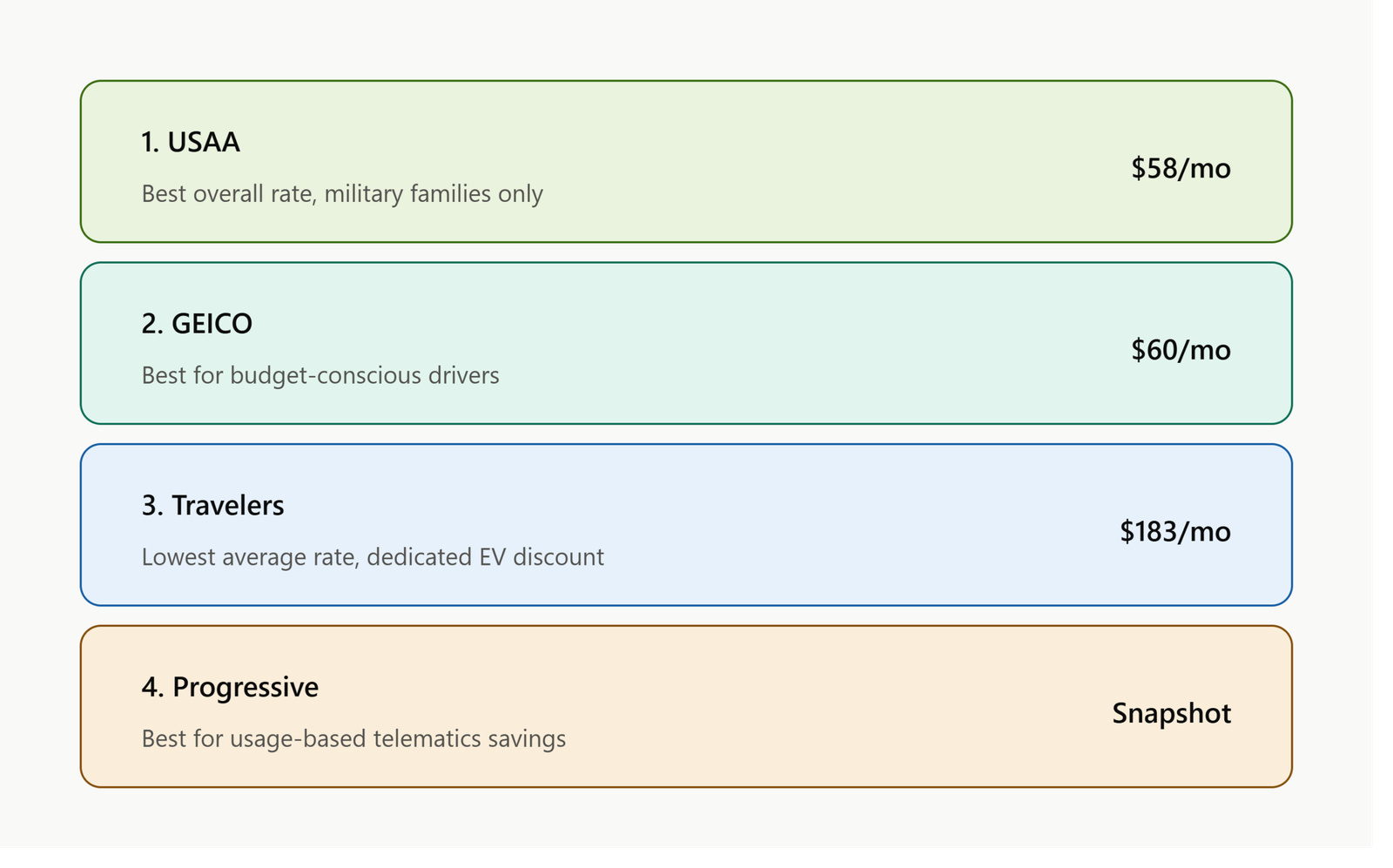
- USAA, GEICO, and Travelers consistently rank among the cheapest options for EV owners, with USAA quotes starting as low as $58 a month, though USAA is restricted to military members and their families.
- Travelers stands out specifically for offering one of the only dedicated hybrid/EV discounts among major carriers, alongside the lowest average rate in at least one major 2026 study.
- No single insurer wins on every dimension: the cheapest option isn’t always the best for claims service, and the best EV-specific coverage isn’t always the cheapest.
- Getting quotes from at least three to five of the insurers on this list, rather than picking one based on reputation alone, remains the single most reliable way to find your actual best rate.
The top-ranked companies, and what each is actually best at
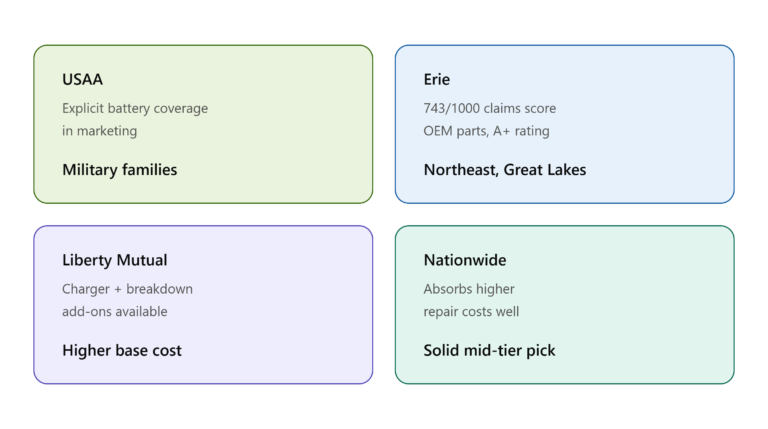
1. USAA — best rates overall, if you qualify Multiple 2026 studies place USAA at or near the top for affordability, with quotes starting around $58 a month, the lowest starting figure found in this research. USAA also stands out for specifically advertising coverage for EV batteries, a detail many competitors don’t highlight clearly. The catch is eligibility: USAA is only available to military members, veterans, and their immediate families, so it isn’t an option for every shopper, but it’s worth checking immediately if you qualify.
2. GEICO — best for budget-conscious drivers without military ties GEICO consistently ranks among the most competitive EV insurers for the general public, with rates starting as low as $60 a month in some analyses. It also offers a strong multi-car discount, up to 25% if you have another vehicle, electric or not, in your household, along with accident forgiveness after five years of a clean record. GEICO is a natural first quote for most non-military EV shoppers specifically because of this combination of low starting rates and meaningful discount stacking.
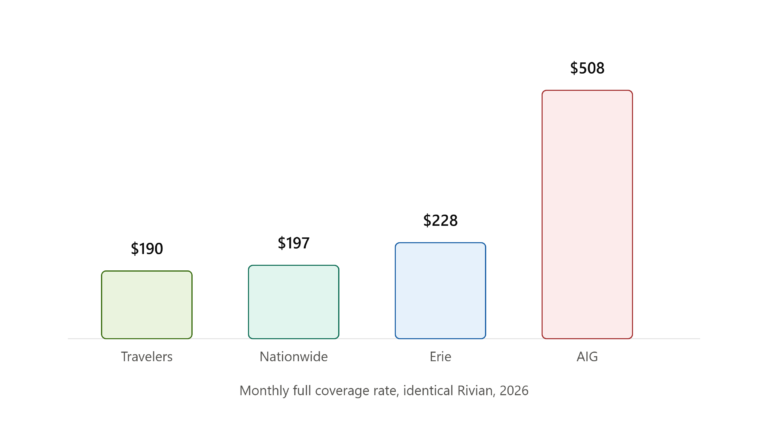
3. Travelers — best for a dedicated EV discount and lowest average rate Travelers shows up repeatedly across independent studies as the cheapest average option for hybrid and electric vehicles specifically, with one major 2026 comparison finding Travelers averaging around $183 a month, the lowest average of any carrier studied. What sets Travelers apart isn’t just price, it’s one of the few major insurers offering an explicit hybrid/electric vehicle discount on top of already competitive base rates, a combination that’s harder to find than you’d expect among mainstream carriers.
4. Progressive — best for usage-based savings and flexible options Progressive’s Snapshot telematics program rewards genuinely safe driving with meaningful discounts over time, and it’s specifically called out as a strong fit for EV owners whose driving patterns, often shorter commutes, frequent home charging, tend to look favorable under usage-based scoring. Progressive is a strong pick if you’re confident in your driving habits and want a program that can improve your rate over time rather than locking in a flat number at signup.
5. State Farm — best for wide agent access and family discounts As the largest auto insurer in the U.S., State Farm brings an extensive agent network and a strong reputation for customer satisfaction, ranking as a consistent go-to for EV owners who value in-person or dedicated agent support over a purely digital experience. It’s also particularly strong for families, offering student discounts up to 25% and a driver education course discount, worth knowing if you’re insuring a young EV driver alongside your own policy.
6. Nationwide — best for policy perks beyond the base rate Nationwide offers competitive core pricing, averaging around $93 a month for liability and $188 a month for full coverage in one analysis, but its real differentiator is the extras: key fob replacement, pet injury protection, and access to a dedicated auto repair network are all included as standard perks, useful additions for EV owners given how often specialized repair access matters for this vehicle category specifically.
7. Liberty Mutual — best for EV-specific add-ons Liberty Mutual is specifically noted for offering optional EV-focused add-ons, including coverage aimed at home charging stations and mechanical breakdown protection, categories that many competitors don’t address directly. If dedicated charging-equipment coverage matters to you beyond what’s covered under a standard homeowners policy, Liberty Mutual is worth a direct call to confirm current availability in your state.
8. Lemonade — best for a genuinely EV-native approach Lemonade’s mileage-based pricing model tends to work in favor of EV drivers specifically, and the company offers dedicated coverage for home chargers and emergency charging situations, along with EV and hybrid discounts built into its structure from the ground up rather than added on as an afterthought. It’s a newer-model insurer worth comparing if you want a company that treats EV ownership as a core use case rather than an exception.
9. Tesla Insurance — best for Tesla owners specifically, in eligible states As covered in our dedicated Tesla insurance breakdown, Tesla’s own insurance product uses real-time driving data rather than traditional factors like age or credit score to price risk, and it’s frequently cited as one of the more competitive options specifically for Tesla owners in the states where it’s available. It isn’t universally available yet and doesn’t automatically beat every traditional insurer for every driver, but it’s worth a direct comparison if you drive a Tesla in an eligible state.
10. Allstate — best for new-vehicle-specific protection Allstate is known specifically for its new-car replacement coverage, which can matter more for EV owners than gas car owners given how much new EVs tend to depreciate in the first year or two, as covered in our leasing versus financing comparison. If you’re buying a brand-new EV and want protection against that early depreciation curve in a total-loss scenario, Allstate’s new-car replacement option is worth a direct look.
How these rankings were built
This list draws from multiple independent 2026 sources rather than a single study, since as covered throughout this site, no single data source captures the full picture on its own. A few patterns held consistently across sources: USAA, GEICO, and Travelers appeared near the top for affordability across nearly every study reviewed, while Liberty Mutual, Lemonade, and Nationwide were consistently flagged for EV-specific features and add-ons beyond base pricing. State Farm and Allstate earned their spots less on raw price and more on service reputation, agent access, and specific policy perks relevant to EV owners.
What actually varies most between these companies
Beyond the headline rate, a few dimensions matter for choosing between insurers on this list:
Battery and high-voltage component coverage. Not every insurer addresses this explicitly in their marketing, USAA does, most others require a direct question to confirm what’s actually covered if your battery is damaged.
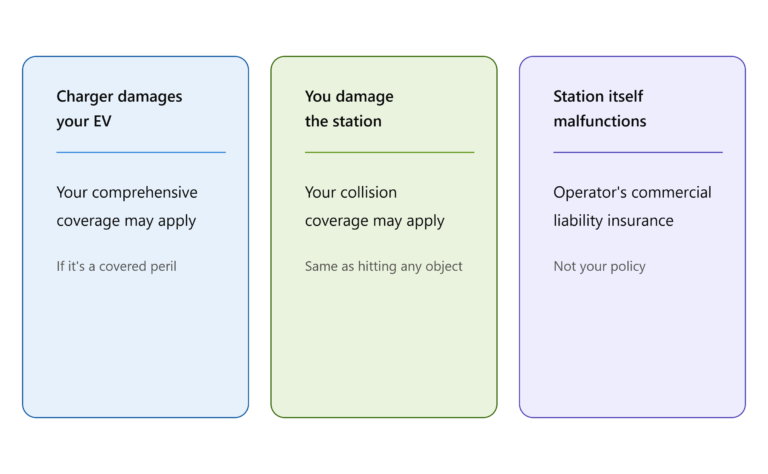
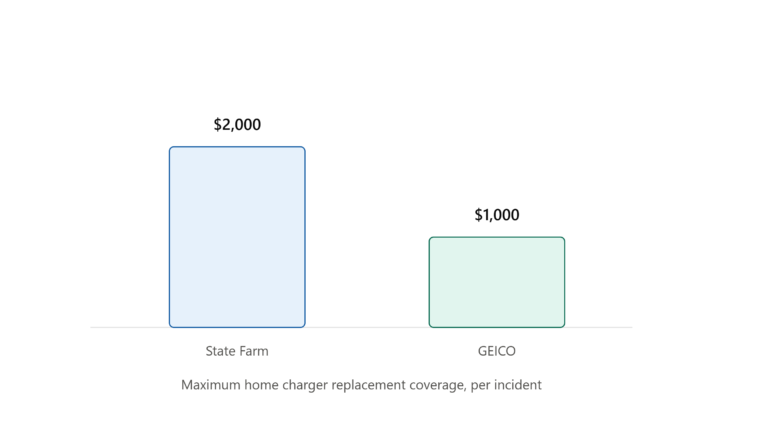
Home charger and charging equipment coverage. As covered in our dedicated guide on this topic, this typically falls under homeowners insurance rather than auto insurance, but Liberty Mutual and Lemonade specifically offer auto-side options addressing this, worth asking about if you want coverage consolidated under one policy.
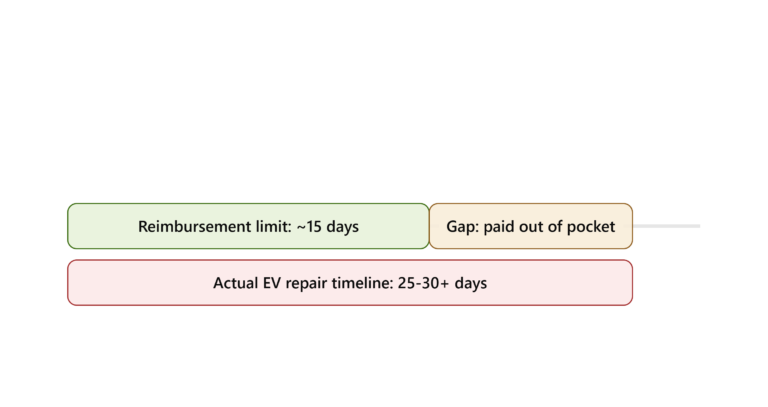
Claims experience and repair network access. A cheap premium doesn’t help much if a claim takes months to resolve because the insurer doesn’t have a strong relationship with EV-certified repair shops in your area. Nationwide’s included repair network access is a specific example of an insurer addressing this directly rather than leaving it to chance.
Telematics and usage-based options. Progressive’s Snapshot program is the most frequently cited example, but several insurers on this list offer some version of usage-based pricing, worth comparing if you’re a low-mileage or demonstrably safe driver.
How to actually use this ranking
Don’t just pick the name at the top of the list. Instead:
- Check eligibility first. If you or a family member has military ties, get a USAA quote before anything else, since it consistently ranks as the cheapest option among sources reviewed for this article.
- Get quotes from at least three to five insurers on this list, not just one, since individual pricing varies significantly by your specific state, vehicle, and driver profile, as covered throughout our broader cost guides.
- Ask each insurer directly about the specific features that matter most to you, battery coverage, charger protection, telematics availability, rather than assuming every company on this list offers the same things at the same level.
- Weigh price against service and claims reputation, particularly for a vehicle category where repair complexity, as covered extensively elsewhere on this site, makes a smooth claims process genuinely more valuable than it might be for a simpler gas car.
The bottom line
USAA, GEICO, and Travelers lead most 2026 comparisons on raw affordability, with USAA the cheapest if you qualify through military affiliation and Travelers standing out for its dedicated EV discount among major carriers. But price alone shouldn’t be the only factor: Progressive’s telematics program, Liberty Mutual and Lemonade’s EV-specific add-ons, and State Farm’s agent network and family discounts all serve genuinely different owner priorities. The right choice depends on what you’re optimizing for, and the only reliable way to find it is comparing real quotes from several of these companies against your specific vehicle and profile, not choosing based on a single ranking alone.
This article is for informational purposes only and does not constitute financial or insurance advice. Insurance rates, coverage options, and company offerings vary by state and change frequently. Always confirm current rates and coverage details directly with each insurer before making a purchasing decision.