How to Switch EV Insurance Companies Without Losing Coverage
Switching EV insurance is one of the highest-value, lowest-risk moves covered throughout this site, drivers save an average of $400 to $900 a year when they switch strategically, and given how wide EV rate variance runs between insurers, as documented in our Rivian and other model-specific guides, the potential savings are often larger for EV owners than for gas car drivers. The process itself takes under an hour. The only real risk is timing it wrong and creating a coverage gap, which is both avoidable and expensive if it happens. This guide walks through exactly how to do it right.
Key takeaways:
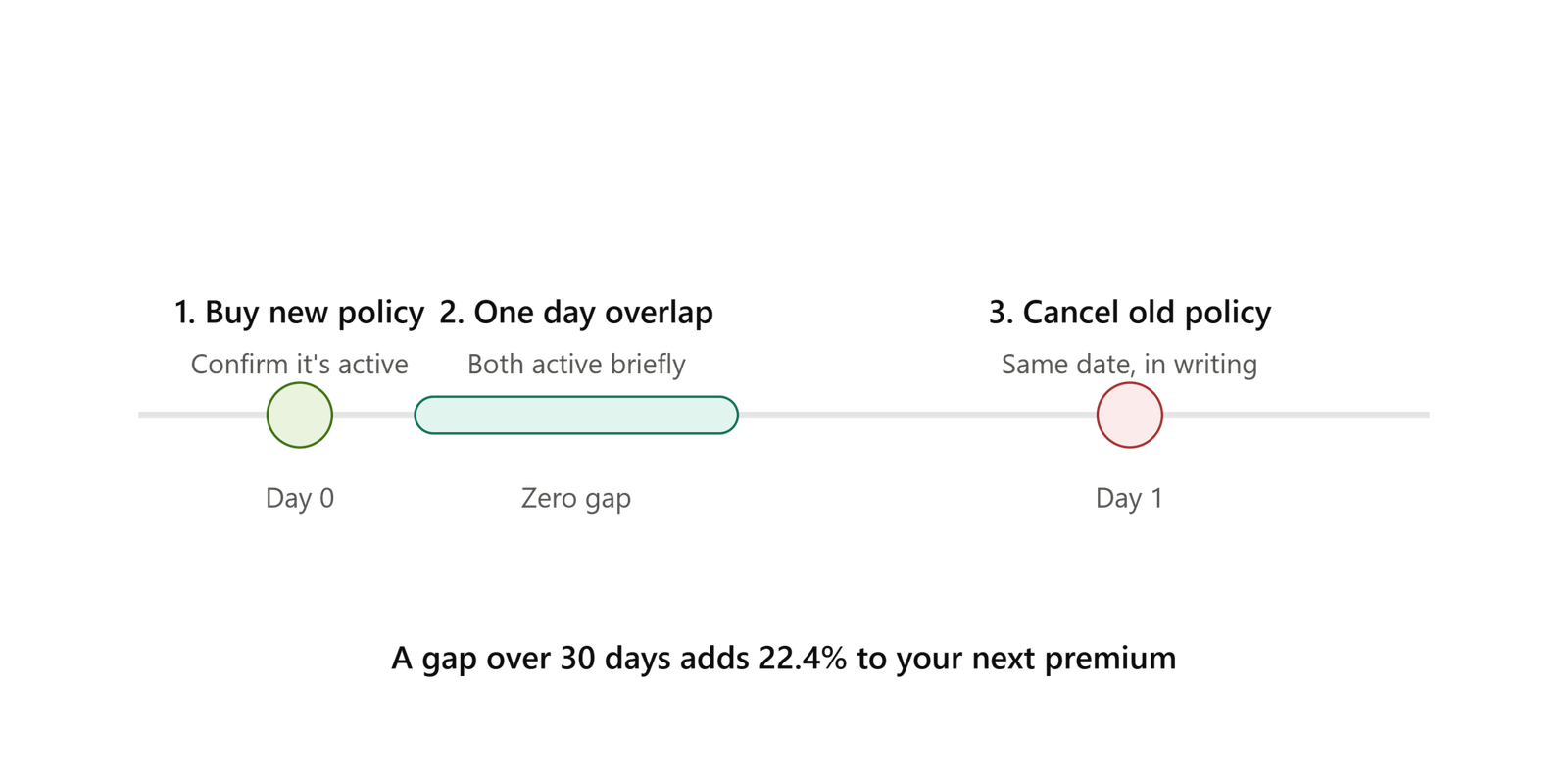
- The single rule that prevents every coverage gap: your new policy must be active before you cancel the old one, never the reverse.
- A coverage lapse is expensive even if nothing bad happens while you’re uninsured: a gap longer than 30 days adds an average of 22.4% to your next premium, and a 45-day gap raises rates by roughly 40%.
- Insurers check your coverage history going back three to five years, meaning a lapse from today can still affect quotes you receive years from now.
- The whole switching process takes about 30 minutes to an hour when done in the right order, and most insurers don’t charge a penalty for canceling mid-policy.
The one rule that prevents every mistake
Before the step-by-step process, it’s worth internalizing the single principle that makes this entire process safe: your new policy must already be in effect before you cancel your old one, never the other way around. Every source reviewed for this guide agrees on this point without exception. Even a one-day gap counts as a lapse that insurers can see on your record when you apply for future coverage, and as covered below, the financial consequences of that gap are meaningfully worse than most drivers expect.
Step-by-step: how to switch without a gap
1. Pull your current policy details. Note your exact liability limits, deductibles, and any endorsements you currently carry, including anything EV-specific like a battery coverage add-on, rideshare endorsement (covered in our dedicated guide), or roadside assistance rider (covered in our EV roadside assistance guide). You’ll need this to make sure your new quotes are comparing genuinely equivalent coverage, not accidentally downgrading protection to make a quote look artificially cheaper.
2. Get at least three quotes with identical coverage levels. Compare apples to apples, same liability limits, same deductible, not just the bottom-line premium. Given how much rate variance exists specifically for EVs, as documented throughout our insurer comparison guides, three quotes is a reasonable minimum, but more comparison generally pays off further for this vehicle category specifically.
3. Purchase your new policy first. This is the step where the «new policy before canceling the old one» rule actually gets executed. Complete payment and confirm you have immediate proof of insurance, via email, app, or physical card, before you do anything else.
4. Confirm your new policy’s exact effective date and time. This detail trips people up more than it should: some insurers begin coverage at 12:01 AM on the effective date, while others start at 12:01 PM. Confirm the exact time, not just the date, when setting up the overlap with your old policy.
5. Set the new policy to overlap with your old policy by at least one day. Purchasing new coverage 7 to 10 days before your current policy expires gives buffer time for processing while ensuring a seamless transition without gaps or unnecessary extended overlap costs.
6. Cancel your old policy in writing, only after the new policy is confirmed active. This is generally your responsibility, not your new insurer’s. Per Progressive’s official guidance, a new insurer can provide proof of insurance to your old company if necessary, but isn’t authorized to cancel a policy with another carrier on your behalf. Specify the cancellation date to match your new policy’s start date exactly, and request written confirmation of the cancellation for your own records.
7. Notify your lender or lessor if you’re financing or leasing. As covered in our dedicated leasing versus financing guide, your lender needs updated proof of insurance (an Evidence of Insurance document) reflecting the new carrier, since your loan or lease agreement specifically requires continuous coverage naming them as a loss payee.
8. Update your registration and ID cards. Remove old insurance ID cards from your vehicle and replace them with new ones. Check whether your state’s DMV requires you to submit documentation yourself or receives updates electronically from insurers, since this varies by state and a mismatch can trigger registration issues even when your actual coverage never lapsed.
What a coverage gap actually costs you
This is worth understanding in concrete numbers, since «avoid a gap» can sound like generic advice until you see the real financial impact:
- A gap longer than 30 days adds an average of $315 a year, a 22.4% increase, to your next premium, based on a national average full-coverage premium baseline.
- A 45-day gap raises rates by roughly 40%, a dramatically steeper penalty for a relatively modest increase in lapse length.
- Insurers check your coverage history going back three to five years, meaning a lapse today isn’t a one-time cost, it can affect quotes you receive years into the future, well after the actual gap is a distant memory.
- Beyond the premium penalty, a lapse can trigger state-level consequences separate from insurance pricing entirely, including fines or registration issues, since some states receive electronic cancellation notifications directly from insurers and flag a gap before you’re ever pulled over.
Given how elevated EV premiums already run compared to gas cars, as covered throughout this site, a 22% to 40% penalty on top of an already-higher baseline is a meaningfully larger dollar amount than the same percentage penalty would represent for a gas car owner, one more reason EV owners specifically should treat gap avoidance as non-negotiable.
What to specifically preserve when switching an EV policy
Beyond the general steps above, a few EV-specific details deserve direct attention during the switch, since a generic insurance-switching checklist won’t flag them automatically:
Battery and high-voltage coverage terms. As covered in our guide to which insurers actually cover EV battery replacement, coverage quality and claims-handling approach varies significantly between carriers. Confirm your new policy’s battery coverage explicitly, don’t assume it matches your old policy’s terms just because both are labeled «comprehensive and collision.»
Home charger endorsements, if you have one. If your old policy or a homeowners endorsement specifically covered your home charger, as covered in our dedicated charger insurance guide, confirm whether that coverage transfers automatically or needs to be re-established with the new carrier or a separate homeowners policy update.
Rideshare or usage-based program enrollment. If you were enrolled in a telematics program, as covered in our dedicated telematics guide, note that driving data generally doesn’t transfer between insurers. Switching carriers typically means starting fresh with a new insurer’s program, worth factoring into your timing if you were partway through building toward a program’s maximum discount tier.
Any EV-specific discount you were receiving. Confirm the new carrier actually applies any dedicated EV or green vehicle discount, as covered throughout our insurer comparisons, some carriers offer this explicitly while others don’t, and it’s not something you want to discover missing after your first new bill arrives.
Is there ever a penalty for switching mid-policy?
Generally no. Most car insurance companies do not charge a penalty for canceling mid-policy, and if you’ve prepaid, you should receive a pro-rated refund for the unused portion once cancellation is confirmed. Some carriers may charge a small flat cancellation fee, typically $25 or less, worth checking your specific policy terms for, but even where a fee applies, it’s almost always worth it against the savings a better-matched new policy provides, especially given the EV-specific rate variance covered throughout this site.
The best time to actually do this
You can switch at any time, mid-policy switching is completely fine and doesn’t hurt your credit score, but a few moments are particularly good triggers to prompt a re-shop:
- 30 to 45 days before your current policy’s renewal, giving enough time to compare quotes and execute a smooth transition without rushing the overlap timing.
- After any life change: moving, marriage, a new EV purchase, adding or removing a driver, or a meaningful credit score improvement, all of which can shift your best available rate significantly, as covered throughout our other cost-factor guides.
- Whenever you notice a competitor’s EV-specific pricing has improved. As covered in our guide on whether EV insurance rates drop over time, broader market pricing has been trending downward, and an existing policy doesn’t automatically capture that improvement without you actively re-shopping.
The bottom line
Switching EV insurance companies is a fast, low-risk process that regularly saves drivers hundreds of dollars a year, and the entire risk of a costly coverage gap is eliminated by following one simple rule: buy the new policy first, confirm it’s active, then cancel the old one. Beyond the general steps, EV owners specifically should double-check that battery coverage, home charger endorsements, and any EV-specific discounts carry over correctly to the new policy, details a generic switching checklist won’t catch automatically. Given that a coverage gap can add 22% to 40% to your next premium and follow you in insurer records for years, the modest extra care required to time this correctly is well worth it, and the process itself takes under an hour from start to finish.
This article is for informational purposes only and does not constitute financial or insurance advice. Insurance switching procedures, cancellation policies, and state requirements vary by insurer and location, and change frequently. Always confirm specific terms directly with your current and new insurers before switching.