EV Insurance Deductibles: How to Choose the Right Amount
Choosing a deductible feels like a simple math problem, higher deductible, lower premium, but for an EV specifically, the right number depends on factors most generic deductible advice doesn’t account for: elevated repair costs, a higher likelihood of total-loss claims, and battery replacement costs that can rival the vehicle’s entire remaining value. This guide walks through how to actually pick the right number for your specific EV.
Key takeaways:
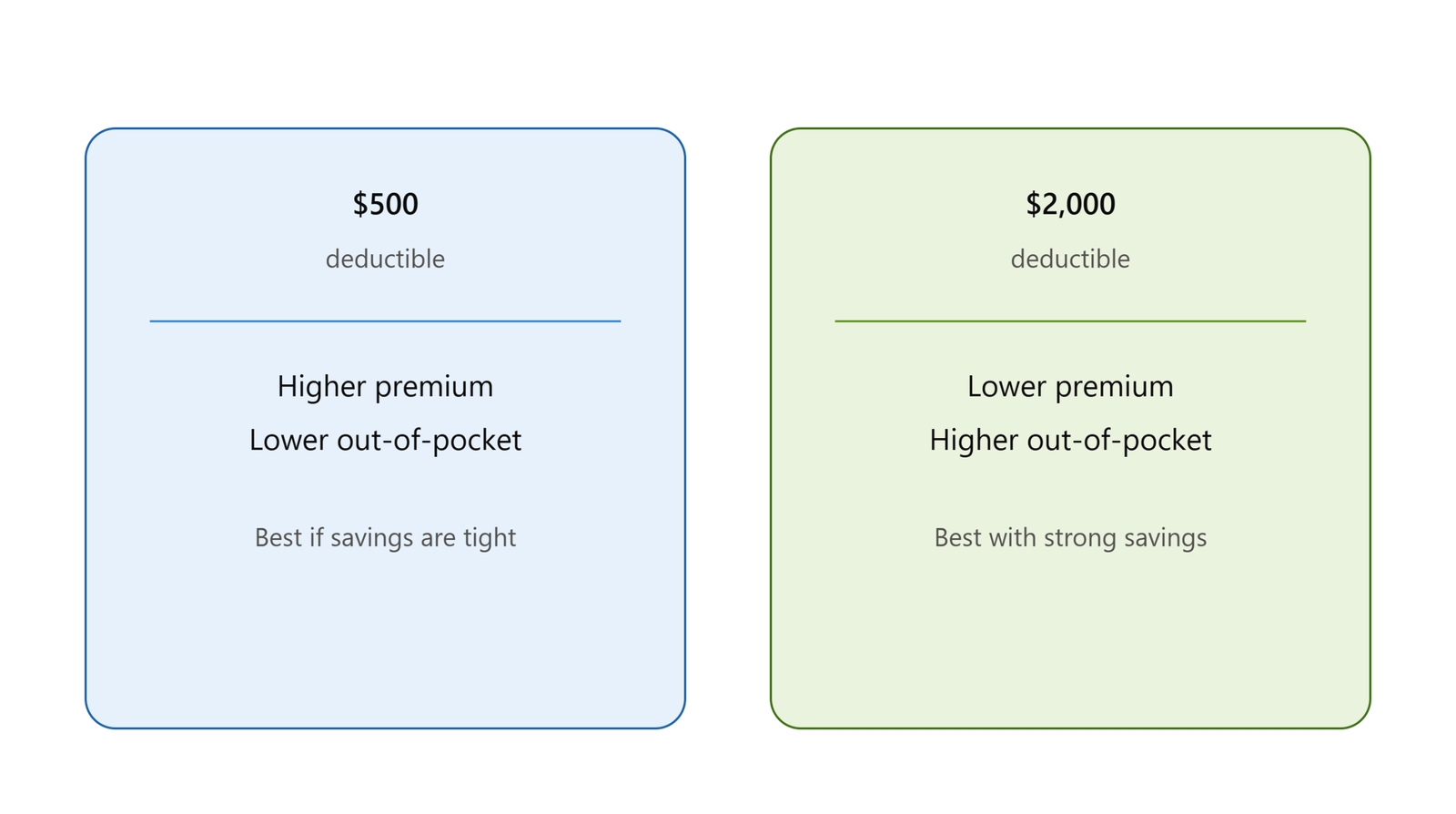
- The standard range is $500 or less if you want lower out-of-pocket costs when you file a claim, or $1,000 or more if you want the lowest possible premium; most drivers choose $500 as a starting point.
- For EVs specifically, given how much more expensive repairs run, a higher deductible often makes more sense than the generic advice suggests, provided you have the savings to back it up.
- Your deductible should never exceed your EV’s actual cash value, if it does and the car is totaled, you’d receive nothing, since the payout can’t go below zero.
- Vanishing deductible programs, which reduce your deductible over time for claim-free driving, are worth asking about specifically, since they let you start conservative and gradually shift toward the savings of a higher deductible.
The basic mechanics, in one example
A deductible is the fixed amount you pay out of pocket on a covered claim before your insurer covers the rest. If your EV needs a $12,000 battery-adjacent repair and your deductible is $1,000, you pay $1,000 and your insurer covers the remaining $11,000. The core tradeoff: generally, the lower your deductible, the higher your premium, and vice versa. If you want to minimize what you’d owe out of pocket when you file a claim, choose $500 or less. If you want the lowest possible monthly premium and can absorb a bigger hit if you do need to file, choose $1,000 or more, commonly ranging up to $2,000.
Why the standard advice needs adjusting for an EV
Generic deductible guidance, choose $500 if you’re risk-averse, $1,000+ if you want savings, doesn’t fully account for a few things that are specifically true of EVs, covered throughout this site:
Repair costs run meaningfully higher. As covered in our detailed battery cost guide, even a moderate repair involving the battery or high-voltage components can run into five figures. Against that backdrop, the difference between a $500 and $1,000 deductible is proportionally smaller than it would be for a gas car, where the average claim size is lower to begin with.
Total-loss claims are more common. As covered throughout our battery and coverage guides, EVs are more likely to be declared a total loss for a given amount of damage than a comparable gas car, since battery repair costs frequently exceed what repair is worth. This matters for your deductible decision because a total loss still requires you to pay your deductible before receiving your payout, meaning the deductible choice affects your total-loss payout, not just repair scenarios.
Battery replacement cost dwarfs typical repair costs. With battery replacement representing 30% to 50% of an EV’s total value, as covered in our detailed cost breakdown, the dollar difference between deductible tiers becomes almost a rounding error against a true battery-related claim, which shifts the calculus meaningfully toward choosing a higher deductible for the premium savings, provided you can comfortably absorb the higher out-of-pocket exposure if a smaller, more routine claim does happen.
The one rule that overrides everything else: don’t exceed your car’s value
This is a genuinely important, easy-to-miss mistake. If your deductible exceeds your EV’s actual cash value, your insurer isn’t obligated to pay you anything if the car is totaled, since the payout can’t go below zero once the deductible is subtracted. You want a deductible meaningfully lower than your car’s actual cash value, not just lower than its original purchase price. As your EV ages and depreciates, as covered in our GAP insurance guide, its actual cash value drops, and a deductible that made sense when the car was new can become disproportionately large relative to its current value. This is worth revisiting periodically, not setting once and forgetting.
A practical framework for choosing your number
Step 1: Add up all your deductibles across every coverage type, including comprehensive, collision, and PIP where applicable, not just one in isolation. What you’d actually owe out of pocket in a real claim is the combined total, not any single line item.
Step 2: Ask yourself one honest question, not «how low can I get my premium,» but «if my EV were damaged tomorrow, could I comfortably pay this amount out of pocket without financial stress?» This single question filters out most bad deductible decisions before they become expensive mistakes.
Step 3: Get actual quotes at two or three different deductible levels for your specific EV, and compare the real dollar savings against the real dollar exposure at each tier, rather than assuming a «typical» savings percentage applies to your specific vehicle and situation.
Step 4: Weigh your emergency savings specifically against EV-scale repair costs, not gas-car-scale ones. A $1,000 deductible might feel manageable in the abstract, but pair that mental math with the realistic $8,000 to $20,000-plus battery repair scenarios covered throughout this site, not a smaller, gas-car-scale fender bender, since that’s the scenario where the deductible actually gets tested most severely for an EV owner.
Popular deductible amounts and where EV owners tend to land
For drivers generally, the most common deductible choice is $500, with $250, $1,000, and $2,000 as other popular options. For EV owners specifically, given the factors covered above, many owners choose higher deductibles, often $1,000, to meaningfully lower their already-elevated EV premium, provided they have the savings to back that choice up. This isn’t a universal recommendation, it depends entirely on your personal financial cushion, but it’s worth knowing that the EV-specific pattern skews somewhat higher than the general population’s most common choice.
Vanishing deductibles: a middle path worth asking about
Some insurers offer vanishing (or disappearing) deductible programs, which reduce your collision or comprehensive deductible for every policy term you go without filing a claim. A common structure: starting at a $500 deductible with a $100 reduction for every claim-free year, working toward $0 over time. This offers a genuinely useful middle path for EV owners who want to start relatively conservative (protecting against the higher out-of-pocket exposure of an EV-scale repair) while working toward lower future exposure as a reward for safe, claim-free driving, rather than being locked into a single static number for the life of the policy.
Factoring in advanced safety tech, a genuine double-edged sword
Worth flagging specifically for EV owners: features like automatic emergency braking and lane-keeping assistance, standard on most EVs, can earn you a discount on your premium. But those same sensors are exactly what drives up repair costs when they’re damaged, as covered throughout our Tesla-specific and battery coverage guides, since even a minor collision can require expensive recalibration. This doesn’t change your deductible decision directly, but it’s worth factoring into your overall sense of how «minor» a minor EV collision claim really tends to be, informing how much cushion you actually want built into your deductible choice.
Questions to ask before finalizing your deductible
- What’s my EV’s current actual cash value, not its original purchase price, and is my deductible meaningfully below that number?
- Do I have the savings to comfortably cover this deductible if a genuine battery-related claim happens, not just a minor fender bender?
- Does my insurer offer a vanishing deductible program, and if so, does starting more conservative and working downward make more sense than committing to a single static number?
- How does my premium actually change at $500 versus $1,000 versus $2,000 for my specific vehicle? Get the real numbers rather than assuming a generic percentage applies.
- Am I setting the same deductible for comprehensive and collision, or does it make sense to set them differently based on the kinds of claims each typically involves, as covered in our comprehensive versus collision guide?
The bottom line
Choosing an EV insurance deductible isn’t just the generic low-premium-versus-low-out-of-pocket tradeoff that applies to any car, it’s shaped by genuinely EV-specific realities: higher repair costs, a greater likelihood of total-loss outcomes, and battery replacement costs that can dwarf the difference between deductible tiers entirely. A higher deductible often makes more financial sense for an EV owner than the generic advice suggests, provided you have real savings to back that choice up, and a vanishing deductible program offers a reasonable middle path if you want to ease into that higher-deductible strategy over time rather than committing immediately. Whatever number you land on, make sure it stays meaningfully below your EV’s current actual cash value, not its original sticker price, and revisit that comparison periodically as your vehicle depreciates.
This article is for informational purposes only and does not constitute financial or insurance advice. Deductible options, premium impacts, and vanishing deductible availability vary by insurer and state, and change frequently. Always confirm specific terms directly with your insurer.