Does Insurance Cover Damage From Public Charging Stations?
There are actually two separate questions hiding inside this one: does your insurance cover damage to your vehicle from a faulty public charger, and does anything cover damage you cause to the charging station itself? The two scenarios involve completely different coverage, and mixing them up is the most common source of confusion. This guide separates them clearly.
Key takeaways:
- If a public charger damages your EV, your auto insurance may cover it under comprehensive coverage, but only if the cause qualifies as a covered peril, not just any charging-related malfunction.
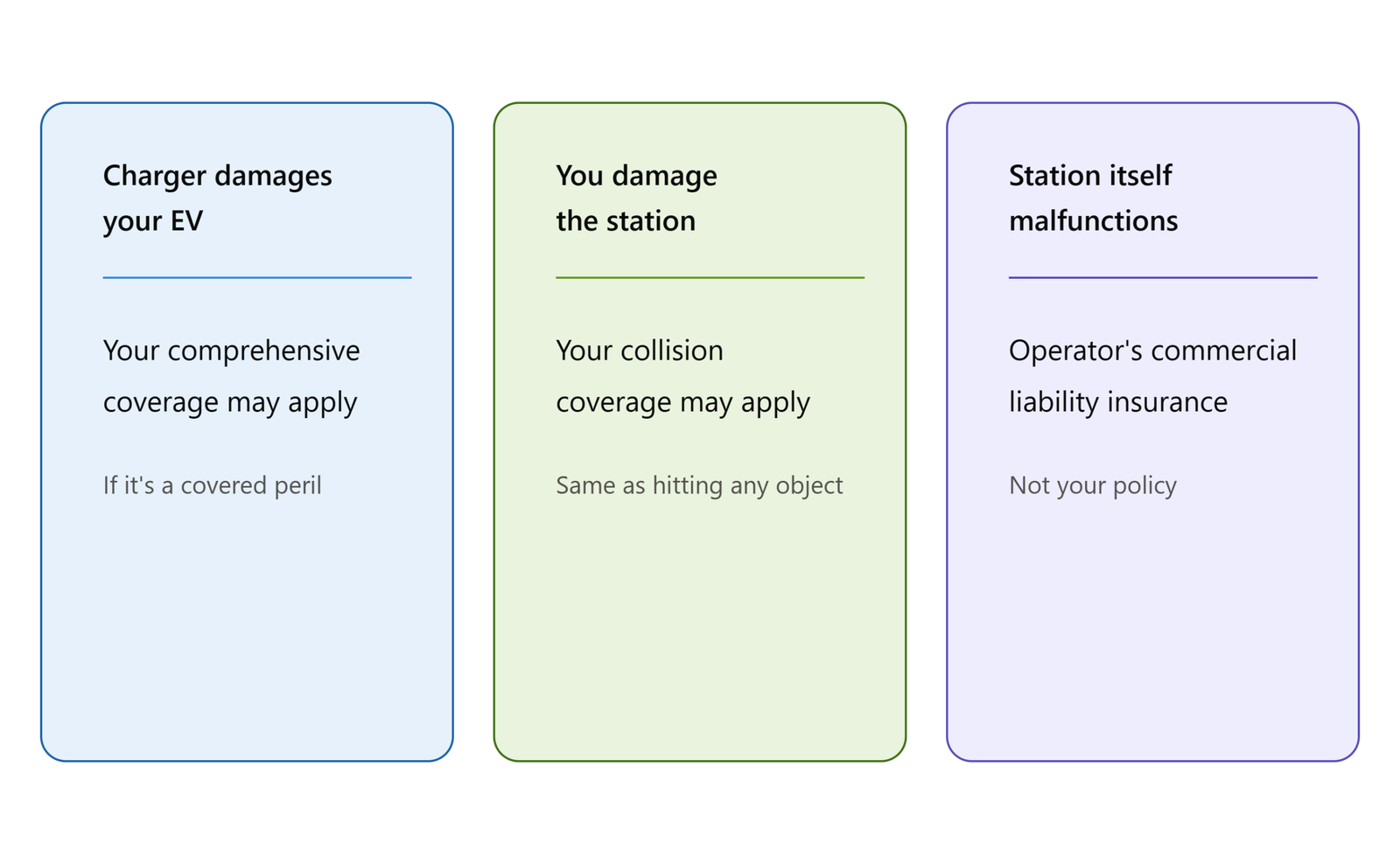
- If your vehicle damages the charging station itself, your collision coverage may apply, similar to backing into any other object, while a claim against the station operator for a malfunction typically falls to their commercial liability insurance, not yours.
- Public charging costs themselves, the electricity you pay for, are never covered by any auto insurance policy, that’s simply a normal expense, not an insurable event.
- If you bring your own charging cable to a public station and it’s damaged there, this is generally treated the same as your home charger under your auto policy’s comprehensive coverage.
Scenario 1: A faulty public charger damages your EV
This is the scenario most people actually mean when they ask this question, and the answer is a genuine «it depends on the cause.» Your auto insurance may cover vehicle damage caused by a faulty public charger if the damage results from a covered peril involving your vehicle, meaning something like a power surge that causes a fire, or an electrical fault that damages your battery or onboard electronics in a way that maps onto your comprehensive coverage’s defined perils.
What it generally does not cover automatically: a charger simply failing to work, charging more slowly than expected, or a software glitch that doesn’t cause actual physical damage. As covered throughout our guides to battery and charger coverage, insurance responds to sudden, covered damage events, not malfunctions, inconvenience, or an unsatisfying charging session.
Scenario 2: You damage the charging station itself
This flips the direction of the claim entirely. If your vehicle damages a public charging pedestal, backing into it, for instance, your auto policy’s collision coverage may apply to the damage your vehicle caused, similar to how it would respond if you hit any other stationary object. This is a claim about protecting you from the cost of the damage you caused, which the charging network operator would otherwise seek to recover from you directly.
Scenario 3: The charger itself malfunctions and it’s the operator’s fault
This is a genuinely different situation from either scenario above, and it’s worth understanding the distinction clearly. If a public charging station has a design flaw, poor maintenance, or an operational fault that causes damage, whether to your vehicle or to someone nearby, liability claims against the station operator for that malfunction typically require the operator’s own commercial liability insurance, not yours. In practice, this means if a charger’s fault damages your EV, you may have options on two fronts: filing under your own comprehensive coverage for the immediate repair (subject to your deductible), and separately pursuing a claim against the charging network operator if their equipment was genuinely at fault, though this second path is generally a more involved process than a standard insurance claim.
What’s never covered, regardless of scenario
The cost of charging itself. This is worth stating plainly since it comes up often: no auto insurance policy covers the electricity cost of charging your EV at a public station, at home, or anywhere else. Charging costs are a normal operating expense, not an insurable event, the same way gasoline was never covered by insurance for a gas car.
A dead battery with no accompanying damage. If your EV simply runs out of charge, that’s a roadside assistance scenario, as covered in our dedicated EV roadside assistance guide, not an insurance claim. There’s no damage for comprehensive or collision to respond to in a simple charge-depletion situation.
Slow or interrupted charging sessions, absent actual damage. A frustrating public charging experience, a station that stops mid-session, one that charges more slowly than advertised, isn’t itself a covered event unless it results in demonstrable damage to your vehicle.
Your own charging cable at a public station
If you bring your own portable charging cable to a public station and it’s damaged there, this is generally treated the same way your home charger’s cable would be under your auto policy, as covered in our dedicated charging cable theft guide: comprehensive coverage typically applies if the cable itself is stolen or damaged by a covered peril, regardless of whether that happens at home or at a public location, since the cable is tied to you and your vehicle rather than to a specific address.
Why this distinction actually matters in practice
Understanding which scenario you’re in changes what you should actually do after an incident:
If your EV was damaged by a public charger, document the charger’s identification (most public chargers display a station ID or network name), take photos of any visible damage or error messages, and contact both your auto insurer and, if you believe the charger itself malfunctioned, the charging network’s customer service line. Some networks maintain their own incident reporting processes specifically for this scenario, worth pursuing alongside your own insurance claim rather than instead of it.
If you damaged a charging station, treat it similarly to any other property-damage incident: exchange information if any network representative or witness is present, document the damage, and report it to your insurer promptly, since delaying a report on damage you caused can complicate your coverage.
If you’re unsure which scenario applies, or the cause is genuinely ambiguous (a fire that could have originated from either the vehicle or the charger), report it to your insurer regardless and let them investigate, rather than trying to determine fault yourself before filing.
A note for business owners with on-site charging
This is worth a brief mention if you’re a business owner rather than an individual EV driver: if you own or operate charging stations for customers or employees, whether purchased, leased, or through a third-party provider, your insurance needs are more complex than an individual EV owner’s. Depending on your ownership structure, you may need comprehensive liability, property, and even business interruption coverage addressing the charging equipment itself, separate from any coverage discussed in this consumer-focused guide. If your business is in this situation, this article’s guidance doesn’t directly apply, and a commercial insurance specialist familiar with EV charging infrastructure is the right resource rather than standard personal auto insurance guidance.
Questions worth asking your insurer directly
- Does my comprehensive coverage specifically address damage caused by a malfunctioning public charger, or only damage from causes explicitly listed as covered perils?
- If I damage a public charging station, does my collision coverage apply the same way it would for hitting any other stationary object?
- Do you have any experience or specific process for coordinating with charging network operators when a malfunction is genuinely the network’s fault, rather than treating every incident purely as a standard claim?
- Is my personal charging cable covered the same way at a public station as it would be at home?
The bottom line
Public charging station damage isn’t a single insurance question, it’s really two or three separate ones depending on which direction the damage went. If a faulty charger damages your EV, your comprehensive coverage may respond if the cause qualifies as a covered peril, and you may separately have recourse against the charging network operator if their equipment was genuinely at fault. If you damage the station itself, your collision coverage functions the same way it would for hitting any other object. What’s never covered, in any scenario, is the ordinary cost of charging itself or a simple dead battery with no accompanying damage. Understanding which scenario you’re actually in shapes both what to document and who to contact first, your insurer, the charging network, or both.
This article is for informational purposes only and does not constitute financial or insurance advice. Coverage details and liability determinations vary significantly by insurer, charging network, and the specific circumstances of an incident. Always confirm specific coverage terms directly with your insurer.