GAP Insurance for Electric Cars: Why It Matters More
GAP insurance isn’t unique to EVs, it’s existed for gas cars for decades. But electric vehicles combine three things that make the coverage genuinely more valuable for this category specifically: steeper early depreciation, higher purchase prices, and a battery-driven total-loss pattern covered throughout this site. This guide explains exactly why the math works differently for an EV, with real numbers and a documented real-world example of the risk actually playing out.
Key takeaways:
- Five-year-old EVs show average depreciation near 60%, compared to the mid-40% range for vehicles overall, a meaningfully steeper drop that widens the gap between what you owe and what the car is worth.
- Tesla’s aggressive 2023 price cuts caused used values of previously financed Teslas to drop sharply and unexpectedly, a real, documented case of manufacturer pricing decisions directly triggering GAP exposure for existing owners.
- EVs are more prone to being declared a total loss for relatively minor damage, since even minor body damage can hide a cracked battery pack, an $8,000-plus repair that frequently exceeds what repair is worth.
- GAP insurance is a temporary need, not a permanent one, it matters most in the first 2 to 3 years of a loan and can typically be dropped once your loan balance drops below the car’s market value.
What GAP insurance actually does, in one example
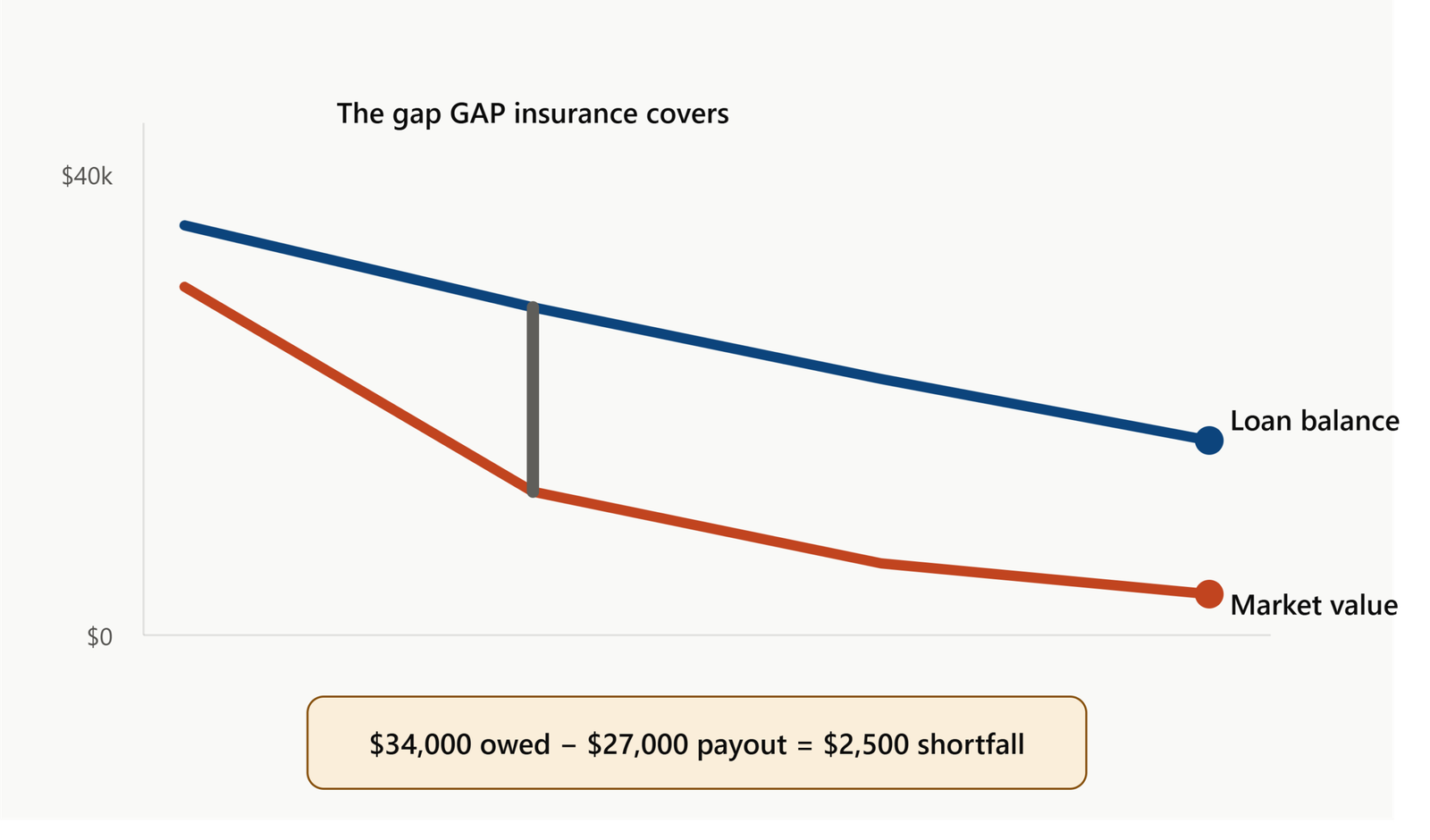
If you owe more on your loan than the car is currently worth, and it’s totaled or stolen, you’re personally responsible for the difference out of pocket unless you have GAP coverage. A concrete example: you finance a Tesla Model Y Long Range for $34,000 with no money down. Eighteen months later, it’s totaled. The car’s current market value has dropped to $27,000, so your insurance pays $27,000. But you still owe $29,500 on the loan. Without GAP insurance, you personally owe $2,500 on a car you no longer have. With GAP insurance, that $2,500 shortfall is covered.
Why EVs create a wider gap than gas cars
Steeper depreciation, especially early on. Studies of five-year-old EVs show average depreciation near 60%, compared to the mid-40% range for vehicles overall. Depreciation is heavily front-loaded on EVs specifically, meaning the steepest drop happens in the first one to two years, exactly the window when your loan balance is highest and you’re most likely to be financially «underwater.» One study of a high-priced EV sedan found six-year-old examples retaining only about 23% of their original MSRP, an unusually steep curve even by EV standards.
Higher purchase prices mean a bigger dollar gap even at the same percentage. As covered throughout this site, EVs generally cost more upfront than comparable gas vehicles. A 20% depreciation gap on a $30,000 gas sedan is a very different dollar amount than the same percentage gap on a $55,000 EV, and EV loan balances tend to start from that higher baseline.
Manufacturer pricing decisions can trigger sudden, unpredictable value drops. This is genuinely different from how gas cars typically depreciate, and it has a real, documented precedent. Buyers who financed new Teslas in 2021 and 2022 watched used values drop sharply in 2023 when Tesla cut new-vehicle prices aggressively across its lineup. Anyone whose financed Tesla was totaled during that window, without GAP coverage, absorbed a real, sudden financial hit that had nothing to do with how they drove or maintained the car, purely a consequence of the manufacturer’s pricing strategy shifting the entire used market beneath them.
Rapid technology improvement compresses older models’ value faster. New EVs with better range, faster charging, and improved driver-assistance features arrive essentially every year, which can push down resale values of older EVs faster than the equivalent effect on gas cars, where year-over-year technology changes are typically more incremental.
The battery connection: why EVs total more easily
This is a factor unique to EVs that compounds directly with the depreciation issue above. As covered extensively in our battery replacement cost guide, even relatively minor collision damage can crack or compromise a battery pack, and battery replacement frequently costs more than the vehicle is worth to repair, pushing insurers toward a total-loss declaration rather than authorizing repair. This means EV owners face a meaningfully higher probability of hitting a total-loss scenario, precisely the scenario where GAP insurance matters, compared to a gas car owner whose comparable fender-bender would likely just be a routine repair.
Put together: EVs are more likely to be totaled for a given amount of damage, and when they are totaled, the payout is more likely to fall short of the loan balance due to steeper depreciation. Both factors point in the same direction, toward GAP coverage mattering more for this vehicle category specifically.
When GAP insurance matters most, and when you can drop it
GAP insurance is designed specifically for the window when your loan balance sits above your car’s market value. Once those two lines cross, meaning you owe less than the car is worth, you generally don’t need it anymore. A few practical guidelines:
You’re likely in the highest-risk window if:
- You financed a $50,000-plus EV with less than 10% down, common when taxes, fees, and add-on packages get rolled into the loan.
- You’re in years one through three of a new EV loan, the steepest part of the depreciation curve as covered above.
- You have a long loan term (72 months or more), which keeps your balance elevated for longer relative to the car’s declining value.
You likely need GAP less, or can drop it, if:
- You’re buying a used EV that has already absorbed the steepest part of its depreciation curve, since the previous owner effectively took that hit already, and your purchase price is closer to the car’s realistic long-term value.
- You made a substantial down payment (20% or more), which keeps your loan balance below the car’s value from day one.
- You’re several years into your loan and your balance has dropped meaningfully, worth checking directly against current trade-in values for your specific model.
A practical habit: re-evaluate once your loan balance gets close to your EV’s current trade-in value, then consider canceling the coverage at that point rather than paying for it for the full life of the loan.
Is GAP insurance ever unnecessary for an EV owner?
Yes, genuinely, in a few specific situations. If you paid cash or put down a large down payment, there’s no meaningful gap to protect in the first place, GAP insurance covers a shortfall between what you owe and what the car is worth, and that shortfall simply doesn’t exist if you don’t owe much relative to the car’s value. Similarly, if covering a several-thousand-dollar shortfall out of pocket wouldn’t meaningfully strain your finances, GAP functions more as a convenience than a necessity, and you may reasonably decide to self-insure that specific risk instead.
Used EVs deserve a specific note
Buying used doesn’t eliminate the GAP conversation, but it does change the math, generally favorably. A used EV has typically already gone through the sharpest part of its depreciation curve, meaning your purchase price sits closer to the car’s realistic long-term resale value than a new EV’s sticker price does. That said, as covered in our used EV insurance guide, battery health becomes a bigger driver of resale value for used EVs specifically, if a used EV’s range has degraded well below what buyers typically expect for its age, its resale value can lag behind similar-year gas cars more than the general depreciation curve alone would predict, worth factoring in if you’re financing a used EV with a smaller down payment.
Where to actually buy GAP coverage
As covered in our leasing versus financing guide, GAP insurance is commonly bundled into lease agreements automatically, worth checking your contract before assuming you need to buy it separately. For financed purchases, GAP is available through your auto insurer, your lender or credit union, or the dealership, and as covered in that same guide, pricing varies enormously by source: dealer-sold GAP coverage frequently costs significantly more, often financed into your loan at interest, than the same coverage purchased directly through your auto insurer or a credit union.
The bottom line
GAP insurance matters more for EV owners than for gas car owners because three factors compound in the same direction: steeper early depreciation (nearly 60% by year five versus the mid-40% range for vehicles generally), higher purchase prices that widen the dollar gap even at comparable percentages, and a battery-driven pattern of total-loss declarations that makes hitting a GAP-relevant scenario more likely in the first place. The 2023 Tesla price-cut episode is a real, documented reminder that EV value can shift suddenly and unpredictably in ways gas car values typically don’t. If you’re financing a new, higher-value EV with a small down payment, GAP insurance is genuinely worth the modest premium, purchased through your insurer or credit union rather than the dealership, for at least the first two to three years of your loan.
This article is for informational purposes only and does not constitute financial or insurance advice. Depreciation patterns, GAP coverage terms, and pricing vary by vehicle, insurer, and lender, and change frequently. Always confirm specific GAP coverage terms directly with your insurer or lender before purchasing.