What Is Battery Coverage in EV Insurance and Do You Need It?
«Battery coverage» gets used loosely in EV insurance marketing, sometimes it just means standard comprehensive and collision applying to your battery like any other part, and sometimes it means a genuinely separate, optional add-on called Mechanical Breakdown Insurance (MBI) that covers failures your standard policy explicitly excludes. This guide untangles the two, and gives you an actual formula to decide whether the optional add-on is worth paying for on your specific vehicle.
Key takeaways:
- Standard comprehensive and collision already cover battery damage from a collision, fire, theft, or storm; that’s not a separate add-on, it’s baked into coverage you likely already have.
- The real «battery coverage» decision is whether to buy Mechanical Breakdown Insurance (MBI), which covers electrical and mechanical failures, battery management system issues, motor problems, charging component failures, not caused by an accident.
- A simple formula, comparing your battery’s replacement cost against your remaining warranty years, against the MBI premium, gives a genuinely useful answer: if the uninsured risk exceeds roughly 10 times the annual MBI cost, it’s generally worth buying.
- Battery protection add-ons are neither a scam nor an automatic must-have, it’s a real financial decision that depends on your specific numbers, not a blanket recommendation either way.
First, clear up what’s already covered without any add-on
As covered in our complete guide to EV battery damage coverage, your standard comprehensive and collision coverage already handles battery damage from a covered event, a collision, fire, theft, vandalism, or storm, minus your deductible. This is not a separate «battery coverage» product, it’s simply how comprehensive and collision already work, applied to whichever part of the car happens to be damaged. If a salesperson or article implies you need to buy something extra just to have battery damage covered from an accident, that’s already included in coverage most EV owners carry.
What «battery coverage» actually refers to as an add-on
The genuine, distinct product worth understanding is Mechanical Breakdown Insurance, commonly abbreviated MBI. This covers electrical and mechanical failures not caused by an accident, including issues with the battery management system, electric motor problems, and charging component failures. It exists specifically to bridge the gap between your manufacturer’s warranty (typically 8 to 10 years) and your standard auto insurance, which as covered throughout this site, never covers gradual degradation, defects, or non-accident internal failures.
In plain terms: MBI is closer to an extended warranty than to traditional insurance, covering the same category of «something just broke on its own» failures that a warranty would, but extending that protection either before a warranty exists or after it has expired.
The formula: is MBI actually worth it for your EV?
This is genuinely useful because it turns a vague «should I buy this add-on» question into real math specific to your vehicle. The formula:
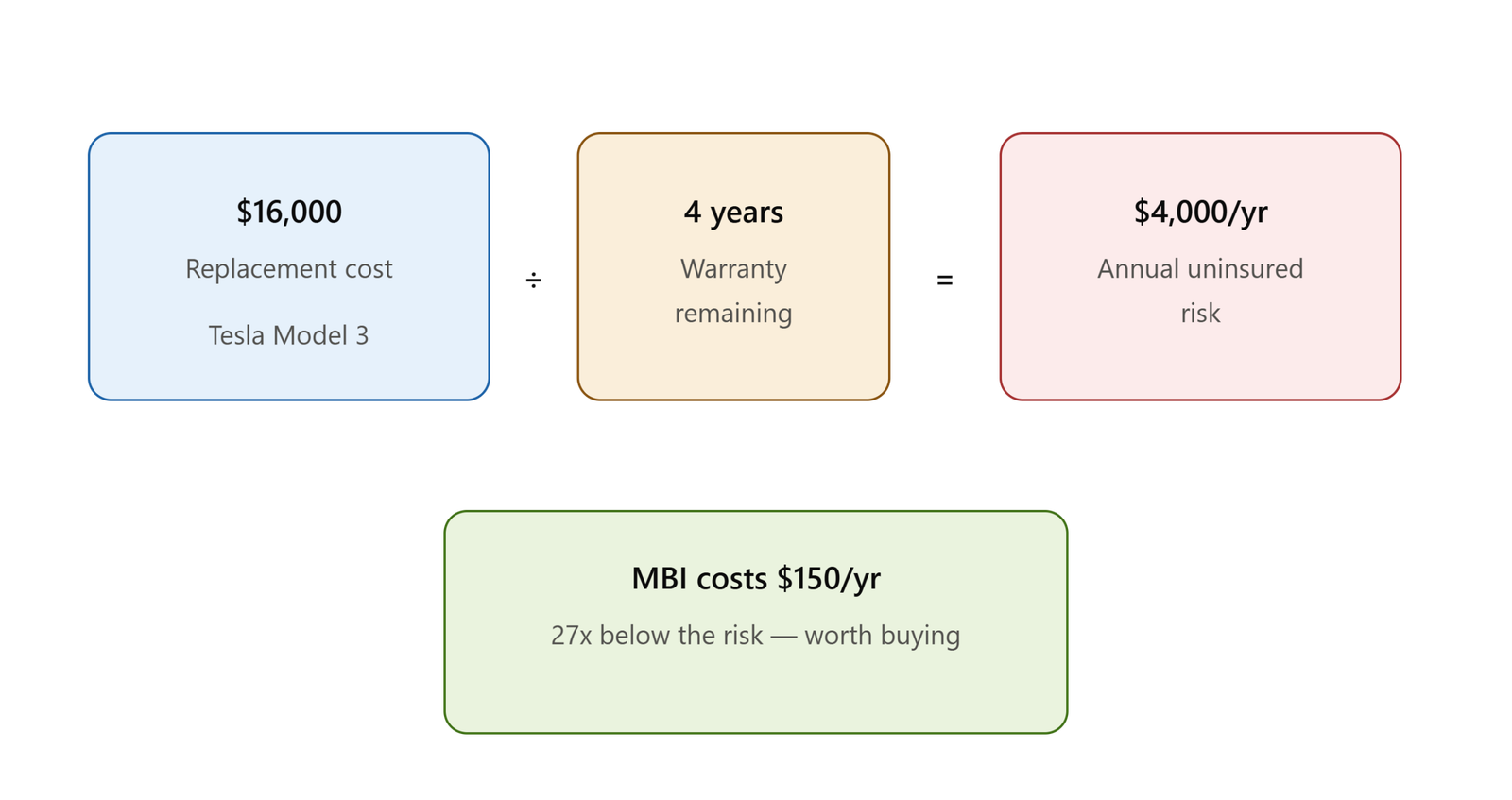
Annual Uninsured Risk = Battery Replacement Cost ÷ Remaining Warranty Years
Then compare that number to the MBI premium. If your Annual Uninsured Risk is more than 10 times the annual MBI cost, it’s generally worth buying.
A worked example, using a Tesla Model 3: a full battery replacement costs roughly $16,000, and you have 4 years remaining on your warranty. That gives an Annual Uninsured Risk of $16,000 ÷ 4 = $4,000 a year. If MBI costs $150 a year for this vehicle, you’re paying $150 to protect against $4,000 of annual exposure, a ratio well above the 10x threshold, meaning the coverage clears the bar easily.
For most EVs on the market, given how expensive battery replacement runs (as covered in our detailed battery cost breakdown, ranging from roughly $4,000 for small packs up to $25,000 or more for flagship performance packs) against how comparatively modest MBI premiums tend to run, this formula passes the 10x threshold for the large majority of vehicles. The exception tends to be smaller, cheaper-to-insure EVs with modest battery packs, as covered in our ranking of the cheapest EVs to insure, where the replacement cost itself is low enough that the math is closer.
Run your own numbers
To apply this formula to your specific EV:
- Find your battery’s realistic replacement cost. Use the pack-size ranges covered in our detailed battery cost guide as a starting point, then confirm with a specific quote or your dealer if you want precision.
- Determine your remaining warranty years. Most EV battery warranties run 8 to 10 years from the original in-service date, subtract however many years have already passed.
- Divide replacement cost by remaining warranty years to get your Annual Uninsured Risk.
- Get an actual MBI quote from your insurer or a third-party provider, and multiply it by 10.
- Compare. If your Annual Uninsured Risk exceeds 10 times the MBI premium, the coverage is very likely worth it by this framework. If it’s close or below, it’s a closer call, and you may reasonably decide to self-insure that risk instead.
When MBI makes the most sense
Once your factory warranty has expired or is close to expiring. This is the single clearest trigger. While under warranty, your battery is already protected against defects and degradation at no additional cost, MBI is largely redundant during that window. As your warranty approaches its end, the calculation above becomes increasingly favorable toward buying coverage, since your remaining warranty years shrink toward zero, driving your Annual Uninsured Risk upward in the formula.
If you’d have difficulty covering a surprise five-figure repair bill out of pocket. Even when the formula favors buying coverage, the underlying question is really about risk tolerance and cash reserves. If a sudden $10,000 to $20,000 expense would be a genuine financial emergency for you, MBI functions as a hedge against that specific risk regardless of the precise math.
High-mileage and rideshare drivers. As covered in our dedicated high-mileage and rideshare EV insurance guides, more time on the road and more charge cycles modestly increase the odds of a non-accident mechanical or electrical issue emerging, strengthening the case for MBI specifically for this driver profile.
Owners of models with a less mature reliability track record. Newer models or brands without years of accumulated reliability data carry more uncertainty, and MBI functions as insurance against that uncertainty specifically.
When you can reasonably skip it
While still well within your factory warranty period. Buying MBI when you have 6+ years of warranty remaining is usually unnecessary, since the manufacturer already covers exactly what MBI would cover during that window.
If you drive a smaller-pack, mainstream EV with modest replacement cost, as covered in our cheapest EVs to insure guide. The formula above is less likely to clear the 10x threshold when your Annual Uninsured Risk starts from a lower base.
If you have substantial savings that could comfortably absorb a worst-case battery replacement. The formula is a useful decision aid, not a moral obligation, self-insuring is a legitimate choice if you have the financial cushion to back it up.
If you plan to sell or trade in the vehicle before your warranty expires. MBI’s value is concentrated in the post-warranty window; if you won’t own the vehicle that long, you’re unlikely to ever use the coverage you’d be paying for.
Questions to ask before buying any battery protection product
Given how much these products vary between providers, ask directly:
- Does this specifically cover battery management system failures, electric motor issues, and charging component problems, or is it a narrower product than true MBI?
- Does depreciation apply to a battery replacement under this plan, or do you get full replacement value regardless of the vehicle’s age?
- How does this interact with my existing comprehensive and collision coverage for accident-related battery damage, is there any overlap or gap between the two?
- What’s excluded specifically, given that even MBI products carry their own exclusions worth understanding upfront rather than discovering during a claim.
- Compare the total cost over your expected ownership period against the formula-based Annual Uninsured Risk calculated above, rather than evaluating the premium in isolation.
The bottom line
Standard comprehensive and collision coverage already handles battery damage from accidents, fire, and theft, that’s not something you need to buy separately. The real decision is whether Mechanical Breakdown Insurance, the actual «battery coverage» add-on worth evaluating, makes financial sense for your specific vehicle. The formula covered in this guide, replacement cost divided by remaining warranty years, compared against 10 times the MBI premium, turns that decision into real math rather than a marketing pitch. For most EVs, particularly as the factory warranty approaches its end, the numbers tend to favor buying coverage, but it’s a genuine financial decision worth running for your specific vehicle rather than a blanket recommendation in either direction.
This article is for informational purposes only and does not constitute financial or insurance advice. Coverage details, costs, and terms for Mechanical Breakdown Insurance and battery protection products vary significantly by provider and vehicle. Always confirm specific terms directly with your insurer or provider before purchasing.