What Happens If Your EV Battery Catches Fire? Insurance Guide
EV battery fires get outsized media attention relative to how often they actually happen, multiple independent studies consistently find electric vehicles catch fire less often than gas cars. But when a battery fire does happen, it behaves very differently than a gas car fire, and that difference has real, specific consequences for how your insurance claim plays out. This guide covers what thermal runaway actually is, how often fires really happen, and exactly what to expect from the insurance side if it happens to you.
Key takeaways:
- Multiple independent studies find EVs catch fire less frequently than gas vehicles, though the exact multiple varies by study, from roughly 20 times less likely in one Swedish analysis to a U.S. NHTSA-cited figure of 7.2 million EV miles per fire versus 18,000 miles for gas cars.
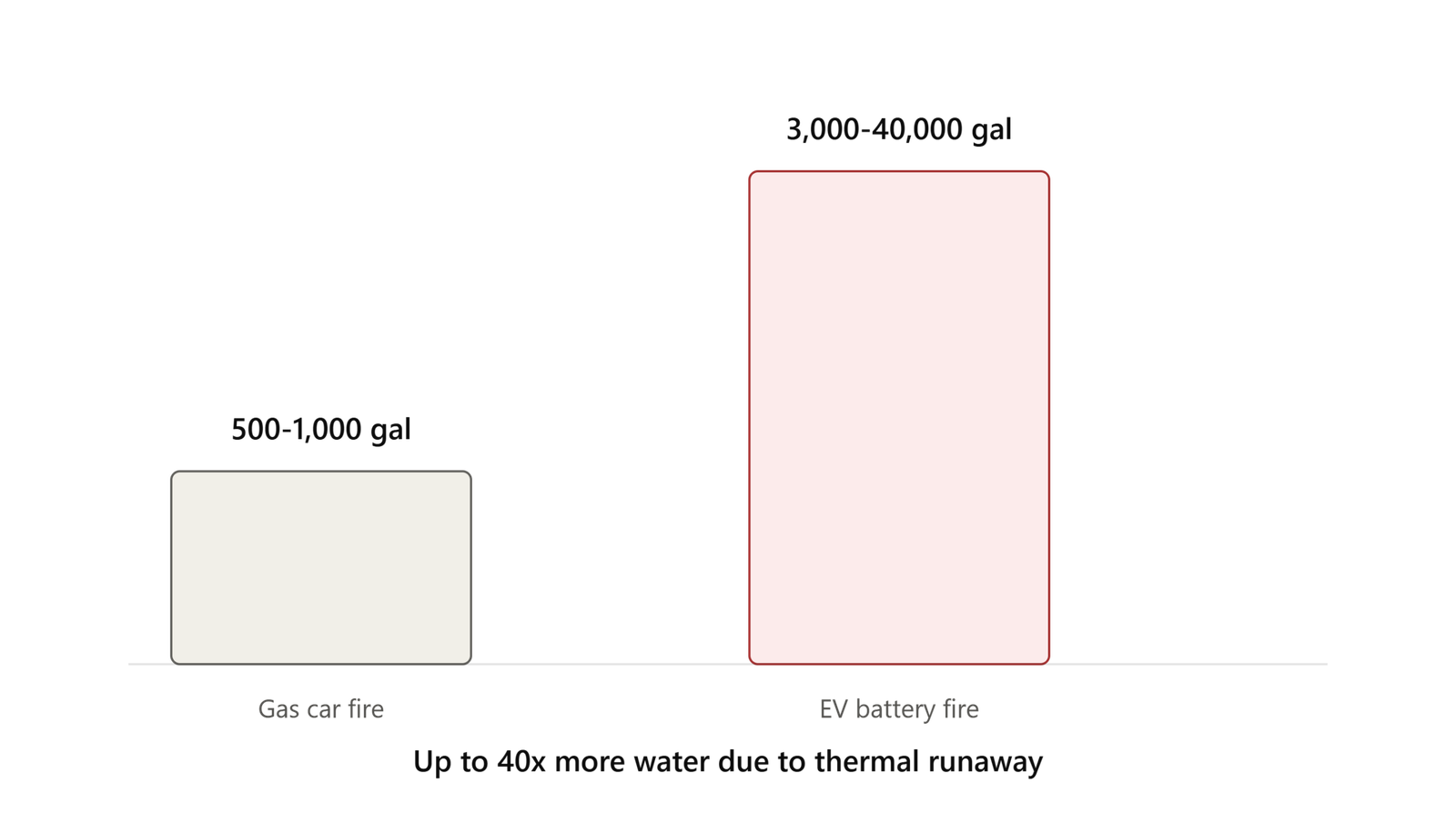
- When an EV battery does catch fire, it’s a fundamentally different event: it can require up to 40 times more water to extinguish than a gas car fire, and reignition hours or even days later is a documented risk.
- Fire caused by a collision, a manufacturing defect, or another covered peril is generally covered under your comprehensive or collision policy, but the claim itself is more complex given reignition risk and specialized disposal requirements.
- Only 5% of EV fires are caused by the battery failing on its own; the large majority stem from collisions, external fire sources, or road debris punctures, meaning the battery itself is rarely the spontaneous cause headlines suggest.
First, the real numbers: how rare is this, actually?
It’s worth establishing this clearly before getting into the insurance mechanics, since the perceived risk shapes a lot of anxious behavior that the actual data doesn’t support. Multiple independent analyses, using different methodologies and datasets, consistently land on the same broad conclusion: EVs catch fire less often than gas-powered cars, though the exact multiple cited varies depending on the study.
A Swedish government agency analysis found gas and diesel vehicles roughly 20 times more likely to catch fire than EVs. A U.S. NHTSA-cited figure puts it in terms of distance: it takes roughly 7.2 million EV miles to trigger a fire, compared to just 18,000 miles for gas vehicles. Separate research specifically comparing EV, gas, and hybrid vehicle fire rates per 100,000 vehicles sold found EVs at the low end, with hybrid vehicles, somewhat counterintuitively, showing the highest rate of the three categories.
Where the picture gets more specific and useful: battery failure on its own accounts for only about 5% of EV fires, compared to engine fires making up 34% of fires in gas vehicles. The leading documented causes of EV battery fires globally are collisions and road debris impact (roughly 22.5%), manufacturing defects (roughly 9.7%), water submersion (roughly 5.6%), and arson or external fire sources (roughly 6.9%), with the cause of about half of documented incidents still unknown or unclassified. In plain terms: the battery spontaneously combusting on its own, the scenario most people picture, is genuinely rare. Most EV fires start because something else happened first, a crash, a defect, or an external cause.
What thermal runaway actually is
When a battery fire does occur, it’s driven by a process called thermal runaway: a single battery cell short-circuits and begins heating uncontrollably, and that heat triggers a chain reaction across neighboring cells. This is fundamentally a self-sustaining process, the reaction generates its own heat and oxygen internally, which is exactly what makes it so difficult for firefighters to extinguish through conventional means.
The most commonly documented triggers are physical damage from a collision or road debris (a puncture to the battery housing), manufacturing defects involving cell-level impurities that can sometimes trigger delayed thermal runaway days after an initial event like a crash, external fires (an adjacent gas vehicle fire igniting a nearby EV’s battery pack secondarily), and flooding or saltwater exposure, which has been specifically documented causing fires well after the actual submersion event, notably during and after hurricanes.
Why an EV battery fire is a genuinely different event to handle
This is where the practical, on-the-ground difference matters, both for safety and for how a claim eventually gets processed:
It takes dramatically more water to extinguish. A typical gas vehicle fire requires roughly 500 to 1,000 gallons of water. An EV battery fire can require anywhere from 3,000 to 40,000 gallons, sometimes cited as up to 40 times more than an equivalent gas car fire, since firefighters often need to continuously cool the battery pack rather than simply extinguishing visible flame.
Reignition is a real, documented risk. Because thermal runaway can persist internally even after visible flames are extinguished, a vehicle that appears to be out can reignite hours or even days later. This has direct practical implications: towing, storage, and disposal of a fire-damaged EV typically require specific protocols, isolating the vehicle at a safe distance from structures and other vehicles, that a fire-damaged gas car doesn’t require.
Firefighter training gaps are a documented, real concern. Nearly half of surveyed firefighters report feeling they lack sufficient training to handle EV battery fires specifically, a gap that can affect response time and outcome, and is part of why fire departments in many areas have developed EV-specific protocols separate from standard vehicle fire response.
The gases released can be more hazardous. Research has found that battery fire gases can contain elevated concentrations of hazardous compounds compared to a typical gas vehicle fire, part of why evacuation and ventilation protocols for EV fires tend to be more conservative than for a standard vehicle fire.
How this affects your insurance claim specifically
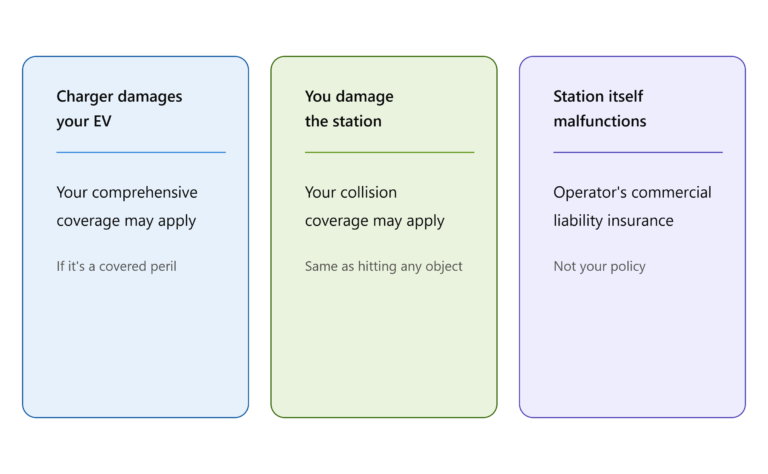
Coverage generally follows the same rules covered throughout our other battery coverage guides. If the fire results from a collision, that’s collision coverage. If it results from another covered peril, a manufacturing defect leading to a documented safety recall, an external fire source, flooding, that’s generally comprehensive coverage, minus your deductible.
Near-certain total loss. Given the specialized disposal requirements, reignition risk, and the sheer cost of battery replacement covered throughout our battery cost guide, a genuine battery fire is about as close to a guaranteed total-loss scenario as exists in EV insurance. Insurers generally won’t authorize a repair-and-return approach for a vehicle that experienced true thermal runaway, given the ongoing safety risk to whoever would eventually drive it.
Specialized disposal and storage costs may factor into the claim. Because a fire-damaged EV can’t simply be parked in a standard salvage lot due to reignition risk, insurers and salvage operators increasingly require specific isolation protocols, sometimes an added cost consideration in how the claim is processed, though this is generally absorbed by the insurer rather than passed to you directly.
If the fire started while charging in your garage, both auto and home insurance can be involved. As covered in our guide to home charger damage coverage, a scenario where a vehicle fire spreads to damage the structure of your home involves coordination between your auto policy (for the vehicle itself) and your homeowners policy (for the structural damage), with primary-and-secondary coverage rules determining which pays first for which portion of the loss.
Does a manufacturing defect change anything?
Yes, potentially significantly. If your specific EV is later found to be part of a manufacturer recall related to fire risk, similar to documented cases involving certain hybrid and EV battery packs in recent years, this can affect both your insurance claim and your ability to seek separate recourse from the manufacturer. If you experience any battery fire, it’s worth specifically checking whether your vehicle was subject to any related recall notice, both for the insurance claim itself and because unresolved recalls are a documented pattern behind some battery fire incidents.
What’s actually changing to make this safer
Given how much attention thermal runaway has received, meaningful engineering responses are already underway. New regulatory standards in some markets now require manufacturers to build in internal fire-suppression measures and improved battery cooling systems specifically to reduce the likelihood and severity of thermal runaway events. Emerging battery chemistries, including solid-state batteries that eliminate the flammable liquid electrolyte found in current lithium-ion designs, are specifically positioned as a major safety improvement, potentially making the thermal runaway process that drives most serious EV fires largely obsolete in future vehicle generations. Advanced battery management systems in current vehicles already play a meaningful role in preventing the overcharging and overheating conditions that can trigger thermal runaway in the first place.
What to do if it happens to you
- Get everyone away from the vehicle immediately and call emergency services, specifying that it’s an electric vehicle so responders can apply appropriate protocols from the start.
- Do not assume the fire is fully out even after flames are no longer visible, given the documented reignition risk covered above; let fire department personnel make that determination.
- Contact your insurer as soon as it’s safe to do so, and be specific that a battery fire was involved, since this affects how the vehicle needs to be handled during towing and storage.
- Ask directly whether your vehicle is subject to any relevant safety recall, both for the claims process and to understand whether the incident might connect to a broader manufacturer issue.
- Expect a total-loss outcome given the pattern covered throughout this guide, and refer to our GAP insurance guide if you’re still financing or leasing the vehicle, since a battery fire total loss is exactly the scenario GAP coverage exists to protect against.
The bottom line
EV battery fires are genuinely rare, less common than gas car fires by most credible measures, and the battery itself spontaneously failing accounts for only a small fraction of the fires that do occur. But when thermal runaway does happen, it behaves fundamentally differently from a conventional vehicle fire: it demands far more water and specialized response, carries a real reignition risk that affects handling well after visible flames are out, and reflects real, documented gaps in firefighter training that have prompted departments to develop EV-specific protocols. From an insurance standpoint, coverage follows the same comprehensive-and-collision rules that apply to any other battery damage, but the practical outcome is almost always a total loss given the safety and disposal complexities involved, making this one more scenario, alongside the others covered throughout this site, where confirming your coverage and considering GAP insurance before an incident happens is worth far more than sorting it out afterward.
This article is for informational purposes only and does not constitute financial or insurance advice. Fire statistics, causes, and coverage details vary by source, region, vehicle, and insurer, and change frequently. Always confirm specific coverage terms directly with your insurer, and follow emergency responder guidance in any actual fire situation.