Do You Need Extra Coverage for a Tesla Wall Connector?
A Tesla Wall Connector isn’t automatically covered just because it’s made by the same company as your car, and as one real condo owner’s experience shows, getting it properly covered can be more complicated than it sounds, especially if you don’t own the wall it’s mounted on. This guide covers exactly what’s covered by default, what Tesla’s own protection package adds, and the specific exclusions worth reading before you assume you’re protected.
Key takeaways:
- A Wall Connector isn’t automatically covered by your auto insurance; it typically falls under homeowners insurance if permanently installed, unless you specifically add wall charger coverage through your auto insurer.
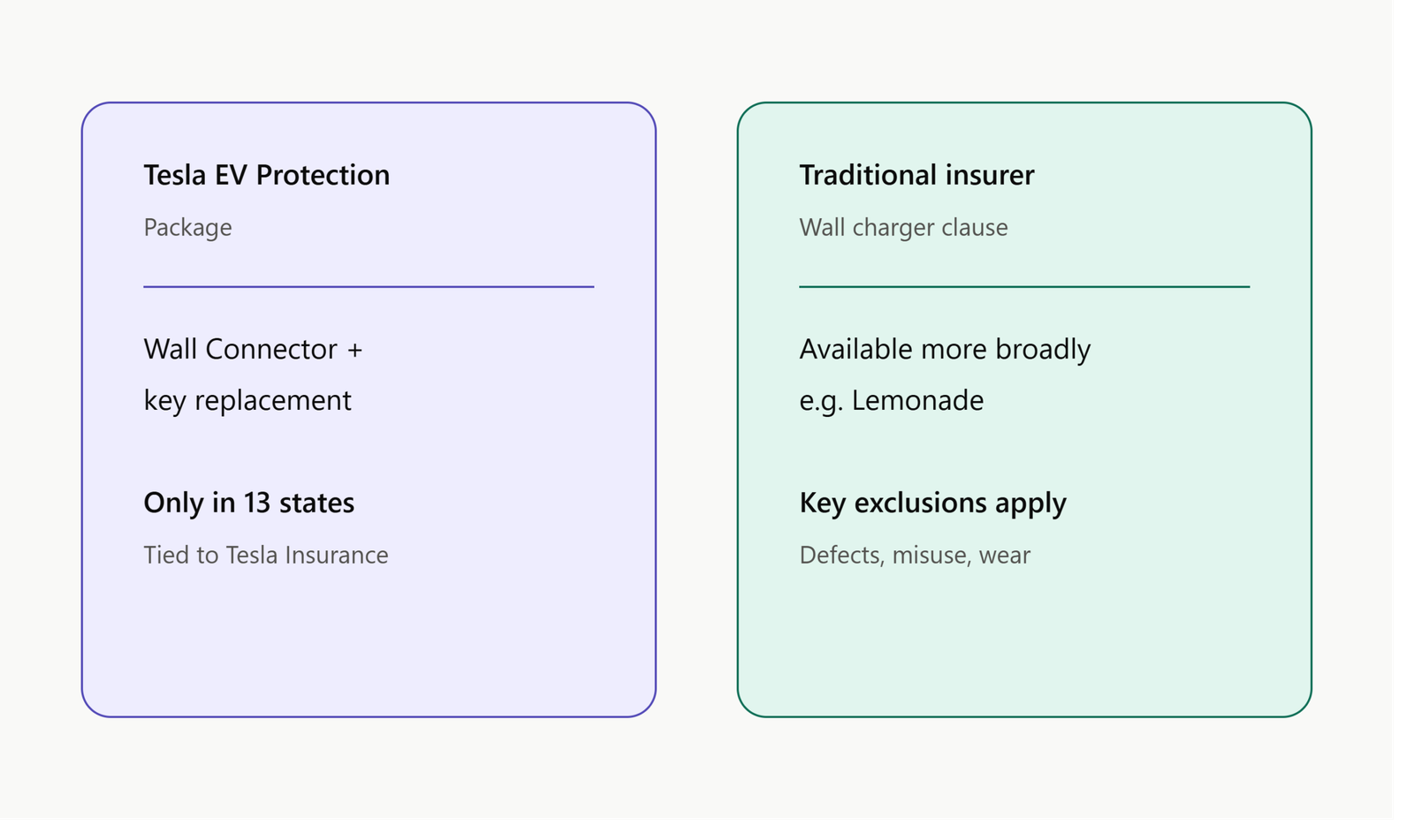
- Tesla’s own «Electric Vehicle Protection Package» includes coverage for the Wall Connector and key replacement, but it’s currently only available in states where Tesla Insurance itself is offered.
- Standard wall charger coverage clauses carry specific exclusions: manufacturer negligence, misuse outside intended purpose, intentional damage, and normal wear and tear are all commonly excluded.
- Condo and HOA situations create genuine complications, since coverage options can be limited by whether you actually own the wall or parking spot the charger is mounted to.
[AD BREAK — insert in-content ad unit here]
The default situation: no automatic coverage
As covered in our broader guide to home charger insurance, a permanently installed Wall Connector is generally treated as part of your home’s structure or personal property, falling under homeowners insurance rather than your auto policy, by default. Nothing about it being a Tesla-branded product changes this general rule. If you haven’t specifically confirmed coverage with your homeowners insurer or added a specific auto-policy endorsement, don’t assume the Wall Connector is protected just because your car and charger share a brand name.
What Tesla’s own protection package adds
Tesla offers what it calls an Electric Vehicle Protection Package, which specifically includes coverage for the Tesla wall charger and electronic key replacement, addressing exactly the gap described above. This is a genuinely useful, EV-specific option, but it comes with a real limitation: it’s tied to Tesla Insurance itself, which as covered in our dedicated Tesla Insurance review, is only available in a limited number of states (13 as of early 2026: Arizona, California, Colorado, Florida, Illinois, Maryland, Minnesota, Nevada, Ohio, Oregon, Texas, Utah, and Virginia). If you’re not eligible for Tesla Insurance in your state, or you’ve chosen a traditional insurer instead for the reasons covered in our Tesla Insurance comparison guide, this specific package isn’t an option for you, and you’ll need to secure Wall Connector coverage through another route.
The traditional insurer route: wall charger coverage clauses
Several traditional auto insurers, Lemonade among them, offer wall charger coverage as an optional clause added directly to your auto insurance policy, reimbursing you for certain kinds of damage or loss to the charger, provided you own it, use it for your covered vehicle, and it’s installed at the garaging address listed on your policy. This is worth specifically asking about when you’re insuring your Tesla, since it isn’t a universal offering and won’t show up automatically on every quote.
[AD BREAK — insert in-content ad unit here]
The exclusions that actually matter
This is the part most owners skip until it’s too late. Every wall charger coverage clause carries specific exclusions, and understanding them in advance is the difference between a smooth claim and a denied one:
Manufacturer negligence, defects, or liability. If the Wall Connector itself fails due to a manufacturing defect, that’s Tesla’s warranty responsibility, not your insurance claim, the same logic that applies to battery defects covered throughout this site.
Faulty workmanship. If the charger was installed incorrectly, whether by an unlicensed installer or a DIY attempt, damage resulting from that faulty installation is commonly excluded, one more reason the professional installation guidance covered in our home charger prep guide matters for insurance purposes, not just safety.
Use outside the manufacturer’s intended purpose. Using the Wall Connector in a way not intended by Tesla, non-standard adapters, improper cable handling, voids coverage for resulting damage.
Intentional damage, whether caused by you or by someone you specifically directed to damage the charger, is excluded from every policy, as it would be for any insurance claim.
Wear and tear, including freezing damage and general mechanical or electrical breakdown. This mirrors the broader pattern covered throughout our battery and charger coverage guides: insurance responds to sudden, covered events, not gradual degradation or age-related wear.
Non-manufacturer-approved cables or connectors. Using a cable or connector not approved by Tesla with your Wall Connector can specifically void coverage, worth confirming you’re using approved equipment if you’ve ever swapped components.
The condo and HOA complication
This is a genuinely underdiscussed scenario worth walking through, since it reflects a real situation Tesla owners have actually run into. A condo owner who installed a Wall Connector in their assigned parking spot found their HOA unsatisfied with standard coverage arrangements, creating real friction about whether the installation could remain in place at all. The owner explored whether their traditional auto insurer (GEICO, in this specific case) could provide adequate coverage, and separately discovered Tesla’s Electric Vehicle Protection Package, only to find Tesla Insurance wasn’t yet available in their state, closing off that option entirely.
The broader lesson: if you’re installing a Wall Connector in a condo, shared garage, or any space you don’t fully own, your coverage situation is more complex than a single-family homeowner’s, and it’s worth resolving three things before installation, not after: what your HOA specifically requires or restricts, whether your traditional auto insurer offers a wall charger clause that satisfies those requirements, and whether Tesla’s own protection package is even available as an option in your state. Don’t assume any single option will work until you’ve confirmed it against your specific HOA’s requirements.
[AD BREAK — insert in-content ad unit here]
How this fits into Tesla’s broader protection plan lineup
Tesla offers a range of vehicle protection plans beyond just the Wall Connector coverage, including extended service agreements, windshield protection, and a specific High Voltage Battery and Drive Unit Extended Service Agreement addressing exactly the post-warranty battery risk covered in our dedicated Mechanical Breakdown Insurance guide. If you’re already evaluating Tesla’s broader protection plan ecosystem for your vehicle, it’s worth reviewing whether the Wall Connector coverage bundles more favorably as part of a larger package versus being added individually, since Tesla periodically adjusts what’s included in bundled offerings like its Luxe Package for certain models and order windows.
Practical steps to actually get this right
- Confirm which state you’re in and whether Tesla Insurance, and its Electric Vehicle Protection Package, is actually available to you. This determines whether the manufacturer’s own bundled option is even on the table.
- If Tesla Insurance isn’t available, ask your traditional auto insurer directly whether they offer a wall charger coverage clause, similar to Lemonade’s structure, rather than assuming your standard policy includes it.
- Separately confirm with your homeowners insurer whether the Wall Connector, as a permanently installed fixture, falls under your existing dwelling or personal property coverage, since this may provide protection independent of anything your auto insurer offers.
- If you’re in a condo or HOA situation, resolve the coverage question with your HOA’s specific requirements before installation, not after, given the real friction documented in the example above.
- Read the exclusions specifically, manufacturer defects, faulty installation, misuse, wear and tear, intentional damage, and non-approved cables, before assuming a policy covers every possible scenario.
- Use only Tesla-approved cables and connectors with your Wall Connector, given that non-approved equipment can specifically void coverage.
The bottom line
A Tesla Wall Connector needs coverage confirmed deliberately, it isn’t automatically protected by either your car insurance or the fact that it shares a brand with your vehicle. Tesla’s own Electric Vehicle Protection Package is a genuinely convenient option where Tesla Insurance is available, while traditional insurers like Lemonade offer a comparable wall charger clause as an auto policy add-on elsewhere. Whichever route you take, read the exclusions closely, manufacturer defects, faulty installation, and misuse are commonly carved out, and if you’re in a condo or HOA situation, resolve your specific coverage options against your HOA’s requirements before installation rather than discovering a gap after the charger is already mounted.
This article is for informational purposes only and does not constitute financial or insurance advice. Coverage details, availability, and terms vary by insurer, state, and specific policy, and change frequently. Always confirm specific coverage terms directly with Tesla, your auto insurer, and your homeowners insurer before installation.