Small Insurers vs Big Carriers for Electric Cars
When you’re shopping EV insurance, it’s tempting to stick with the names you already know, GEICO, Progressive, State Farm. But regional and membership-based carriers, ones with little to no name recognition outside their home markets, regularly beat national brands on both price and service where they operate. This guide breaks down when a small insurer is genuinely the better choice for an EV specifically, and when the scale of a national carrier actually matters more.
Key takeaways:
- Regional carriers like Auto-Owners and Erie consistently score at or near the top for both price and service in the specific states where they operate, despite having little brand recognition nationally.
- Erie and Auto Club Enterprises share the top customer satisfaction score in one major 2026 survey at 92%, ahead of most large national brands.
- National carriers offer a genuine advantage in digital tools, claims processing speed through centralized systems, and consistent coverage if you move between states, all relevant given how EV-specific repair and battery claims covered throughout this site benefit from strong claims infrastructure.
- More than half of drivers who shop across 12 or more carriers save $500 or more annually, meaning the biggest single mistake is simply not checking whether a regional option beats your default national quote.
The core tradeoff, in plain terms
Small companies tend to offer more personalized service, while large insurers typically provide a wider range of coverage options and can handle a higher claim volume more predictably. Neither side of that tradeoff is universally better, it depends on what you’re optimizing for and, importantly, where you live, since regional carrier strength varies enormously by state.
Where regional carriers genuinely win
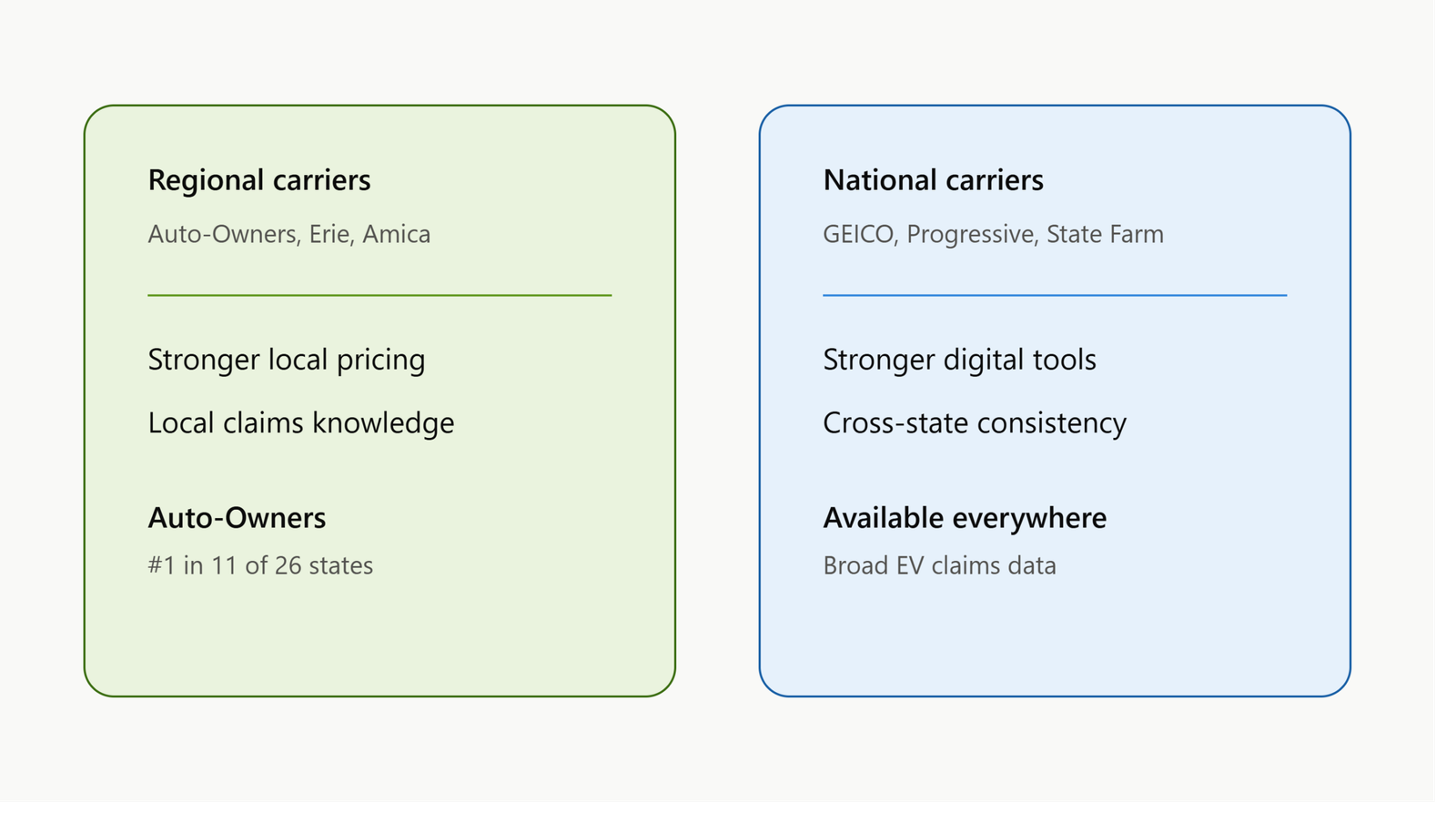
Price, in their specific home markets. This is the single most important, and most counterintuitive, finding across the research for this article: regional carriers beat national brands on price and service more often than national rankings suggest, precisely because their business is concentrated in smaller markets where claims and agent networks are built around local conditions rather than broad national averages. Auto-Owners is a specific, telling example: it operates in only 26 states, but ranks first in 11 of them, performing near the top for both price and service in nearly every state where it actually writes policies.
Claims handling with local knowledge. Regional carriers frequently use local adjusters who understand the area’s typical repair costs, contractor and shop relationships, and realistic timelines, which matters directly for EV claims given how much repair-network quality affects your actual claims experience, as covered throughout our guides to battery replacement coverage and roadside assistance. A national carrier routing your EV battery claim through a centralized call center may not have the same granular understanding of which shops in your specific area are actually equipped to handle a high-voltage repair.
Customer satisfaction. In one major 2026 survey, Erie and CSAA Insurance Group shared the top customer satisfaction score at 92%, with USAA and Auto Club Enterprises close behind at 90%, all ahead of most large national brands measured in the same study. This directly reinforces Erie’s strong showing throughout our other EV-specific research, including its top marks for battery claims handling covered in our guide to insurers that actually cover EV battery replacement.
Claims handling scores specifically. USAA and Auto Club Enterprises earned the highest claims handling scores at 87% in the same survey, followed by Erie and Auto Club Group at 84%, with Travelers and American Family also scoring above the category average. This is a meaningfully different metric than customer satisfaction broadly, and it’s arguably the more important one given how much EV insurance value depends on what happens when you actually need to file a claim, not just the buying experience.
Where national carriers genuinely win
Digital tools and self-service technology. National carriers have invested heavily in digital platforms: filing a claim from your phone, accessing ID cards instantly, and tracking a claim’s progress in real time are now standard features at most major national brands. Some regional carriers have caught up, but many still rely on older systems, worth confirming directly if seamless app-based service matters to you.
Consistency if you move or travel between states. A national carrier offers the convenience of a single policy that covers your entire footprint, simplifying administration and reducing the risk of a coverage gap if you relocate. This is a genuine advantage if your life circumstances involve moving between states more than once every few years, something a regional carrier operating in only 20 to 30 states simply can’t match.
Catastrophic loss absorption. National carriers spread risk across a huge geographic footprint, which helps them absorb catastrophic losses in any single region without that concentration of risk threatening the company’s stability, relevant if you live somewhere with elevated hurricane, wildfire, or severe storm exposure.
Formulaic, but predictable, underwriting. National carrier underwriting tends to be more standardized across ZIP codes and regions, which can occasionally miss local nuance a regional insurer would catch, but it also means more predictable, consistent treatment regardless of exactly where within a state you live.
How this specifically applies to EV owners
A few EV-specific considerations layer on top of the general small-versus-large tradeoff covered above:
Repair network quality matters more for EVs than for gas cars. As covered throughout this site, EV claims are more sensitive to whether an insurer’s adjusters and repair network genuinely understand high-voltage systems, battery replacement, and sensor recalibration. A regional carrier’s local knowledge advantage can translate into a meaningfully better EV claims experience if that carrier has genuinely built out EV expertise in your specific market, but this isn’t guaranteed, some regional carriers may have less EV-specific experience simply due to lower EV adoption in their home markets historically.
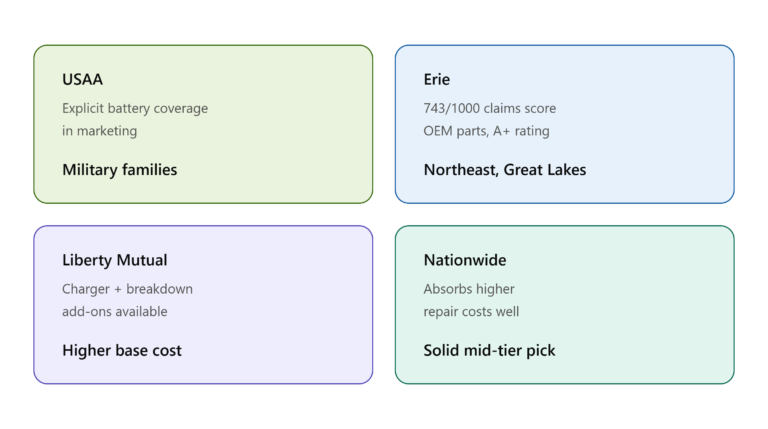
National EV-focused carriers offer more standardized EV expertise. Insurers like Erie (technically regional but with strong EV-specific claims performance covered in our battery coverage guide) and larger national carriers like Liberty Mutual and Nationwide, both repeatedly cited throughout this site for EV-specific strengths, have had more opportunity to build broad EV claims experience across many markets simultaneously.
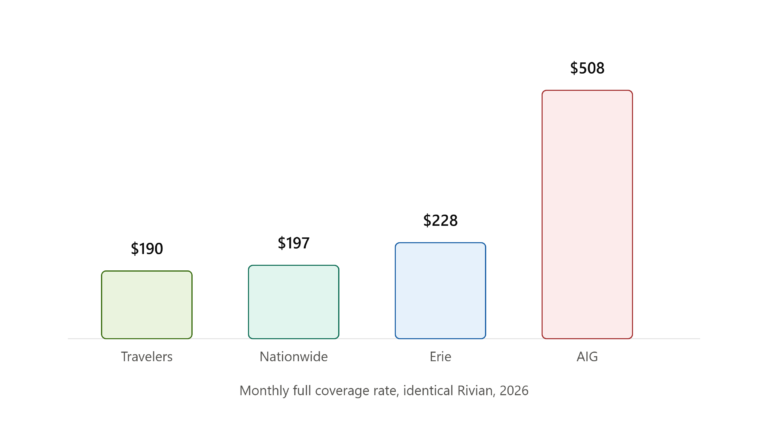
Rate variance is unusually wide for EVs specifically, as demonstrated throughout our model-specific guides (the Rivian comparison found a $318-a-month gap between the cheapest and most expensive insurer for the identical vehicle). This makes the general advice to shop widely even more valuable for EV owners than for gas car owners, since the dollar stakes of skipping a regional carrier comparison are larger.
A practical shopping approach
- Start with a national carrier baseline. Get a quote from GEICO or another major national brand to establish a reference point, given their broad availability and generally competitive pricing covered throughout this site.
- Check which regional carriers operate in your specific state. Auto-Owners, Erie, Amica, and similar regional players don’t all operate everywhere, but where they do, they frequently beat national pricing, as covered above.
- Weigh EV-specific claims experience directly, not just general reputation. Ask any regional carrier you’re considering the same EV-specific questions covered in our guide to battery coverage: do they use OEM parts, do their adjusters have high-voltage training, and what’s their typical EV claim timeline.
- Don’t assume brand recognition equals better value. As the Auto-Owners example shows, a carrier you’ve never heard of, operating in a fraction of the states a national brand covers, can meaningfully outperform that national brand specifically where you live.
- Get at least three quotes total, mixing national and regional options. Given that more than half of drivers who shop across 12 or more carriers save $500 or more annually, and that EV rate variance runs even wider than average, three is a reasonable minimum, but more comparison generally pays off further.
The bottom line
There’s no universal answer to small insurer versus big carrier for EV owners, it genuinely depends on your specific state and what you value most. Regional carriers like Auto-Owners and Erie consistently beat national brands on both price and service where they operate, backed by real survey data on customer satisfaction and claims handling, while national carriers offer superior digital tools, cross-state consistency, and, in some cases, more standardized EV-specific claims infrastructure built from experience across many markets at once. The single biggest mistake is defaulting to a familiar national brand without checking whether a regional carrier operating in your state offers meaningfully better pricing or service, given how often that turns out to be the case.
This article is for informational purposes only and does not constitute financial or insurance advice. Insurer availability, pricing, and service quality vary significantly by state and change frequently. Always get personalized quotes from both national and regional carriers available in your area before making a purchasing decision.