Usage-Based Insurance for EVs: Is Telematics Worth It?
Telematics insurance sounds like an easy win: drive safely, get a discount. But the real picture is more nuanced than the marketing suggests. Some programs can only lower your rate, others can raise it if your data shows risky patterns, and the technology itself sometimes misreads perfectly safe driving as dangerous. This guide breaks down what these programs actually do, which ones are safe bets, and which ones are a genuine gamble.
Key takeaways:
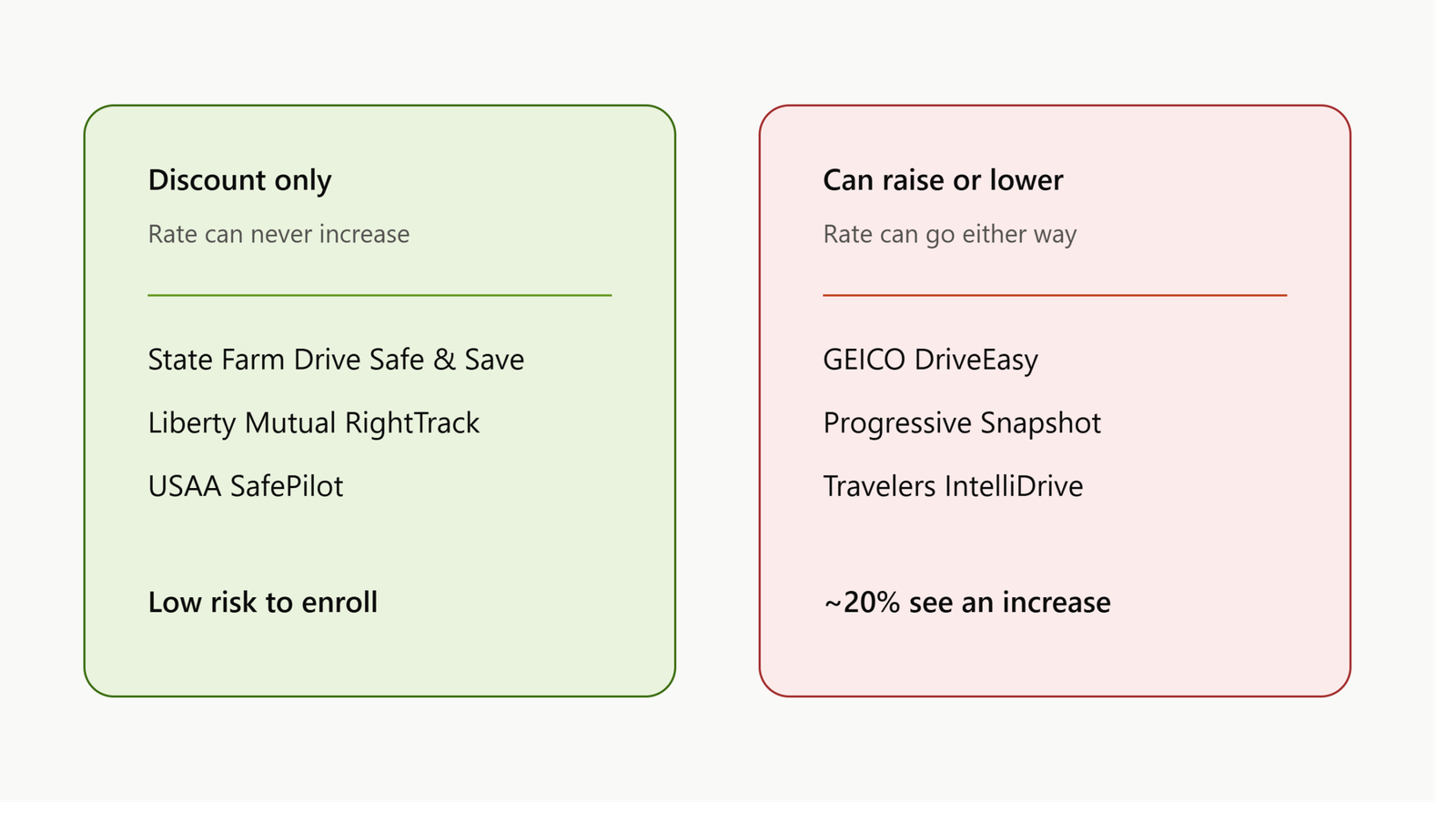
- Some telematics programs (Progressive Snapshot, GEICO DriveEasy, Travelers IntelliDrive) can raise your rate for risky driving data, while others (State Farm Drive Safe & Save, Liberty Mutual RightTrack, USAA SafePilot) only ever apply a discount, never a penalty.
- Real-world savings are more modest than headline percentages suggest: Consumer Reports found a median annual savings of just $120 across telematics users, well below the «up to 40%» figures insurers advertise.
- These programs are consistently least kind to city drivers, since frequent braking at red lights, dense traffic, and late-night trips all get flagged as risky regardless of actual safety.
- California has effectively banned telematics insurance programs entirely, so if you live there, none of the programs covered in this article are available to you.
The critical distinction: can your rate go up, or only down?
This is the single most important thing to understand before enrolling in any telematics program, and it varies significantly by insurer:
Programs where your rate can only improve, never worsen: State Farm’s Drive Safe & Save is specifically noted for a key feature: your rates will not go up based on the data collected, regardless of what your driving looks like. Liberty Mutual’s RightTrack and USAA’s SafePilot work the same way, applying discounts only, with no downside risk built into the program structure.
Programs where risky driving data can raise your rate: GEICO’s DriveEasy, Progressive’s Snapshot, and Travelers’ IntelliDrive can all increase your premium at renewal if your tracked behavior looks risky. Progressive is explicit about this risk: around 20% of enrolled drivers see their rates increase due to how their driving data reads, not a small minority.
This distinction alone should shape your decision more than any advertised savings percentage. If you’re at all uncertain about your driving habits, or if your daily routine includes a lot of city traffic, night driving, or unavoidable hard braking, a no-downside program like Drive Safe & Save is a meaningfully safer bet than one where your rate can move in either direction.
The real savings numbers, not just the marketing
Insurer marketing tends to lead with headline maximums, up to 30%, up to 40%. The real, independently measured numbers tell a more modest story:
- Consumer Reports’ survey of actual telematics users found a median annual savings of just $120 across all programs and insurers, a fraction of the percentages typically advertised.
- GEICO’s DriveEasy specifically delivers savings in the $60 to $250 a year range for most users, with an advertised discount range of 5% to 15% depending on your individual driving score.
- Progressive states that Snapshot users save an average of $169 just for signing up, with those who actively save money averaging $322 a year, figures that sit well above the Consumer Reports median but reflect Progressive’s own more favorable framing.
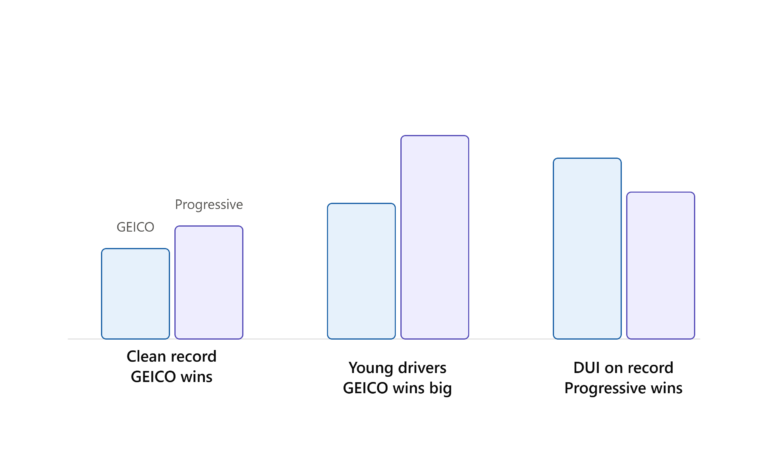
- Younger drivers see meaningfully larger savings than average: Consumer Reports found a median savings of $245 for policies with younger drivers, and $145 for drivers under 45 generally, compared to $93 to $115 for drivers over 60. This connects directly to the pattern covered in our guide to insurance for young EV drivers, since a discount percentage is worth more dollars on an already-larger premium.
The takeaway: treat the advertised maximum percentage as a best-case ceiling, not a realistic expectation, and budget for something closer to the $120 median unless your specific profile (young driver, low mileage, suburban commute) points toward the higher end.
Why these programs are hardest on city drivers
This is a structural pattern worth understanding before you enroll, not after a disappointing result. The technology behind every major telematics program penalizes a consistent set of behaviors: hard braking, rapid acceleration, sharp cornering, and late-night driving (commonly 12 a.m. to 4 a.m.). The problem is that these exact patterns show up constantly in ordinary city driving that has nothing to do with actual risk. Frequent red lights read as hard braking. Dense traffic reads as erratic driving. A late finish at a job with irregular hours reads as risky nighttime driving, regardless of how carefully you actually drive during that window.
The ideal telematics customer, by contrast, drives modest miles on suburban roads in daylight, a profile these programs are implicitly built around. If that doesn’t describe your actual driving pattern, particularly if you’re a rideshare or delivery driver as covered in our dedicated rideshare EV insurance guide, it’s worth thinking twice before enrolling in a program that can penalize you, rather than assuming your genuinely safe driving will automatically translate into genuinely safe-looking data.
Program-by-program quick comparison
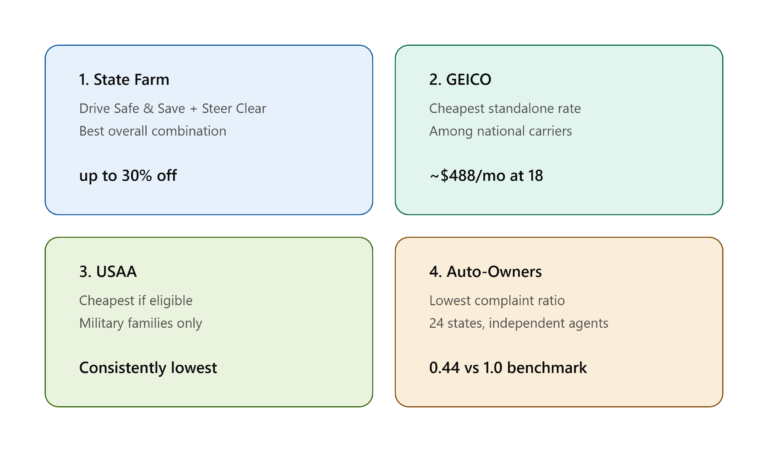
State Farm Drive Safe & Save — No downside risk; rates only improve. As covered in our State Farm review, this pairs well with State Farm’s already-strong EV pricing.
Liberty Mutual RightTrack — No downside risk; can save up to 30%; notably shorter tracking period than some competitors, meaning you get your discount locked in faster.
USAA SafePilot — No downside risk; available only to military-affiliated members, consistent with USAA’s broader eligibility restrictions covered throughout this site.
GEICO DriveEasy — Can raise or lower your rate; no hardware required, uses your phone’s sensors; savings of $60 to $250 a year for most users; your data stays within GEICO’s system and isn’t shared with data brokers, according to the company.
Progressive Snapshot — Can raise or lower your rate, with about 20% of users seeing an increase; average savings of $169 for signing up, $322 for those who actively save; in some states, the mobile app option is only available to brand-new customers, meaning existing customers switching in later may be limited to a plug-in device instead.
Root Insurance — A telematics-only insurer rather than an add-on program; tends to run cheaper than average specifically for good drivers, since its entire pricing model is built around driving behavior data rather than traditional factors layered on top.
Nationwide SmartRide — Can save up to 40% according to Nationwide’s own figures, among the higher advertised maximums; distinct from Nationwide’s SmartMiles pay-per-mile program covered in our dedicated pay-per-mile guide, worth confirming which specific Nationwide program you’re comparing.
An important privacy tradeoff
Every program on this list, regardless of whether it can raise your rate, collects detailed driving and location data as the actual mechanism behind the discount. This is the genuine price of participation, not a hidden catch, but it’s worth being clear-eyed about it. If you’re privacy-averse, this is a legitimate reason to skip telematics entirely, separate from the financial math covered above.
Who should enroll without much hesitation
- State Farm customers specifically, given the no-downside structure covered above, this is close to a free option worth taking.
- Low-mileage, suburban, daytime drivers, whose actual habits align closely with what these programs reward.
- Young drivers, given the outsized dollar savings documented by Consumer Reports for this specific group, worth reading alongside our dedicated young-driver EV insurance guide.
- Anyone in a high-premium state, since a percentage discount is worth more in absolute dollars on a larger baseline premium, a dynamic that also applies to EV owners generally given how much higher EV premiums already run compared to gas cars.
Who should think twice
- Rideshare and delivery drivers, given the high mileage, dense traffic, and irregular hours covered in our dedicated rideshare guide, a combination these programs consistently penalize.
- Night-shift workers, whose necessary driving hours fall directly into the penalized late-night window regardless of actual safety.
- Privacy-averse drivers, given the genuine data collection tradeoff covered above.
- Anyone enrolling with GEICO, Progressive, or Travelers specifically who isn’t confident in how their actual driving data will read, given that these three programs can raise your rate, unlike the no-downside alternatives.
The right order of operations
Whichever program appeals to you, the sequence matters: compare base quotes across insurers first, using the broader comparisons covered throughout this site, then layer telematics onto whichever carrier already wins on base price. A 15% telematics discount on an already-overpriced policy still loses to a well-shopped policy without any telematics discount at all. Treat the telematics decision as a secondary optimization on top of your insurer choice, not a replacement for actually comparison shopping first.
The bottom line
Usage-based insurance can genuinely save you money, but the realistic median savings ($120 a year according to independent survey data) is far more modest than the advertised maximums suggest, and the risk profile varies enormously by insurer. State Farm, Liberty Mutual, and USAA offer a no-downside structure worth enrolling in almost without hesitation if you’re already a customer, while GEICO, Progressive, and Travelers carry genuine upside and downside risk that depends heavily on how well your actual driving pattern, especially your mileage, city versus suburban routes, and typical hours, matches what these programs reward. Compare your base insurance quote first, then decide on telematics as a secondary layer, not the primary factor in your insurer choice.
This article is for informational purposes only and does not constitute financial or insurance advice. Telematics program terms, discount percentages, and availability vary by insurer and state, and change frequently. Always confirm current program details directly with your insurer before enrolling.