Best Electric Car Insurance for Young Drivers
As covered in our broader guide to EV insurance cost by age, a driver under 25 can pay two to three times what an older driver pays for the identical EV. That’s the reality, but it doesn’t mean every insurer treats young drivers the same way. Some carriers have built genuinely strong programs specifically for this age group, discounts, telematics, driver training, that can meaningfully soften the blow. This guide covers which companies actually do this best for a young driver insuring an EV.
Key takeaways:
- GEICO consistently offers the cheapest standalone rates for teen and young adult drivers among national carriers, averaging around $488 to $514 a month for full coverage at 18, still expensive, but the lowest among major insurers.
- State Farm stands out for combining strong young-driver-specific programs, Drive Safe & Save telematics and Steer Clear driver training, with the broad EV competitiveness covered in our dedicated State Farm review.
- Auto-Owners posts the lowest complaint ratio of any major teen-focused insurer (0.44, well below the 1.0 industry benchmark) alongside strong rates, though it’s only available in 24 states.
- Staying on a parent’s policy remains dramatically cheaper than a standalone policy for any driver under 25, regardless of which insurer you choose.
The single biggest lever: stay on a parent’s policy
Before comparing insurers, it’s worth restating the most powerful cost lever available to a young EV driver, and it isn’t about which company you pick. A standalone full-coverage policy for an 18-year-old averages around $7,611 a year, while being added to a parent’s existing policy costs hundreds of dollars less for the same coverage. Insurance companies generally require every licensed driver in a household to be listed on the policy unless a specific exclusion applies, so in nearly every case, adding a young EV driver to an existing family policy is both the cheapest and simplest path, regardless of which insurer that family policy is with.
Best insurers for young EV drivers, ranked
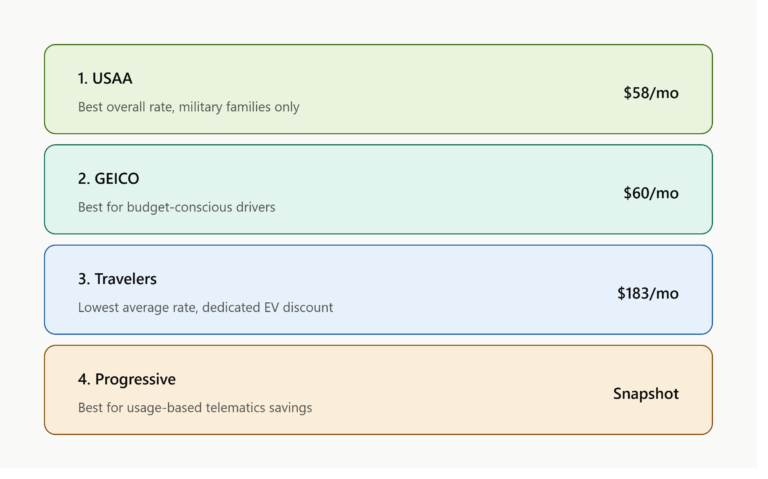
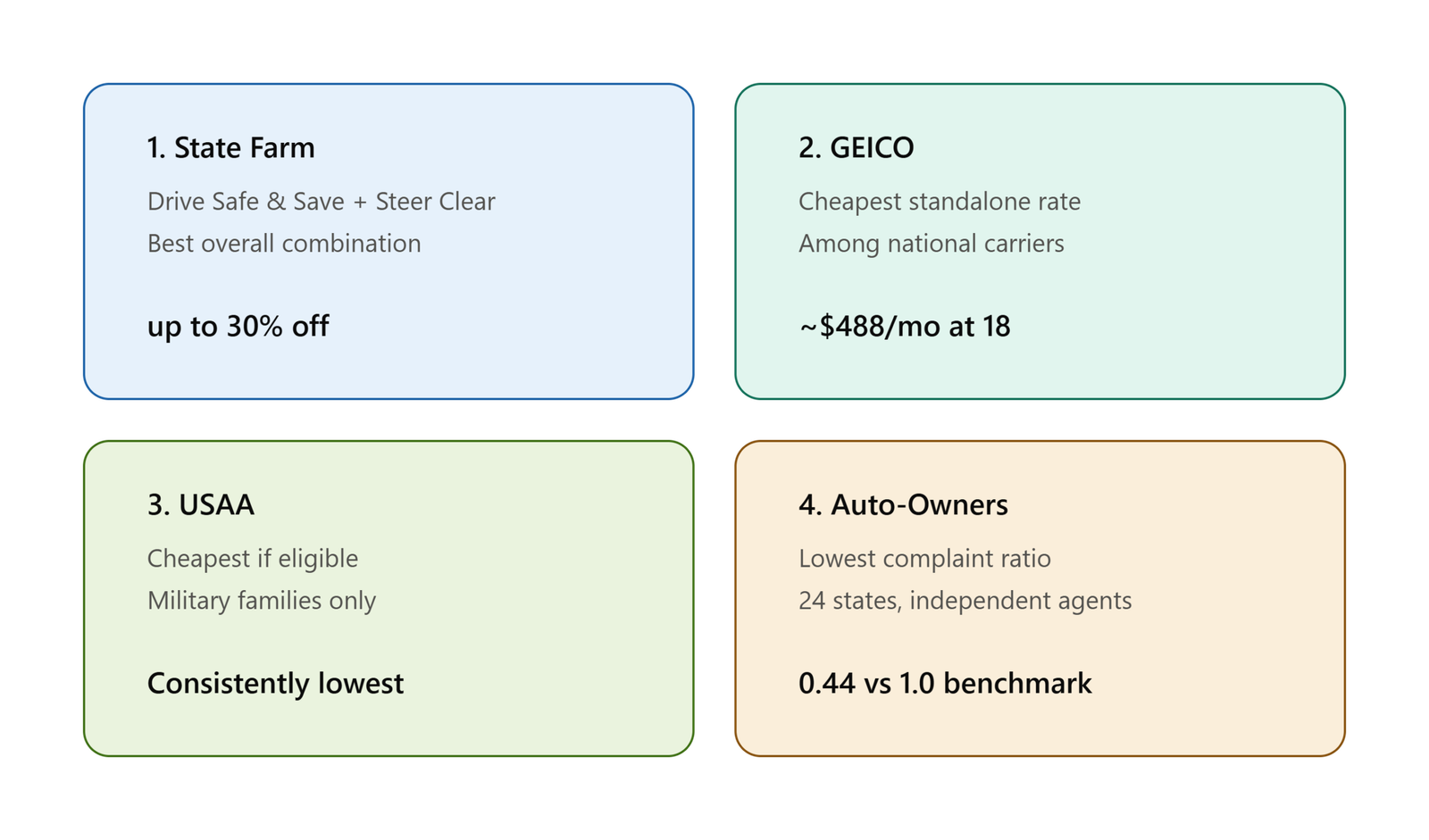
1. State Farm — best overall combination of programs and EV competitiveness State Farm brings together two things that matter specifically for a young EV driver: strong youth-focused programs and the broader EV pricing strength covered in our dedicated State Farm review. Its Drive Safe & Save telematics program can cut a premium by up to 30% based on demonstrated safe driving, a meaningful discount for a young driver willing to prove their habits behind the wheel. Layer on a good student discount of up to 25% for maintaining a 3.0 GPA or better, and the Steer Clear program, which offers additional savings specifically for drivers under 25 who complete a driver training module, and State Farm’s combined discount stack is hard to match for this age group. Given that State Farm already ranks among the cheapest options for Tesla owners specifically, this makes it a particularly strong first quote for a young Tesla driver.
2. GEICO — cheapest standalone rate among national carriers If a standalone policy is unavoidable, GEICO consistently posts the lowest average rate for 18-year-old drivers among major national insurers, at roughly $488 a month for full coverage, still a significant sum, but meaningfully lower than most large competitors. GEICO’s DriveEasy telematics program offers a usage-based path to further savings, though one important caveat worth noting: unlike State Farm’s Drive Safe & Save, GEICO’s telematics program structure works somewhat differently, worth confirming directly how it applies to a young driver’s specific situation.
3. USAA — cheapest option if you qualify For military-affiliated families, USAA remains the cheapest option available, consistent with its strong showing across nearly every insurer comparison covered elsewhere on this site. If a young EV driver in your household qualifies through a parent’s or their own military service, get a USAA quote before anything else.
4. Auto-Owners — best complaint ratio, if available in your state Auto-Owners posted the lowest NAIC complaint ratio of any major teen-focused insurer at just 0.44, well below the 1.0 industry benchmark, alongside rates around $5,858 a year, among the lowest measured in a broad national comparison. The tradeoff: it operates in only 24 states and exclusively through independent agents, so it isn’t accessible everywhere, but where it is available, it’s worth serious consideration for the combination of low complaints and competitive pricing.
5. Erie Insurance — best regional option in the Northeast and Great Lakes Erie posted the lowest rates among all carriers in at least one broad national survey, plus a strong 4.5-out-of-5 satisfaction score, making it a standout if you’re located in its service area. As covered in our broader Tesla insurer comparison, Erie is also specifically noted for guaranteeing access to Tesla-certified repair facilities, a genuinely useful feature for a young driver whose EV is more likely to need repairs given the statistically higher accident rate in this age group.
6. Travelers — competitive for both families and standalone young-driver policies Travelers posts some of the lowest sample rates for both families insuring teen drivers and young adults on their own standalone policy, and as covered throughout this site, it’s also one of the only major insurers offering a dedicated EV discount, a combination that makes it worth a direct quote for a young EV driver specifically.
Discounts every young EV driver should ask about
Beyond picking the right insurer, a specific set of discounts consistently moves the number for this age group, regardless of which company you choose:
Good student discount. Full-time students ages 16 to 24 maintaining roughly a B average (3.0 GPA) typically qualify, and most major insurers, State Farm, GEICO, Progressive, Allstate, and Nationwide among them, offer some version of this discount.
Driver training or defensive driving course completion. Programs like State Farm’s Steer Clear, or third-party programs like TeenSmart (originally developed with Allstate and now used by AAA, Hanover, and others), combine structured education with a direct premium discount.
Distant student discount. If a young driver is away at college, generally defined as 100 miles or more from home, and leaves the EV behind, most insurers offer a meaningful discount for the reduced driving exposure.
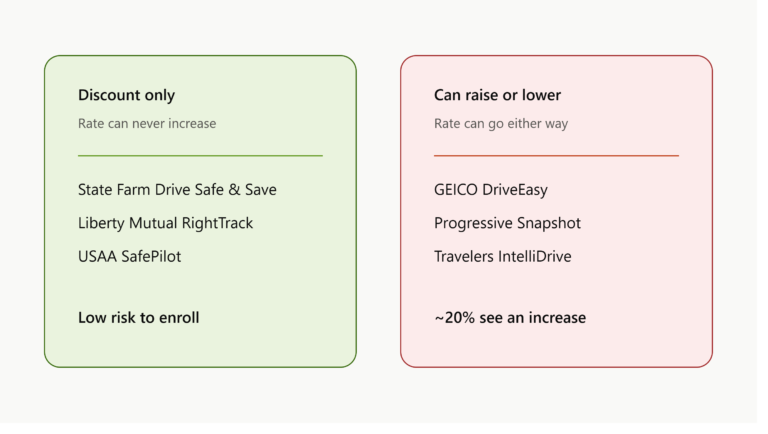
Telematics enrollment. As covered throughout this site, usage-based programs reward demonstrably safe driving directly, and a young driver willing to prove good habits through an app or device can offset a meaningful portion of the age-based premium increase.
Does the EV itself matter for a young driver’s rate?
Yes, significantly, and this compounds with everything above rather than replacing it. As covered in our detailed breakdown of EV insurance by age, the age penalty and the vehicle-specific cost factor stack multiplicatively, not additively. A young driver in a mainstream, lower-cost-to-insure EV like a Chevrolet Equinox EV or Nissan Leaf, as covered in our cheapest EVs to insure ranking, will see a meaningfully smaller total premium than the same young driver in a Tesla Model X or Rivian, even before any insurer-specific discount is applied. If you’re selecting a first EV specifically for a young driver in the household, vehicle choice deserves at least as much attention as which insurer you pick.
A practical action plan
- Confirm the young driver is added to an existing family policy first, rather than defaulting to a standalone policy, given the dramatic cost difference covered above.
- Get quotes from State Farm and GEICO as your first two comparisons, given their consistent strength for this specific combination of young drivers and EVs.
- Check USAA eligibility immediately if there’s any military connection in the family.
- Ask specifically about every discount covered above, good student, driver training, distant student, and telematics, since these often aren’t applied automatically and require a direct request.
- If choosing the EV itself, favor a mainstream, lower-cost-to-insure model for a young driver specifically, given how the age and vehicle factors compound rather than simply add together.
The bottom line
No insurer makes EV insurance genuinely cheap for a driver under 25, that reality doesn’t change regardless of which company you choose. But State Farm’s combination of youth-specific programs and broad EV competitiveness makes it the strongest overall starting point, GEICO remains the cheapest standalone option among national carriers if a family policy genuinely isn’t available, and USAA is unbeatable if you qualify. Layer the right discounts, good student, driver training, telematics, on top of whichever insurer you choose, and choose a mainstream EV model if you have the flexibility to do so, since the vehicle itself compounds with the age factor more than most young drivers and their families realize going in.
This article is for informational purposes only and does not constitute financial or insurance advice. Insurance rates, discounts, and program availability vary by insurer, state, and individual driver profile, and change frequently. Always get a personalized quote before making a purchasing decision.