Best EV Insurance for Rideshare Drivers (Uber/Lyft)
If you’re driving your EV for Uber or Lyft, standard personal auto insurance has a gap you need to know about before you ever start accepting rides, not after an accident reveals it. Combine that gap with the EV-specific cost factors covered throughout this site, and rideshare EV drivers face a genuinely more complex insurance picture than either rideshare drivers in gas cars or personal-use EV owners. This guide covers exactly how the coverage gap works and which insurers handle it best.
Key takeaways:
- Your personal auto policy stops covering you the moment you turn on the Uber or Lyft app, a «commercial use» exclusion that applies regardless of what you drive.
- Uber and Lyft’s own coverage is weakest during Period 1 (app on, waiting for a ride request), offering only limited liability with no guarantee of comprehensive or collision protection for your vehicle.
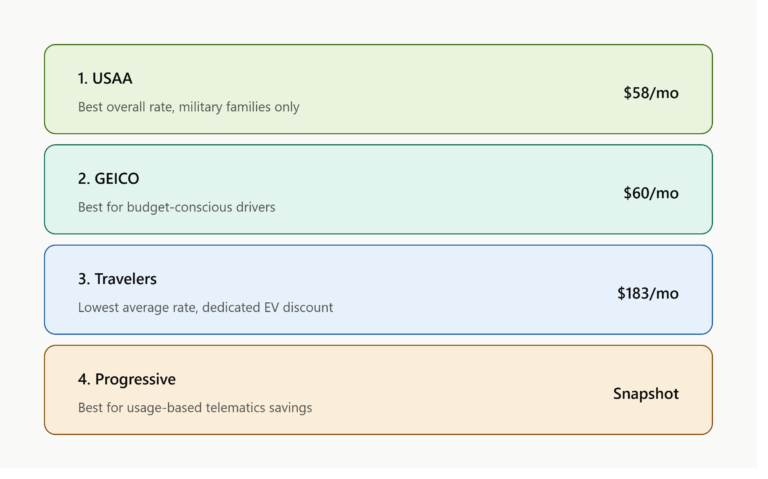
- State Farm, USAA, and Allstate consistently rank among the strongest rideshare endorsement providers, with USAA offering endorsements for as little as $6 a month for eligible military families.
- A rideshare endorsement typically costs far less than commercial auto insurance and is the right choice for most drivers, but isn’t available in every state, where a commercial policy becomes the fallback.
The coverage gap, explained
This is the single most important thing to understand before driving your EV for any rideshare platform. Personal auto insurance policies specifically exclude commercial use, and driving for Uber or Lyft counts as commercial use the moment you activate the app, regardless of whether you have a passenger yet. Your regular policy simply isn’t in force during that window.
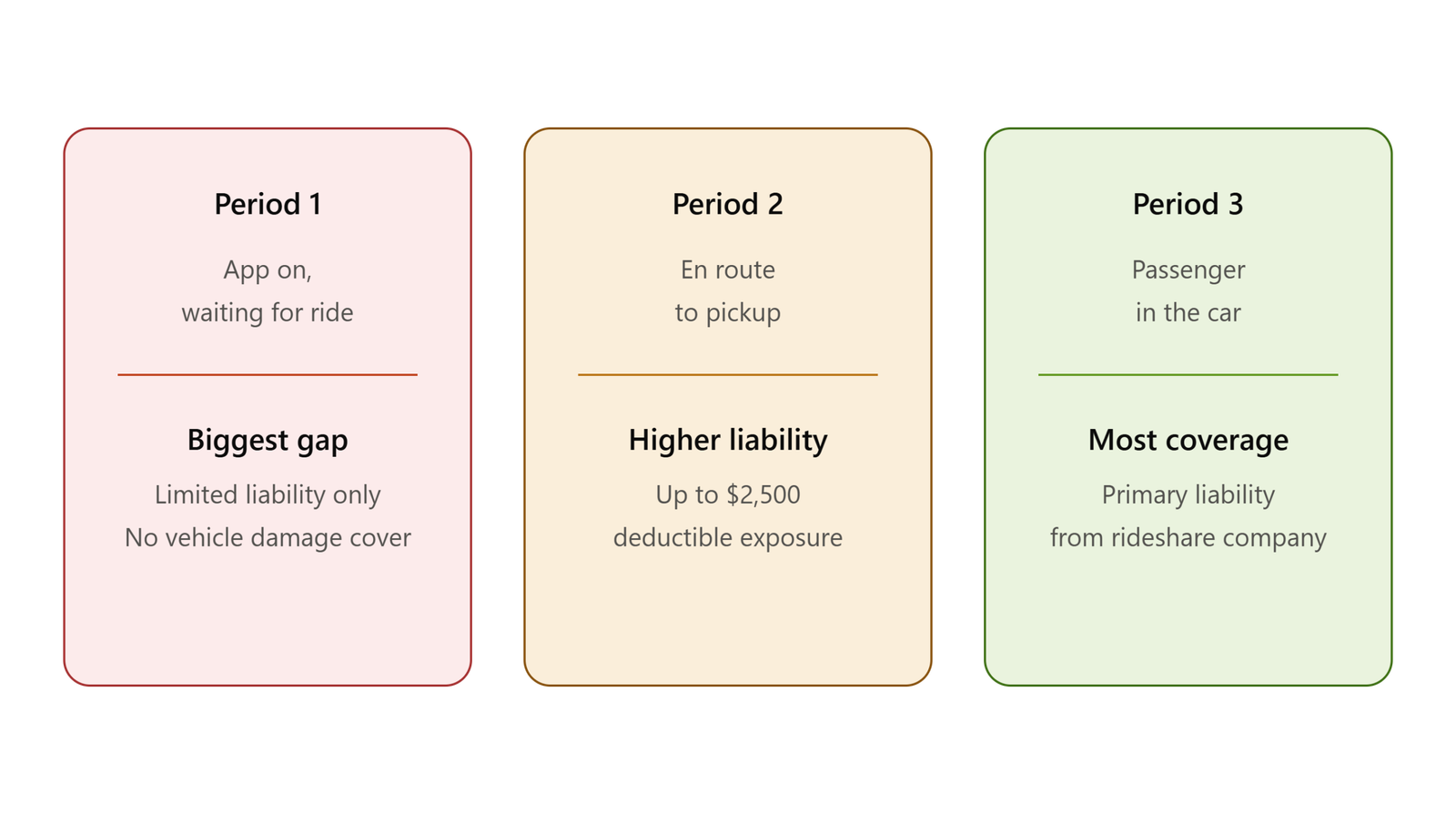
Rideshare companies are required by law to provide some coverage during this time, but it varies significantly depending on which of three «periods» you’re in:
- Period 1 (app on, waiting for a ride request): This is the biggest gap. Uber and Lyft provide only limited liability coverage during this phase, commonly around $50,000/$100,000/$25,000, and critically, no guarantee of comprehensive or collision coverage for damage to your own vehicle. If you’re in an accident during this period without a rideshare endorsement, you could be paying out of pocket for repairs to your EV, an outcome that’s especially painful given how expensive EV repairs are, as covered throughout this site.
- Periods 2 and 3 (accepted a ride, en route to pickup, or passenger in the car): Uber and Lyft’s coverage becomes substantially more robust here, generally providing higher liability limits and primary coverage. However, collision and comprehensive coverage during these periods typically only applies if you already carry that coverage on your personal policy, and deductibles through the rideshare company’s coverage can run as high as $2,500, a significant out-of-pocket exposure for a battery-related EV claim specifically.
A rideshare endorsement added to your personal auto policy closes the Period 1 gap entirely and, in many cases, can reduce the high deductible you’d otherwise face during Periods 2 and 3.
Why this matters more for EV drivers specifically
Everything above applies to any rideshare driver, gas or electric. But two factors make this a bigger deal for EV owners specifically:
Higher stakes per incident. As covered throughout our cost guides, EV repairs, and battery damage in particular, run significantly more expensive than comparable gas car repairs. Facing a $2,500 deductible during Period 2 or 3 without a proper endorsement is a meaningfully bigger financial risk on an EV than on a typical gas sedan.
Compounding with high mileage. Rideshare driving inherently means high mileage, often well above the 12,000-to-13,000-mile threshold covered in our dedicated high-mileage EV insurance guide. That means rideshare EV drivers are simultaneously managing the mileage-based premium increase, the EV-specific repair cost premium, and the rideshare coverage gap, three separate cost factors stacking at once.
Best insurers for a rideshare endorsement
State Farm — best overall for availability and coverage depth State Farm is repeatedly ranked as the best overall rideshare insurance option, offering wide availability and coverage across all three driving periods rather than just the gaps Uber and Lyft leave open. Its rideshare endorsement covers drivers who are online and waiting for a ride request specifically, the Period 1 gap that matters most. Combined with State Farm’s broader EV competitiveness covered in our dedicated review, it’s a strong first quote for a rideshare EV driver specifically.
USAA — cheapest option if you’re eligible For military-affiliated drivers, USAA offers a rideshare endorsement for as little as $6 a month, among the cheapest options found in this research, on top of USAA’s already strong general EV pricing covered throughout this site. If you qualify, this is worth checking before anything else.
Allstate — most affordable non-military option, with useful add-ons Allstate adds a rideshare endorsement for roughly $4 a month according to one comparison, an unusually low figure, and pairs it with Drivewise telematics savings up to 25% and pay-per-mile MileWise coverage in 18 states, worth considering if your rideshare hours vary significantly week to week. Allstate is also highly rated for claims processing by J.D. Power, a meaningful factor given the higher stakes of an EV-specific claim.
Progressive — best for drivers who mix rideshare and delivery platforms If you use your EV for both rideshare and food delivery (DoorDash, Uber Eats), Progressive stands out specifically for publicly clarifying that it covers delivery drivers during certain phases of app use, a detail many insurers don’t address clearly. Progressive also lets existing customers add a rideshare endorsement while keeping other policy perks like rental car reimbursement intact.
American Family and Farmers — top-rated in broader rideshare-specific reviews One comprehensive 20-insurer comparison rated American Family highest overall for rideshare coverage at 5.0 out of 5 stars, with Farmers close behind at 4.9. Both are worth including in your comparison set if they’re available in your state, particularly if you value the broadest possible feature set alongside the endorsement itself.
Do you ever need a full commercial policy instead?
Yes, in specific circumstances. A rideshare endorsement is the right, more affordable choice for most drivers, but it isn’t available in every state. Where it isn’t offered, a full commercial auto policy becomes the fallback, a meaningfully more expensive option, but a necessary one if a proper endorsement simply isn’t sold where you live. It’s also worth considering a commercial policy if you’re driving extremely high rideshare volume, since some endorsements have caps or limitations that a full commercial policy doesn’t share.
Practical steps for a rideshare EV driver
- Never drive for Uber or Lyft on a standard personal policy alone. The Period 1 gap is real and specifically dangerous for an EV given repair costs covered throughout this site.
- Get quotes from State Farm, USAA (if eligible), and Allstate first, given their consistent strength in this specific category.
- Ask directly how the endorsement affects your deductible during Periods 2 and 3, since a properly structured endorsement can meaningfully reduce Uber or Lyft’s default $2,500 deductible exposure.
- Factor in your actual rideshare mileage when comparing quotes, and cross-reference against our high-mileage EV insurance guide, since you’re very likely well above the threshold where standard low-mileage discounts apply.
- Confirm your battery and EV-specific coverage still applies with the endorsement added. As covered in our guide to which insurers actually cover EV battery replacement, this varies by carrier, and it’s worth confirming the rideshare endorsement doesn’t inadvertently narrow that protection.
The bottom line
Driving your EV for Uber or Lyft without a rideshare endorsement leaves a real, well-documented coverage gap, specifically during Period 1, that combines badly with how expensive EV repairs already are. State Farm and USAA (for eligible drivers) consistently rank as the strongest overall choices, with Allstate and Progressive offering compelling alternatives depending on your specific mix of platforms and driving patterns. Given how much financial exposure stacks up between high mileage, expensive EV repairs, and the rideshare coverage gap, this is one insurance decision worth getting right before you start driving, not after an accident forces the question.
This article is for informational purposes only and does not constitute financial or insurance advice. Insurance rates, endorsement availability, and coverage details vary by insurer, state, and rideshare platform, and change frequently. Always confirm specific coverage terms directly with your insurer before driving for a rideshare platform.