Does Insurance Cover Battery Degradation Over Time?
No, and this is one of the most consistent rules across every insurer and every policy type covered throughout this site: gradual battery degradation is never an insurance matter. But that simple «no» leaves out the more useful part of the story: how much degradation is actually normal, how it’s measured, when it crosses into genuine warranty-claim territory, and what real fleet data says about how EV batteries are actually holding up in 2026. This guide covers all of it.
Key takeaways:
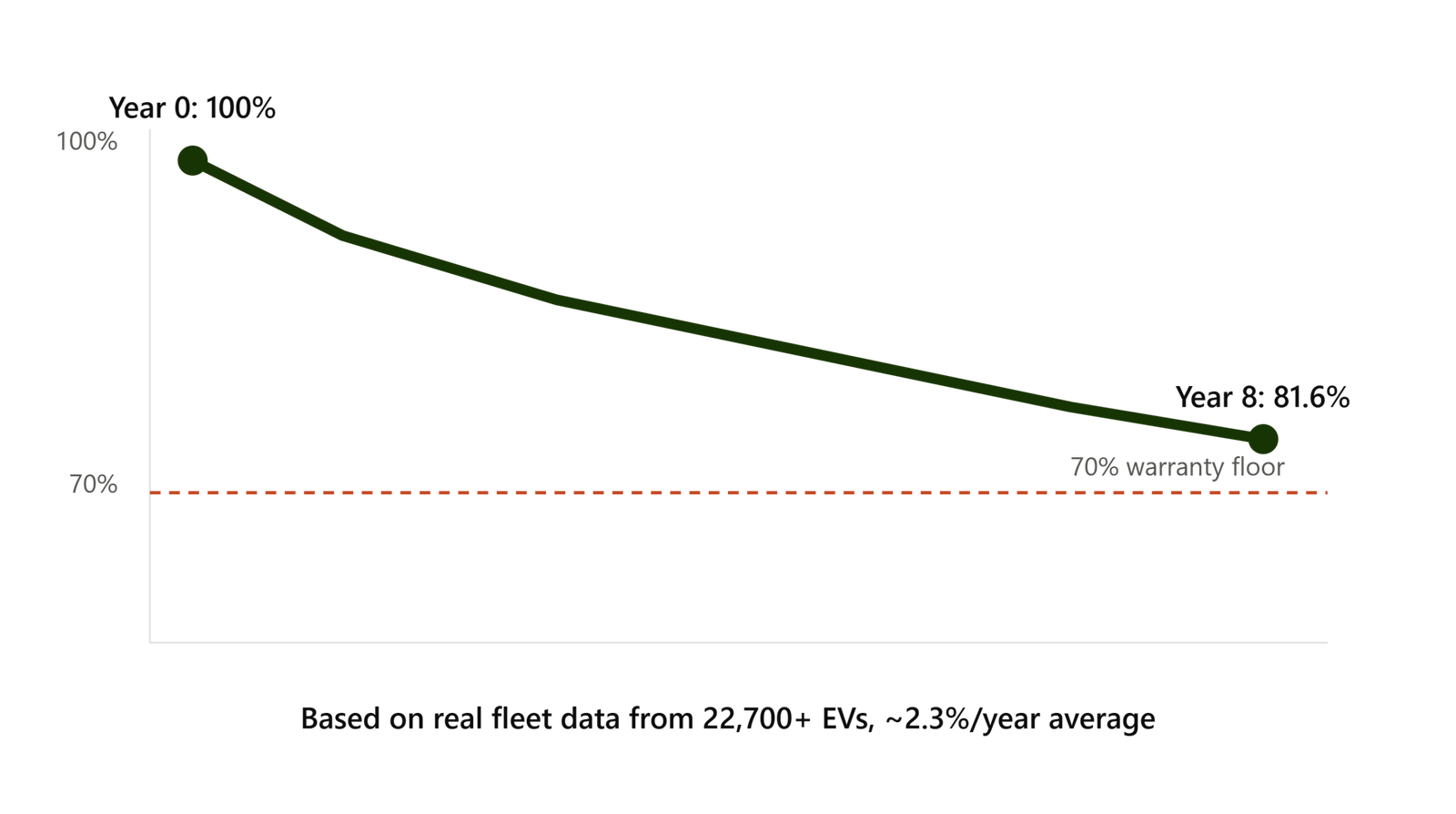
- Real-world data from more than 22,700 EVs shows average degradation of about 2.3% per year, with most vehicles retaining roughly 80% of original capacity after 8 years, comfortably at or above most warranty thresholds.
- Degradation is measured as State of Health (SoH), a percentage comparing current capacity to original capacity, and it’s front-loaded: a bigger dip in year one or two, then a much slower, steadier decline afterward.
- Manufacturer warranties, not insurance, cover degradation, typically guaranteeing at least 70% capacity retention for 8 to 10 years, and claim rates for full or partial pack replacement under warranty run under 1-2% for most modern brands.
- California now requires certain 2026-model-year EVs sold in the state to retain at least 70% of range for 10 years or 150,000 miles, a regulatory floor other CARB-aligned states are likely to adopt over time.
Why insurance never covers this, restated clearly
As covered throughout our battery and coverage guides, auto insurance responds to sudden, accidental, external causes of damage, a collision, a fire, theft. Gradual capacity loss from age and normal use doesn’t fit that model at all, it’s an expected, well-documented characteristic of every lithium-ion battery, closer to how a phone battery holds less charge after a few years than to an insurable accident. No insurer, regardless of how comprehensive the policy, covers this, and no add-on product changes that rule, degradation coverage exists exclusively through the manufacturer’s warranty.
How degradation is actually measured
Battery degradation is tracked using a metric called State of Health, or SoH: a new battery starts at 100% SoH, and that percentage declines over time as the pack’s actual usable capacity shrinks relative to its original capacity. A 60 kWh battery at 80% SoH behaves like a 48 kWh battery, same vehicle, same charging routine, just meaningfully less range per charge. This is distinct from a simple range estimate you see on your dashboard, SoH reflects the underlying physical capacity of the pack itself, while displayed range also factors in driving conditions, climate, and driving style.
Two things happen inside the battery as it ages: the active lithium that shuttles charge between electrodes is gradually consumed by side chemical reactions, and internal resistance creeps upward, which also reduces usable power output. This combined effect is called capacity fade, and it’s the underlying physical process behind the SoH percentage you’d see on a diagnostic readout.
What normal degradation actually looks like
This is genuinely useful to know, since it lets you distinguish ordinary aging from a real problem worth investigating. Pulling together fleet data and manufacturer patterns, a typical degradation curve looks like this:
- Year one: a quicker initial drop, commonly 2% to 5%, as the battery chemistry settles into normal operation. This early dip is expected and not a sign of a defective pack.
- Years two through five: degradation slows considerably, typically to around 1% to 2% per year.
- Years six through ten: continues at roughly 1% to 3% per year, with the exact rate depending heavily on climate exposure and charging habits, covered below.
The most credible real-world data comes from actual vehicle fleets rather than lab testing. A landmark analysis of more than 22,700 real-world EVs across 21 makes and models found average degradation of about 2.3% per year, with vehicles retaining roughly 81.6% of original capacity after 8 years, comfortably above the 70% threshold most manufacturer warranties guarantee. Tesla’s own fleet reporting has shown similarly favorable results, with average degradation of only about 12% at 200,000 miles in one internal analysis, suggesting newer battery chemistry and improved thermal management are outperforming older assumptions about EV battery longevity.
What actually accelerates degradation
A few factors measurably speed up capacity loss beyond the baseline rate, worth understanding if you want to protect your battery’s long-term health:
Hot climate exposure. Consistently high ambient temperatures add an estimated 0.2% to 0.5% per year to your degradation rate beyond the baseline, a meaningful consideration if you live somewhere with genuinely hot summers.
Frequent DC fast charging. Regular use of fast charging beyond occasional need adds an estimated 0.2% to 0.4% per year, connecting to a theme covered in our home charging guides: relying primarily on slower Level 2 home charging, with fast charging reserved for road trips, is gentler on long-term battery health.
Consistently charging to 100% or deeply discharging below 20%. The single most impactful habit most owners can adopt is limiting daily charging to around 80% and avoiding regularly draining the battery below 20%, guidance that most modern EVs make easy to follow automatically through built-in charge-limit settings.
Premium EVs with active thermal management systems tend to show slower degradation than models with simpler, passive cooling, one more factor, alongside the vehicle-choice guidance covered throughout our cost comparison guides, worth considering if long-term battery health is a priority in your buying decision.
When degradation crosses from normal into warranty-claim territory
Manufacturer warranties typically combine two components: a time/mileage window (commonly 8 years or 100,000 miles, whichever comes first) and a capacity retention guarantee, typically 70% to 80% of original usable capacity by the end of that window. If your battery’s SoH drops below that threshold while still within the warranty period, you have grounds to open a warranty claim for repair or replacement, generally at no cost to you.
A useful rule of thumb for when to actually investigate: if your EV has lost more than 20% of its capacity in under 5 years, or shows below 70% capacity while still within the factory warranty window, that’s a genuine red flag worth pursuing with your manufacturer, since it falls meaningfully outside the normal degradation curve described above.
Real claim rates are reassuringly low. Modern EVs from established brands, Tesla, Hyundai/Kia, and others, show full or partial pack replacement claim rates under warranty of roughly 1% to 2%, according to analysis of warranty terms and field data across more than 20 EV brands. This suggests that while the warranty protection exists and matters, the large majority of EV owners will never actually need to use it.
How to actually monitor your battery’s health
Given that gradual degradation is a warranty matter, not an insurance one, tracking your own SoH proactively is genuinely useful, both for catching a real problem early and for understanding your vehicle’s resale value over time.
Tesla owners can use a third-party OBD app or dedicated diagnostic tools to check SoH directly.
Nissan Leaf owners commonly use a specific, well-established OBD adapter and app combination that’s become a standard tool in that ownership community.
For most other brands, third-party telematics platforms exist that track SoH automatically for enrolled vehicles, offering a more passive, ongoing monitoring option than manually checking.
For the most rigorous measurement, fleet-grade telematics platforms provide the most accurate SoH calculations by directly measuring actual energy in and out of the battery over time, rather than relying on estimated range alone.
Regardless of method, keeping records of your charging habits, any software updates your vehicle has received, and any unusual or sudden range loss you notice supports a stronger warranty claim if you ever need to file one, similar to the documentation guidance that applies throughout our other coverage guides.
What’s coming: regulation and next-generation battery chemistry
Two developments worth watching, both aimed at improving the degradation picture further:
Regulatory floors are rising. Beginning with certain 2026-model-year vehicles sold in California, EV batteries must retain at least 70% of range for 10 years or 150,000 miles, a stronger guarantee than many existing manufacturer warranties, with future rules targeting 80% retention. Other CARB-aligned states are likely to adopt similar requirements over time, which would extend this stronger protection well beyond California alone.
Next-generation battery chemistry aims to reduce degradation dramatically. Solid-state batteries, which eliminate the flammable liquid electrolyte used in current lithium-ion designs, are expected to substantially reduce degradation rates alongside the fire-safety improvements covered in our EV battery fire guide. Some manufacturers have specifically targeted dramatically longer usable lifespans from solid-state cells compared to current-generation averages, though this technology remains in early stages of commercial deployment as of 2026.
The bottom line
Battery degradation is never an insurance matter, full stop, that’s exclusively the manufacturer warranty’s job, typically guaranteeing at least 70% capacity retention for 8 to 10 years. The reassuring part, backed by real fleet data from tens of thousands of vehicles, is that actual degradation is running better than most people assume, averaging about 2.3% per year and leaving most EVs comfortably above 80% capacity even after 8 years of typical use. Understanding the normal degradation curve, front-loaded in year one, then slow and steady, helps you distinguish ordinary aging from a genuine problem worth a warranty claim, and proactively monitoring your own battery’s State of Health gives you real data rather than guesswork if that distinction ever matters for your specific vehicle.
This article is for informational purposes only and does not constitute financial or insurance advice. Degradation rates, warranty terms, and regulatory requirements vary by manufacturer, model, region, and change frequently. Always confirm specific warranty terms directly with your vehicle’s manufacturer.