Best Pay-Per-Mile Insurance for Electric Vehicles
If your EV spends most of its life parked in the driveway, charging overnight and only coming out for short errands or a modest commute, you’re very likely paying for coverage you don’t use. Pay-per-mile insurance flips the standard model: instead of a flat monthly premium regardless of use, you pay a small base rate plus a charge for each mile you actually drive. For the right EV owner, this can mean savings of 30% to 40% or more. This guide ranks the best options and shows the real math behind when it actually pays off.
Key takeaways:
- Nationwide SmartMiles is the best overall pick for most EV owners, with the widest availability (44 states), a 250-mile daily road trip cap, and average savings around 25% to 33%.
- Lemonade (formerly Metromile) offers the lowest rates specifically for low-mileage urban drivers, though availability is more limited.
- The real break-even point sits around 10,000 to 14,000 miles a year; below that, pay-per-mile clearly wins, above it, the savings shrink to marginal or disappear entirely.
- Every plan on this list offers the same core coverage (liability, collision, comprehensive) as a standard policy, the only thing that changes is how the premium is calculated.
The best pay-per-mile options, ranked
1. Nationwide SmartMiles — best overall for EV owners Available in 44 states (all except Alaska, Hawaii, Louisiana, North Carolina, Oklahoma, and New York), SmartMiles is the most widely accessible option on this list by a wide margin. It caps daily charges at 250 miles, meaning a road trip won’t blow up your monthly bill, and it offers an additional safe-driving discount of up to 10% after your first renewal, stacked on top of the base pay-per-mile savings. Nationwide reports that SmartMiles drivers, excluding California, saved an average of 33% compared to similar drivers on standard policies. It tracks mileage either through a small plug-in device or, notably for EV owners, through a connected-car integration on compatible vehicles, meaning some EVs can skip the hardware entirely.
2. Lemonade (formerly Metromile) — best for low-mileage urban drivers Lemonade specializes purely in pay-per-mile coverage and leads on tracking convenience and a clean digital experience, though it tends to run somewhat more expensive than Nationwide on a pure rate basis. It uses a small device (the Metromile Pulse) that plugs into your vehicle’s OBD-II port, with a base rate starting around $29 a month plus a per-mile fee starting around $0.06 a mile. It’s specifically well-suited to city drivers who rarely leave a compact urban radius, though availability is narrower than Nationwide’s.
3. Allstate Milewise — best for flexible plan structure Milewise offers two distinct structures: a traditional pay-per-mile plan, and a separate «Unlimited» option where you pay only the daily rate with no per-mile charge at all, useful if your mileage is unpredictable month to month. Milewise customers remain eligible for all of Allstate’s standard discounts and coverage options, including the new-car replacement coverage covered in our broader insurer ranking. It’s available in 22 states, a narrower footprint than Nationwide but wider than several smaller competitors.
4. Mile Auto — best for simplicity, without an app or telematics device Mile Auto takes a different technical approach entirely: instead of an in-car device, it asks for periodic odometer photo submissions, which some owners find simpler and less invasive than a hardware tracker or connected-car data sharing. It advertises savings of up to 40% for drivers under 10,000 miles a year, though it offers no discounts beyond the base pay-per-mile structure and no mobile app, a real tradeoff for the added privacy and simplicity.
5. USAA — best if you’re eligible through military affiliation USAA offers its own pay-per-mile option, and given USAA’s consistently strong showing across our broader insurer rankings for both price and service quality, it’s worth prioritizing if you qualify through military service or a family connection.
The real math: three worked examples
Numbers make this concept much clearer than percentages alone, so here are three realistic scenarios based on actual mileage patterns.
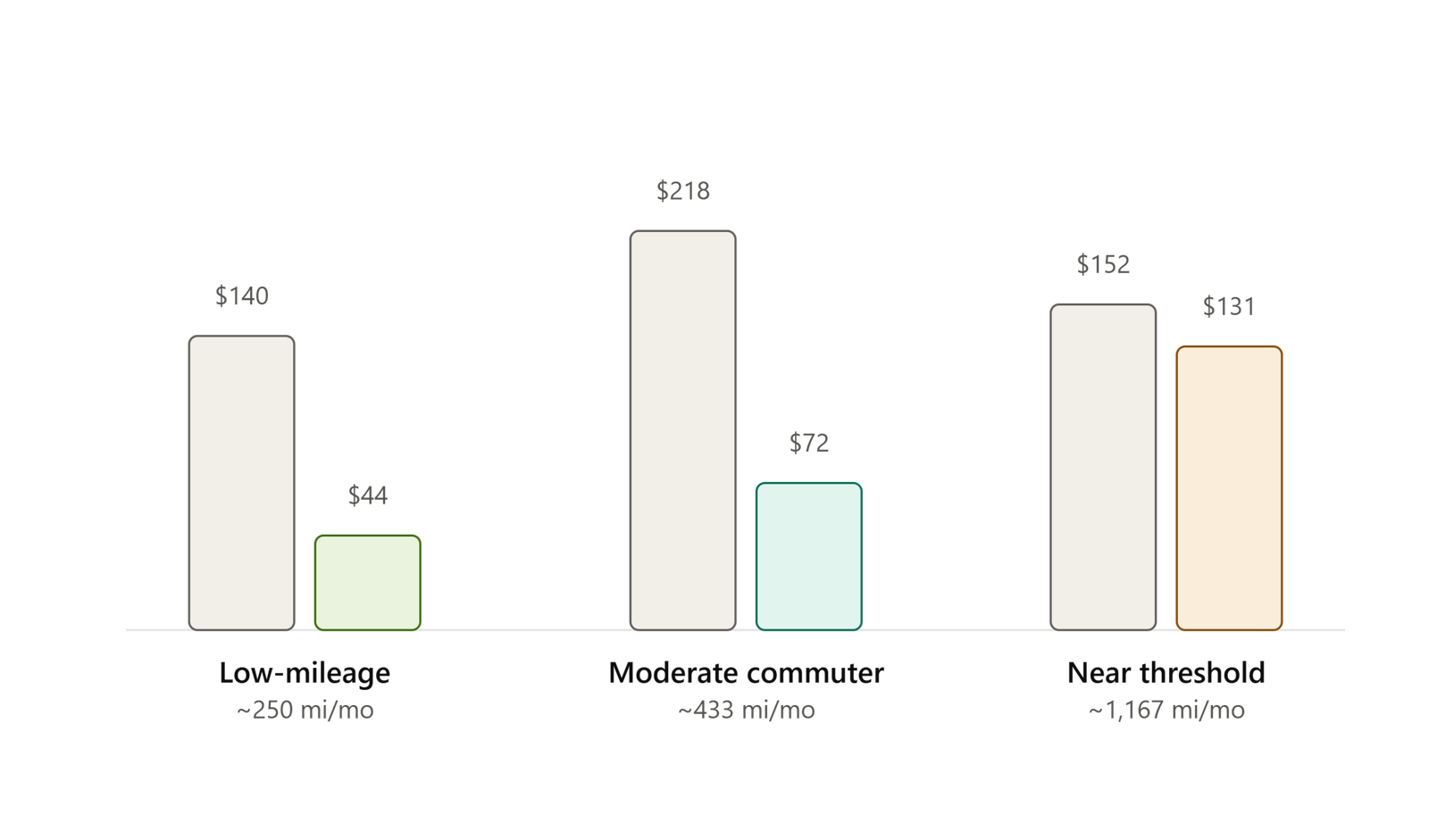
Low-mileage city driver: Driving about 250 miles a month and paying $140 a month for a traditional policy. Switching to Lemonade/Metromile at a $29 base plus $0.06 a mile works out to roughly $44 a month, a savings of about $1,152 a year. This is the clearest, most dramatic case for pay-per-mile.
Moderate commuter: Driving about 433 miles a month (roughly 5,200 miles a year) and paying $218 a month for traditional full coverage. Switching to Nationwide SmartMiles at a $42 base plus $0.07 a mile works out to about $72 a month, a substantial savings of well over $100 a month.
Higher-mileage driver approaching the threshold: Driving about 1,167 miles a month (roughly 14,000 miles a year) and paying $152 a month traditionally. Nationwide SmartMiles at a $38 base plus $0.08 a mile comes out to about $131 a month, cheaper, but only marginally. At this mileage level, the gap narrows enough that a standard safe-driving telematics program (like State Farm’s Drive Safe & Save or Progressive’s Snapshot, both covered in our broader insurer comparisons) may deliver comparable savings without requiring you to switch your entire policy structure.
The pattern across all three: the savings are dramatic at low mileage, meaningful at moderate mileage, and shrink to marginal as you approach 12,000 to 14,000 miles a year, consistent with the mileage threshold covered in our guide to insurance for high-mileage EV drivers.
Why this fits EV owners particularly well
A few reasons pay-per-mile tends to be an especially good match for electric vehicle owners specifically, beyond just general low-mileage driving:
Home charging encourages shorter-radius driving patterns. EV owners who charge overnight at home often naturally settle into driving patterns built around a battery’s comfortable range rather than fuel stops, which tends to concentrate driving into shorter, more frequent trips rather than long-distance mileage.
Second-car and errand-vehicle use cases are common. Many EVs, particularly in multi-vehicle households, get used specifically for local errands and short commutes while a second vehicle handles longer trips, a usage pattern that maps directly onto the pay-per-mile value proposition.
Connected-car compatibility is increasingly available. As covered above, Nationwide’s SmartMiles can integrate directly with certain connected vehicles rather than requiring a separate plug-in device, and this compatibility tends to be stronger with newer EVs that already have robust onboard connectivity built in.
Who should skip pay-per-mile entirely
Be honest with yourself about your actual mileage before switching, since this isn’t the right fit for everyone:
- Drivers averaging above roughly 12,000 to 14,000 miles a year should expect marginal or no savings, and should instead compare standard safe-driving telematics programs as covered in our high-mileage EV insurance guide.
- Drivers with unpredictable, spiky mileage patterns, long, irregular road trips mixed with quiet weeks, may find the day-to-day cost swings harder to budget around than a flat monthly premium, even if the annual total works out similarly.
- Rideshare or commercial drivers need separate coverage entirely, as covered in our high-mileage insurance guide, since none of the pay-per-mile products on this list are designed for active rideshare use.
How to calculate your own break-even point
- Pull your last three months of actual mileage, not an estimate from memory, and average it to a monthly figure.
- Multiply that monthly average by 12 to get your realistic annual mileage.
- Compare against the roughly 12,000-to-14,000-mile threshold covered throughout this guide. Meaningfully below it, pay-per-mile is very likely to save you money. Right around it, get quotes from both a pay-per-mile provider and a standard telematics program before deciding.
- Get an actual quote from Nationwide first, given its strong availability and connected-car compatibility, then compare against Lemonade if you’re a low-mileage urban driver specifically, since it may edge out Nationwide on pure rate for that use case.
The bottom line
For EV owners genuinely driving under roughly 10,000 to 12,000 miles a year, pay-per-mile insurance is one of the more reliable ways to meaningfully cut your premium, often by 30% to 40%, without giving up any standard coverage. Nationwide SmartMiles stands out as the best overall pick given its wide availability and connected-car compatibility, while Lemonade edges it out specifically for low-mileage urban drivers. Once your mileage climbs toward 12,000 to 14,000 a year, run the actual math before switching, since the advantage narrows considerably and a standard safe-driving telematics program may serve you just as well without the added complexity of a variable monthly bill.
This article is for informational purposes only and does not constitute financial or insurance advice. Insurance rates, program availability, and savings estimates vary by insurer, state, and individual driving pattern, and change frequently. Always get a personalized quote before making a purchasing decision.