Which Insurers Actually Cover EV Battery Replacement?
Every standard auto policy technically covers battery damage from a covered event, that part is universal. But «technically covered under comprehensive and collision» is very different from an insurer that actually understands EV batteries, employs claims adjusters trained on high-voltage systems, and has a repair network that won’t leave your car sitting for months. This guide covers which insurers actually distinguish themselves on battery-specific coverage and claims handling, not just which ones will cut a check eventually.
Key takeaways:
- All standard auto policies cover battery damage from a covered event (collision, fire, vandalism, storm) under comprehensive or collision, minus your deductible; none cover gradual capacity loss or manufacturing defects, which fall to the manufacturer’s warranty.
- USAA is the insurer most consistently and explicitly noted for advertising EV battery coverage directly in its marketing, though it’s restricted to military-affiliated members.
- Erie, Liberty Mutual, and Nationwide are repeatedly cited as the strongest overall performers specifically for battery and high-tech component claims, thanks to established repair relationships and claims teams trained on EV protocols.
- Liberty Mutual offers optional EV-specific add-ons addressing charging equipment and mechanical breakdown, a genuinely distinct offering most competitors don’t match directly.
What’s covered everywhere, and what isn’t
Before comparing insurers, it’s worth being precise about what «battery coverage» actually means, since this baseline applies regardless of which company you choose. Standard auto policies generally cover EV battery damage caused by a covered event, a collision, fire, vandalism, or storm, under your collision or comprehensive coverage, minus your deductible. This is universal across every major insurer; there’s no such thing as a standard policy that excludes battery damage from a covered accident entirely.
What’s excluded everywhere, without exception: normal battery wear, gradual capacity loss over time, and manufacturing defects. These fall to the manufacturer’s warranty (typically 8 to 10 years, as covered in our detailed battery cost guide) or an extended service plan, never to your auto insurance policy, regardless of which insurer you choose. If your battery degrades naturally with age and needs replacement after the warranty expires, no auto insurer on this list, or anywhere else, will cover that cost.
So the real question isn’t «which insurers cover battery damage,» since they all technically do for covered events. It’s which insurers handle that coverage well, with adjusters who understand high-voltage systems, repair networks that can actually complete the work, and claims processes that don’t leave you waiting months for a resolution.
The insurers that actually stand out
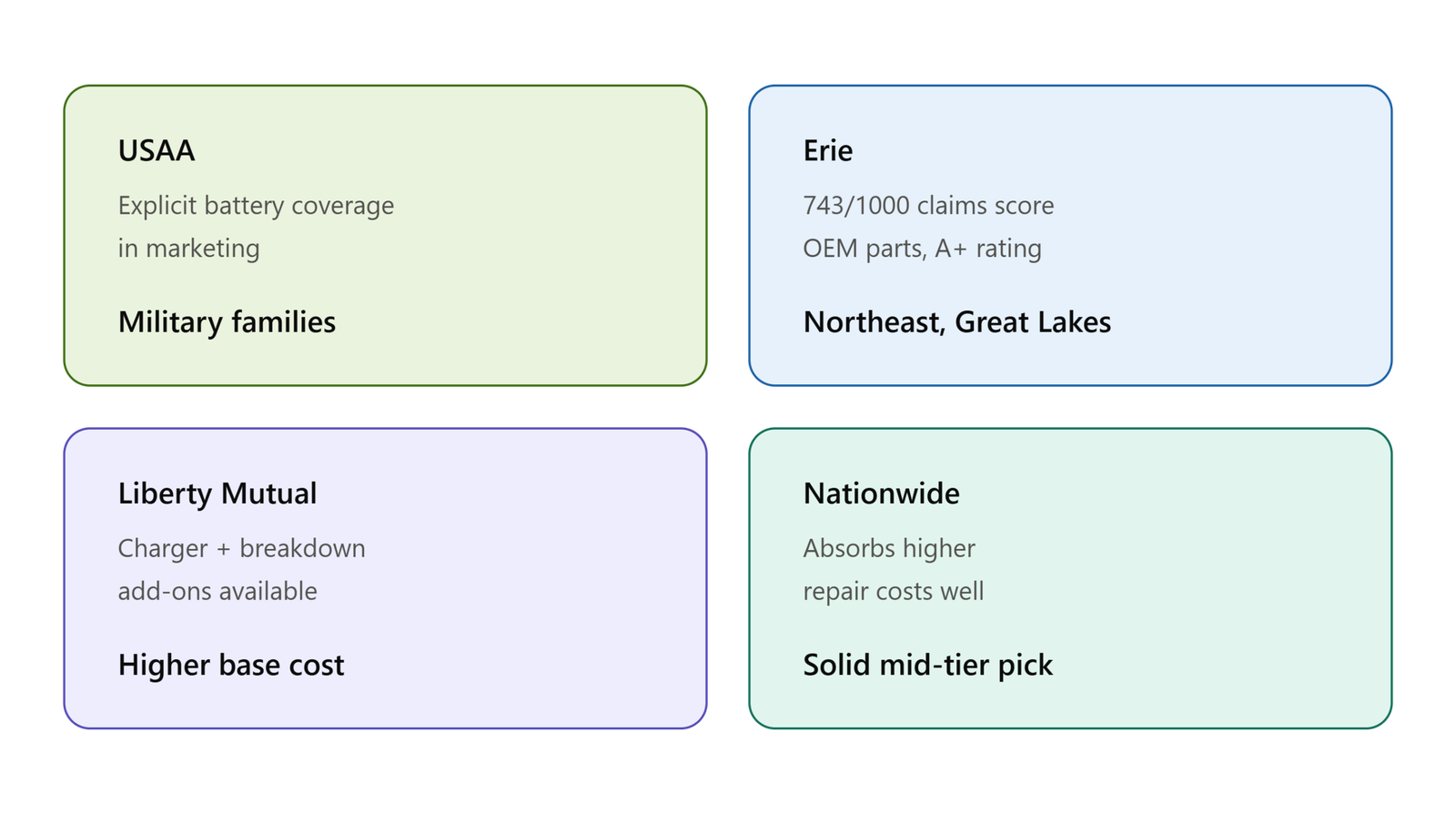
USAA — most explicit about battery coverage in its marketing USAA is repeatedly and specifically cited as advertising coverage for electric vehicle batteries directly, a distinction most competitors don’t make as clearly in their own marketing materials. Combined with USAA’s consistently strong pricing covered throughout this site, it’s the clearest starting point if you’re eligible through military affiliation and want battery coverage spelled out rather than inferred from standard policy language.
Erie Insurance — strongest claims-handling track record for EV-specific repairs Erie posts a notably strong claims satisfaction score (743 out of 1,000 in one industry measurement) specifically relevant to hybrid and electric vehicle owners getting battery and electronic repairs approved. Erie also allows the use of manufacturer (OEM) parts for battery replacements, a meaningful detail given how much repair-cost variation on this site traces back to parts availability and quality. Backed by an A+ (Superior) A.M. Best financial strength rating, Erie is specifically positioned to handle the large payouts associated with high-voltage battery damage claims. The tradeoff, as covered in our broader Tesla insurer research, is limited geographic availability, concentrated in the Northeast and Great Lakes regions.
Liberty Mutual — most comprehensive EV-specific add-on structure Liberty Mutual stands out less for battery coverage in isolation and more for a broader package of EV-specific options: optional add-ons addressing charging stations and mechanical breakdown coverage, categories many competitors don’t address directly at all. It’s specifically described as offering thoughtful, comprehensive EV insurance accounting for the full spectrum of electric vehicle risk, including new car replacement (valuable given how quickly EVs depreciate, as covered in our leasing versus financing guide), battery-specific protection, and roadside assistance tailored to range-related breakdowns rather than just generic towing. Liberty Mutual has also specifically invested in training its claims teams on EV repair protocols, aiming to ensure vehicles are restored to manufacturer specifications rather than repaired with shortcuts. The tradeoff: Liberty Mutual is generally a more expensive option overall, with liability averaging around $129 a month and full coverage around $207 a month for a clean-record driver, regardless of vehicle type.
Nationwide — strong on higher repair-cost absorption Nationwide is repeatedly grouped alongside Erie and Liberty Mutual as one of the strongest overall performers for hybrid and electric vehicle owners specifically, credited with helping absorb the higher repair costs that come with these vehicles. Combined with the repair network access and policy perks covered in our broader insurer ranking, Nationwide represents a solid mid-tier option for battery-related claims confidence without Erie’s geographic limitations.
Allstate — repair network experience with EV-specific work Allstate is specifically noted, alongside Liberty Mutual, for a repair network with genuine experience handling EV repairs, a meaningful distinction given that a battery replacement can exceed $10,000, as covered in our detailed battery cost breakdown, and an inexperienced repair network can turn an already expensive claim into a slow, frustrating one.
Where Tesla Insurance fits into this comparison
It’s worth a direct mention given how often it comes up elsewhere on this site: Tesla Insurance’s coverage structure does address battery-related risk as part of its standard offering, but as covered extensively in our dedicated Tesla Insurance review, the company’s claims-handling track record, including a 2025 California regulatory action over systemic claims-handling failures, is a serious factor to weigh against any battery-coverage marketing claims. A policy that technically covers battery damage isn’t worth much if the claims process itself is unreliable when you actually need it.
What to actually ask when shopping specifically for battery protection
Given that standard coverage exists everywhere but quality varies enormously, a few direct questions are worth asking any insurer you’re comparing:
- «Does your claims team have specific training on high-voltage EV systems?» This is different from asking whether battery damage is covered, since the answer to that is almost always yes. The real question is whether the person handling your claim actually understands what they’re looking at.
- «Do you use OEM (manufacturer) parts for battery repairs, or aftermarket alternatives?» As Erie’s example shows, this varies by insurer and can meaningfully affect both repair quality and how quickly a claim moves.
- «What’s your typical timeline for a battery-related claim, from report to resolution?» Given how expensive and complex these repairs are, as covered throughout this site, timeline variance between insurers can be significant.
- «Do you offer any EV-specific add-ons beyond standard comprehensive and collision?» As Liberty Mutual’s example shows, some insurers offer genuinely distinct options, mechanical breakdown coverage, charging equipment protection, range-related roadside assistance, worth asking about directly rather than assuming a standard policy covers everything.
- «What’s your financial strength rating?» Given that a battery replacement claim can represent a payout in the tens of thousands of dollars, as covered in our battery cost guide, an insurer’s ability to actually pay large claims (reflected in ratings like Erie’s A+ A.M. Best rating) matters more here than it might for a smaller, routine claim.
The bottom line
Every standard auto policy covers EV battery damage from a covered event, so «does this insurer cover my battery» is almost never the right question to ask. The better question is which insurer handles that coverage competently: USAA stands out for explicitly marketing battery coverage and consistently strong pricing if you’re eligible, Erie for its strong claims-handling track record and OEM parts access within its limited geographic footprint, Liberty Mutual for the most comprehensive EV-specific add-on structure despite higher baseline costs, and Nationwide and Allstate as solid mid-tier options with genuine EV repair network experience. Whichever you choose, ask the specific questions above rather than assuming a «yes, we cover batteries» answer tells you everything you need to know.
This article is for informational purposes only and does not constitute financial or insurance advice. Coverage details, claims-handling quality, and pricing vary by insurer, state, and individual policy, and change frequently. Always confirm specific coverage terms directly with any insurer before making a purchasing decision.