Cheapest EV Insurance Companies for Bad Credit
Credit-based insurance scoring is one of the least understood factors in your EV premium, and it’s also one of the most punishing. Drivers with poor credit pay dramatically more than drivers with excellent credit for the identical coverage, a gap that compounds badly with the already-elevated cost of EV insurance covered throughout this site. This guide covers exactly how much bad credit costs you, which insurers handle it best, and what you can actually do about it.
Key takeaways:
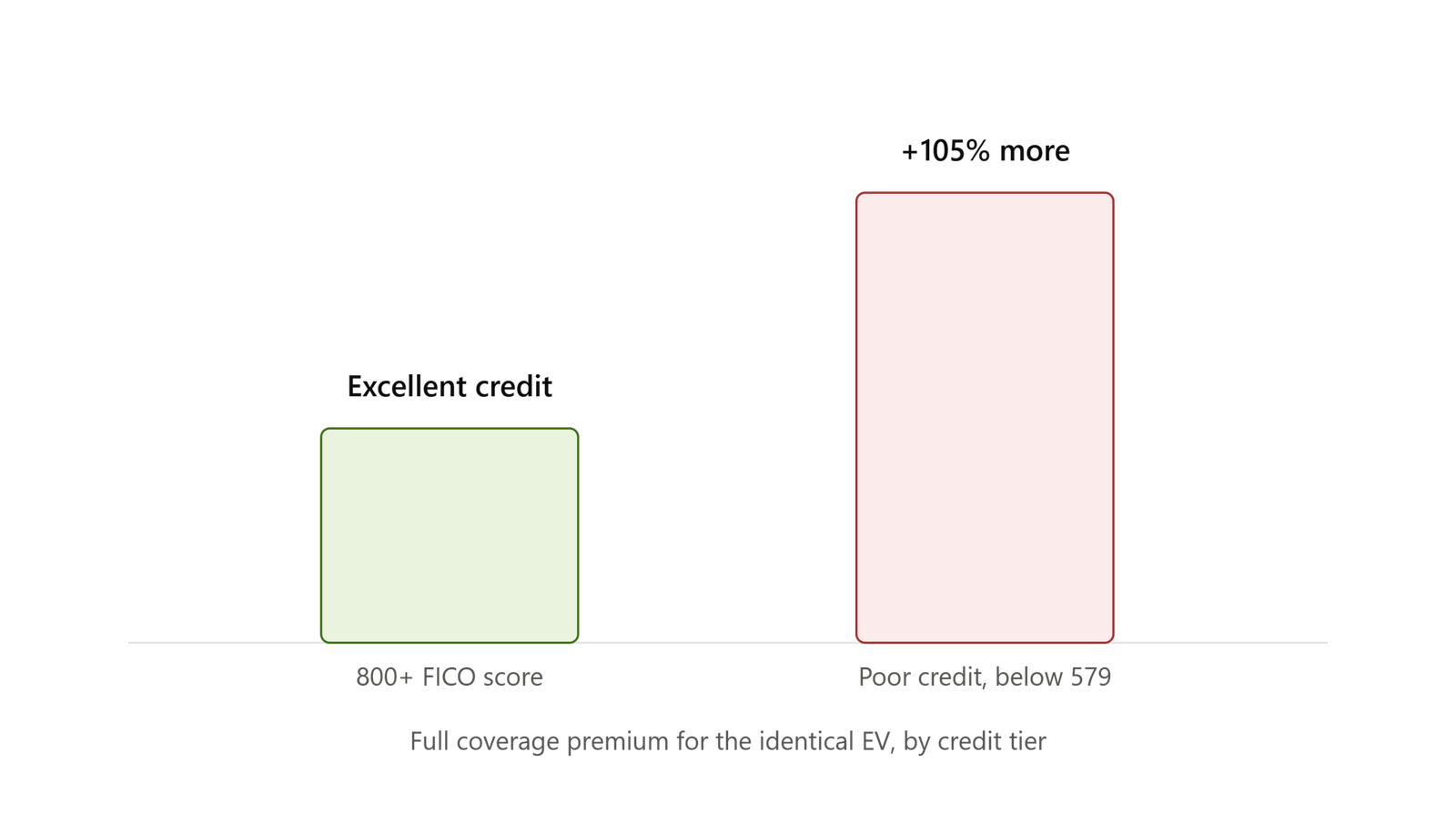
- Drivers with poor credit (a FICO score below 579) pay an average of 105% more for full coverage than drivers with excellent credit (800 or above), more than double for the identical vehicle and coverage.
- Nationwide, GEICO, and USAA consistently post the lowest rates among major carriers for drivers with bad credit, with Nationwide averaging around $2,635 a year and GEICO around $181 a month.
- Amica stands out specifically for pricing bad-credit drivers about 30% below the industry average, backed by an unusually large discount menu of 18 available options.
- Eight states, including California and Massachusetts, prohibit insurers from using credit-based scoring entirely, a genuinely useful fact if you have flexibility about where you’re insured.
Why credit affects your EV premium so much
Insurers in most states use a credit-based insurance score, distinct from your regular credit score but built from similar underlying data, as one of the rating factors in your premium. The reasoning insurers give is statistical: broad industry data has shown a correlation between credit-based scores and the likelihood of filing a claim, and insurers price that correlation into your rate regardless of your actual driving record.
The dollar impact is severe. Drivers with poor credit pay on average 105% more for full coverage than drivers with excellent credit, according to Bankrate data, more than double the premium for the identical vehicle and coverage level. For an EV owner, this compounds with everything else covered throughout this site: the general EV cost premium, your age, your specific model, and now your credit score, all stacking on top of each other rather than averaging out.
The real numbers among major insurers
Pulling together multiple 2026 sources specifically focused on bad-credit pricing:
- Nationwide posted an average rate of $2,635 a year for drivers with poor credit in one comprehensive comparison, among the lowest figures found for this specific driver profile.
- GEICO came in among the cheapest major carriers for poor-credit drivers at roughly $181 a month, consistent with GEICO’s broader affordability covered throughout our other insurer comparisons.
- USAA ranked third among major carriers for poor-credit drivers at around $199 a month, though as always restricted to military-affiliated members.
- Amica stands out with rates for poor-credit drivers running about 30% below the industry average, a notably strong figure, backed by an unusually large menu of 18 different available discounts to stack on top of that already-favorable base rate.
The overall pattern: the same insurers that perform well in our broader EV cost comparisons, Nationwide, GEICO, and USAA in particular, also tend to handle bad-credit pricing more favorably than average, though Amica specifically distinguishes itself as a strong option focused on this driver profile.
Best insurers for bad-credit EV drivers, ranked
1. Nationwide — strongest overall combination for this profile Nationwide’s competitive bad-credit pricing, combined with the broader EV strengths covered throughout this site (SmartMiles pay-per-mile savings up to 30% for lower-mileage drivers, SmartRide behavior-based discounts up to 40%, and a free annual On Your Side Review to catch missed discounts), makes it a particularly strong starting point if bad credit is combining with other cost factors like high mileage, as covered in our dedicated high-mileage EV guide.
2. GEICO — consistently cheap regardless of credit profile GEICO’s strong bad-credit pricing tracks with its broader reputation covered throughout our other insurer comparisons as one of the most consistently affordable major carriers across nearly every driver profile, not just clean-credit, clean-record drivers.
3. Amica — best rate specifically for this profile, plus a large discount menu Amica’s 30%-below-average pricing for poor-credit drivers, combined with 18 available discounts including up to 30% for bundling life, home, or renters insurance, makes it worth a direct quote specifically because it’s positioned favorably for this exact situation rather than just generally competitive.
4. USAA — best if you qualify As with nearly every comparison on this site, USAA’s strong bad-credit pricing makes it worth checking first if you have any military affiliation in the household.
The eight states where this entire problem doesn’t apply
This is worth knowing regardless of your credit situation: eight states prohibit insurers from using credit-based scoring in auto insurance pricing at all, including California, Hawaii, Massachusetts, Michigan, and a handful of others. If you live in one of these states, your credit score simply isn’t a factor in your EV premium, and the entire comparison in this article becomes largely irrelevant to your specific situation. If you have any flexibility about where you register a vehicle or establish residency, and bad credit is a significant financial factor for you, this is worth knowing, though it obviously shouldn’t be the primary driver of a major life decision like where you live.
How to actually improve your position, beyond just picking the right insurer
Improve your credit score directly, even modestly. Since credit-based scoring works on a curve rather than a binary threshold, even a modest improvement in your underlying credit can meaningfully reduce your premium, unlike some rating factors (like your specific EV model) that are fixed once you’ve already bought the vehicle.
Stack every available discount aggressively. Given how much bad credit already elevates your baseline, the dollar value of every discount covered throughout our broader savings guide, bundling, telematics, defensive driving courses, becomes proportionally larger. Amica’s 18-discount menu specifically illustrates why a insurer with a deep discount stack can matter more for this driver profile than for an already-favorably-priced clean-credit driver.
Consider a higher deductible. As covered throughout this site, raising your deductible lowers your premium, and given how elevated a bad-credit EV premium already runs, the percentage savings translate into larger absolute dollars than they would for a lower baseline.
Prioritize a mainstream, lower-cost-to-insure EV if you’re still choosing a vehicle. As covered in our ranking of the cheapest EVs to insure, vehicle choice remains one of the largest levers available, and it matters even more when credit is already working against you, since the two factors compound rather than offset each other.
Re-shop specifically as your credit improves, not just annually. Unlike age, which improves automatically over time, credit improvement requires active management, but the payoff for actually paying attention to it and re-shopping once your score moves meaningfully is real and often underestimated.
A note on how this interacts with other EV-specific factors
Bad credit doesn’t operate in isolation, it stacks with everything else covered throughout this site. A young driver with bad credit driving a Tesla Model X in a high-cost state, as covered in our age, model ranking, and state guides respectively, is combining four separate elevated-cost factors simultaneously, not just one. If multiple of these factors apply to your specific situation, the practical levers you actually control, vehicle choice, insurer selection, discount stacking, and deductible level, become proportionally more important, since you can’t change your age or your state overnight, but you can control which EV you buy and which insurer you choose.
The bottom line
Bad credit can more than double your EV insurance premium compared to excellent credit, a genuinely severe penalty that compounds with every other cost factor covered throughout this site. Nationwide, GEICO, and USAA consistently offer the most competitive pricing for this specific driver profile among major national carriers, while Amica stands out for pricing specifically favorable to bad-credit drivers combined with an unusually deep discount menu. If you live in one of the eight states that prohibit credit-based insurance scoring entirely, this factor doesn’t apply to you at all, worth knowing if you have any flexibility in where you’re insured. For everyone else, comparison shopping specifically among these credit-friendly insurers, combined with aggressive discount stacking, is the most reliable way to soften a genuinely painful cost factor.
This article is for informational purposes only and does not constitute financial or insurance advice. Insurance rates, credit-scoring practices, and state regulations vary by insurer and location, and change frequently. Always get a personalized quote before making a purchasing decision.