Does Car Insurance Cover EV Battery Damage? Complete Answer
The short answer: yes, if the damage comes from a covered event like a collision, fire, theft, or storm. No, if it’s gradual wear, a manufacturing defect, or certain edge cases like power surges from your own home charger. The real answer depends entirely on which scenario you’re in, and this guide walks through every one of them so there’s no ambiguity when you actually need to know.
Key takeaways:
- Comprehensive and collision coverage generally pay for battery damage from a collision, fire, theft, vandalism, or weather event, minus your deductible, the same as any other part of your car.
- Normal capacity loss over time, manufacturing defects, and internal malfunctions are never covered by auto insurance under any circumstances, that’s the manufacturer’s warranty’s job, typically 8 years or 100,000 miles.
- A real, documented case shows insurers denying claims for battery damage caused by a power surge during home charging, a genuine gap most owners don’t know exists until it’s too late.
- Because battery replacement can cost $13,000 to over $22,000, insurers frequently declare a total loss rather than repair, even for damage that would be a routine fix on a gas car.
The baseline rule, in one sentence
Standard auto policies generally cover EV battery damage caused by a covered event, meaning collision, fire, vandalism, or storm, under your collision or comprehensive coverage, minus your deductible, the exact same way those coverage types handle damage to any other part of your vehicle. The battery isn’t treated as a special, excluded component when the cause of damage is something your policy already covers. What matters isn’t the battery itself, it’s the cause of the damage.
Scenario by scenario: what’s actually covered
You hit another car, a wall, or a pole, and the battery is damaged. Collision coverage typically pays for repair or replacement of the battery, or the whole vehicle if it’s totaled, minus your deductible. This is the most straightforward scenario and works essentially like any other collision claim.
Your EV is damaged by flood, fire, falling objects, vandalism, or theft. Comprehensive coverage typically applies here. Water intrusion into the battery pack or fire damage is handled under comprehensive, subject to the insurer’s repair-versus-total-loss decision, covered in more detail below.
Someone else hits you and it’s their fault. Their liability coverage should pay for your battery damage as part of the overall vehicle damage claim. Your own liability coverage, by contrast, only pays for damage you cause to others, it never repairs your own vehicle regardless of fault, an important distinction covered further below.
Thermal runaway or a battery fire occurs. This is generally covered under comprehensive, treated the same as any other vehicle fire, provided the fire wasn’t caused by something specifically excluded, like a known defect you failed to address under a safety recall.
Your battery is damaged by a pothole, road debris, or a puncture while driving. This typically falls under collision coverage, since it’s a sudden, accidental impact rather than gradual wear, similar to how a pothole-related suspension or tire claim would be handled on any vehicle.
Scenario by scenario: what’s never covered, regardless of insurer
Gradual capacity loss from normal aging and use. Every lithium-ion battery loses some capacity over time and mileage, this is expected, well-documented behavior, not damage in the insurance sense. It’s considered maintenance, not an insurable event, and no auto policy from any insurer covers it. This is exclusively the manufacturer’s warranty’s responsibility, typically guaranteeing a minimum capacity retention (commonly around 70%) for 8 years or 100,000 miles.
Manufacturing defects. If a battery fails due to a defect in how it was built, that’s a warranty and potentially a recall matter, not an insurance claim. Auto insurance responds to sudden, accidental, external causes of damage, not internal product defects.
Internal malfunctions or software issues. A battery management system glitch or internal electrical fault that isn’t the result of a collision or other covered peril generally isn’t something your auto policy addresses, again falling to the manufacturer.
Liability-only coverage, in any scenario involving your own vehicle. This is a distinction worth being explicit about: liability coverage pays for damage you cause to other people and their property, it never repairs your own car, battery included, regardless of whether you were at fault. If you’re carrying liability-only coverage, as covered in our broader guide to EV insurance costs, your own battery has no insurance protection at all outside of what liability might indirectly cover through another driver’s policy if they were at fault.
The gap most owners don’t know about: home charging incidents
This is worth its own dedicated section because it’s a genuine, documented coverage gap that catches owners off guard specifically because it sits in a gray area between «covered event» and «excluded cause.»
A real, documented case illustrates this clearly: an EV owner with standard comprehensive and collision coverage experienced a battery pack failure after a severe thunderstorm caused a power surge through his home charging setup, a $17,800 replacement cost. His insurer denied the claim, explaining that the standard comprehensive policy covered fire, theft, and weather damage to the vehicle’s body, but explicitly excluded electrical system failure caused by an external power supply issue, meaning the power surge originated from his home’s electrical system rather than being direct storm damage to the vehicle itself.
This is a meaningfully different scenario than the storm and weather coverage described earlier in this article, and the distinction matters: direct weather damage to your vehicle (hail, flooding, a falling tree branch) is generally covered under comprehensive, but damage transmitted through your home’s electrical system during charging occupies a genuine gray area that some standard policies exclude outright. As covered in our dedicated guide to home charger insurance, this is exactly the kind of scenario where confirming your specific coverage with your insurer, and potentially your homeowners policy, before an incident happens matters far more than assuming standard coverage has you protected.
Why battery claims so often become total-loss claims
Given how expensive battery replacement runs, as covered in our detailed battery cost breakdown ($13,000 to $20,000 for a Tesla Model 3, exceeding $22,000 for a Model S or Model X), insurers frequently declare a vehicle a total loss rather than authorizing repair, even for damage that would be a routine fix on a gas car with a cheaper-to-replace engine. If repairing or replacing a damaged battery costs more than the vehicle is actually worth, insurers generally total the car and pay out its actual cash value instead of covering the repair. This pattern is backed by broader claims data: EV claim frequency runs about 17% higher than for gas vehicles overall, and the average EV takes 15.6 days to repair after a collision versus 12.7 days for a gas vehicle, both factors that push insurers toward total-loss decisions rather than lengthy, expensive repairs.
Does GAP insurance interact with battery coverage?
Yes, and it’s worth understanding the connection given how often battery damage leads to a total loss. If you owe more on your EV than your comprehensive or collision coverage pays out after a total loss, a real possibility given how quickly new vehicles depreciate as covered in our leasing versus financing guide, gap insurance covers that difference. Given how frequently battery damage specifically triggers a total-loss decision rather than a repair, gap insurance is arguably more relevant for EV owners than for gas car owners carrying comparable loan balances, a connection worth considering alongside the standard gap insurance guidance covered elsewhere on this site.
Should you buy additional battery-specific coverage?
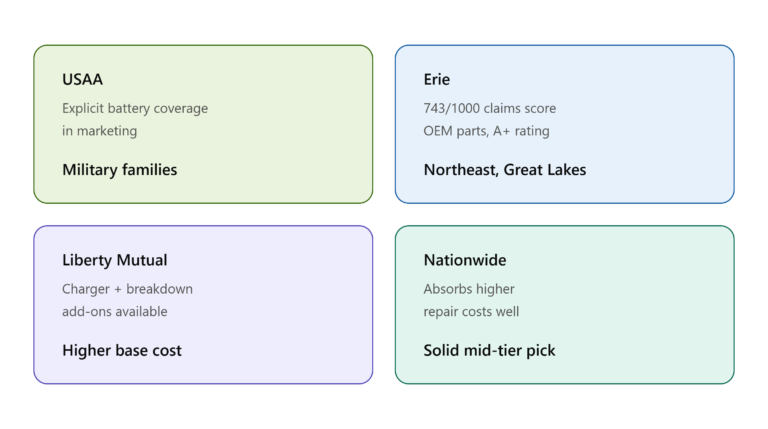
Some insurers offer optional EV-specific add-ons or mechanical breakdown insurance (MBI) that extends beyond standard comprehensive and collision, particularly useful once your manufacturer’s warranty expires. As covered in our guide to which insurers actually cover EV battery replacement, Liberty Mutual and a handful of others offer distinct EV-focused options worth comparing directly. Before buying any add-on, ask your insurer these specific questions:
- Does this policy cover the battery pack in a non-collision event, including scenarios like the home-charging power surge described above?
- Is damage from a power surge during home charging specifically covered or specifically excluded?
- Do you offer mechanical breakdown coverage once the manufacturer’s warranty expires?
- If the insurer can’t answer these clearly and specifically, that’s a signal to compare other options rather than assume standard language covers you.
A quick reference checklist
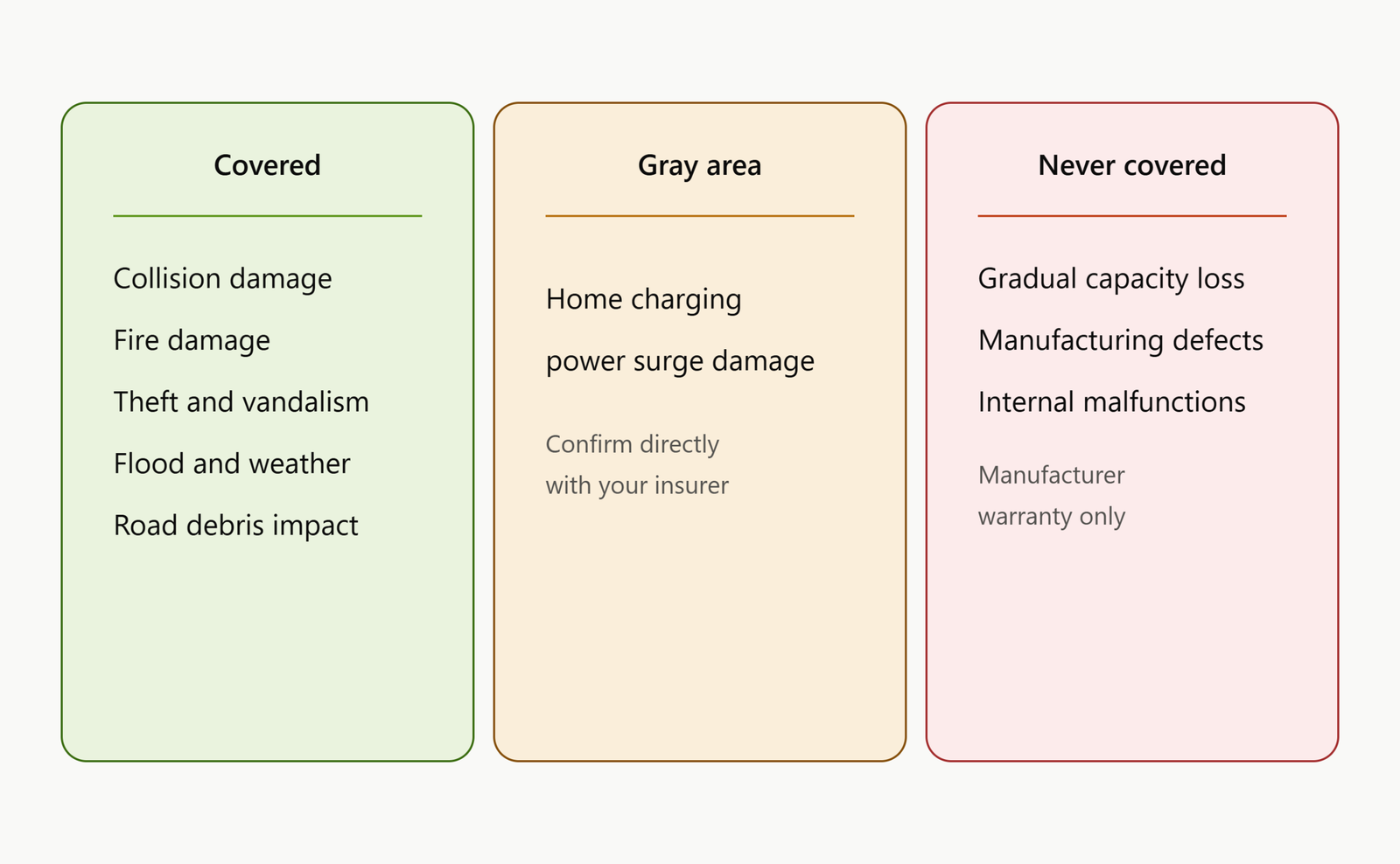
Covered under standard comprehensive/collision:
- Collision damage to the battery
- Fire damage (with some exclusions, see below)
- Theft-related damage
- Vandalism
- Flood and weather damage
- Falling objects and road debris impacts
Not covered, ever, by any standard auto policy:
- Gradual capacity loss from age and normal use
- Manufacturing defects
- Internal malfunctions or software issues
- Damage while carrying liability-only coverage
Gray area, confirm directly with your insurer:
- Power surge or electrical damage transmitted through your home charging setup
- Damage during a covered event that also involves any element of owner negligence or improper charging practices
The bottom line
Car insurance does cover EV battery damage, but only from a covered event, collision, fire, theft, vandalism, or weather, under comprehensive or collision coverage, minus your deductible. It never covers gradual wear, manufacturing defects, or internal malfunctions, that’s exclusively the manufacturer’s warranty’s job. The genuinely important gap most owners don’t know about until it’s too late is home-charging-related electrical damage, which some standard policies specifically exclude even though it might feel like it should fall under weather or fire coverage. Given how expensive battery replacement runs and how often it triggers a total-loss decision rather than repair, confirming these specifics with your insurer before an incident happens, not after, is genuinely worth the ten-minute phone call.
This article is for informational purposes only and does not constitute financial or insurance advice. Coverage details vary significantly by insurer, policy, and state. Always confirm specific coverage terms directly with your insurer.