Does EV Insurance Cover Charging Cable Theft?
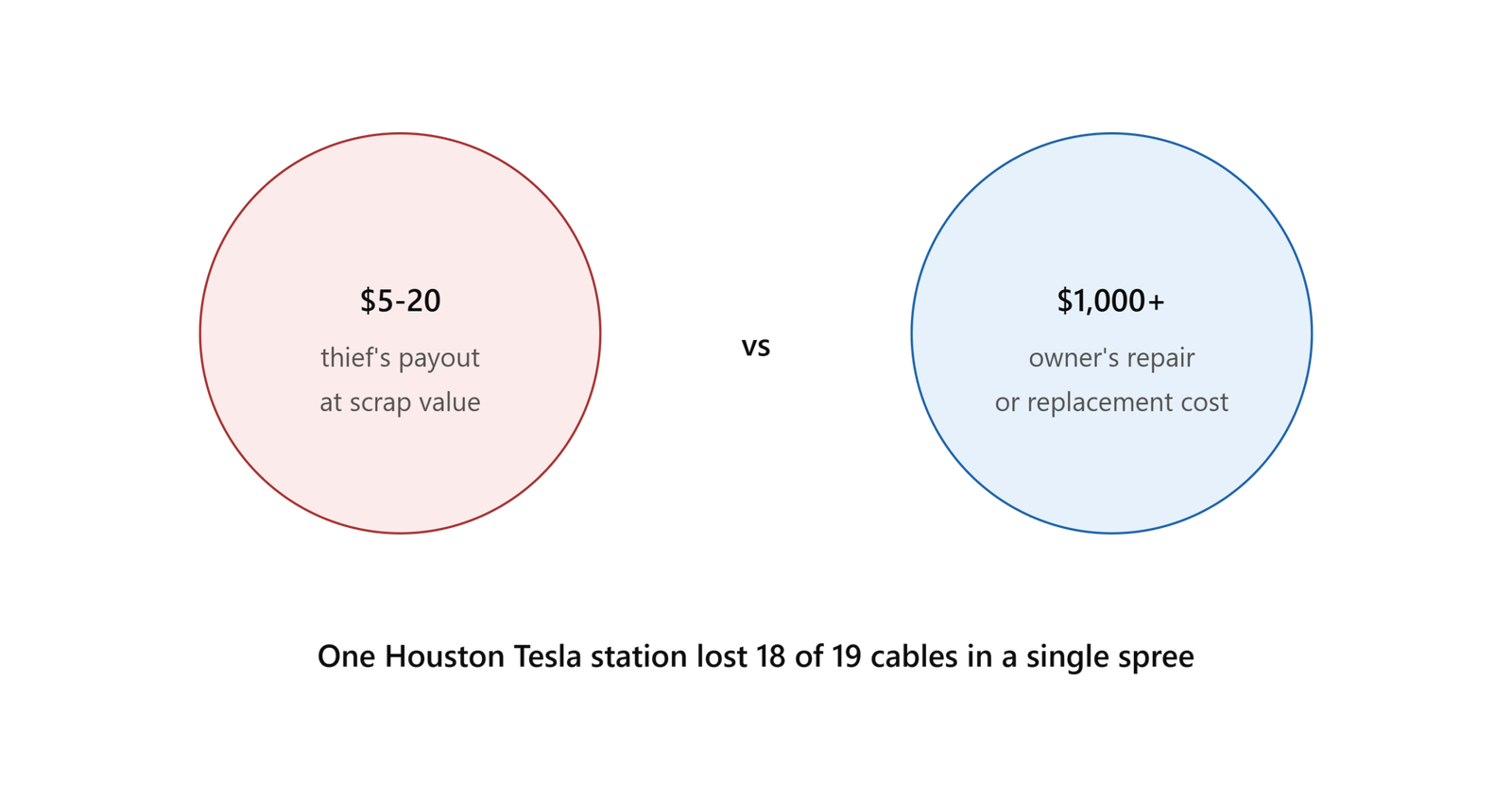
Charging cable theft has gone from a rare oddity to a documented, accelerating problem, and the strange part is how little the thieves actually get for it. A stolen cable nets a criminal maybe $5 to $20 worth of copper at a scrap yard, while replacing that same cable costs the owner or charging network over $1,000. This guide covers whether your policy actually protects you against this specific, growing risk, and what you can do to avoid becoming a statistic.
Key takeaways:
- Comprehensive auto insurance generally covers charging cable theft, but coverage depends on how your specific insurer classifies the cable, as part of the vehicle, a separate accessory, or under a homeowners policy instead.
- The theft economics are almost absurd: a cable contains roughly $5 to $20 worth of copper, but repair or replacement commonly exceeds $1,000, and public charging networks have documented hundreds of stolen cables at individual site clusters.
- Filing repeated theft claims for the same cable can trigger a rate increase or non-renewal, even though each individual incident is technically a covered loss.
- Physical prevention (locking cables, garage installation, visibility reduction) remains more effective than relying on insurance alone, since insurance replaces the cable but doesn’t prevent the disruption of losing access to your charger.
[AD BREAK — insert in-content ad unit here]
How big is this problem, actually?
This isn’t a hypothetical risk, it’s a documented, growing trend across the public charging network specifically, with real implications for home charging owners too. Electrify America reported a cut cable at one of its stations roughly every six months two years ago; through May of a recent year, reported cut cables had already reached 129, four more than the entirety of the prior year. Flo and EVgo have reported similar increases, and Tesla’s own Supercharger stations haven’t been spared: at one Houston-area Tesla station, thieves stole 18 of the station’s 19 charging cables in a single spree. In the UK, one major charging operator reported 174 cables stolen across 27 sites over an eight-month window.
While these figures center on public charging infrastructure, the underlying motivation, extracting and reselling copper, applies just as much to a cable sitting in your driveway as to one at a public station, and insurers are aware this is a developing form of crime likely to affect pricing over time even though comprehensive official statistics specific to home charging theft don’t yet exist.
The strange economics behind this crime
This is worth understanding because it explains why the crime keeps happening despite yielding thieves so little. A charging cable’s copper content is worth remarkably little once stripped and sold, commonly cited figures range from about $5 to $20 per cable at scrap value. Copper prices have hit record highs in recent years, which is part of what’s driving the increase in thefts despite each individual cable yielding so little, opportunistic thieves calculate that a pair of bolt cutters and a few minutes of effort is worth even a small, fast cash payout with minimal traceability once the copper reaches a scrap yard.
Meanwhile, the cost to the owner or operator is dramatically disproportionate: repairing or replacing a damaged charging station or cable can run £1,000 (roughly $1,270) or more for a public charging operator, and a home charger’s cable replacement, while typically less than a full station repair, still represents a meaningful expense relative to the few dollars of copper the thief actually recovers.
[AD BREAK — insert in-content ad unit here]
Is it actually covered, and by which policy?
This is where the answer gets genuinely specific to your situation, since coverage depends on classification, not just the fact that a theft occurred.
If the cable came with your vehicle and is treated as part of it: comprehensive auto insurance coverage typically applies, since theft of vehicle-related equipment falls under the same comprehensive coverage discussed throughout our guides to EV battery and charger damage.
If your insurer classifies the cable as a separate accessory rather than part of the vehicle: coverage becomes less automatic, and you may need to confirm specifically whether accessories are covered under your policy or whether a separate endorsement is required.
If the cable is part of a permanently installed home charging station: as covered in our dedicated home charger damage guide, this typically falls under your homeowners or renters policy rather than your auto policy, meaning a stolen cable from your home charger may need to be claimed against your property insurance instead.
If it’s a portable cable stored in your trunk or frunk: this occupies a genuine gray area. It could reasonably be classified as vehicle equipment (auto policy) or personal property (homeowners/renters policy), and the honest answer is that your insurer’s specific classification determines which applies, worth confirming directly rather than assuming.
The practical takeaway, consistent with a theme throughout this site: don’t assume coverage exists just because «comprehensive» sounds broad. Confirm directly with your insurer whether charging cable theft specifically is covered, and under which policy, before you need to file a claim.
The claims-frequency trap
Even when coverage clearly applies, there’s a downstream consequence worth understanding before you file repeated claims for the same recurring issue. Filing multiple theft claims for cable replacement, even though each one is individually a legitimate, covered loss, can trigger a rate increase or, in a worst case, non-renewal of your policy. Insurers track claim frequency independent of fault, and a pattern of repeated small claims for the same vulnerability can read as elevated risk regardless of the underlying cause being genuinely outside your control.
This creates a real incentive to invest in prevention rather than relying purely on insurance to absorb repeated losses, covered in detail below.
[AD BREAK — insert in-content ad unit here]
How to actually prevent cable theft
Given the claims-frequency issue above, prevention is worth taking seriously rather than treating insurance as a full substitute for physical security:
Install your home charger in a garage rather than a visible driveway, if you have that option. Many EV owners charge in driveways specifically because they’re convenient and visible, but that same visibility is exactly what attracts opportunistic theft. A garage removes the cable from casual view entirely.
Invest in a locking cable or charging port lock. Purpose-built devices exist specifically to physically secure a charging cable to the vehicle or the charging unit, meaningfully raising the effort required for a theft attempt beyond what an opportunistic thief is willing to invest.
Use a cable organizer or storage solution when the cable isn’t in use. Beyond protecting the cable from wear, as covered in our broader charger maintenance guidance, storing it out of sight reduces its visibility as a target, similar to the garage-installation logic above.
Consider a cable alarm. Newer devices specifically designed to detect tampering or cutting attempts and trigger an audible alert have emerged in response to the rising theft trend, worth researching if you live in an area with documented incidents nearby.
Document your charger and cable with photos and receipts, consistent with the general claims-preparation advice covered throughout our other charger and battery coverage guides. This streamlines any claim you do need to file and supports an accurate valuation.
Report theft to police, even if recovery seems unlikely. Beyond supporting your insurance claim, consistent police reports help law enforcement and charging operators track the broader pattern of this crime in your area, and stolen or damaged public charging infrastructure can carry more serious legal consequences for the thief than a simple theft charge.
What to ask your insurer specifically
Given the classification ambiguity covered above, ask directly:
- Does my comprehensive coverage specifically include theft of the charging cable, or only the charging unit itself?
- How does my policy classify a portable cable I store in the vehicle versus one attached to a permanently installed home charger?
- Will multiple theft claims for the same recurring issue affect my renewal or rate, and if so, at what point?
- Does my homeowners or renters policy cover a home charger’s cable separately from my auto policy, and is there any overlap or gap between the two?
The bottom line
Charging cable theft is a real, accelerating, and financially lopsided crime, thieves net a few dollars in copper while owners and operators absorb a repair bill that can exceed $1,000. Whether your specific policy covers it depends on how your insurer classifies the cable, part of the vehicle, a separate accessory, or home property, so confirming this directly, rather than assuming «comprehensive» covers everything, is worth the ten-minute call. Given that repeated claims can affect your rate even when each one is a legitimate covered loss, pairing insurance with genuine physical prevention, garage storage, locking cables, and reduced visibility, is the more resilient approach than relying on your policy alone to absorb a recurring, preventable vulnerability.
This article is for informational purposes only and does not constitute financial or insurance advice. Coverage details and classifications vary significantly by insurer and policy. Always confirm specific coverage terms directly with your insurer.