EV Insurance in Massachusetts: Full Guide
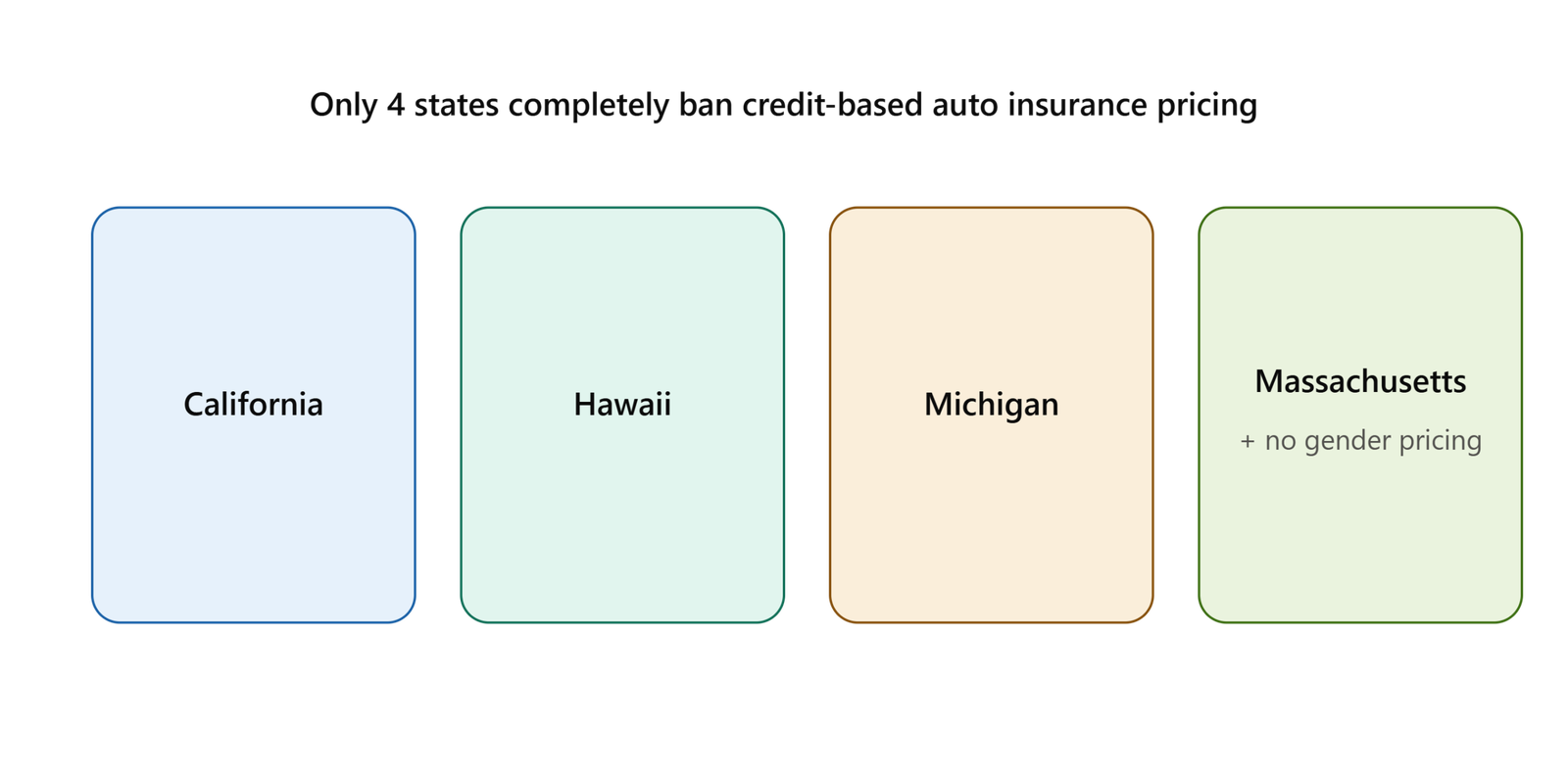
Massachusetts stands out for two consumer protections that directly benefit EV owners, alongside anyone else with less-than-perfect credit: it’s one of only four states in the country that completely bans credit-based insurance pricing, and it separately prohibits gender-based pricing entirely. Combine that with genuinely strong purchase-side incentives through the MOR-EV program, and Massachusetts offers a distinct and, in several ways, favorable environment for EV owners. This guide covers the full picture.
Key takeaways:
- Massachusetts is one of only four states, alongside California, Hawaii, and Michigan, that completely bans insurers from using credit information, credit scores, or credit-based insurance scores when setting, underwriting, or renewing auto insurance rates.
- Massachusetts also prohibits gender-based pricing entirely, a further consumer protection not universal across the states covered throughout this site.
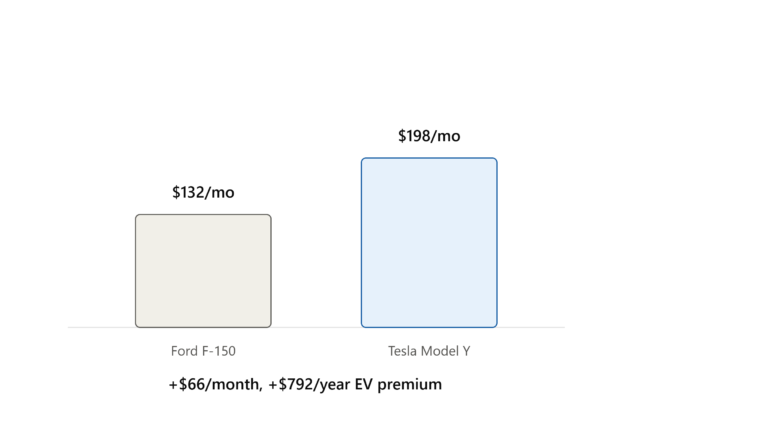
- A Tesla Model Y costs $95 a month more to insure in Massachusetts than a Ford F-150, $263 versus $168 for full coverage, while the cheaper Tesla Model 3 runs $230 a month, still $62 above the F-150.
- Massachusetts offers a MOR-EV rebate of up to $3,500 for new EVs (with a $55,000 MSRP cap), plus an additional $1,500 for income-qualified buyers through MOR-EV+ and $1,000 for an ICE trade-in, genuinely strong purchase-side incentives layered on top of the insurance picture.
The two consumer protections that set Massachusetts apart
This is worth leading with, since it’s a genuine, quantifiable advantage for a meaningful share of EV shoppers.
No credit-based pricing, ever. Massachusetts law (M.G.L. c. 175, § 4E) explicitly prohibits auto insurers from using credit information, credit scores, or credit-based insurance scores when setting rates, underwriting new policies, or renewing existing ones. In practice, a driver with a 520 credit score and a driver with a 790 credit score receive identical quotes from the same carrier, all else being equal. This connects directly to the broader bad-credit EV insurance guidance covered elsewhere on this site, where we noted that drivers with poor credit pay on average 105% more than drivers with excellent credit nationally, a penalty that simply doesn’t apply in Massachusetts at all.
No gender-based pricing. Massachusetts additionally prohibits insurers from pricing based on gender, a further protection that isn’t universal across the states covered throughout our broader research, and one worth knowing about specifically if you’re comparing Massachusetts against a state where this factor still applies to your specific driver profile.
The real EV cost numbers
In Massachusetts, a Tesla Model Y costs $95 a month more to insure than a Ford F-150, $263 versus $168 for full coverage, making the Model Y the most expensive vehicle in one detailed comparative analysis, while the F-150 was the least expensive. The cheaper Tesla Model 3 runs $230 a month, still $62 more than the F-150, consistent with the trim and model hierarchy documented throughout our dedicated Tesla model guides. For budget-conscious comparison, a Honda Civic runs $177 a month and a Toyota Camry $187 a month in Massachusetts, meaning either gas-powered option costs $53 to $86 less per month than the Tesla models covered above.
The explanation given tracks the broader EV cost factors covered throughout this site: EV repair costs run higher because specialized battery systems and unique parts generate more expensive claims, the same underlying pattern documented across nearly every model and coverage guide on this site.
Massachusetts’s overall cost positioning
Massachusetts full coverage averages $1,800 a year statewide in one source, described as below the national average, though the Boston metro area specifically adds 25% to 55% above these statewide averages, a genuinely significant urban premium worth understanding if you’re comparing Boston-area costs against the broader state figures. This urban-versus-broader-state pattern is consistent with what we’ve documented throughout our other state guides, dense metro areas driving costs meaningfully above rural and suburban baselines.
Why Massachusetts costs what it does structurally
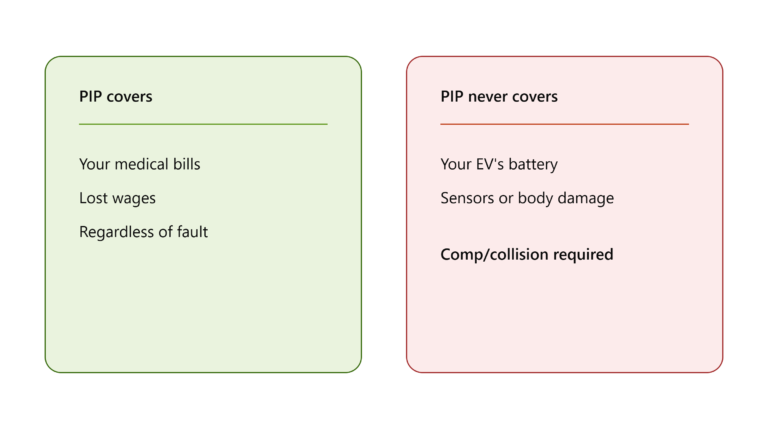
Massachusetts operates a no-fault insurance system requiring personal injury protection coverage, meaning insurers pay medical claims regardless of who caused the accident, which increases claim frequency and raises premiums statewide, the same structural pattern covered in our Florida, New York, Texas, and New Jersey no-fault guides. Dense urban traffic in Boston and Worcester adds to accident rates, and frequent nor’easters increase the risk of comprehensive claims, a genuinely regional weather factor worth knowing about specifically for Massachusetts, similar to how Florida’s hurricane exposure and Arizona’s heat each shape their own state-specific risk profiles covered in our dedicated guides.
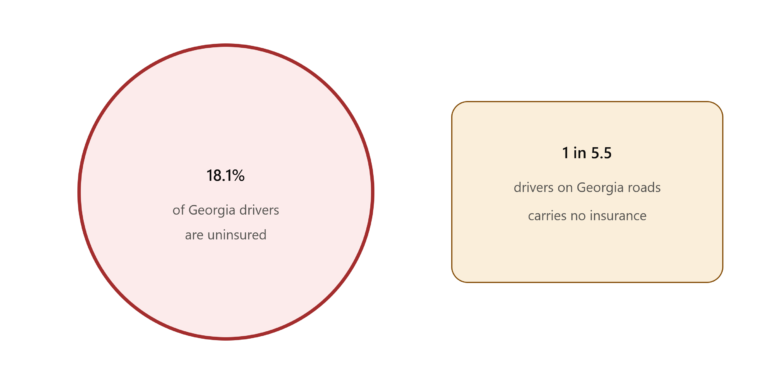
One genuinely favorable data point: Massachusetts’s uninsured driver rate sits at just 4.5%, well below the national average of 13%, which moderates the uninsured motorist component of premiums statewide, a meaningfully lower risk than the double-digit uninsured rates documented in our Texas and Florida guides.
Where the mandatory minimums fall short
The four mandatory coverages in Massachusetts, particularly the $5,000 property damage minimum, run lower than most experts recommend, worth increasing given how easily that figure can be exceeded by damage to any modern vehicle, and especially an EV given the elevated repair costs documented throughout this site’s broader coverage guides.
Massachusetts’s genuinely strong purchase-side incentives
Layered on top of the insurance picture, Massachusetts offers MOR-EV rebates of up to $3,500 for new battery electric vehicles, capped at a $55,000 MSRP, with an additional $1,500 available through MOR-EV+ for income-qualified buyers, and a further $1,000 for trading in an internal combustion vehicle, meaning a qualifying buyer could combine up to $6,000 in state-level incentives on top of whatever remains of federal incentive eligibility. A used-EV rebate of $3,500 is also available, capped at a $40,000 purchase price, though the separate federal used-EV credit ended September 30, 2025.
Massachusetts also specifically prohibits condo associations from unreasonably restricting EV charger installation in unit owner parking spaces, a meaningful protection connecting to the condo and HOA friction documented in our dedicated Tesla Wall Connector and home charger installation guides, and MassSave offers rebates for EV charging installations on top of the federal Section 30C credit, available through June 30, 2026.
Best insurers for Massachusetts EV owners
GEICO offers full coverage at $82 a month in one detailed comparison, against Safety Insurance’s $90 a month, an $8 monthly gap for the same driver and coverage.
Arbella and Amica Mutual, both regional carriers specializing specifically in the Massachusetts market, frequently outprice national brands here according to one source, since their local-market understanding lets them price more competitively than national carriers using generic state-level adjustments, worth prioritizing in your comparison shopping given this genuine regional-carrier advantage.
USAA, for those eligible through military affiliation, is specifically noted as offering some of the best coverage and support at the best rates in Massachusetts, consistent with USAA’s broader strength documented throughout this site.
Plymouth Rock stands out specifically for teen drivers, offering full coverage around $4,151 for a teen driver, 19% cheaper than the state average for that age group, worth prioritizing if you’re insuring a young EV driver in Massachusetts specifically, following the broader young-driver guidance covered in our dedicated age-based EV insurance guide.
If you can’t find coverage on the open market
Massachusetts maintains the Massachusetts Automobile Insurance Plan (MAIP) as a last-resort system for drivers who can’t find a carrier willing to sell them a policy voluntarily. This isn’t a discount program, rates through MAIP typically run higher than voluntary market rates, but it’s worth knowing about as a genuine safety net if you’re struggling to find coverage through standard channels, distinct from California’s Low Cost Automobile Insurance Program, which Massachusetts doesn’t offer an equivalent to.
Practical steps for Massachusetts EV owners
- Take full advantage of the no-credit-scoring and no-gender-pricing protections if either factor would otherwise work against you in a different state, this is a genuine, quantifiable Massachusetts-specific advantage.
- Get quotes from regional specialists Arbella and Amica Mutual alongside national carriers like GEICO, given the documented regional-pricing advantage covered above.
- Confirm your Boston-area status specifically, given the documented 25% to 55% urban premium over statewide averages.
- Consider coverage above the $5,000 property damage minimum, given how easily that figure is exceeded by any modern vehicle, especially an EV.
- Combine your insurance shopping with the MOR-EV rebate application, given how substantial the combined state incentive can run for qualifying buyers, up to $6,000 when stacking base, income-qualified, and trade-in bonuses.
- If insuring a teen driver, get a specific quote from Plymouth Rock, given its documented 19% discount below the state average for that age group.
The bottom line
Massachusetts offers EV owners a genuinely distinct combination: strong consumer protections through its ban on both credit-based and gender-based insurance pricing, a below-national-average statewide baseline (outside the Boston metro premium), and some of the strongest purchase-side EV incentives covered throughout this site’s state-by-state research, up to $6,000 combined through MOR-EV for qualifying buyers. The real EV-specific premium remains genuine and quantifiable, roughly $95 a month more for a Model Y than a comparable F-150, but Massachusetts’s structural consumer protections and strong regional carrier options give EV owners here more genuine control over their total cost than in many other states covered throughout this site.
This article is for informational purposes only and does not constitute financial or insurance advice. Insurance rates, requirements, and incentive programs vary and change frequently. Always confirm current requirements directly with the Massachusetts Division of Insurance and a licensed insurance agent.