How EV Accidents Affect Your Future Premiums
The same at-fault accident produces a bigger dollar hit on an EV than on a gas car, not because insurers apply a higher percentage, but because the percentage applies to a higher starting number. A 45% surcharge on a $2,500 gas car premium adds about $1,125. That same 45% on a $3,400 EV premium adds over $1,500. This guide covers exactly how long an accident follows you, how the surcharge fades, and what’s genuinely different about how this plays out for an EV owner.
Key takeaways:
- An at-fault accident raises premiums by an average of 44% to 56% nationally at the first renewal, and this percentage applies against the EV cost baseline documented throughout this site, meaning the dollar impact runs proportionally higher than for a comparable gas car.
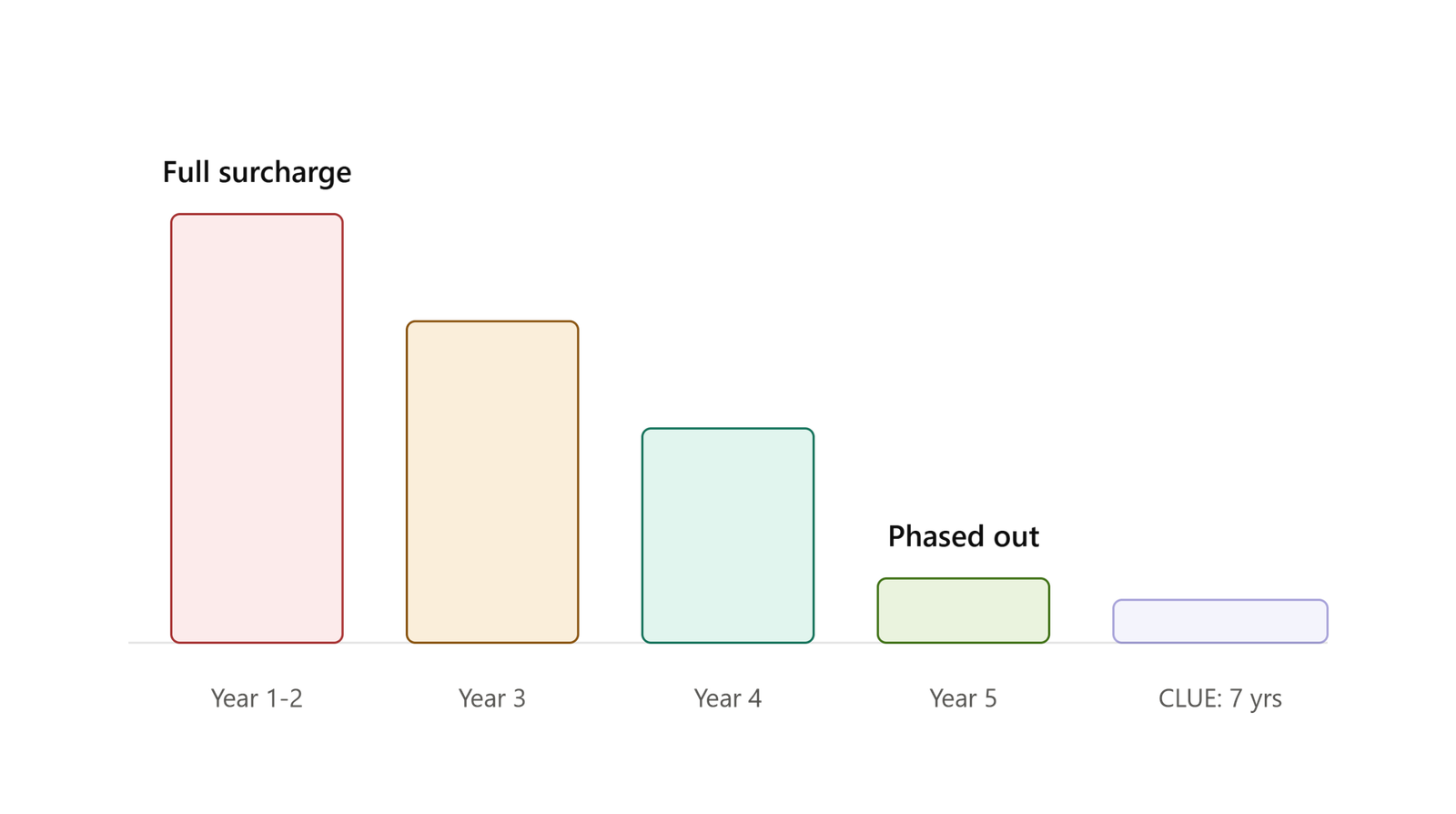
- Surcharges follow a sliding schedule, typically the full increase for years one and two, then gradually decreasing, phasing out entirely after three to five years of a clean record.
- The LexisNexis CLUE report tracks all auto insurance claims for seven years nationwide, meaning your accident history remains visible to insurers well beyond when the surcharge itself expires.
- Not-at-fault accidents typically add just 7% to 12% to your premium, and California, Oklahoma, and Massachusetts prohibit these surcharges entirely, a meaningful state-specific protection worth knowing.
The real numbers, and why they hit harder on an EV
An at-fault accident increases auto insurance premiums by an average of 45% at the first renewal, raising the average annual premium from $3,475 to $5,040, a yearly surcharge of $1,565, according to 2026 premium data. Other studies land in a similar range: a multi-state analysis found a single at-fault crash causing at least $2,000 in property damage raises premiums by 45.0% on average, while a separate historical analysis found standard at-fault accidents raising rates by 56% nationally.
Here’s the part that matters specifically for EV owners: these are percentage increases, and as covered throughout this site’s broader model and cost guides, EV baseline premiums already run meaningfully higher than comparable gas vehicles. If your EV premium sits at $3,400 a year rather than a gas car’s $2,500, that same 45% surcharge adds roughly $1,530 rather than $1,125, a genuinely larger dollar impact for the identical percentage increase, purely because the underlying baseline you’re applying that percentage to starts higher.
How the surcharge fades over time
Insurers don’t charge you the same rate increase forever. Most carriers apply a sliding surcharge schedule over a three-to-five-year lookback window: the full premium surcharge, typically 40% to 70%, applies in years one and two, then gradually decreases each subsequent year you remain accident-free, phasing out entirely once you reach the full lookback window. This gradual decrease is worth understanding clearly, since it means the financial pain is front-loaded, the first one to two years after an at-fault EV accident represent the steepest cost, with meaningful relief building each year afterward provided you don’t add a second incident to your record.
The seven-year shadow: what CLUE tracking actually means
This is worth understanding even after your surcharge itself has fully expired. The LexisNexis CLUE (Comprehensive Loss Underwriting Exchange) report tracks all auto insurance claims for seven years nationwide under the Fair Credit Reporting Act. Even after a surcharge period ends, typically three to five years, the accident may still be part of your claims history and could influence factors like discount eligibility or overall risk assessment, depending on your insurer, for up to two additional years beyond when the direct premium surcharge itself has phased out. This matters specifically when shopping for new coverage, a new insurer pulling your CLUE report may see the accident even after your prior carrier’s surcharge has fully expired.
Why EV-specific claim severity compounds this pattern
The severity of the damage directly impacts the surcharge itself, not just the fact that an accident occurred. A major collision involving bodily injury claims triggers a higher surcharge than a minor fender-bender, and even a seemingly minor claim can run into thousands of dollars once paint, sensors, calibration, and labor are factored in, exactly the pattern documented throughout our dedicated guides on why insurers total EVs after minor accidents and why insurers struggle with EV repair costs specifically. Given that EV claims already run more expensive on average, $6,042 for battery electric vehicles versus $4,902 for gas vehicles according to industry claims data covered in our dedicated repair-cost guide, the underlying claim that triggers your surcharge is itself more likely to be classified as more severe, potentially pushing your specific surcharge toward the higher end of the 40% to 70% range rather than the lower end.
Insurer-to-insurer variance is genuinely dramatic
Not every insurer penalizes an accident the same way. Erie and Auto-Owners are specifically identified as among the most forgiving after one accident, with Erie keeping its rate increases under $20 a month in one detailed comparison, consistent with Erie’s broader strength for EV-specific claims handling covered throughout this site. By contrast, some national companies raise rates by only 14% (State Farm cited in one example), while others, GEICO or Progressive among them in that same comparison, might increase them by over 60% for the identical accident. Given how much this varies, comparison shopping specifically after an accident, not just at your original purchase, is genuinely worthwhile, though timing matters, since a very recent accident or ticket may limit which companies offer you a competitive rate immediately following the incident.
The not-at-fault distinction, and where it’s legally protected
Not-at-fault accidents can raise rates by 7% to 12% in most states, a meaningfully smaller impact than the 44% to 56% at-fault range, but not zero in every state. California, Oklahoma, and Massachusetts specifically prohibit insurers from surcharging drivers for accidents that weren’t their fault, a genuine legal protection worth knowing if you live in one of these states, consistent with the consumer-protection patterns we’ve documented throughout our dedicated California and Massachusetts guides. If you live elsewhere and are hit by another driver, confirm directly with your insurer whether and how much your own rate might still be affected, since this varies by state and carrier outside these three protected states.
The multi-car household effect, worth knowing specifically
This is a genuinely underappreciated detail. Some insurers, USAA specifically documented as an example, re-rate every vehicle on your policy after just one driver’s at-fault accident, recalculating the premium for every car in the household based on that one driver’s new risk tier, not just the specific vehicle involved in the crash. For an EV-owning household with multiple vehicles, this means an accident in your gas car can raise your EV’s premium too, and vice versa, since the surcharge applies to the household’s overall risk classification rather than being isolated to the one vehicle that was actually damaged. The surcharge timeline anchors to the original accident date, not to when you first see the increase at renewal, and adding a new vehicle during the surcharge period doesn’t reset or extend that timeline, worth understanding if you’re planning to add an EV to your household policy while an existing surcharge is still active.
Accident forgiveness, worth checking specifically
Many providers offer accident forgiveness to protect your rates from increasing after your first collision, either as a feature that kicks in after you’ve been with the company a certain number of years, or as an optional endorsement you can add proactively. This is worth confirming directly with your insurer before you need it, since accident forgiveness is precisely the kind of coverage feature that only matters retroactively, if you haven’t enrolled before an accident happens, it’s typically too late to add it for that specific incident.
What actually helps reduce the impact
Shop around, even with a recent accident on your record. As covered above, insurer-to-insurer variance is dramatic, and given the Erie-versus-GEICO-or-Progressive gap documented above, a comparison quote can meaningfully soften the dollar impact even without waiting out the full surcharge period.
Take a defensive driving course. In many situations, this can earn a discount or help in specific underwriting scenarios, and even when it doesn’t erase the surcharge entirely, it can soften the overall premium impact through a separate, stacking discount.
Ask your agent specifically what changed at your next renewal. If your premium shifts, ask directly whether it’s a new violation, a lost discount, a mileage update, a vehicle change, a territory change, or simply a general rate increase affecting your entire state, since sometimes the accident is only part of the story, and understanding the full picture helps you address the right factor.
Confirm whether you have accident forgiveness before you need it. As covered above, this protection generally can’t be added retroactively after an incident, making it worth reviewing proactively as part of your regular policy review.
The bottom line
An at-fault accident raises your premium by 44% to 56% on average nationally, following a sliding schedule that phases out over three to five years, but stays visible in your claims history for up to seven years through CLUE reporting. For EV owners specifically, this same percentage applies against an already-elevated baseline premium, meaning the dollar cost of an accident runs proportionally higher than it would for a comparable gas car, compounded further by the higher average claim severity EVs already carry. Not-at-fault accidents carry a much smaller impact, and California, Oklahoma, and Massachusetts protect drivers from any surcharge at all in that scenario. Whatever your situation, comparison shopping after an accident, confirming accident forgiveness before you need it, and understanding your specific insurer’s surcharge policy, given how dramatically that varies between carriers, remain the most effective levers for managing the real, extended financial impact of a single at-fault claim.
This article is for informational purposes only and does not constitute financial or insurance advice. Surcharge amounts, duration, and state regulations vary significantly by insurer and location, and change frequently. Always confirm specific policy terms directly with your insurer.