Leasing an EV almost always costs more to insure than financing or owning the same vehicle outright, and the gap is bigger than most first-time lessees expect. This isn’t about the car itself being priced differently, it’s about who’s setting the coverage requirements and why. This guide breaks down exactly where the cost difference comes from, how much it typically adds up to, and what you actually control in each scenario.
Key takeaways:
- Leasing companies typically require liability limits well above your state’s legal minimum, often 100/300/50, adding roughly $400 to $800 a year compared to state-minimum coverage.
- Both leased and financed EVs generally require full coverage (comprehensive and collision) for the duration of the lease or loan, but a financed vehicle gives you more flexibility to adjust coverage once it’s paid off.
- Gap insurance is frequently required on leases and often built into the contract, while it’s optional but sometimes wise for financed EVs, particularly with a small down payment or a long loan term.
- Once you own the EV outright, whether it was leased-then-purchased or financed-then-paid-off, you regain full control over your coverage choices, something you never have during an active lease.
Why leasing costs more to insure in the first place
The core reason is straightforward: when you lease, you don’t own the car, the leasing company does, and you’re financially responsible for it while someone else holds the title. That arrangement changes who’s exposed if something goes wrong, and insurance requirements shift accordingly.
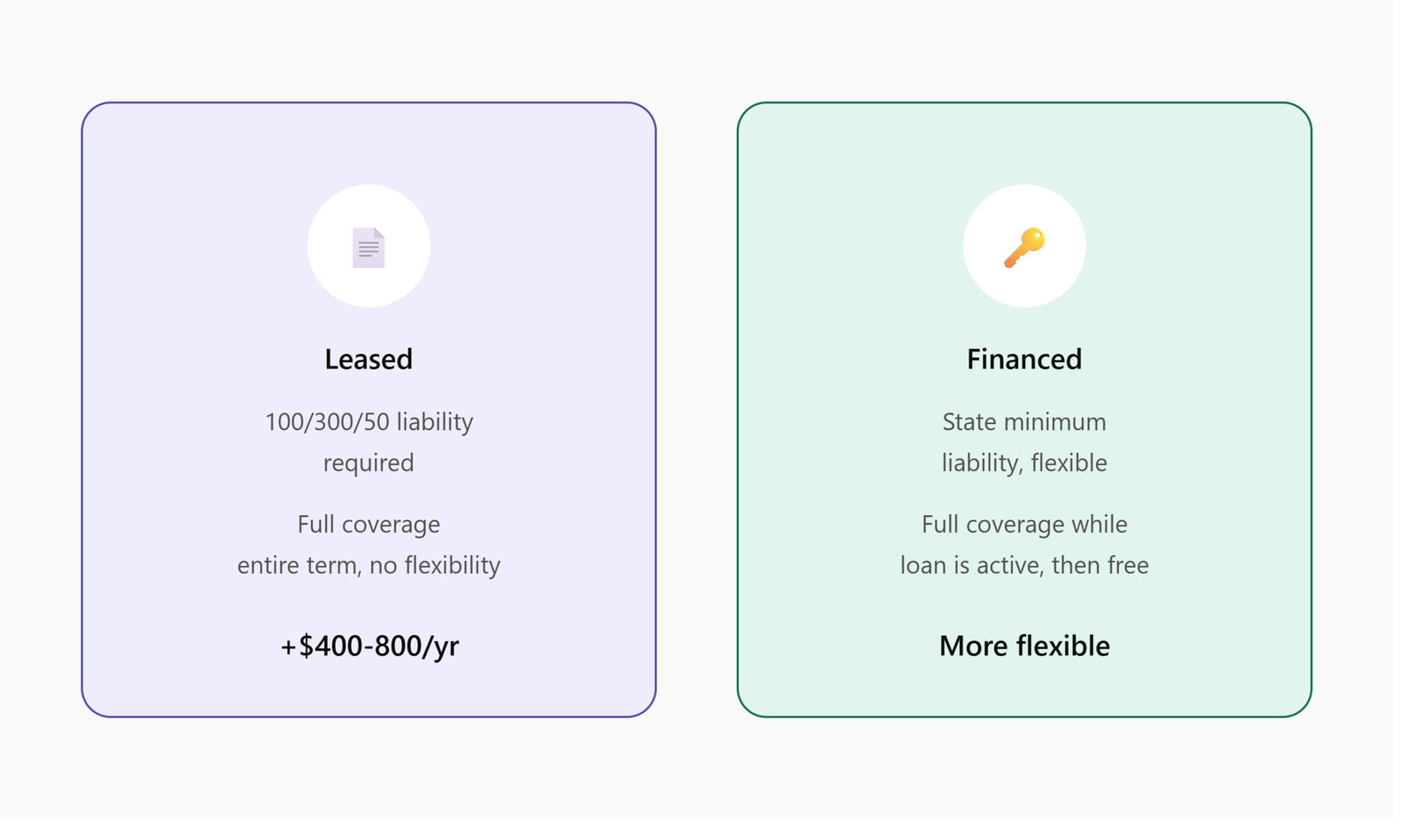
Higher liability limits are mandatory, not optional. Leasing companies typically require liability coverage of $100,000 per person and $300,000 per accident for bodily injury, plus $50,000 for property damage, figures that sit well above what most states legally require. For comparison, California’s state minimum is $15,000/$30,000 and Florida’s is $10,000/$20,000. The gap between what your state requires and what your lease demands can add roughly $400 to $800 a year to your premium, depending on your state’s baseline. These higher limits exist because financial exposure is shared: if you cause a serious accident, the leasing company, as the vehicle’s legal owner, can be named in resulting litigation, so they require higher limits to protect their own exposure, not just yours.
Full coverage is required for the entire lease term, with no flexibility to drop it. Both comprehensive and collision coverage are mandatory for the duration of a lease, and unlike a financed vehicle, you can’t reduce coverage partway through, even if you’d be comfortable carrying less protection. This locks in the higher cost of full coverage for the full length of the lease, regardless of how the vehicle’s value changes over that period.
You, not the leasing company, pay every cost. It’s worth being clear about this: the lessee pays all insurance premiums, deductibles, and claim costs throughout the lease. The leasing company is listed on your policy as an additional insured and loss payee, meaning they receive claim payments directly for vehicle damage, but the entire financial responsibility for insuring the car belongs to you.
How financing compares
Financing an EV shares some of the same requirements as leasing but with meaningfully more flexibility:
Full coverage is still generally required, but liability limits are more flexible. Lenders typically require comprehensive and collision coverage to protect their collateral (the car) for as long as the loan is active, similar to a lease. However, financed vehicles generally don’t come with the same elevated liability minimums that leasing companies impose, giving you more room to choose coverage limits closer to your state’s actual requirements if you’re trying to minimize cost.
You gain full flexibility once the loan is paid off. This is the biggest structural difference between financing and leasing. Once your loan is paid in full, you own the car outright and can adjust your coverage however you see fit, including dropping comprehensive and collision entirely if the vehicle’s value no longer justifies the cost of that coverage. A leased vehicle never reaches this point, since you either return it or buy it out at the end of the term.
Gap insurance: required for leases, optional but often wise for financing
Gap insurance is one of the clearest cost differences between the two paths, and it’s worth understanding on its own.
What it actually covers. Gap insurance covers the difference between what your comprehensive or collision coverage pays out after a total loss (the vehicle’s actual cash value) and what you still owe on your lease or loan. New vehicles, EVs included, can lose up to 20% of their value in the first year alone, which means a total loss early in a lease or loan term can leave a substantial gap between the payout and what you owe.
On a lease, it’s frequently required and often already included. Most lease agreements build gap coverage directly into the contract, since leasing companies know exactly how fast vehicle values move and structure their agreements accordingly. If your lease already includes it, buying additional gap insurance separately means paying for coverage you don’t need.
On a financed EV, it’s optional but worth considering in specific situations. Gap insurance tends to make real financial sense if you made a down payment of less than 20%, took a loan term of 60 months or longer, or rolled negative equity from a previous vehicle into the new loan. EVs specifically are sometimes flagged as a category where gap insurance deserves extra consideration, since rapid depreciation on certain models, particularly early-generation or lower-range EVs, can widen the gap between loan balance and vehicle value faster than a typical gas car.
Where you buy it matters enormously for cost. This applies to both leased and financed vehicles if you’re purchasing gap coverage separately: dealer-sold gap insurance typically runs $500 to $1,000 as a lump sum, often financed into your loan at interest, meaning a $700 policy can effectively cost $800 or more once interest is factored in over the loan term. The same coverage added through your auto insurer typically costs just $3 to $15 a month, with no interest and the ability to cancel anytime. Credit unions often include gap coverage with auto loans for a flat $200 to $400, sometimes free with certain loan products. If you’re financing an EV and considering gap insurance, your auto insurer or credit union is almost always the cheaper route compared to the dealership.
Side-by-side cost comparison
| Factor | Leased EV | Financed EV | Owned outright |
|---|---|---|---|
| Full coverage required | Yes, entire term, no exceptions | Yes, while loan is active | No, optional |
| Liability minimums | Elevated (often 100/300/50) | Your state’s minimum, flexible | Your state’s minimum, flexible |
| Gap insurance | Often required, usually included | Optional, situational | Not applicable |
| Coverage flexibility | None during lease term | Increases as loan balance drops | Full flexibility |
| Typical added annual cost vs. minimum coverage | $400-800+ from liability limits alone, plus full coverage cost | Full coverage cost, but flexible limits | None |
Which insurers work well for leased vehicles specifically
If you’re leasing, it’s worth knowing that not every insurer prices leased-vehicle policies the same way. One 2026 analysis found GEICO offering some of the more competitive rates specifically for leased vehicles, averaging around $102 a month, though as with any EV insurance quote, your actual rate will depend heavily on your specific vehicle, state, and driver profile rather than the insurer alone.
Practical guidance for each path
If you’re leasing an EV:
- Confirm your specific liability requirement with your leasing company before shopping quotes, since guessing at «full coverage» without the exact limits can lead to an inaccurate estimate.
- Check your lease contract for included gap coverage before paying for a separate policy.
- Shop multiple insurers specifically for leased-vehicle pricing, since rates for the same coverage can vary meaningfully between carriers.
If you’re financing an EV:
- Ask your lender for their specific coverage requirements, since these vary by lender and loan terms, unlike a leasing company’s more standardized minimums.
- Evaluate gap insurance honestly based on your down payment size and loan term, and price it through your insurer or credit union rather than defaulting to the dealer’s offer.
- Plan to revisit your coverage as your loan balance decreases, since the case for carrying full comprehensive and collision weakens as you build equity in the vehicle.
If you already own your EV outright:
- Reassess whether comprehensive and collision still make financial sense given the vehicle’s current value, particularly if it’s several years old and has depreciated substantially.
- Use the full flexibility ownership provides to shop for the coverage level that actually matches your risk tolerance, rather than carrying lease- or loan-mandated minimums out of habit.
The bottom line
Leasing an EV costs more to insure than financing the same vehicle, primarily because of elevated liability requirements and the inability to adjust coverage during the lease term, not because leased cars are inherently riskier to insure. Financing sits in the middle, generally requiring full coverage while the loan is active but offering more flexibility on liability limits and increasing freedom as you pay down the balance. Owning outright gives you complete control. If you’re choosing between leasing and financing with insurance cost specifically in mind, expect to pay a genuine premium for the lease’s rigidity, and factor that $400 to $800-plus annual gap into your total cost comparison, not just the monthly lease payment itself.
This article is for informational purposes only and does not constitute financial or insurance advice. Insurance requirements vary by leasing company, lender, insurer, and state, and change frequently. Always confirm specific coverage requirements with your leasing company or lender before purchasing a policy.