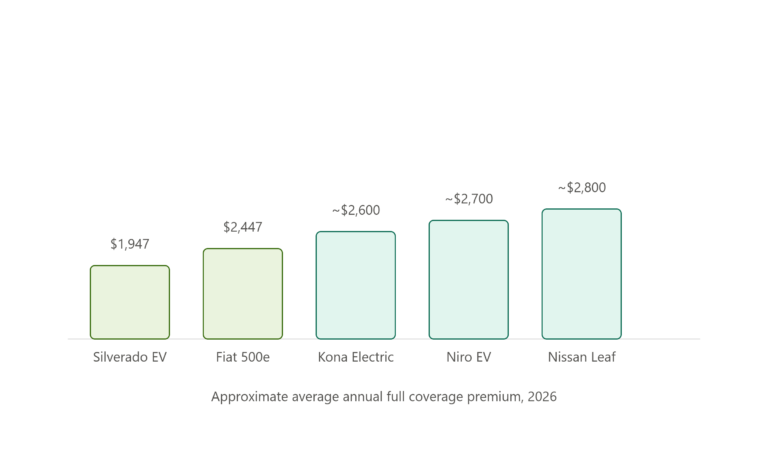
If the cheapest EVs to insure share a common profile, mainstream, simple, backed by an established repair network, the most expensive ones share the exact opposite. This is the full ranking of the priciest electric vehicles to insure in 2026, and a breakdown of exactly what pushes each one to the top of the list.
Key takeaways:
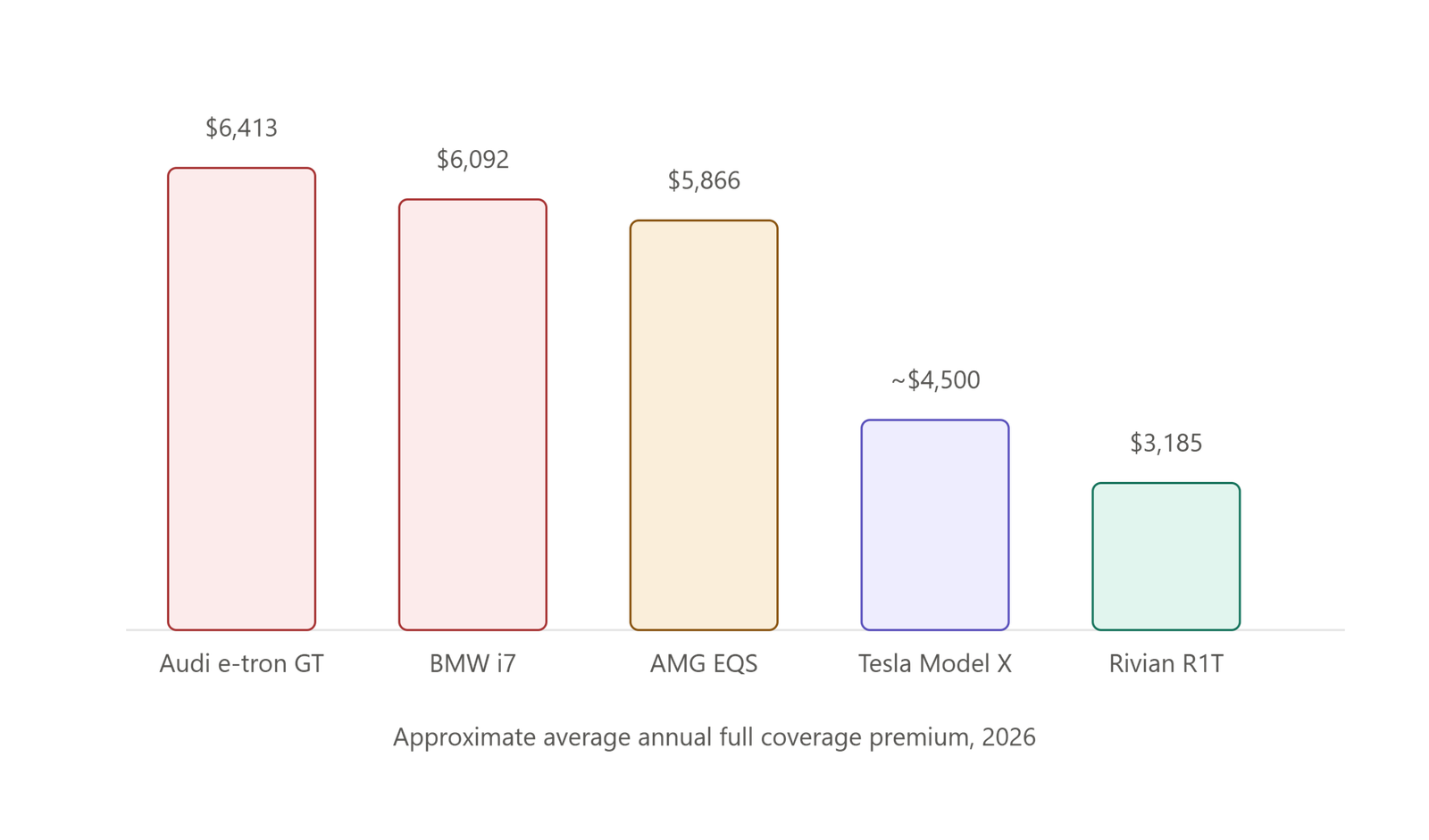
- The Audi e-tron GT currently tops the list at roughly $6,413 a year for full coverage, with the BMW i7 and Mercedes-AMG EQS close behind.
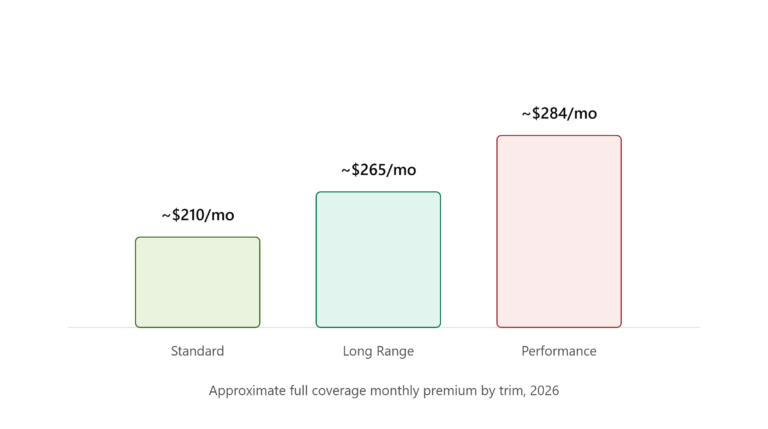
- Every Tesla model exceeds $2,800 a year for full coverage, with four of five Tesla models ranking among the most expensive EVs overall.
- Luxury and EV-only brands (Audi e-tron, Tesla, Rivian, Lucid, Polestar) dominate the top of the list almost entirely, while legacy mainstream automakers rarely appear.
- The single biggest driver isn’t horsepower or top speed, it’s proprietary technology that limits who can perform repairs and where.
The most expensive EVs to insure, ranked
1. Audi e-tron GT Currently the single most expensive EV to insure in national rankings, averaging around $6,413 a year for full coverage. Its dual-motor configuration and 800-volt electrical architecture make repairs considerably more complex and expensive than average, and its tightly integrated systems limit which shops can safely service it after an accident.
2. BMW i7 Averaging roughly $6,092 a year, the i7 combines advanced electric powertrain technology with premium materials throughout the cabin, meaning even minor damage can require specialized parts or labor that push repair, and therefore insurance, costs well above the EV average.
3. Mercedes-AMG EQS Rounding out the top three at around $5,866 a year, the EQS carries the same pattern as the two vehicles above it: high-end materials, complex electronics, and a repair network that hasn’t scaled to match the vehicle’s technical complexity.
4. Audi SQ8 e-tron One of the highest individual figures recorded in recent rate studies, reaching as high as $10,402 a year for full coverage in at least one major dataset, reflecting both the vehicle’s high purchase price and the broader e-tron lineup’s pattern of expensive, specialized repairs.
5. Tesla Model S and Model X Tesla’s two largest and most expensive models both land firmly in the priciest tier, with the Model X in particular known for its distinctive falcon-wing doors, which are notably expensive to repair. Every Tesla model exceeds $2,800 a year for full coverage, and these two sit at the top of that range.
6. Tesla Model Y and Model 3 Even Tesla’s more mainstream, higher-volume models still rank among the more expensive EVs on the market overall. The Model Y averages roughly $2,890 a year (about $241 a month), and even the Model 3, Tesla’s cheapest model to insure, still runs meaningfully above comparable non-Tesla EVs.
7. Rivian R1T and R1S Rivian’s electric trucks and SUVs consistently rank among the most expensive popular EVs to insure, with the R1T averaging around $3,185 a year, roughly $93 a month more than a comparably equipped Volkswagen ID.4. As a newer, low-volume, EV-only brand, Rivian faces the same repair network limitations that push Tesla and Audi e-tron pricing upward.
8. GMC Hummer EV Regularly appears on «most expensive to insure» lists alongside Tesla’s priciest models, driven by its enormous size, high purchase price, and complex, low-volume components.
Why these specific vehicles, and not others?
Nine of the thirteen most expensive vehicles in one major national rate study came from just two sources: the Audi e-tron lineup and Tesla. That’s not a coincidence, it points directly at the underlying pattern behind every vehicle on this list.
Proprietary technology limits where repairs can happen. The Audi e-tron lineup, the full Tesla lineup, and premium models from Lucid, Rivian, and Polestar all rely heavily on proprietary components and tightly integrated electrical systems. Aftermarket parts alternatives, common and cost-reducing in the gas car world, largely don’t exist for these vehicles, which keeps repair costs elevated and pricing competition minimal.
Specialized training requirements shrink the available repair network. EV repairs in general require technicians trained specifically on battery systems, high-voltage components, and advanced driver-assistance technology. For the vehicles at the very top of this list, that training requirement is even more specific, sometimes brand-certified, which further limits the number of shops that can legally and safely perform repairs. Fewer capable shops means less competition and higher labor rates.
Sensor and camera systems add cost to even minor accidents. Most EVs on this list are loaded with cameras, radar, and sensor arrays supporting lane keeping, automatic braking, and other advanced safety features. Even a minor collision can require recalibration or outright replacement of these systems, adding hundreds or thousands of dollars to what would otherwise be a routine repair bill on a simpler vehicle.
Repairs take longer, which compounds the total claim cost. Vehicles on this list tend to take meaningfully longer to repair than mainstream EVs or gas cars, which extends rental car reimbursement periods and raises the total cost an insurer pays out per claim, a cost that ultimately gets distributed back into everyone’s premiums for that model.
High purchase price raises total-loss exposure. Nearly every vehicle on this list carries a purchase price well above the EV average, meaning a total loss represents a significantly larger payout obligation for the insurer than a mainstream model would.
What doesn’t seem to matter as much as you’d expect
It’s worth noting what doesn’t fully explain this list, because it clarifies what’s actually driving the cost. Pure performance (0-60 times, top speed) plays a role, particularly for models like the Audi e-tron GT, but it’s a secondary factor here compared to the auto insurance market overall, where dedicated sports cars and high-performance gas vehicles often top the broader «most expensive to insure» rankings across all vehicle types, not just EVs. Within the EV category specifically, repair complexity and parts exclusivity consistently outweigh raw performance specs as the driving factor.
Similarly, being electric alone doesn’t automatically put a vehicle on this list. Mainstream EVs from legacy automakers, covered in our guide to the cheapest EVs to insure, prove that an electric drivetrain by itself doesn’t guarantee a high premium. It’s the combination of electric drivetrain plus proprietary, low-competition repair infrastructure that consistently produces the most expensive outcomes.
If you’re considering one of these vehicles anyway
None of this means you shouldn’t buy a car on this list if it’s genuinely what you want or need. It does mean you should budget for the insurance cost honestly rather than being surprised by it after the fact. A few practical steps if you’re set on a vehicle from this ranking:
- Get a real quote before you buy, not after. The gap between models on this list and mainstream alternatives can exceed $3,000 to $4,000 a year, a number worth knowing while you’re still comparing vehicles rather than after you’ve signed the paperwork.
- Shop across multiple insurers specifically. Pricing variance between carriers tends to be even wider for these specialized, higher-risk vehicles than it is for mainstream cars, meaning the difference between the cheapest and most expensive quote you receive can be substantial.
- Consider a higher deductible. Given how expensive repairs already are on these vehicles, a modest deductible increase can meaningfully offset the base premium.
- Ask specifically about manufacturer-affiliated insurance programs, where available. Tesla Insurance, for genuinely safe drivers in eligible states, can sometimes undercut traditional carriers for Tesla owners specifically, since it prices risk using real driving data rather than category averages alone.
- Factor the insurance premium into your total cost of ownership math, not just the sticker price and fuel savings. A vehicle that looks competitively priced against a gas alternative can lose much of that advantage once the insurance gap is included.
The bottom line
The most expensive EVs to insure in 2026 share a clear and consistent story: luxury or EV-only brands, proprietary and tightly integrated technology, limited certified repair networks, and high purchase prices that raise total-loss exposure. The Audi e-tron GT, BMW i7, Mercedes-AMG EQS, the full Tesla lineup, and Rivian’s trucks and SUVs all sit at the top of the ranking for fundamentally the same reasons, not because they’re electric, but because of what happens, and what it costs, when they need to be fixed.
This article is for informational purposes only and does not constitute financial or insurance advice. Insurance rates vary by insurer, individual driving history, location, and vehicle trim, and change frequently. Always get a personalized quote before making a purchasing decision.