There are actually two different questions hiding inside this one, and they have two different answers. The first is personal: does your own rate drop after a year of owning and insuring your specific EV? The second is about the market: are EV insurance rates broadly trending down over time as the category matures? Both are worth understanding, since they explain different parts of what you’ll see on your renewal notice.
Key takeaways:
- On an individual level, a clean first year with no claims typically earns you a modest renewal discount, though it’s rarely dramatic on its own.
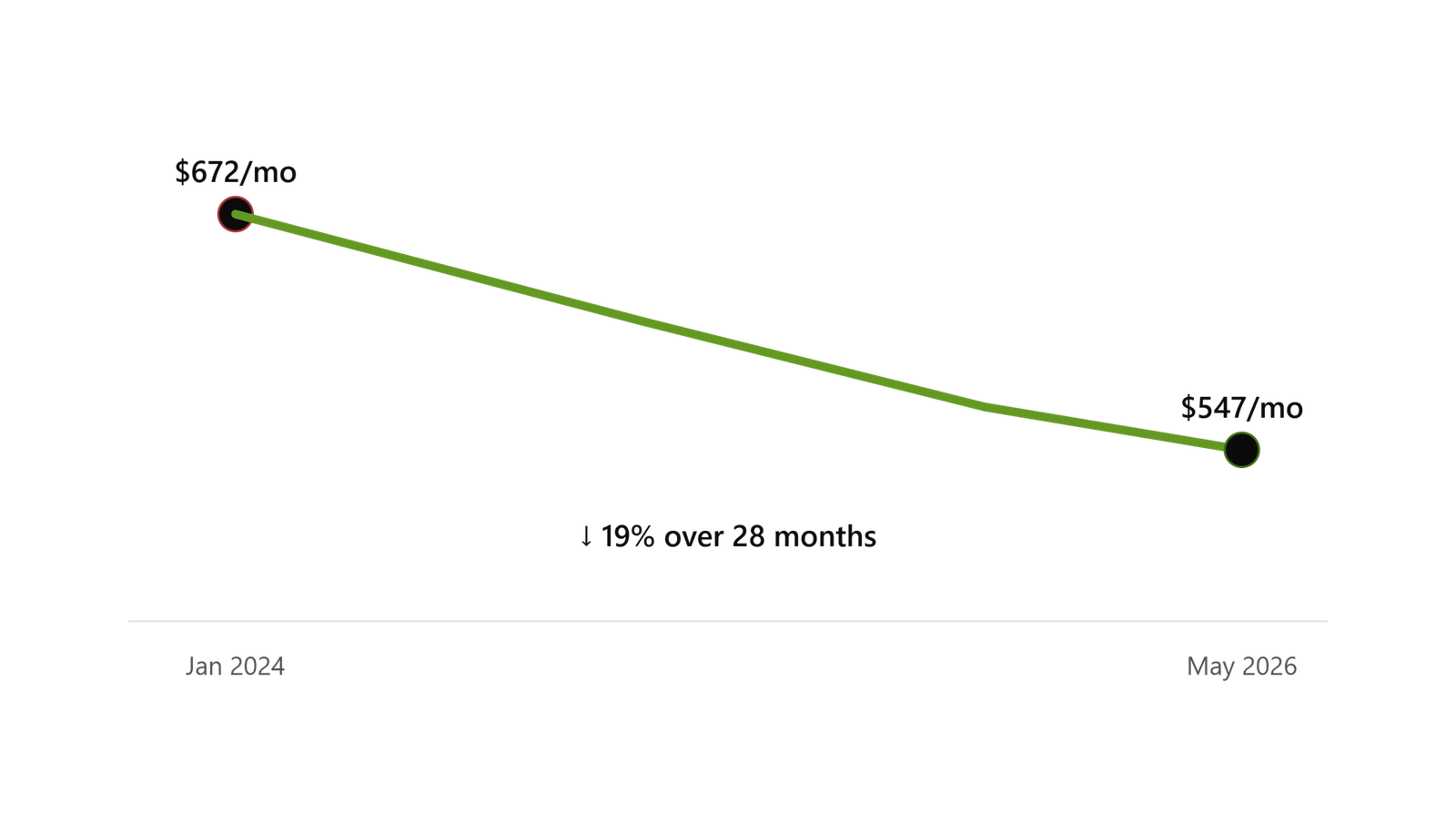
- At a market level, full-coverage EV insurance quotes fell roughly 19% between January 2024 and May 2026, a genuinely significant trend that benefits every EV owner shopping during that window.
- The EV-to-gas insurance gap has been narrowing at the same time, particularly for newer model years, meaning the «EV penalty» itself is shrinking industry-wide.
- Your best move after year one isn’t to simply wait for your current insurer to lower your rate, it’s to actively re-shop and let both trends work in your favor.
Your personal rate: what actually happens at your first renewal
For an individual driver, a first year with a clean record, no accidents, no claims, no violations, does typically translate into some improvement at renewal. Insurers reward a demonstrated track record, and having one full year of actual claims-free history with your specific insurer is a real, if usually modest, factor in their pricing.
That said, don’t expect a dramatic swing based on a single clean year alone. The bigger individual-level rate drops tend to come from specific milestones rather than the simple passage of time: turning 25 if you were younger, a moving violation aging off your record (typically 3 to 5 years, with DUIs taking 5 to 7 years to fully clear), improving your credit score in states where it’s used as a rating factor, or a major life event like getting married, which is associated with meaningfully lower rates since married drivers statistically file fewer claims. A single clean year without any of these accompanying changes will usually produce a smaller effect than people expect.
The market-level trend: this is where the real movement has been
This is the more significant story for EV owners specifically, and it’s easy to miss if you’re only thinking about your individual driving record. Broader EV insurance pricing across the market has been falling. Full-coverage EV insurance quotes fell from an average of $672 a month in January 2024 to $547 a month by May 2026, a drop of roughly 19% over that period, according to quote data tracked across that window.
That decline wasn’t driven by any individual driver doing anything differently, it reflects the insurance industry adjusting its EV pricing models as more claims data accumulates, as repair networks mature, and as competition among insurers writing EV policies increases. In practical terms, this means an EV owner who first got a quote in early 2024 and is still with the same policy in 2026 has very likely been sitting on rates that no longer reflect current market pricing, in the favorable direction. If you haven’t re-shopped since then, you may be missing out on savings that have nothing to do with your driving record and everything to do with timing.
The EV-to-gas gap is narrowing too, on the same timeline
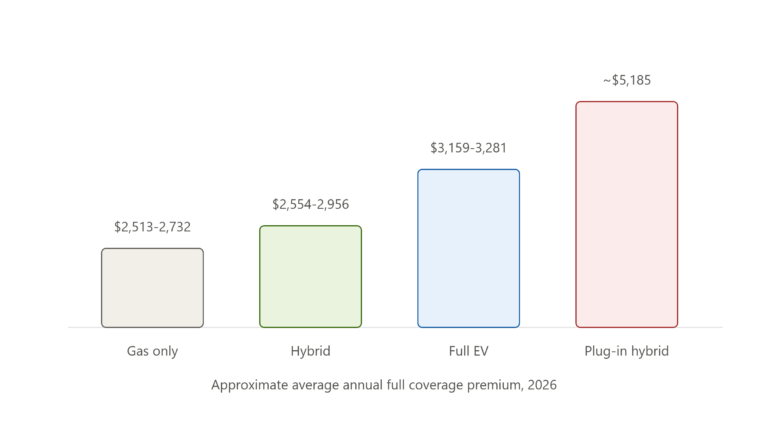
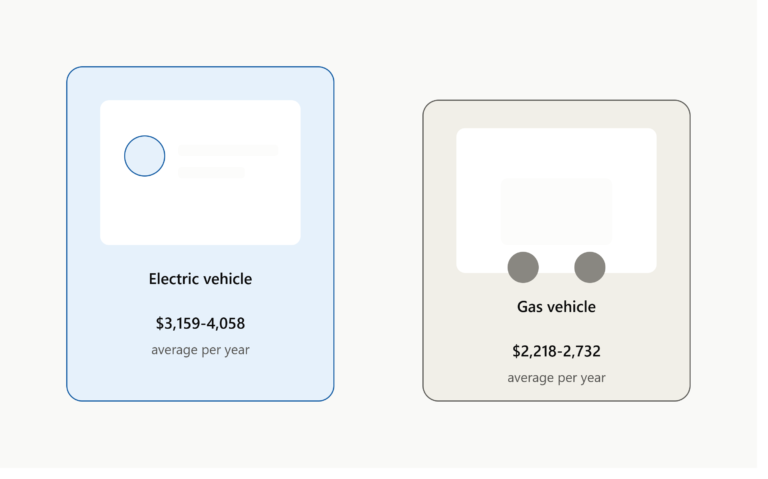
Layered on top of the overall price decline is a second, related trend: the gap between EV and gas car insurance costs has also been shrinking. At full coverage, EVs were roughly 68% more expensive than non-electric vehicles in 2024, falling to about 59% more expensive by 2026. At state-minimum coverage, the gap has narrowed even more sharply, from about 17% in 2024 down to roughly 4% by 2026.
This mirrors a pattern covered in our broader guide comparing EV and gas insurance costs: the gap is consistently smaller for newer model years than for the fleet as a whole, since insurers have more confidence pricing risk on vehicles built with more mature repair networks and more standardized safety technology. If your EV is a newer model year, you’re likely benefiting from this narrowing gap more than an owner of an older EV would be.
Why is this happening now?
A few forces are driving both trends at once, and understanding them helps explain why this isn’t a temporary blip:
More claims data. As EV sales have grown, insurers simply have more real-world claims history to price against, which reduces the uncertainty premium that gets baked into rates for a less-understood vehicle category.
Maturing repair networks. Independent shops and aftermarket parts suppliers have increasingly entered the EV repair market, reducing the repair-cost premium that originally justified much of the EV insurance gap.
Falling battery costs. The cost of EV batteries, one of the largest single risk factors insurers price into a policy, has been trending downward, which directly reduces the tail-risk exposure insurers are accounting for.
Gas cars catching up in complexity. Somewhat counterintuitively, part of the narrowing gap comes from the other direction: internal-combustion vehicles have become more complicated and expensive to repair themselves, thanks to increasingly common advanced driver-assistance technology, which has pushed gas car insurance costs upward and narrowed the relative gap rather than EVs getting dramatically cheaper in isolation.
More competitive pressure among insurers. As EV ownership has grown, more insurers are actively competing for EV customers rather than treating the category as a niche risk to avoid or overprice, and that competition puts downward pressure on rates.
What this means for your renewal strategy
Given both trends, here’s the practical takeaway: don’t assume your rate will automatically reflect the market-wide improvement just because you’ve been a loyal, claims-free customer for a year. Insurers don’t automatically reprice existing policies to match current market averages, that’s not how renewal pricing typically works. The responsibility for capturing this savings falls on you, not your insurer.
A few concrete steps:
- Re-shop at every renewal, not just when something changes. As covered in our full guide to lowering your EV insurance premium, this remains the single highest-impact action available, and it’s especially valuable right now given how much the broader market has moved over the past two years.
- Specifically ask if your insurer has updated their EV rate model recently. Some insurers reprice EV risk more slowly than others, and a direct question can surface whether you’re on an outdated internal rate table.
- Don’t assume «I’ve been with them a long time» guarantees a good rate. Loyalty and favorable pricing aren’t the same thing in the insurance industry, and a new customer quote from the same company can sometimes be lower than what an existing long-term customer is currently paying.
- Factor in your specific model year. If you’re driving a newer EV, you’re likely benefiting more from the narrowing EV-to-gas gap than someone with an older model, which is worth mentioning explicitly when you’re comparing quotes.
Does this trend mean rates will keep falling indefinitely?
Not necessarily, and it’s worth being realistic here. The forces driving the recent decline, maturing repair networks, more claims data, falling battery costs, are real and likely to continue in the near term, but insurance pricing also responds to external pressures that can push in the opposite direction: inflation in parts and labor costs generally, severe weather trends affecting comprehensive claims, and shifts in the broader auto insurance market that have nothing to do with EVs specifically. Treat the recent downward trend as a genuine and useful tailwind, not a guarantee that next year’s renewal will automatically be cheaper than this year’s without you doing anything.
The bottom line
Yes, EV insurance rates have been dropping, but the more useful way to think about it is that there are two separate effects happening at once: a modest personal discount you can earn through a clean driving record, and a much larger market-wide decline driven by the EV insurance category maturing. The market-level trend, roughly a 19% drop in full-coverage quotes and a meaningfully narrower EV-to-gas gap over the 2024-2026 window, is the bigger story, but it only benefits you if you actively re-shop rather than assuming your existing insurer will pass the savings along automatically.
This article is for informational purposes only and does not constitute financial or insurance advice. Insurance rate trends vary by insurer, state, vehicle, and individual driver profile, and change frequently. Always get a personalized quote before making a purchasing decision.