State Farm EV Insurance Review: Coverage and Costs
Across nearly every independent 2026 rate comparison, one name shows up near the top for EV owners more consistently than almost any other: State Farm. It doesn’t offer a dedicated EV discount, and it doesn’t have Tesla’s flashy real-time pricing model, but on raw affordability and broad availability, it’s hard to beat. This review covers exactly what State Farm offers EV owners, what it actually costs, and where it falls short.
Key takeaways:
- State Farm consistently ranks as the cheapest or among the cheapest insurers for Tesla and other EVs, with rates as low as $33 to $36 a month for minimum coverage and $144 a month for full coverage on some models.
- State Farm doesn’t offer a dedicated EV or green vehicle discount, unlike Travelers or USAA, relying instead on broad-based discounts like Drive Safe & Save, bundling, and student discounts.
- Its massive agent network and top-tier customer satisfaction reputation make it a strong choice if in-person support and claims reliability matter to you as much as price.
- State Farm’s rate advantage isn’t universal across every EV model, it’s strongest for Tesla specifically, so it’s still worth cross-shopping for other EV brands.
The real cost numbers
Pulling together multiple independent 2026 studies gives a consistent, favorable picture for State Farm specifically:
- One comprehensive Tesla-focused analysis found State Farm offering the cheapest overall rates across all Tesla models and model years, at $36 a month for minimum coverage and $144 a month for full coverage, the lowest figures found in that study.
- A separate analysis found State Farm and GEICO tied at the top for the cheapest overall Tesla coverage, both starting around $33 a month.
- Another comparison specifically highlighted State Farm as offering the cheapest rates for the Tesla Model S, a notably expensive model to insure generally, with State Farm bringing pricing more in line with traditional vehicle costs than most competitors manage for that model.
- One broader study found State Farm delivering slightly below-average premiums across the board for Tesla owners, with particular strength on the Model S specifically.
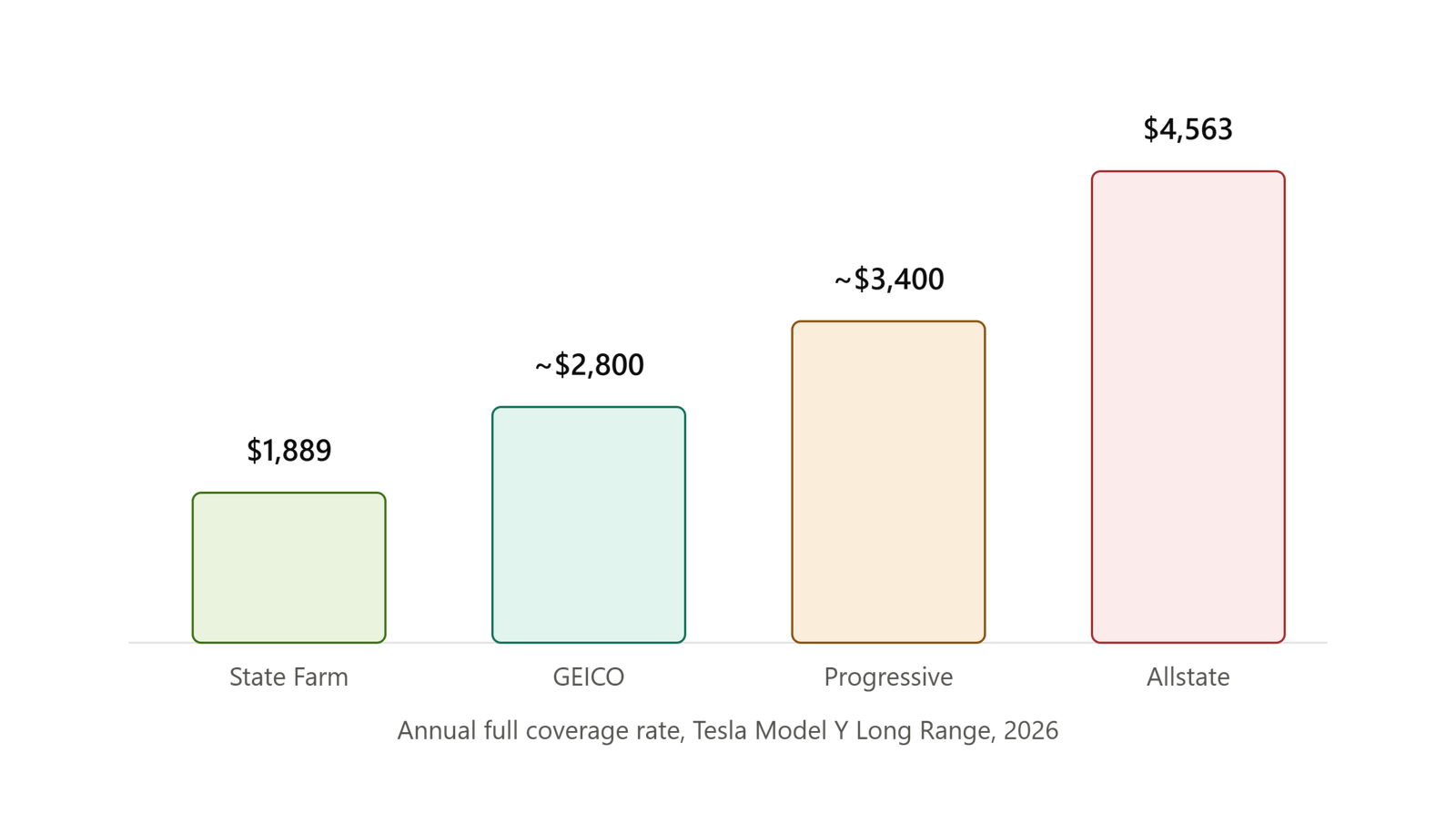
- For a Tesla Model Y Long Range specifically, one comparison found rates ranging from $1,889 a year at State Farm up to $4,563 a year at Allstate for the identical vehicle, a difference of nearly $2,700 a year between the cheapest and most expensive quote in that study.
The consistent theme across sources: State Farm isn’t just competitively priced, it’s frequently the single cheapest option, particularly for Tesla owners, though as covered below, that advantage isn’t guaranteed for every EV brand or model.
Why State Farm prices EVs so competitively
A few structural factors likely explain State Farm’s consistent affordability for EV owners specifically:
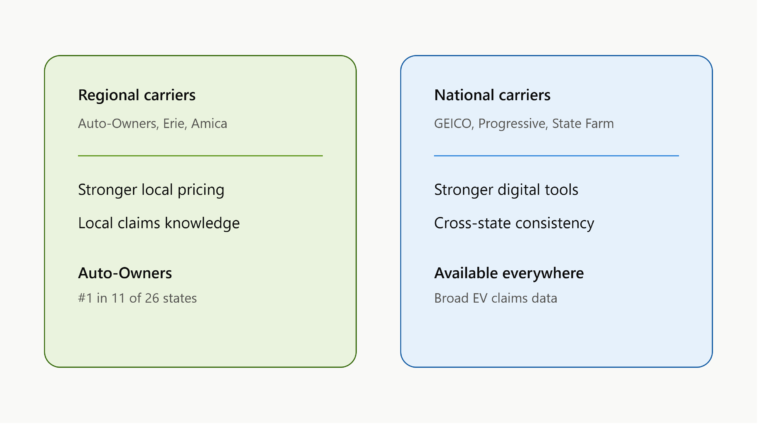
Massive scale and market share. As the largest auto insurer in the U.S., covered in our broader insurer ranking, State Farm has an enormous pool of policyholders and claims data to price risk against, which tends to produce more stable, competitive pricing than smaller or newer entrants still building out their EV-specific risk models.
Extensive agent network. State Farm’s wide network of local agents allows for more individualized underwriting in some cases, which can work in favor of drivers with strong but not perfectly «average» profiles.
Broad discount stacking. Even without a dedicated EV discount, State Farm’s combination of bundling, student, and safe-driving discounts often adds up to a lower effective rate than a competitor’s narrower EV-specific discount would provide on its own.
What State Farm actually offers EV owners
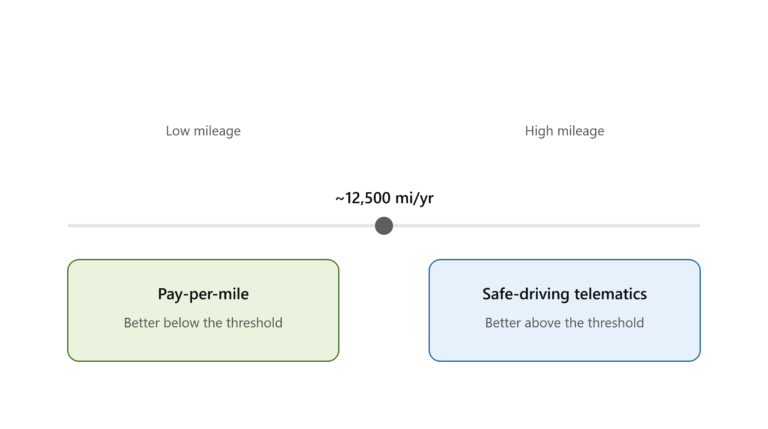
Drive Safe & Save. State Farm’s telematics program tracks driving behavior and can meaningfully lower your premium for demonstrably safe habits, a similar concept to Progressive’s Snapshot but backed by State Farm’s stronger overall customer satisfaction reputation, as covered in our broader insurer comparison.
Strong bundling discounts. As covered throughout this site, bundling home or renters insurance with your auto policy remains one of the most reliable ways to cut your total cost, and State Farm is specifically noted for offering a generous bundling discount on top of its already competitive base rates.
Family and student discounts. State Farm offers a student discount of up to 25% and a discount for completing an approved driver education course, genuinely useful if you’re insuring a young driver alongside your EV, an important consideration given how dramatically age affects EV premiums specifically, as covered in our dedicated age guide.
Wide standard coverage options. State Farm offers the full range of standard coverage types, liability, collision, comprehensive, uninsured/underinsured motorist, and rental reimbursement, without requiring specialty add-ons for basic protection.
Where State Farm falls short
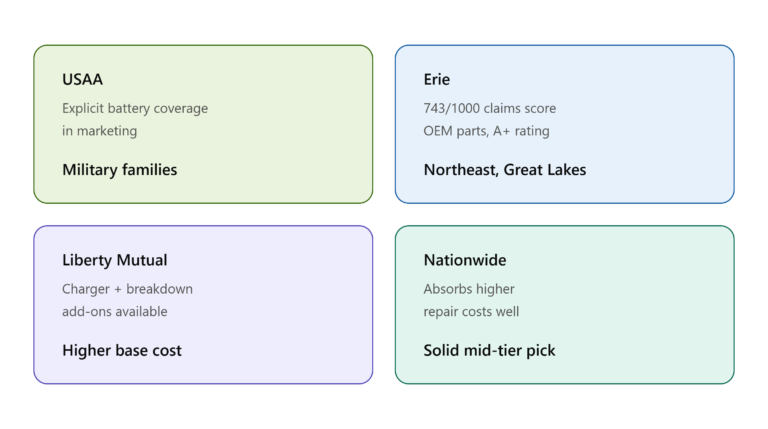
No dedicated EV or green vehicle discount. Unlike Travelers, which offers an explicit hybrid/EV discount, or USAA, which specifically advertises battery coverage, State Farm doesn’t market anything specifically tailored to electric vehicle ownership. Its competitive pricing comes from broad-based strength, not EV-specific underwriting.
The advantage is strongest for Tesla, less proven for other brands. Nearly every source cited above measured State Farm’s advantage specifically against Tesla pricing. If you drive a different EV brand, Rivian, Ford, Hyundai, or others, it’s worth confirming State Farm’s competitiveness directly rather than assuming the Tesla-specific advantage carries over automatically.
No gap insurance mentioned as a standout feature. Unlike Nationwide or American Family, which are specifically noted elsewhere in this research for offering gap coverage as a distinguishing feature, State Farm’s gap coverage offering isn’t highlighted as a particular strength in the sources reviewed for this article, worth confirming directly if that’s a priority for your specific financing or lease situation, as covered in our leasing versus financing guide.
How State Farm compares to Tesla Insurance directly
This comparison deserves specific attention given how often the two are cross-shopped by Tesla owners. One direct comparison found the answer genuinely mixed: Tesla Insurance’s real-time Safety Score model can produce meaningful discounts for demonstrably safe drivers, but it isn’t automatically the cheapest option for every Tesla model. For a Model 3 specifically, State Farm’s Drive Safe & Save program has been found to offer better rates than Tesla Insurance in direct comparisons, contradicting the assumption that Tesla’s own branded product automatically undercuts every traditional competitor.
Combined with the customer service concerns covered in our dedicated Tesla Insurance review, State Farm represents a genuinely strong alternative for Tesla owners specifically, not just a fallback for drivers in states where Tesla Insurance isn’t available.
Real owner feedback
Beyond the aggregate rate data, individual owner accounts offer a useful reality check. Some Tesla Model 3 Performance owners report paying noticeably more than the headline averages suggest, one specific account described paying $192 a month for a fairly comprehensive coverage package (100/300 bodily injury, $50,000 property damage, full comprehensive and collision with a $500 deductible, uninsured motorist coverage, and rental reimbursement), a reminder that performance trims and comprehensive coverage selections can push your actual quote well above the headline «cheapest» figures cited in broad comparisons. This tracks with the trim-level pricing pattern covered in our dedicated Tesla Model 3 monthly cost breakdown.
Is State Farm the right choice for your EV?
Choose State Farm if:
- You drive a Tesla specifically, where State Farm’s pricing advantage is most consistently documented across multiple independent sources.
- You value a strong local agent network and top-tier customer satisfaction over having the single lowest possible headline rate.
- You want to bundle home and auto insurance for maximum combined savings.
- You’re insuring a young or student driver alongside your EV and want access to State Farm’s family-oriented discount stack.
Look elsewhere or cross-shop first if:
- You drive a non-Tesla EV, where State Farm’s advantage is less consistently documented in available research.
- A dedicated EV-specific discount matters to you philosophically, in which case Travelers or USAA are worth comparing directly.
- Gap insurance bundled directly into your policy is a priority, in which case Nationwide or American Family may be a better direct fit.
The bottom line
State Farm earns its reputation as one of the strongest overall choices for EV insurance, particularly for Tesla owners, through a combination of broad-based competitive pricing, a large and reliable agent network, and strong customer satisfaction rather than any EV-specific gimmick. It doesn’t offer a dedicated green vehicle discount, and its documented advantage leans heavily toward Tesla specifically, but for the large share of EV owners driving a Tesla, it’s consistently one of the first quotes worth getting, and in several independent comparisons, the cheapest.
This article is for informational purposes only and does not constitute financial or insurance advice. Insurance rates, discounts, and coverage options vary by state and individual driver profile, and change frequently. Always get a personalized quote before making a purchasing decision.