Rivian R1T Insurance Cost: What to Expect
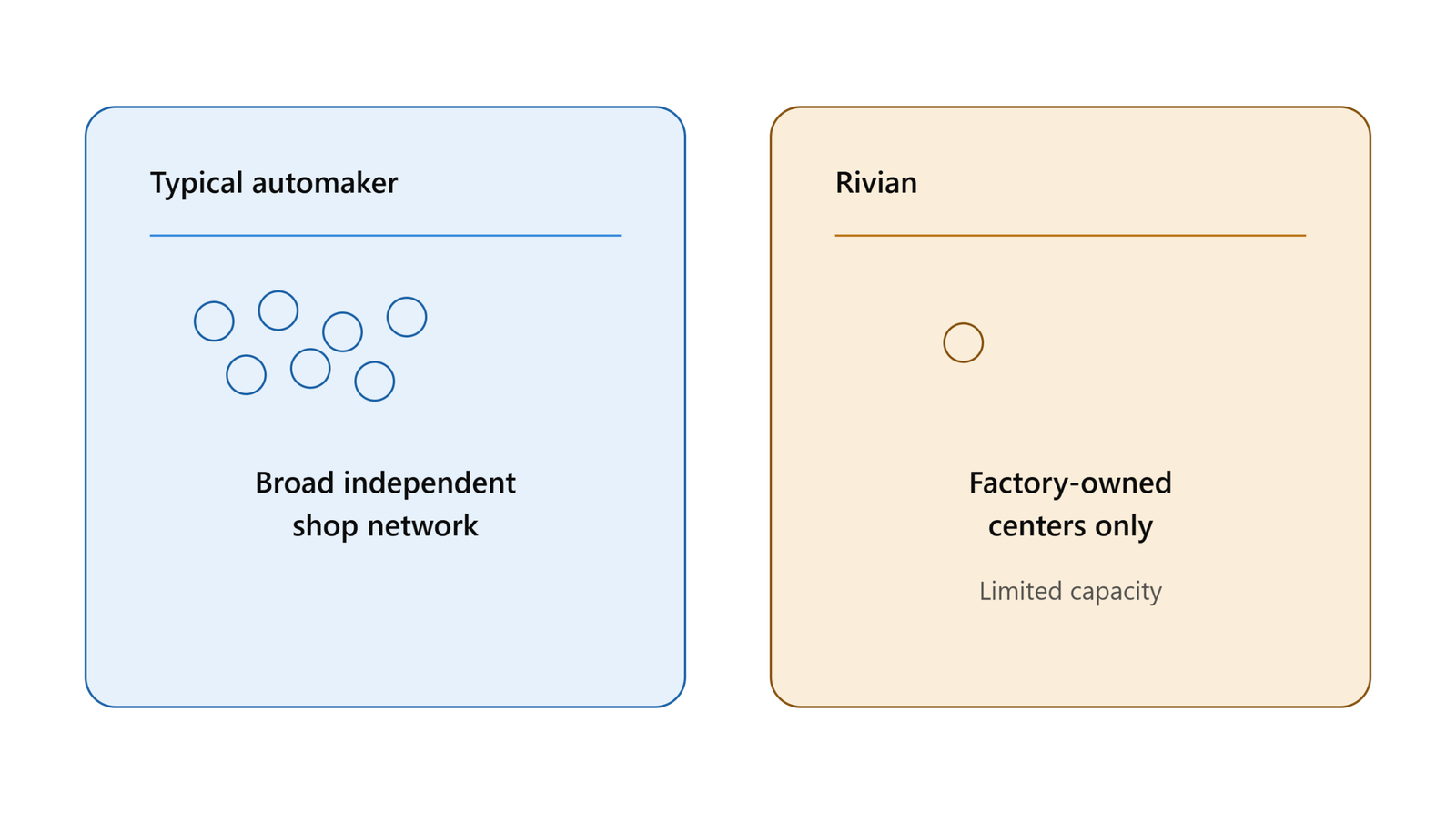
Rivian made an unusual choice most automakers haven’t: it operates its own factory-owned service centers instead of authorizing a network of independent repair shops. That decision shapes nearly everything about what R1T insurance actually costs and how claims get handled. This guide covers what real owners report paying and why the R1T’s repair model matters more than most buyers realize going in.
Key takeaways:
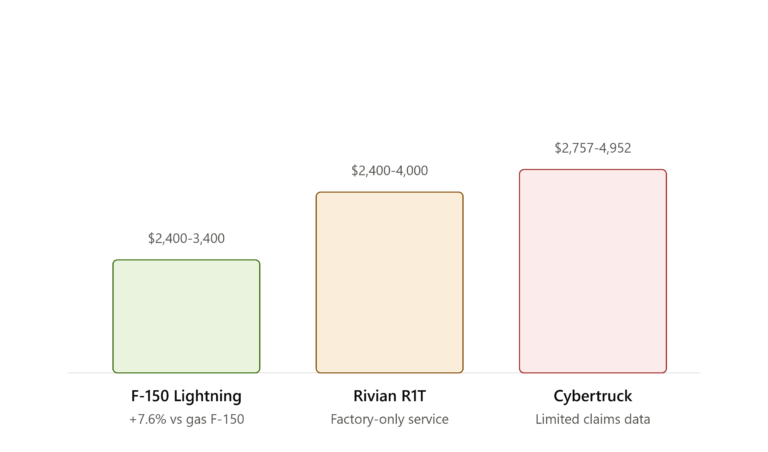
- Most 2024-2026 R1T owners with clean records report full-coverage premiums between $2,400 and $4,000 a year, with real-world monthly figures commonly landing around $230 to $320.
- Sources genuinely disagree on whether the R1T or R1S costs more to insure, one detailed analysis finds the R1T cheaper at $265 a month versus the R1S’s $286, while a separate index-based estimate finds the opposite, the R1T pricier at $1,694 a year against the R1S’s $1,662.
- Rivian’s factory-owned service center model, rather than a network of independent authorized shops, limits repair capacity and extends time-on-rent during claims, a cost insurers price directly into your premium.
- Travelers and Nationwide consistently rank as the cheapest insurers, while AIG has shown up as dramatically more expensive, a $318-a-month gap for the identical vehicle in one direct comparison.
The real numbers, and the genuine disagreement between sources
Consistent with the wide-range pattern covered throughout our other model guides, multiple 2026 sources land in a broadly similar range but disagree on specifics worth being upfront about:
- One comprehensive guide finds $2,400 to $4,000 a year for clean-record 2024-2025 R1T owners, with outliers in expensive coastal cities exceeding $5,000 and lower-risk rural owners landing closer to $2,000.
- A monthly-focused breakdown finds full coverage typically running $230 to $320 a month, describing the R1T as running 20% to 30% above midsize gas pickups.
- MoneyGeek’s detailed model-year analysis finds the R1T averaging $265 a month, cheaper than the R1S’s $286 a month, a $21 monthly gap consistent across every model year in their dataset, with 2022-2023 models at $242 to $255 a month and 2025 models at $302 to $309 a month.
- A separate index-based estimate using HLDI insurance-loss data reaches the opposite conclusion on model comparison: the R1T as the pricier Rivian model at roughly $1,694 a year (about 18% above the average car), against the R1S at $1,662 a year (about 16% below average).
- The Zebra’s data shows $1,802 for a 6-month policy ($3,604 annualized), with Nationwide offering the cheapest rate at $216 a month.
This genuine disagreement about whether the R1T or R1S costs more is worth taking at face value rather than resolving artificially, different methodologies (real quote aggregation versus statistical loss-index modeling) can reasonably produce different rankings, and the practical takeaway is the same either way: the two models are close enough in cost that your specific trim, state, and driver profile will matter more than which of the two vehicles you choose.
Why Rivian’s repair model shapes your premium directly
This is the detail most worth understanding if you’re specifically considering an R1T, and it’s distinct from the general EV repair-cost story covered throughout this site. Rivian operates its own network of service centers rather than authorizing independent repair shops, which limits repair capacity and extends time-on-rent costs during claims, costs insurers price directly into your base premium. This connects to a second structural factor: the R1T and R1S use a proprietary quad-motor architecture and large battery packs with no cross-brand parts compatibility, meaning a major powertrain claim requires factory components with lead times that can meaningfully slow claim resolution.
Together, these two factors push Rivian’s insurance costs higher than the vehicle’s price tier alone would otherwise suggest, similar in spirit to the proprietary-parts problem covered in our broader Tesla insurance research, but arguably more acute for Rivian given how much more limited its service center footprint is compared to Tesla’s more established network.
The insurer spread: comparison shopping matters enormously here
This is worth restating from our broader Rivian insurer guide, since it’s one of the most dramatic examples of insurer variance covered anywhere on this site. Travelers offers the cheapest average rate at $190 a month for full coverage, with Nationwide close behind at $197 a month. At the other extreme, AIG charges $508 a month for the identical vehicle, a gap of $318 a month, or $3,816 a year, purely from choosing the wrong insurer. This spread is dramatically wider than what we’ve seen for mainstream models like the Kia EV6 or Chevrolet Bolt covered elsewhere on this site, making comparison shopping arguably the single most financially consequential action an R1T owner can take, more so than almost any other lever covered in this guide.
Age remains a dramatic factor, worth taking seriously for a truck this powerful
One source specifically flags that younger drivers in powerful EVs face steep risk multipliers even with modern safety technology, and recommends bracing for real sticker shock if you’re under 25 and pricing an R1T as a first vehicle. This connects directly to the compounding-factors pattern covered in our dedicated guide to EV insurance by age: a young driver in a genuinely powerful, expensive-to-repair truck like the R1T combines two of the most significant cost multipliers covered throughout this site simultaneously. If this describes your situation, that same guide’s suggestions, staying on a family policy, or considering a less expensive vehicle for a first car specifically, are worth serious consideration before committing to an R1T as a starter vehicle.
Does the fuel and maintenance savings offset the higher insurance?
This is worth addressing directly, since insurance cost alone doesn’t tell the complete ownership story. Owners charging at home during off-peak hours commonly pay the equivalent of $1 to $1.50 a gallon, and routine maintenance runs lower than a gas truck, no oil changes, fewer moving parts, and regenerative braking that extends brake pad life. Over a 5-year ownership horizon, these savings can meaningfully offset the roughly $50 to $80 a month insurance premium gap versus a comparable gas midsize pickup like a Tacoma. In plain terms: the R1T may lose the insurance comparison specifically, but still come out ahead, or close to even, in total cost of ownership once fuel and maintenance are factored in, a framing worth keeping alongside the insurance-specific numbers throughout this guide.
Does buying used meaningfully lower your R1T insurance?
Yes, following the same logic covered throughout our GAP insurance and used-EV cost guides. Both the 2022 and 2023 R1T averaged $242 to $255 a month for full coverage, compared to $302 to $309 a month for a 2025 model, a savings of $47 to $67 a month simply from choosing an earlier model year. Buying a pre-owned R1T through a transparent marketplace also means someone else has already absorbed the steepest part of the depreciation curve, directly reducing the comprehensive and collision math your insurer prices against.
Rivian’s own insurance program versus traditional carriers
As covered in our broader Rivian insurer guide, Rivian offers its own dedicated insurance program alongside traditional carrier options. Given the customer-service and claims-handling scrutiny we’ve applied to manufacturer-branded insurance products throughout this site, most notably in our detailed Tesla Insurance review, the same principle applies here: compare Rivian’s own program directly against Travelers, Nationwide, and other traditional options covered above rather than assuming the manufacturer’s product automatically offers the best combination of price and service.
How to actually lower your R1T premium
Shop aggressively, starting with Travelers and Nationwide. Given the documented $318-a-month spread against AIG, this is the single highest-value action available to an R1T owner specifically.
Consider a slightly older model year if minimizing cost is a real priority, given the $47-to-$67-a-month savings documented between 2022-2023 and 2025 models.
If you’re insuring a young driver, seriously weigh whether an R1T is the right first vehicle, given how directly age and vehicle power multiply together in the pricing, as covered throughout our dedicated age-based EV insurance guide.
Ask specifically about specialized coverage for chargers and accessories, following the guidance covered in our broader home charger and Tesla Wall Connector coverage guides, adapted to whatever charging setup you use with your R1T.
Factor in the total ownership picture, not insurance in isolation. As covered above, the fuel and maintenance savings genuinely offset a meaningful portion of the insurance premium gap over a multi-year ownership horizon.
The bottom line
Rivian R1T insurance typically lands between $2,400 and $4,000 a year for a clean-record owner, driven by the same repair-cost and parts-exclusivity factors covered throughout this site, intensified by Rivian’s factory-only service center model and proprietary quad-motor architecture. Sources genuinely disagree on whether the R1T or R1S costs more, a reflection of different measurement methodologies rather than a settled fact, but the practical takeaway is the same either way: your choice of insurer matters far more than which of the two Rivian models you pick, given the documented $318-a-month gap between the cheapest and most expensive quotes for the identical vehicle. Shop Travelers and Nationwide first, consider a slightly older model year if cost matters, and weigh the genuine fuel and maintenance savings against the higher insurance premium before writing off the R1T on cost alone.
This article is for informational purposes only and does not constitute financial or insurance advice. Insurance rates vary by insurer, state, model year, trim, and individual driver profile, and change frequently. Always get a personalized quote before making a purchasing decision.