Tesla Model 3 Insurance Cost: Complete 2026 Guide
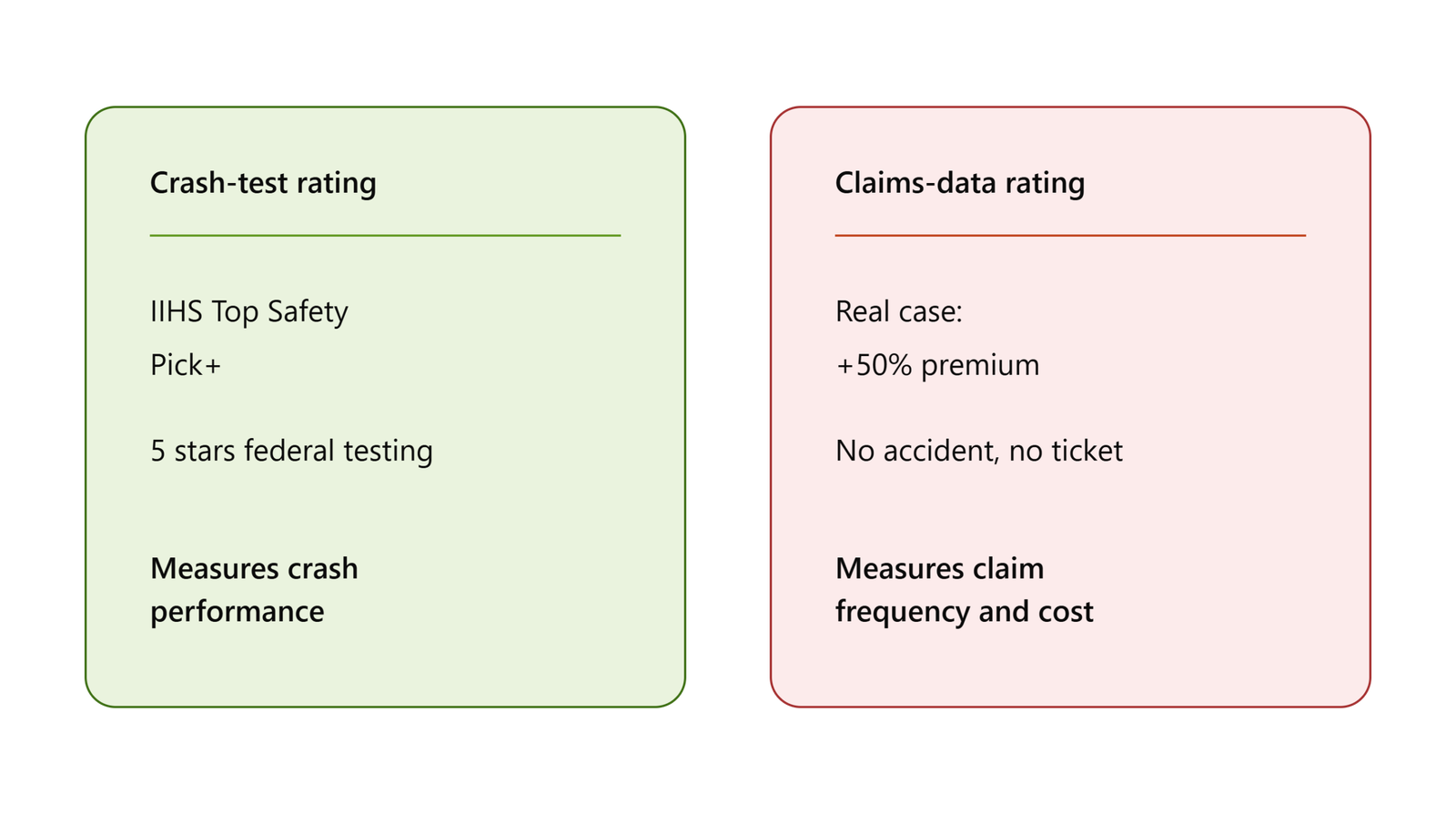
The Model 3 holds one of the best crash-safety records of any sedan on the road, an IIHS Top Safety Pick+ and five stars across federal testing. So why did one owner’s premium jump 50% in a single renewal with no accident, no ticket, nothing on their record? The answer reveals something most Model 3 shopping guides miss entirely: insurance rating systems track claims data, not just crash-test scores, and the two can move in completely different directions. This guide covers the full picture, safety performance, real claims-driven rate changes, and how to buy and insure a Model 3 with both in mind.
Key takeaways:
- The Model 3 is the cheapest Tesla model to insure, averaging around $3,153 a year for full coverage, thanks to its lower purchase price, wider parts availability, and the best safety rating in Tesla’s lineup.
- It holds IIHS Top Safety Pick+ status and five stars in federal testing, but a documented 2025 case shows a major insurer raising a Model 3 owner’s premium 50% based on claims-frequency data, separate entirely from crash-test performance.
- IIHS ratings are based on claims data, not just crash outcomes: number of claims for that year, make, and model, and how much gets paid out in injuries and repairs, meaning rates can shift even without any change to your personal driving record.
- Model year matters more than most buyers realize, since IIHS re-tests redesigned vehicles and updates its methodology over time, meaning an older Model 3’s safety rating on paper may not reflect current testing standards.
Where the Model 3 sits in Tesla’s insurance lineup
As covered in our Tesla-wide insurance breakdown, the Model 3 consistently sits at the cheap end of Tesla’s lineup, averaging around $3,153 a year for full coverage, compared to the Model X’s roughly $4,529 at the expensive end. The spread between a Model 3 and a Model X runs over $1,300 a year nationally, a gap driven by three compounding factors: the Model 3’s lower sticker price directly reduces total-loss exposure, its parts are more widely available than other Tesla models given its higher production volume, and it holds the best safety rating of any vehicle in Tesla’s current lineup.
The safety record, in detail
The 2026 Model 3 earned IIHS’s top rating of Good in the side and small overlap front crash tests, and Acceptable, the second-highest tier, in the moderate overlap front test and headlight performance. It’s one of only a small number of sedans to hold both an IIHS Top Safety Pick+ award and a full five-star rating in federal government testing, a genuinely strong combination.
That said, the picture has real nuance worth knowing rather than treating «top safety pick» as the entire story. In the updated moderate-overlap test for the redesigned 2025-2026 generation, the Model 3 showed higher chest forces on the rear-seat test dummy than IIHS would prefer, not a safety failure, but a specific, documented limitation worth knowing if rear-passenger protection matters to your buying decision. It’s also worth remembering that IIHS itself is funded by the insurance industry and is generally considered a stricter grader than the federal NHTSA testing system, meaning a «top safety pick» from IIHS specifically reflects insurer-relevant priorities, not just general crashworthiness.
The claims-data twist: why your rate can move independent of crash safety
This is the part worth understanding in real depth, since it’s genuinely counterintuitive and directly affects what you should expect from your own policy over time. A documented 2025 case involved a Model 3 owner whose State Farm premium jumped from $645 to $945 for a six-month term, a 50% increase, with no accident or violation on their own record. The insurer’s own explanation cited a dramatic change in the vehicle’s insurance industry rating, based specifically on the number of claims filed for that year, make, and model, and the amount paid out for injuries and repairs, not on updated crash-test results or anything about the individual driver’s behavior.
This distinction matters enormously for how you should think about «Model 3 insurance cost» going forward: the vehicle’s actual crash-test safety rating is only one input into what you pay. A separate, claims-frequency-based rating, which reflects how expensive Model 3 claims have been running across the entire insured population of that model and year, can shift your premium significantly even when nothing about your own driving or the car’s engineering has changed. As covered throughout our broader Tesla and battery cost guides, Model 3 repair costs, sensor recalibration, and total-loss patterns feed directly into this claims-data rating, meaning the same repair-cost factors that make EVs expensive to insure generally can specifically move your Model 3’s rate year to year, independent of the vehicle’s genuine safety performance.
Why model year matters more than people assume
IIHS re-tests vehicles when they’re substantially redesigned, and updates its testing methodology over time, meaning a rating you see for one model year doesn’t automatically carry over to another. The 2024 redesign of the Model 3 prompted IIHS to re-run its full battery of tests and specifically list the 2025-2026 generation as a redesigned vehicle for rating purposes, separate from how earlier Model 3 model years were evaluated. If you’re shopping for a used Model 3 specifically, it’s worth confirming the actual IIHS and NHTSA ratings for that specific model year rather than assuming «Model 3» as a nameplate carries one static safety score across its entire production history, since testing standards, and the vehicle itself, have changed meaningfully over time.
Reliability, worth knowing alongside safety
Beyond crash safety, the 2026 Model 3 carries a J.D. Power predicted reliability score of 82 out of 100, landing in the «Great» tier (81-90), just above the «Average» range. This is relevant to your insurance picture indirectly: reliability affects how often a vehicle needs mechanical attention outside of accidents, and as covered in our Mechanical Breakdown Insurance guide, this factors into decisions about supplemental coverage once your factory warranty (4 years/50,000 miles overall, 8 years/100,000 miles specifically for the battery pack and motors) expires.
How to shop for Model 3 insurance with this full picture in mind
Don’t assume «top safety pick» guarantees a stable, low premium indefinitely. As the 50% rate-increase case above illustrates, claims-frequency data can move your rate independent of the vehicle’s crash-test performance, making the annual re-shopping habit covered throughout our broader savings guides especially relevant for Model 3 owners specifically.
Confirm the specific model year’s actual safety data if buying used. Given how much IIHS testing has evolved around the 2024 redesign specifically, don’t assume an older Model 3’s safety reputation automatically applies to the current generation, or vice versa.
Favor the Standard trim if minimizing premium is a priority, consistent with the trim-level guidance covered in our detailed Model 3 monthly cost breakdown, since Performance trims carry meaningfully higher premiums within the Model 3 lineup itself.
Ask your insurer directly what’s driving your specific rate at each renewal, rather than assuming a stable number year over year. Given the documented pattern above, a meaningful increase with no personal driving changes may reflect a broader claims-data rating shift for the model and year, worth understanding rather than simply accepting.
Get multiple quotes specifically because of this claims-data variability. As covered throughout our insurer comparison guides, State Farm, GEICO, and others price Tesla risk differently from one another, and a claims-driven rating shift at one insurer doesn’t necessarily mean every insurer has repriced the same way at the same time.
Putting the full picture together
The Model 3 remains the most sensible entry point into Tesla ownership from an insurance perspective: genuinely excellent crash-test performance, the lowest premiums in Tesla’s own lineup, and strong reliability scores relative to other EVs covered throughout this site. But «safest Tesla to insure» doesn’t mean «immune to rate increases,» and the claims-data mechanics behind IIHS and insurer-specific vehicle ratings mean your premium can shift for reasons that have nothing to do with your own driving record or a change in the car’s actual safety. Going in with that full picture, rather than assuming a top safety rating locks in a permanently low, stable premium, sets more realistic expectations for what Model 3 ownership actually costs to insure over time.
The bottom line
The Tesla Model 3 earns its reputation as both a genuinely safe vehicle and the most insurance-friendly option in Tesla’s lineup, backed by real IIHS Top Safety Pick+ status, five-star federal ratings, and the lowest average premium among current Tesla models. But a documented case of a 50% rate increase driven entirely by claims-frequency data, not crash safety or personal driving record, is a genuine reminder that vehicle insurance ratings and crash-test safety ratings are related but distinct systems. Shop with both in mind: choose the Model 3 for its strong safety credentials and comparatively low baseline cost, but don’t assume that baseline is permanently fixed, and re-shop your coverage periodically the same way you would for any EV, given how much claims data alone can move your rate year to year.
This article is for informational purposes only and does not constitute financial or insurance advice. Safety ratings, reliability scores, and insurance rates vary by model year, trim, insurer, and individual circumstances, and change frequently. Always confirm current ratings and get a personalized insurance quote before making a purchasing decision.