Electric Truck Insurance: Lightning vs Cybertruck vs R1T
Among America’s three highest-profile electric trucks, one consistently insures the cheapest by a meaningful margin, and it’s not the one with the biggest headlines. This guide puts the Ford F-150 Lightning, Tesla Cybertruck, and Rivian R1T head to head on insurance cost, pulling together everything documented in our dedicated guides to each truck into one direct comparison.
Key takeaways:
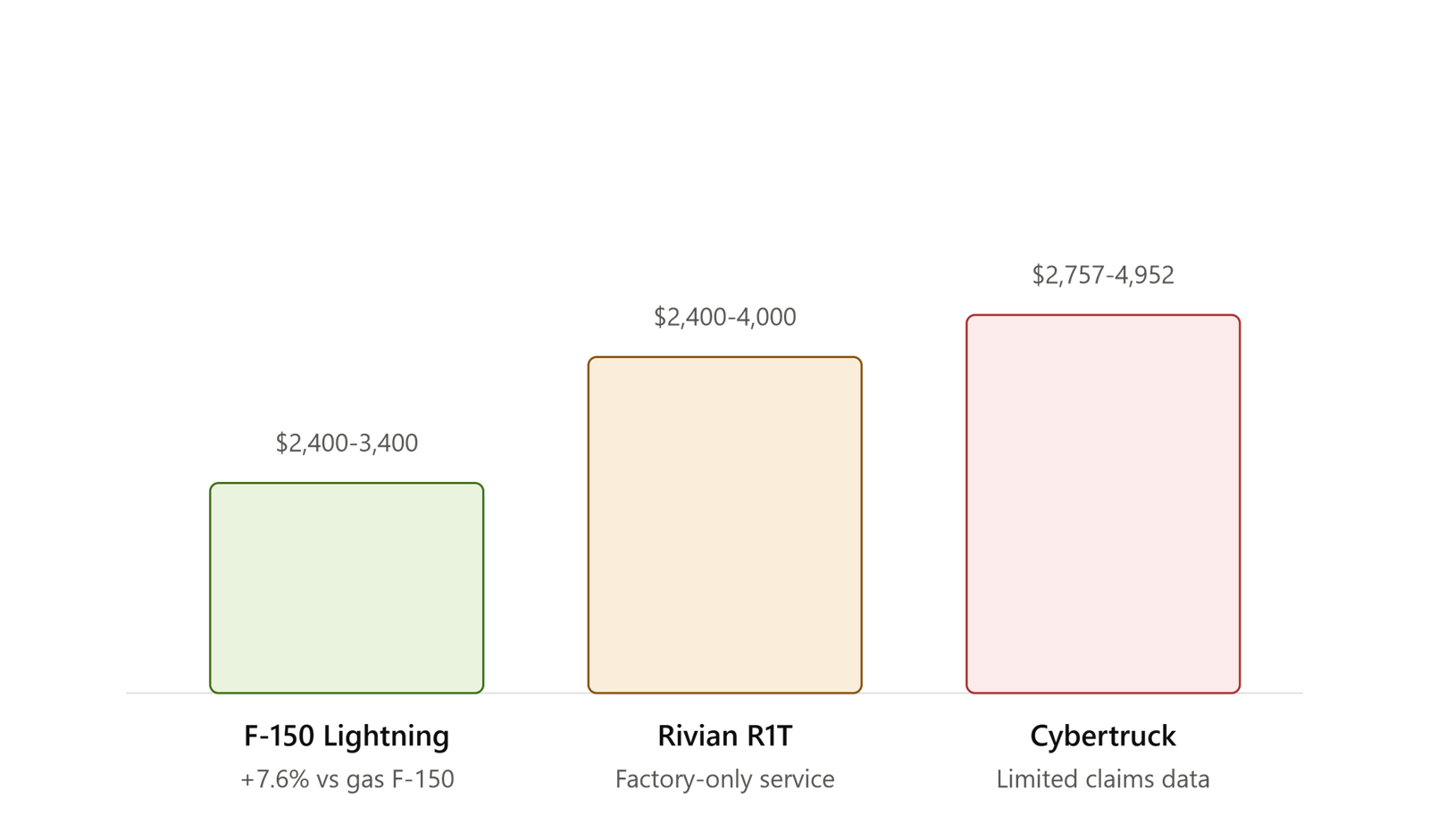
- The F-150 Lightning consistently insures the cheapest of the three, running just 7.6% above its own gas F-150 sibling, versus the Cybertruck’s $2,757 to $4,952 a year range and the R1T’s $2,400 to $4,000 a year range.
- Electric and hybrid trucks dominate the expensive end of the entire truck insurance market, with the GMC Hummer EV Pickup topping the list at $4,585 a year, followed closely by the Cybertruck and R1T.
- All three trucks share the same underlying cost drivers, specialized repair networks, proprietary parts, and elevated vehicle value, but the Lightning benefits uniquely from sharing meaningful repair infrastructure with the conventional, high-volume gas F-150.
- Trucks overall insure about 31% cheaper than cars on average nationally, a favorable baseline that all three electric trucks still exceed given their EV-specific cost factors.
The three trucks, side by side
Pulling together the model-specific data from our dedicated guides to each vehicle:
| Truck | Typical full-coverage range | Gap vs. closest gas sibling |
|---|---|---|
| Ford F-150 Lightning | $2,600–$3,100/year (realistic band: $2,400–$3,400) | +7.6% vs. gas F-150 |
| Rivian R1T | $2,400–$4,000/year | No direct gas sibling; ~18% above average car per one index |
| Tesla Cybertruck | $2,757–$4,952/year | No direct gas sibling; limited claims data adds uncertainty |
The Lightning’s advantage is clear and consistent across nearly every source reviewed for our dedicated guides to each truck. The Cybertruck and R1T run closer together, with genuine overlap depending on trim, state, and specific insurer, similar to the R1T-versus-R1S disagreement documented in our dedicated Rivian guides.
Why the Lightning wins this comparison
As covered in detail in our dedicated F-150 Lightning guide, this truck’s advantage comes down to one specific structural factor: it shares meaningful body-work and repair-network infrastructure with the conventional gas F-150, America’s best-selling vehicle for decades, running on an enormous, deeply established network of body shops, parts suppliers, and trained technicians. The Lightning benefits from a real share of that infrastructure even though its battery and high-voltage components still require specialized attention, keeping its EV-to-gas insurance gap at just 7.6%, one of the smallest documented anywhere on this site.
Where the Cybertruck and R1T lose ground
The Cybertruck’s challenge is largely about newness, not just technology. As covered in our dedicated Cybertruck guide, insurers explicitly cite limited claims data as a factor pushing rates higher, alongside its unconventional stainless-steel exoskeleton construction, which represents an even less common repair scenario for the broader body shop industry than the aluminum unibody construction found on many other EVs.
The R1T’s challenge is structural and company-specific. As covered in our dedicated R1T guide, Rivian operates its own factory-owned service centers rather than authorizing independent repair shops, which limits repair capacity and extends time-on-rent costs during claims, layered on top of its proprietary quad-motor architecture with no cross-brand parts compatibility.
Neither truck has a repair-network head start comparable to what the Lightning gets from the conventional F-150, and both pay for that gap in their premiums.
Where these trucks sit in the broader truck insurance market
This is worth understanding in the context of the entire truck category, not just these three vehicles against each other. The GMC Hummer EV Pickup tops the list of most expensive trucks to insure nationally at $4,585 a year, nearly double the truck insurance average, with the Tesla Cybertruck and Rivian R1T following close behind. Electric and hybrid models dominate the upper end of the truck pricing spectrum broadly, driven by the same higher vehicle values, specialized parts, and elevated repair costs documented throughout this comparison.
This context matters because it reframes the Lightning’s advantage: it isn’t just cheaper than the Cybertruck and R1T, it’s specifically avoiding the electric-truck cost penalty that has become a defining feature of this entire emerging vehicle category, largely by virtue of its unusually strong repair-network inheritance from the conventional F-150.
The favorable truck baseline all three still exceed
Worth noting as useful context: trucks overall insure meaningfully cheaper than cars on average nationally, the national average for truck insurance runs $2,892 a year compared to $3,798 for cars, making trucks about 31% less expensive to insure on average, largely because many trucks use sheet metal or aluminum panels that are cheaper and easier to repair than a typical car’s more complex body structure. All three electric trucks in this comparison exceed this favorable truck-category baseline, a reminder that even the Lightning’s relatively strong positioning still reflects a real EV-specific premium layered on top of what would otherwise be a comparatively cheap-to-insure vehicle category.
What these trucks actually offer beyond insurance cost, for context
Since insurance is only one factor in choosing between these three, it’s worth briefly noting their genuine differentiators. The Rivian R1T offers a distinctive gear tunnel between the cab and bed that neither the Lightning nor Cybertruck provides, plus genuinely strong off-road capability. The Cybertruck offers Supercharger network access and Tesla’s mature software ecosystem, along with the most polarizing design of the three. The Lightning offers the most conventional truck experience and the largest frunk among the group, appealing directly to traditional truck buyers making their first EV purchase. In real-world sales through the first half of 2025, the Lightning led U.S. electric truck sales with over 13,000 units, ahead of the Cybertruck’s roughly 10,000 and the R1T trailing both.
How to actually lower your electric truck premium, whichever you choose
Shop aggressively regardless of which truck you choose, but especially for the Cybertruck and R1T, given the documented insurer-to-insurer spreads covered in our dedicated guides to each, including AIG’s $508-a-month Rivian quote against Travelers’ $190 in one direct comparison.
Consider a used truck if minimizing cost matters. As covered throughout our dedicated guides, all three trucks show meaningful savings from choosing an older model year, given the standard depreciation-driven logic documented across nearly every vehicle on this site.
If you’re specifically choosing based on insurance cost, the Lightning’s advantage is genuine and well-documented, not a fluke of any single data source, making it the strongest choice among these three if minimizing your premium is a real priority alongside your other truck needs.
Ask about telematics and safe-driver programs regardless of which truck you choose, following the general savings guidance covered throughout this site, since all three trucks benefit from the same discount mechanisms documented across our broader EV insurance guides.
The bottom line
Among the Ford F-150 Lightning, Tesla Cybertruck, and Rivian R1T, the Lightning consistently emerges as the cheapest to insure, a genuine, well-documented advantage rooted in its unusually strong repair-network inheritance from the conventional gas F-150, rather than any temporary pricing quirk. The Cybertruck and Rivian R1T both carry real, distinct cost drivers, limited claims data and unconventional construction for the Cybertruck, a factory-only service model for the R1T, that keep them positioned alongside the GMC Hummer EV Pickup at the expensive end of the entire truck insurance market. Whichever of these three trucks fits your actual driving needs best, expect electric trucks generally to cost more than the favorable truck-category baseline, and shop specifically for your chosen truck given how much insurer-to-insurer variance our dedicated guides have documented for each.
This article is for informational purposes only and does not constitute financial or insurance advice. Insurance rates vary by insurer, state, model year, trim, and individual driver profile, and change frequently. Always get a personalized quote before making a purchasing decision.