Yes, on average, insuring an electric vehicle costs more than insuring a comparable gas-powered car in 2026. That part isn’t really in dispute anymore. What’s more interesting, and more useful if you’re actually trying to budget for a car, is how much more, where the gap is shrinking, and why the answer can look completely different depending on which vehicle, which state, and which model year you’re looking at. This article walks through the real numbers rather than a single headline percentage.
Key takeaways:
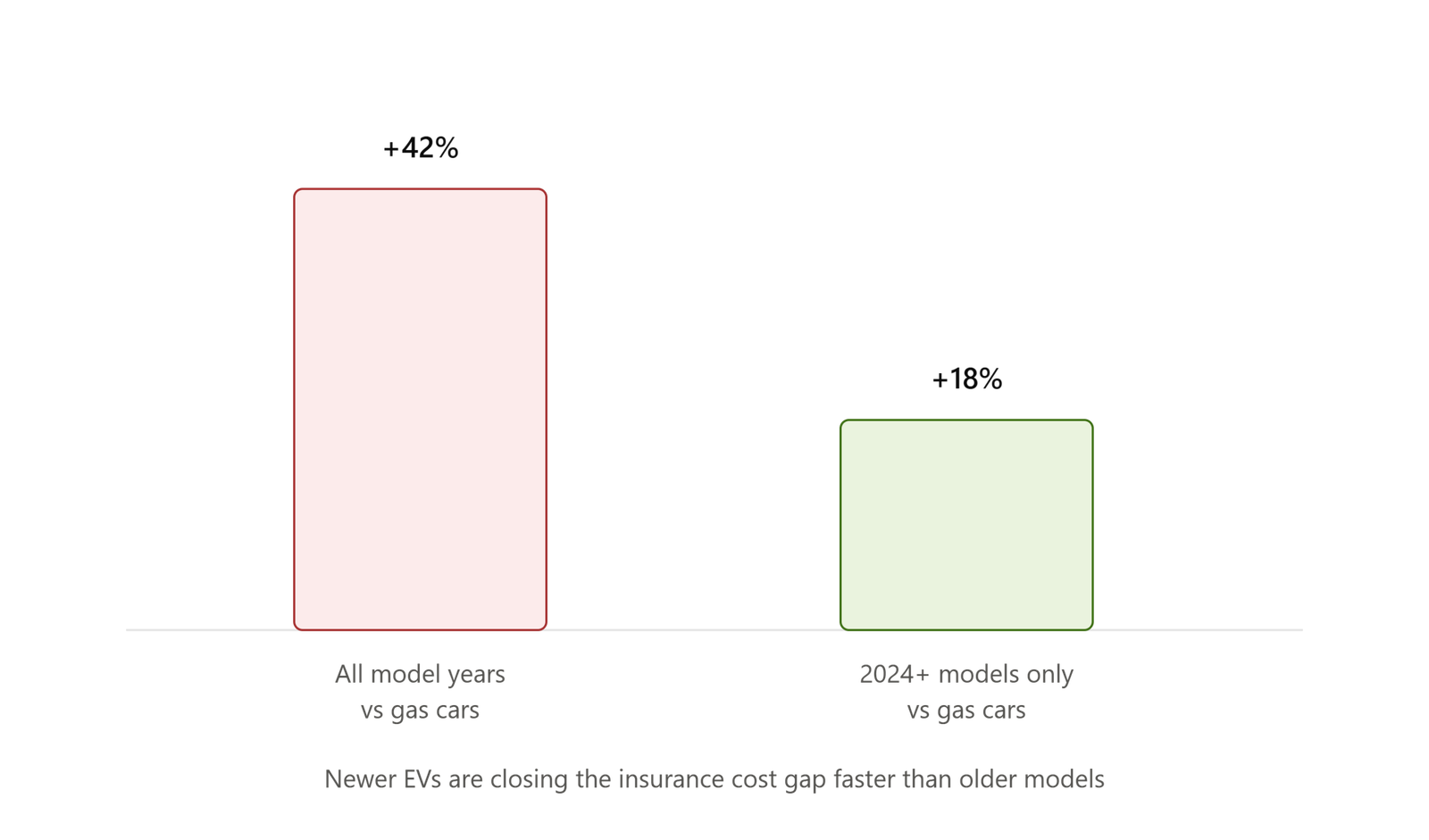
- Nationally, EVs cost about 42% more to insure than gas cars on average across all model years, but that gap narrows to roughly 18% when comparing only newer models (2024 and up).
- The dollar gap is close to $1,000 a year nationally, but it varies enormously by state, from under 5% in some places to nearly double the cost of a gas car in others.
- Some individual EV models, like the electric F-150 Lightning, now cost only a few percent more than their gas equivalents.
- Newer EVs are narrowing the gap faster than older ones because of improved driver-assist technology and a maturing repair network.
The national headline number
According to a 2026 analysis of more than 235 million insurance rate quotes, the average electric vehicle costs about 42% more to insure than a comparable gas-powered vehicle. In dollar terms, that works out to full coverage on an EV running about $3,159 a year nationally, compared to roughly $2,218 a year for a gas-powered car, a gap of just under $1,000 annually, or roughly $78 a month.
That 42% figure gets repeated a lot, and it’s accurate, but it’s also an average across every EV on the road, including vehicles that are a decade old alongside vehicles that rolled off the line this year. When you narrow the comparison to newer vehicles only, model years 2024 through 2026, the picture changes meaningfully.
The gap shrinks fast for newer models
Comparing only newer EVs to newer gas cars, the average cost difference drops to about 18%, or roughly $501 a year. That’s a meaningfully smaller gap than the all-model-years average suggests, and it points to something real: newer EVs increasingly ship with advanced driver-assistance features that reduce accident frequency, which insurers are starting to reflect in pricing.
There’s also a year-over-year trend worth knowing. As recently as 2025, the newer-model gap was around 23%. By 2026 it had narrowed to 18%. That’s real, measurable progress, even though insurance costs for EVs are still rising in absolute dollar terms, just not as fast as they were.
Where the comparison depends entirely on the model
Averages hide a lot, and nowhere is that more obvious than when you compare specific EV models to their closest gas equivalent.
Take the Ford F-150 Lightning against the standard gas-powered F-150. A gas F-150 runs about $258 a month to insure with full coverage. The electric Lightning version costs about $269 a month, only about 4% more. That’s a tiny gap, well within the range where other factors (your driving record, your location, your coverage choices) will move your actual quote more than the fuel type does.
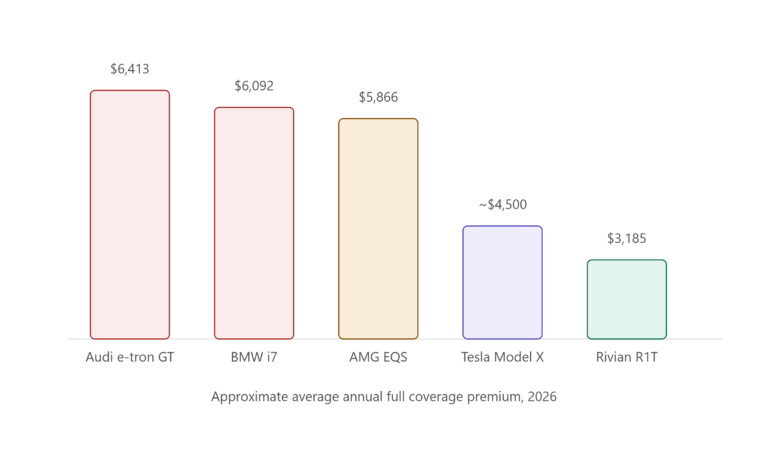
Compare that to the spread across the broader EV lineup. Among a set of nine popular EV models, the cheapest to insure, the Chevrolet Equinox EV, runs about $226 a month. The most expensive in that same comparison, the Rivian R1S, runs about $477 a month, more than double. That gap has nothing to do with «EV versus gas» and everything to do with vehicle value, repair complexity, and claim history for that specific model.
The takeaway: if you’re choosing between two EVs, or between an EV and a gas car, the specific model you pick matters far more than the fact that it’s electric. A mainstream EV from an automaker with an established repair network can insure close to gas-car pricing. A low-volume, high-value EV from a newer brand can cost twice as much as a more ordinary electric vehicle, let alone a gas car.
The state-by-state picture is dramatic
This is where the «how much more expensive» question gets genuinely surprising, because the gap between EV and gas insurance costs varies enormously depending on where you live.
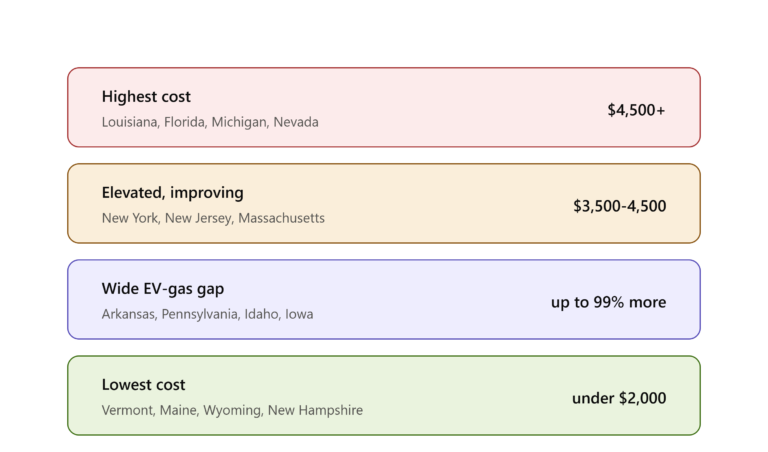
At the extreme end, Arkansas has the largest gap in the country: EVs there cost about 99% more to insure than gas cars, with EV owners paying an average of roughly $4,817 a year compared to $2,415 for a gas car. Pennsylvania sits right behind it with an essentially identical 99% gap, EV premiums averaging around $4,598 against $2,314 for gas vehicles.
A few other states with wide gaps:
- Idaho: a 95% cost difference, with EVs averaging about $3,332 a year versus $1,708 for gas cars.
- Iowa: an 87% gap, EVs at roughly $3,354 versus $1,793 for gas vehicles.
- Delaware: a 76% gap, though notably the premiums themselves run high across the board here, EVs averaging about $5,840 a year against $3,310 for gas cars.
- Louisiana: a 72% gap, driven in part by generally elevated insurance costs tied to hurricane and severe weather risk in the state.
At the other end of the spectrum, Massachusetts stands out for a different reason: even though EVs there cost 54% more than gas cars, a smaller relative gap than the states above, the absolute dollar figures are high because the state has expensive insurance across the board, driven by dense urban exposure and a body shop network that hasn’t fully caught up with EV repair demand around the Boston metro area.
And Washington, D.C. currently holds the title of most expensive market in the country for EV insurance specifically, with EV drivers there paying an average of about $6,394 a year, regardless of the percentage gap versus gas cars.
Why does the gap vary so much by state?
A few overlapping factors explain the wide state-by-state spread:
Local repair network maturity. States where EV adoption has been slower often have fewer certified EV repair shops. Fewer shops means longer repair times and higher labor costs when a claim does happen, and insurers price that scarcity into every policy in that state, not just for the driver who eventually files a claim.
Baseline insurance costs. States that already have expensive auto insurance overall, due to weather risk, litigation environment, or urban density, tend to see that cost carried over and often amplified when applied to EVs, since a higher-value vehicle raises the dollar stakes on every cost factor.
Theft and total-loss risk. In markets with higher vehicle theft rates, EVs are particularly exposed, since a stolen or written-off EV is expensive to replace. States with elevated vehicle crime statistics tend to show up with wider EV-to-gas cost gaps for this reason.
Local EV market maturity. States with a longer history of EV adoption and larger EV populations tend to have more data for insurers to price accurately, and more competition among insurers writing EV policies, both of which tend to narrow rather than widen the pricing gap over time.
Why EVs cost more to insure in the first place
Stepping back from the state and model-level numbers, the underlying reasons EVs cost more to insure haven’t changed much even as the size of the gap has narrowed:
Repair complexity and cost. EVs use specialized components, particularly the high-voltage battery pack, that require trained technicians and often longer repair timelines than a comparable gas car repair. Industry claims data has shown EV collision repairs running meaningfully higher than equivalent gas vehicle repairs, in part because certified EV repair capacity hasn’t kept pace with EV sales growth in every market.
Vehicle value. EVs tend to carry higher purchase prices than directly comparable gas vehicles, which raises the replacement cost an insurer is on the hook for after a total loss.
A higher likelihood of total-loss declarations. Because repairs are pricier and more complex, insurers are statistically more likely to total an EV after damage that might have been repairable on a gas car, which affects both claim payouts and subsequent premiums.
A younger, smaller vehicle population overall. The broader gas car fleet on the road, with a median vehicle age well over a decade, includes a huge number of older, cheaper, well-understood vehicles that pull the gas-car average down. EVs, as a newer category, don’t have that same long tail of older, cheap-to-insure vehicles yet, though that will change as the EV fleet ages.
What this means if you’re actually deciding on a car
If you’re cross-shopping an EV against a gas equivalent, the single most useful thing you can do is get an actual insurance quote for both specific vehicles before you buy, rather than relying on any general «EVs cost X% more» statistic. As the numbers above show, that percentage can range from essentially nothing (the F-150 Lightning) to nearly double (Arkansas and Pennsylvania’s statewide averages), depending entirely on the specific model and your location.
A few practical steps that follow directly from the data:
- Favor mainstream models from established automakers if insurance cost is a priority. Vehicles from brands with a broad, mature service network consistently insure closer to gas-car pricing than EV-only or luxury brands.
- Check your state’s specific gap before assuming a national average applies to you. A driver in Massachusetts or Arkansas faces a very different math problem than a driver in a state where the EV-to-gas gap is small.
- Newer is often relatively cheaper, not just in absolute terms but as a percentage gap. If you’re deciding between a slightly older EV and a current model year, the newer vehicle may carry a smaller insurance premium over its gas equivalent, thanks to safety tech insurers are starting to reward.
- Don’t let the insurance gap alone kill an EV purchase. Even with a higher insurance premium, EV owners typically still come out ahead on fuel costs, and in many cases the insurance gap is smaller than people assume once you’re comparing model-year to model-year rather than fleet-wide averages.
The bottom line
EV insurance is more expensive than gas car insurance in 2026, but «more expensive» is doing a lot of work in that sentence. Nationally the gap is around 42%, but it shrinks to about 18% for newer models, drops to nearly nothing for specific vehicles like the F-150 Lightning, and can approach 100% in certain states for certain models. The honest answer isn’t a single percentage. It’s that the gap is real, it’s shrinking for newer vehicles, and it depends far more on which specific car and which state you’re in than on the fact that the vehicle happens to be electric.
This article is for informational purposes only and does not constitute financial or insurance advice. Insurance rates vary by insurer, individual driving history, location, and vehicle, and change frequently. Always get a personalized quote before making a purchasing decision.