What Is Diminished Value and How Does It Apply to EVs?
Your EV gets into an accident, the insurance company pays for a perfect repair, and you pick up the car looking flawless. You’d reasonably assume the ordeal is over. It isn’t. Your vehicle now carries a permanent accident record on its CARFAX or AutoCheck history, and that record alone reduces what the car is worth, even with flawless repairs. This is diminished value, and it applies to EVs in ways that are genuinely more severe than for gas cars, for reasons specific to how buyers perceive a repaired battery pack.
Key takeaways:
- Diminished value is the gap between what your car was worth before an accident and what it’s worth after, even following a perfect repair, driven by the permanent accident history on its record.
- Insurers commonly use a formula called the «17c rule» to calculate payouts, and it’s specifically designed to minimize what they pay, understanding it is the key to not accepting a lowball offer.
- EVs face amplified diminished value because buyers specifically worry about hidden battery or high-voltage system damage, even when the battery itself was never touched, a perception gap gas cars don’t face to the same degree.
- You can only file a diminished value claim against the at-fault driver’s insurance, not your own, and only in states that legally recognize this type of claim, worth confirming before you assume you’re eligible.
What diminished value actually is
When your vehicle is repaired after an accident, the insurance company’s job is technically done, they’ve restored it to pre-accident condition, paint matched, panels replaced, sensors recalibrated. But the vehicle now carries a permanent disclosure on its vehicle history report: an accident occurred, with some description of severity. That disclosure alone reduces resale and trade-in value compared to an identical vehicle with a clean history, regardless of how good the repair actually was. That reduction in value is diminished value, and it’s a real, quantifiable financial loss separate from the repair cost itself.
The formula insurers use, and why it’s designed against you
Most insurers calculate diminished value using what’s commonly called the «17c rule,» a formula built around three multipliers:
Step one, the cap: the maximum possible diminished value payout is capped at 10% of the vehicle’s pre-accident value, regardless of actual loss. A $40,000 car has its potential diminished value payout capped at $4,000 from the outset, before any other factor is even applied.
Step two, the damage multiplier: a factor based on damage severity, commonly 1.00 for structural damage, 0.50 for moderate panel damage, and 0.25 for minor cosmetic damage, further reduces the capped amount.
Step three, the mileage multiplier: a factor based on the vehicle’s mileage, commonly 1.00 for a new car declining to as low as 0.20 for a car with 100,000 miles, reduces it again.
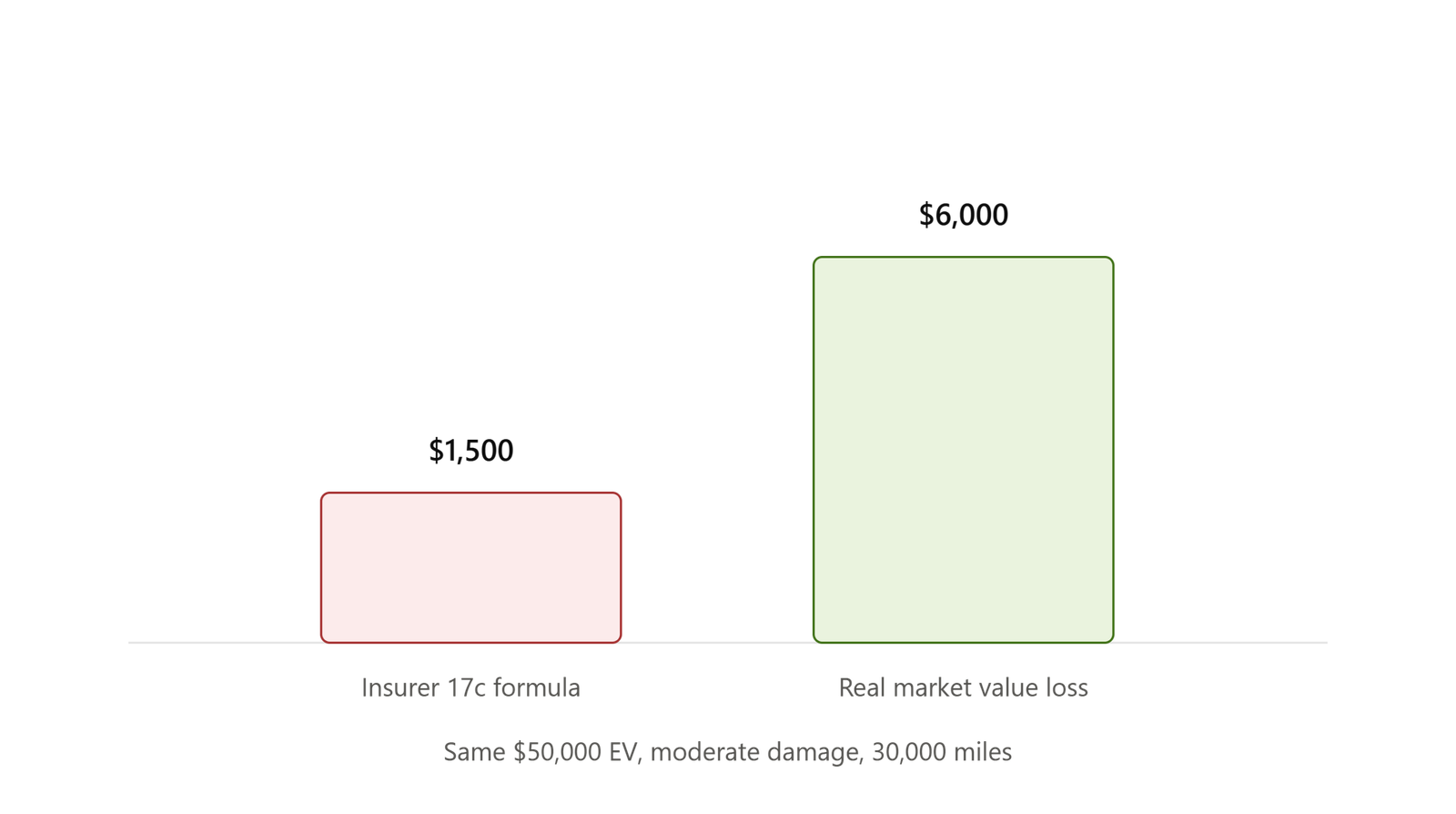
A worked example makes the effect clear: a $50,000 luxury EV with moderate damage and 30,000 miles works out to $50,000 × 10% × 0.50 × 0.60, or just $1,500. But the real-world market impact, what a dealer would actually knock off the trade-in value for an EV with a battery-related accident on its history, can run closer to $6,000 for the identical scenario. The formula is explicitly a negotiation tactic, not a genuine market-value calculation, and it’s designed to lowball claimants who don’t come prepared with their own data. Roughly 90% of drivers reportedly don’t know the term «diminished value» exists at all, which is exactly why insurers rely on the 17c formula going unchallenged.
Why EVs face a worse diminished value problem than gas cars
This is the part genuinely specific to electric vehicles, and it’s worth understanding in detail since it directly affects both the size of your claim and how you should argue it.
Buyer perception around the battery is the single biggest driver. Potential buyers shopping for a used EV are specifically wary of a vehicle with any accident history, worried that internal battery or high-voltage system damage could compromise performance or safety, even when the battery itself was never touched in the accident. This perception gap exists independent of the actual repair quality, a buyer comparing two otherwise identical used EVs will typically discount the one with any accident disclosure more heavily than they would for an equivalent gas car, purely because of battery-related uncertainty.
Specialized repair requirements add a second layer of buyer hesitation. As covered throughout our repair-network and Tesla-specific guides, many EV brands rely on proprietary technology requiring specialized shops and parts. Delays or difficulties sourcing the right components, or any deviation from manufacturer-recommended repair procedures, can further affect the vehicle’s actual and perceived quality after repair, a concern that compounds the general accident-history discount.
Higher purchase prices amplify the dollar impact even at the same percentage. As covered in our detailed Rivian and Tesla cost guides, EVs frequently carry higher purchase prices than comparable gas cars, and higher-value vehicles generally experience larger diminished value in both percentage and dollar terms after an accident, since buyers of expensive vehicles are typically more risk-averse about accident history than budget-car buyers.
Structural or ADAS-affecting repairs hit EVs particularly hard. Damage or repairs affecting the battery system or advanced driver-assistance sensor arrays, both extensively covered throughout our EV-specific coverage guides, result in meaningfully greater value loss than purely cosmetic damage, and EVs are more likely than gas cars to have ADAS components involved in even a moderate collision given how standard this technology has become across the category.
How to actually file a strong diminished value claim
You can only claim against the at-fault party’s insurance, not your own. This is a critical distinction: diminished value claims are third-party claims, meaning you’re pursuing the other driver’s liability insurer, not filing under your own comprehensive or collision coverage, only viable when you were not at fault in the accident.
Confirm your state actually recognizes this type of claim. Not every state legally supports diminished value claims in the same way, and the process and likelihood of success varies meaningfully by jurisdiction, worth confirming before investing significant time pursuing one.
Reject the 17c formula and build your own valuation. Given that the formula is explicitly structured to minimize payouts, as covered above, the practical path to a fair settlement involves gathering independent evidence rather than accepting the insurer’s first number.
Gather evidence of pre-accident value specifically. A purchase invoice, recent listings for comparable vehicles in pristine condition, or a professional pre-accident appraisal all strengthen your position, giving you a real, defensible baseline rather than relying on the insurer’s own capped calculation.
Document the nature of the repair specifically, not just that repair occurred. For an EV claim, this means specifically noting whether the battery system or ADAS components were involved, since these carry meaningfully greater diminished value than cosmetic panel work, as covered above, and whether repairs used manufacturer-recommended parts and procedures versus aftermarket alternatives.
Consider a professional diminished value appraisal, particularly for a higher-value EV where the dollar stakes justify the appraisal cost, since a documented, independent third-party valuation carries more weight in a negotiation or dispute than your own estimate alone.
A worked example specific to a luxury EV
Illustrating how this plays out for a genuinely high-value EV: a Lucid Air, which can cost over $80,000 with higher trims surpassing $100,000, faces amplified diminished value for several compounding reasons covered above, its high starting value, the buyer perception around battery and technology concerns even when the battery is unharmed, and Lucid’s specialized, proprietary repair requirements that can extend timelines and affect perceived repair quality. For an owner in this situation, structural damage or any repair touching the battery system or ADAS would justify a meaningfully larger diminished value claim than cosmetic-only damage, and gathering strong pre-accident value documentation matters even more given how much of the vehicle’s value is tied up in exactly the systems buyers worry about most.
The bottom line
Diminished value is a real, permanent financial loss that follows your EV even after a flawless repair, driven by the accident disclosure that stays on its history report indefinitely. Insurers rely on a formula, the 17c rule, specifically designed to minimize what they pay, and on the fact that most drivers have never heard of this type of claim at all. EVs face a genuinely worse version of this problem than gas cars, since buyer wariness around battery and high-voltage system damage, even when unaffected, compounds with higher purchase prices and specialized repair requirements to produce a larger real-world value gap than the insurer’s capped formula acknowledges. If you’re not at fault in an accident involving your EV, understanding this dynamic, and coming prepared with your own pre-accident valuation evidence rather than accepting the first number offered, is the difference between a fair settlement and leaving real money on the table.
This article is for informational purposes only and does not constitute financial or insurance advice. Diminished value claim eligibility, calculation methods, and outcomes vary significantly by state, insurer, and individual circumstances. Consider consulting a qualified professional or attorney for guidance specific to your situation.