EV Insurance in Colorado: Incentives and Rates
Colorado occupies a genuinely favorable spot for EV owners: real state tax credits on the purchase side, and one of the country’s 13 states where Tesla Insurance operates with its full telematics-based pricing model, unlike California’s restricted version covered in our dedicated guide. This guide covers both halves of the Colorado EV financial picture, what the state gives you at purchase, and what you’ll actually pay to insure the vehicle afterward.
Key takeaways:
- Colorado requires 25/50/15 liability coverage, and full-coverage averages range widely across sources, from about $2,690 to $3,181 a year depending on methodology and data vintage.
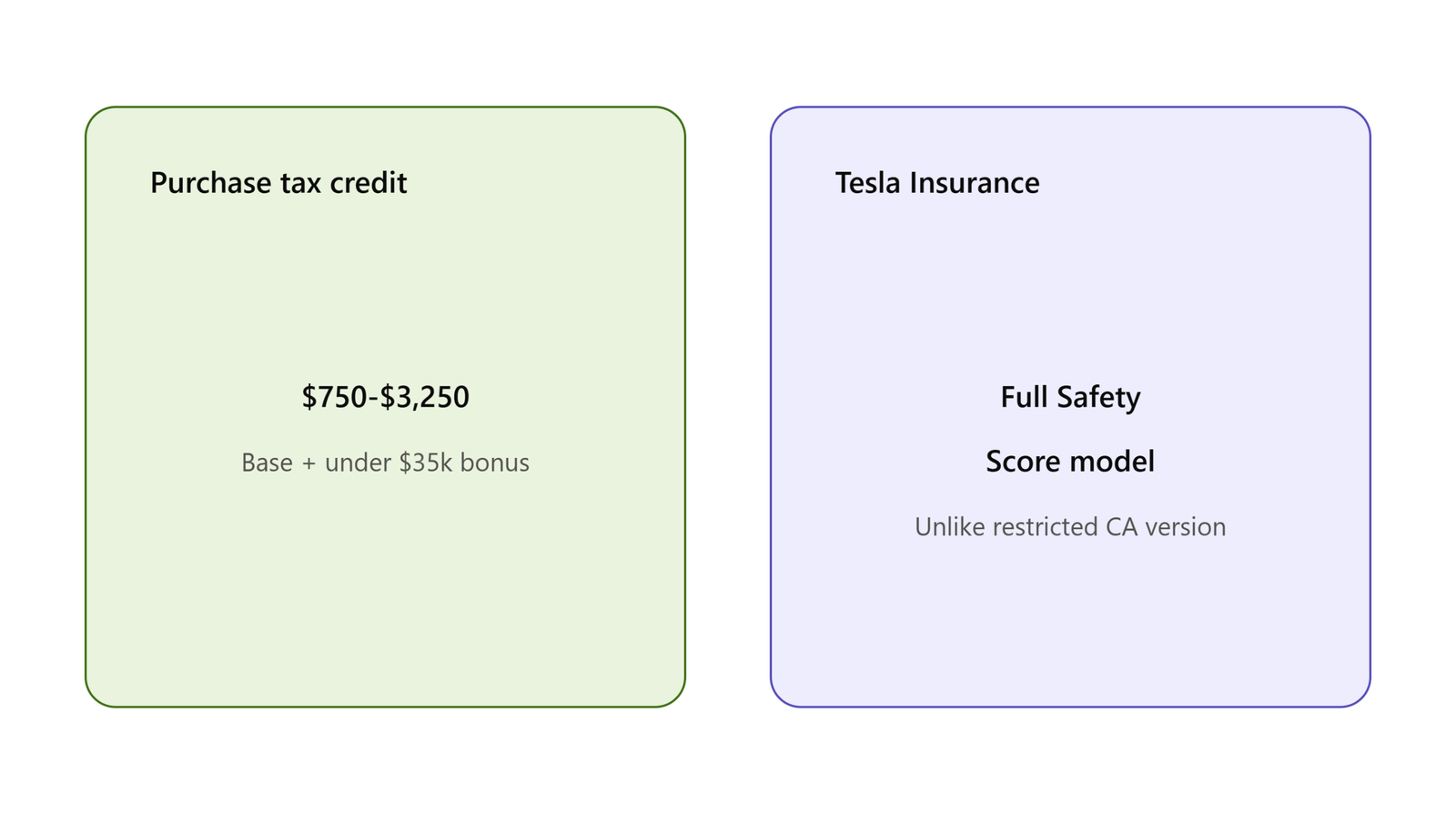
- Colorado offers a $750 state tax credit for EV purchases in 2026, with an additional $2,500 credit for vehicles with an MSRP under $35,000, for eligible vehicles priced below $80,000.
- Colorado is one of the 13 states where Tesla Insurance is available, and unlike California, it isn’t subject to a telematics-pricing restriction, meaning Tesla owners get the full real-time Safety Score model here.
- GEICO and American National both show up as leading low-cost options in independent Colorado-specific comparisons, though rates vary significantly by city, from around $886 a year for minimum coverage in Aurora up to notably higher figures elsewhere in the state.
Colorado’s actual requirements
Colorado requires all drivers to carry liability insurance with at least $25,000 for bodily injury per person, $50,000 for bodily injury per accident, and $15,000 for property damage per accident, commonly written as 25/50/15. While this keeps you legal, many experts recommend higher coverage, especially given the elevated repair costs of any modern vehicle, and particularly an EV, as covered throughout this site’s broader coverage guides.
The real cost numbers
Pulling together multiple 2026 sources gives a genuinely wide range for Colorado overall:
- One source finds the average full-coverage cost at $3,181 a year ($265 a month), with rates ranging from $171 to $421 a month depending on location and profile.
- A separate broker-sourced analysis finds a similar $216 a month average, with liability-only at $103 a month and full coverage at $285 a month for non-SR22 drivers.
- A third source finds a somewhat lower $2,690 a year for full coverage, with minimum coverage around $630 a year, and specifically notes affordable options exist for low-income drivers, with minimum coverage policies starting around $75 a month.
- NerdWallet’s analysis finds full coverage averaging $227 a month, with American National offering the cheapest full coverage at $1,327 a year and GEICO offering the cheapest minimum coverage at $40 a month.
Bringing this together: budget roughly $2,700 to $3,200 a year for full coverage as a realistic planning range for a typical Colorado driver, with your specific EV model layering on top of this baseline according to the patterns documented throughout our dedicated model guides.
The purchase-side incentive worth knowing about
This is where Colorado genuinely stands out, and it’s worth understanding as part of your total EV cost picture, even though it doesn’t directly reduce your insurance premium. Colorado offers a $750 state tax credit for EV purchases in 2026, with an additional $2,500 credit available for vehicles with an MSRP under $35,000, for eligible light-duty EVs and fuel cell vehicles purchased or leased before January 1, 2029, provided the vehicle’s MSRP stays below $80,000.
While this credit doesn’t reduce your ongoing insurance cost, it directly improves your total cost of ownership, and it’s worth factoring into your overall EV budget alongside the insurance figures throughout this guide. If you’re specifically shopping for a lower-priced EV to maximize this incentive, several of the mainstream models covered in our dedicated cheapest-EVs-to-insure guide, models under the $35,000 threshold, would qualify for the larger combined credit while also tending to insure more affordably given their establishment automaker backing.
Colorado’s Tesla Insurance advantage over California
This is a genuinely useful, specific data point for Colorado Tesla owners. As covered in our dedicated Tesla Insurance review, Colorado is one of the 13 states where Tesla Insurance is currently available. Critically, unlike California, which prohibits telematics-based pricing entirely, Colorado has no such restriction, meaning Tesla Insurance in Colorado uses its full real-time Safety Score model, tracking behaviors like hard braking and unsafe following distance to set monthly premiums directly. For a genuinely safe, low-mileage Tesla driver in Colorado, this represents real access to the savings potential covered in our dedicated Tesla Insurance guide, without the California-specific limitation that forces standard rating factors instead.
How Colorado EV owners can find the best carrier-specific discounts
Since a carrier that’s cheapest for a Tesla Model 3 might not be cheapest for a Ford F-150 Lightning, following the model-specific insurer variance documented throughout our dedicated Tesla, Ford, and Rivian guides, working with an independent agency that compares multiple carriers, Nationwide, Travelers, Progressive, and Safeco among the options cited for Colorado specifically, can help identify which carrier offers the best EV discount for your exact vehicle rather than assuming a single «best» insurer applies universally.
Discounts worth asking about specifically in Colorado, consistent with the broader savings guidance covered throughout this site, include multi-policy bundles with homeowners or umbrella coverage, layered on top of any green-vehicle or EV-specific discount your chosen carrier offers.
City-level rate variance within Colorado
Following the general pattern covered throughout our broader state-by-state EV insurance guide, rates vary meaningfully by Colorado city. Aurora’s average minimum coverage cost runs around $886 a year in one detailed comparison, and Colorado Springs and other major cities show their own distinct figures reflecting local traffic density, accident frequency, and claim costs. Given how much this in-state variance can move your actual premium, confirming your specific city or ZIP code’s positioning is worth as much attention as comparing insurers broadly.
Best insurers for Colorado EV owners
GEICO offers the cheapest minimum coverage in Colorado according to NerdWallet’s analysis, at $40 a month, backed by strong financial strength, an extensive discount list, and few regulatory complaints.
American National offers the cheapest full coverage in the same analysis, at $1,327 a year, a notably lower figure than several of the broader averages cited above, worth confirming with a direct quote given how much this differs from other sources’ central estimates.
Nationwide, Travelers, Progressive, and Safeco are specifically cited as carriers worth comparing for EV-specific discounts through an independent agency, given how much carrier-to-carrier variance exists for any specific EV model, consistent with the broader insurer-comparison guidance covered throughout this site.
Practical steps for Colorado EV owners
- Confirm your specific city or ZIP code’s rate positioning, given the documented variance between Aurora and other Colorado cities.
- Get quotes from GEICO and American National as a starting comparison set, given their standout showings in independent Colorado-specific analysis, but compare against your specific EV model’s typical insurer rankings covered in our dedicated model guides.
- If you’re a Tesla owner, take advantage of Colorado’s full telematics-based Tesla Insurance availability, unlike the restricted version available in California, if you’re a genuinely safe, low-mileage driver.
- Factor the $750 to $3,250 combined state tax credit into your total EV budget, even though it doesn’t reduce your insurance premium directly, it meaningfully improves your total cost of ownership picture.
- Ask about multi-policy bundling and EV-specific discounts through an independent agency, given how much carrier-to-carrier variance exists for any specific EV model in Colorado.
The bottom line
Colorado offers EV owners a genuinely favorable combination: real purchase-side tax credits (up to $3,250 combined for qualifying lower-priced EVs), full access to Tesla Insurance’s telematics-based pricing model unlike California’s restricted version, and a competitive insurance market with GEICO and American National both posting strong independent rankings. Full-coverage costs range widely across sources, roughly $2,700 to $3,200 a year for a typical driver, with meaningful variance by city and by the specific EV model you drive, covered in detail throughout our dedicated model guides. Combining the purchase-side incentives with careful insurer comparison gives Colorado EV owners more total-cost-of-ownership control than in many other states covered throughout this site.
This article is for informational purposes only and does not constitute financial or insurance advice. Insurance rates, tax credit eligibility, and program details vary and change frequently. Always confirm current requirements and incentive eligibility directly with the Colorado Department of Revenue and a licensed insurance agent.