States With EV Insurance Discounts and Green Vehicle Credits
There are actually two separate savings categories hiding inside this topic, and mixing them up leads to real confusion. Insurance-specific «green vehicle» discounts, offered by individual carriers like Travelers, apply regardless of which state you live in, while state-level purchase incentives are entirely separate programs tied to specific states. This guide untangles both, and covers exactly which states and insurers offer what.
Key takeaways:
- Green vehicle or hybrid/EV insurance discounts come from individual carriers, Travelers is specifically named as offering one of the most consistent versions, typically worth 5% to 15% off, and these discounts aren’t tied to any particular state, they’re available wherever that specific insurer operates.
- State-level purchase incentives, a separate category entirely, are currently concentrated in nine states: California, Colorado, Connecticut, Delaware, Maine, Massachusetts, New Jersey, New York, and Rhode Island.
- The federal EV tax credit ended for vehicles purchased after September 30, 2025, meaning state-level incentives now represent the primary remaining purchase-side savings for most EV buyers.
- Standard, non-EV-specific discounts, bundling, telematics, good student, good driver, remain available to EV owners the same as anyone else, and often deliver larger savings than the EV-specific discount alone.
First, the crucial distinction: insurance discounts versus purchase incentives
This is worth clarifying immediately, since these two categories work completely differently and get conflated constantly in casual conversation about «EV savings.»
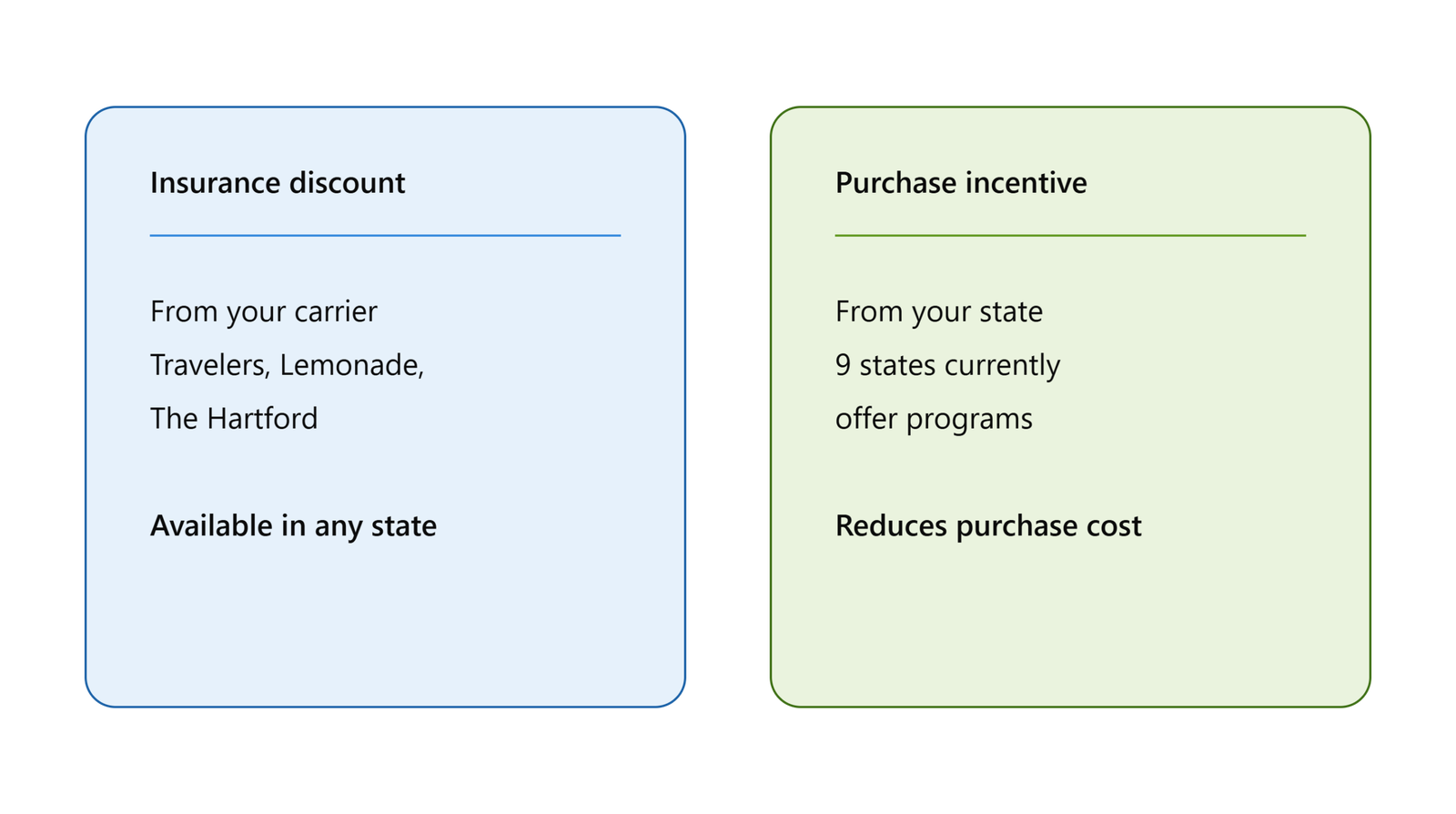
Insurance-specific green vehicle discounts are offered by individual insurance carriers, not state governments, as a discount on your ongoing insurance premium. These discounts follow the insurer, not your state, meaning if Travelers offers a green vehicle discount, it’s available to Travelers customers regardless of which state they live in, provided Travelers operates there.
State-level purchase incentives are entirely separate government programs, tax credits, rebates, or point-of-sale discounts tied to buying or leasing the vehicle itself, administered by specific state agencies and only available to residents of that particular state. These don’t reduce your ongoing insurance premium at all, they reduce your upfront purchase cost.
Understanding this distinction matters because the question «does my state offer EV insurance discounts» is actually two different questions with two different answers, and this guide addresses both.
Insurance carriers offering green vehicle discounts, regardless of state
Travelers is repeatedly and consistently named across multiple sources as offering one of the most reliable green vehicle or hybrid/electric car discounts among major national carriers, on top of already being identified throughout this site as one of the cheapest overall insurers for EV owners, as covered in our broader insurer comparison guide. Premium reductions from this category of discount often average around 5% per six-month policy period.
Lemonade offers EV and hybrid discounts as part of its broader EV-native approach, alongside extra coverage specifically for home chargers and emergency charging situations, consistent with the EV-focused product design covered in our dedicated best-insurers guide.
The Hartford offers one of the more distinctive green vehicle discounts, though it comes with a membership requirement: you need to be an AARP member to qualify for coverage through The Hartford in the first place, worth knowing if you’re eligible through age or AARP membership specifically.
ALFA Insurance also offers competitive EV premiums according to at least one source, though it’s only available in select states, worth checking directly whether it operates where you live.
Beyond these specific standouts, the broader guidance covered throughout our discount and savings guides applies directly: some insurers advertise their green vehicle discount prominently, while others don’t, meaning it’s always worth asking directly when getting quotes, since letting an insurer know you drive an EV can sometimes surface discounts that aren’t automatically applied.
What qualifies a vehicle for these insurance-specific discounts
A few consistent qualifying factors show up across the sources reviewed for this guide:
High fuel efficiency, particularly relevant for hybrids and EVs specifically, often triggers eligibility for a green vehicle insurance discount.
Living in a participating state matters, but not the way you might expect. Not all discounts are available nationwide, some states have more EV-friendly insurer policies than others, though this is a function of which insurers choose to operate and offer the discount in a given state, not a state government mandate.
Low or zero emissions can separately qualify a vehicle for EV insurance discounts, tracking the broader environmental framing some insurers use for this discount category.
Advanced driver-assistance systems (ADAS), standard on most current EVs, are specifically identified as a primary driver of insurance discounts, since insurers view these features as proactive tools that prevent expensive claims rather than simply rewarding the vehicle’s fuel type.
The nine states currently offering purchase-side EV incentives
This is the separate, state-government category. As of 2026, the states offering EV purchase incentives include California, Colorado, Connecticut, Delaware, Maine, Massachusetts, New Jersey, New York, and Rhode Island. Several of these programs are covered in detail in our dedicated state guides: Colorado’s combined $750 to $3,250 tax credit structure, Massachusetts’s MOR-EV program offering up to $3,500 plus additional income-qualified and trade-in bonuses, and New Jersey’s Charge Up New Jersey program, providing a point-of-sale rebate of up to $4,000 on new EVs under a specified MSRP cap, plus a separate $250 rebate for a qualifying home charger purchase.
Worth noting directly: there is no federal EV tax credit currently available. The federal Clean Vehicle Credit ended for vehicles purchased after September 30, 2025, under the One Big Beautiful Bill Act, meaning these nine state programs now represent the primary remaining purchase-side incentive landscape for most EV buyers nationally, a genuinely important shift from the pre-2025 landscape where federal credits applied broadly regardless of state.
Standard discounts that apply to EV owners the same as anyone else
This is worth emphasizing, since these often deliver more savings than the EV-specific discount alone, a pattern covered throughout our broader savings guides:
Bundling home and auto insurance typically delivers a discount between 15% and 25%, according to multiple sources, consistently larger than the 5% to 15% typical range for EV-specific green vehicle discounts alone.
Telematics program enrollment, covered in detail in our dedicated usage-based insurance guide, remains available to EV owners exactly as it would to any other driver, and many 2026 eco-friendly drivers are specifically described as doubling their savings by combining a green vehicle discount with telematics enrollment.
Credit score improvement, where used as a rating factor, carries genuinely large stakes: drivers with poor credit (a FICO score below 579) pay an average of 105% more for full coverage than those with excellent credit (800 or above), a gap covered in detail in our dedicated bad-credit EV insurance guide, and one that dwarfs the EV-specific discount in most cases.
Garaging your vehicle securely can sometimes trigger additional discounts by reducing theft and weather-damage risk, worth specifically informing your agent about if your EV is regularly parked in a secure garage for charging.
How to actually find and claim these discounts
- Ask directly about a green vehicle, hybrid/EV, or alternative fuel discount when getting any quote, since these aren’t always advertised prominently or applied automatically.
- Confirm which of the nine incentive states you live in, if any, and research your specific state’s program directly, since these change and evolve, our dedicated California, Colorado, Massachusetts, and New Jersey guides cover several of these programs in detail.
- Prioritize the standard, larger discounts, bundling and telematics specifically, over chasing the EV-specific discount alone, given how much larger these categories typically run.
- Get quotes from Travelers, Lemonade, and, if eligible, The Hartford, given their consistent recognition across multiple sources for EV-specific discount offerings.
- Remember that state purchase incentives and insurance discounts are entirely separate savings streams, worth pursuing both independently rather than assuming one substitutes for the other.
The bottom line
«EV insurance discounts and green vehicle credits» actually describes two distinct savings categories: carrier-specific insurance discounts (Travelers, Lemonade, and The Hartford among the most consistently recognized) that apply regardless of your state, and state-government purchase incentives currently concentrated in nine states, California, Colorado, Connecticut, Delaware, Maine, Massachusetts, New Jersey, New York, and Rhode Island, that reduce your upfront purchase cost rather than your ongoing premium. With the federal EV tax credit no longer available as of late 2025, these state programs carry more relative weight than they used to, while on the insurance side, standard discounts like bundling and telematics typically deliver larger savings than the EV-specific discount alone, worth prioritizing in your overall savings strategy regardless of which state you call home.
This article is for informational purposes only and does not constitute financial or insurance advice. Insurance discounts, state incentive programs, and eligibility requirements vary and change frequently. Always confirm current offerings directly with your insurer and your state’s relevant incentive program administrator.