EV Repair Costs and Why Insurers Struggle With Them
«Initially, it was not uncommon for EVs to receive premium discounts,» according to Zurich Insurance Group’s head of motor group underwriting, «but this has shifted due to their unique risks and repair costs.» That single quote captures an entire industry’s reversal: insurers used to view EVs as a good bet, and now many are actively struggling to price and process EV claims accurately at all. This guide looks at the problem from the insurer’s side, why the industry’s own pricing models are genuinely struggling to keep up.
Key takeaways:
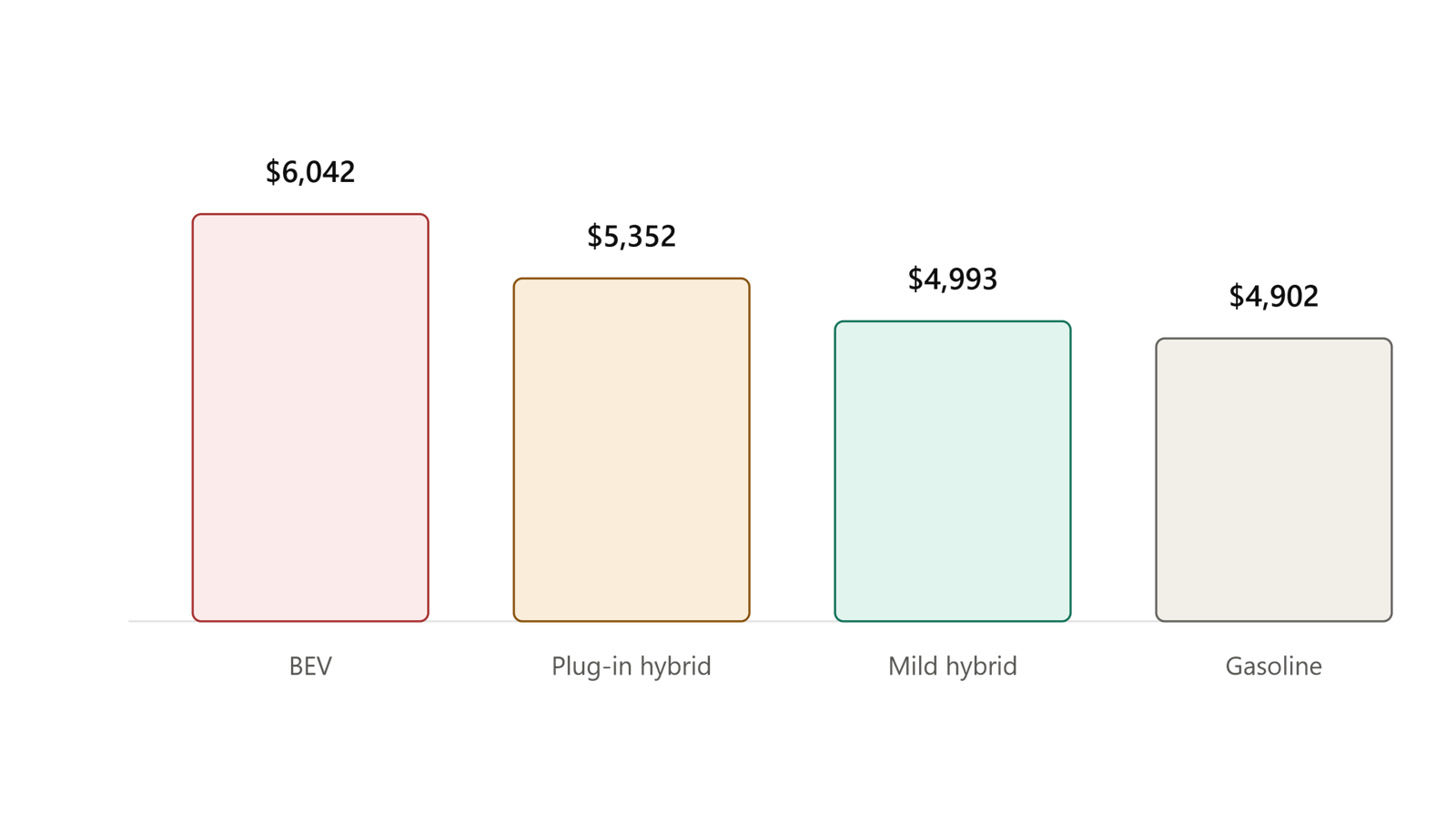
- The average repairable claim severity for battery electric vehicles hit $6,042 in Q1 2026, compared to $4,902 for gas-powered vehicles, according to Mitchell’s industry-wide claims data, a gap of over $1,100 per claim.
- Traditional motor insurance pricing models, built on decades of internal combustion engine claims data, are structurally struggling to accommodate the unique cost drivers behind EV claims, forcing insurers to rebuild their actuarial approach essentially from scratch.
- Hybrid vehicle claims are surging even faster than pure EV claims, up 25% to 33% year over year in early 2026, adding a second, fast-growing category insurers are still learning to price.
- High-voltage battery management requires de-energizing and often fully removing the pack during collision repair, adding labor hours that simply don’t exist in a comparable gas car repair.
The real severity numbers, straight from industry claims data
This is worth leading with, since it’s the clearest, most current evidence of the gap insurers are actually grappling with. According to Mitchell’s Q1 2026 Plugged-In: EV Collision Insights report, average repairable severity in the U.S. reached $6,042 for battery electric vehicles, compared to $5,352 for plug-in hybrids, $4,993 for mild hybrids, and $4,902 for gasoline-powered vehicles. That’s a genuine, quantified gap of over $1,100 per claim between a BEV and a comparable gas vehicle, based on actual claims processed industry-wide, not a projection or estimate.
Worth noting separately: the share of repairable collision claims involving BEVs held steady at 3.33% in the U.S. in Q1 2026, while mild hybrid claims surged to record highs of 5.69%, a year-over-year increase of 25%. As one Mitchell executive put it, electrification isn’t slowing, it’s evolving, even as pure BEV sales soften somewhat, the number of hybrids on the road is growing fast, and that’s clearly reflected in rising hybrid collision claims specifically, a second front insurers are now managing alongside the BEV-specific challenges covered throughout the rest of this guide.
Why the insurance industry’s own pricing models are struggling
This is the structural problem worth understanding in depth, since it explains why EV insurance pricing has felt so volatile and inconsistent throughout this site’s broader research. Traditional motor insurance models, built on decades of internal combustion engine vehicle data, are struggling to accommodate the unique cost drivers of EV claims. Insurers spent generations refining their pricing models against a deep, stable well of gas car claims history, and EVs simply don’t fit that existing framework cleanly.
Actuaries specifically need to differentiate EV pricing based on factors that barely mattered for gas cars: battery capacity, battery chemistry, and the specific ADAS feature set on a given model, all inputs that require genuinely new data collection and modeling approaches rather than simply extending existing gas car formulas. A claims professional noticing a recurring pattern of battery-related incidents in low-speed impacts for one specific EV model, for example, faces a real challenge in getting that granular insight properly captured and communicated to the actuarial team in time to actually inform pricing, since the feedback loop between claims experience and pricing adjustment is still being built out industry-wide for this vehicle category.
The specific mechanical reason EV repairs take longer
Beyond the pricing-model challenge, there’s a genuine, physical reason EV repairs consume more labor hours than a comparable gas car repair. High-voltage battery management necessitates de-energizing the pack, and frequently full removal, to protect it during collision repair and refinishing procedures, and this additional handling requirement is a primary driver of the extra labor hours EV repairs require compared to gas vehicles. This isn’t a temporary training gap that will close on its own, it’s a structural safety requirement built into how high-voltage systems must be handled, meaning it will remain a genuine cost and time driver even as the broader EV repair industry matures.
Separately, EV repairs in the UK now average £3,408 (roughly $4,300) and take around 21 days to complete, according to one detailed industry analysis, illustrating both the cost and the extended timeline insurers must account for when reserving funds against an open EV claim.
Why the repair network itself is part of the pricing challenge
This connects directly to the repair-network limitations covered throughout our broader Tesla and Rivian research, but from the insurer’s side specifically: pricing increasingly needs to reflect an insurer’s actual access to certified EV repair networks, since that access directly impacts how well the insurer can manage and control repair costs. An insurer with strong relationships and volume access to EV-certified shops can genuinely price more competitively than one without that access, meaning the insurer you choose isn’t just about customer service, it’s about which company has actually built out the infrastructure to handle your specific vehicle efficiently, a factor worth weighing alongside the insurer comparisons covered throughout this site’s broader model guides.
Specialized parts and labor compound this further: EVs use unique components, from power electronics and high-voltage cabling to bespoke charging ports, and sourcing these parts can be genuinely challenging for insurers and repairers still building out their EV-specific supply chains.
The write-off consequence, from the insurer’s side
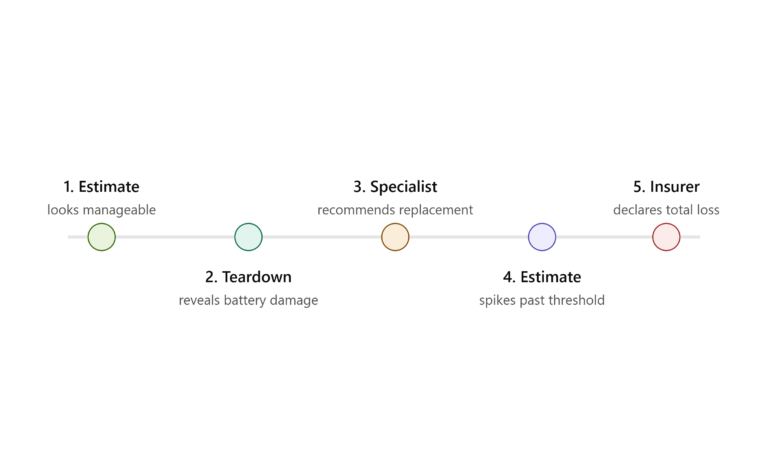
As covered in detail in our dedicated guide on why insurers total EVs after minor accidents, the direct consequence of all these compounding cost factors is a genuinely higher write-off rate for EVs. From the insurer’s perspective, this isn’t a punitive choice, it’s the rational outcome of pricing a repair that’s grown consistently more expensive and time-consuming against a vehicle value that, once you factor in the battery representing 30% to 40% of the car’s worth, crosses the total-loss threshold far more easily than a comparable gas car repair would. Insurers and fleets that succeed in this environment, according to industry analysis, will be the ones that specifically adapt their claims handling, write-off thresholds, and repair routing for EVs, rather than continuing to apply the same processes built for gas vehicles.
What insurers are actually changing in response
Battery health and software data are becoming genuine pricing inputs, not just vehicle age and mileage, according to industry analysis, a meaningful shift from the traditional rating factors covered throughout our broader cost guides, and one that connects directly to the battery degradation monitoring covered in our dedicated battery degradation guide.
Insurers are increasingly relying on approved repairer networks with genuine diagnostic and calibration capability, since with the majority of vehicles sold globally now equipped with Level 2+ ADAS features, recalibration requirements have become a routine, unavoidable part of nearly every repair, not an occasional complication.
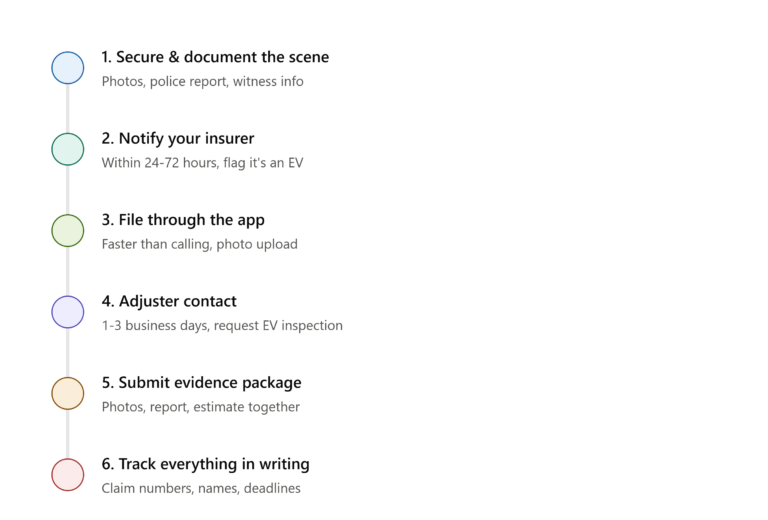
Sending EVs to the right repair centers early is specifically identified as one of the best ways to control repair costs and make claims easier, both for the insurer and, in practice, for you as the claimant, connecting directly to the guidance in our own step-by-step EV claim-filing guide to flag your vehicle as electric immediately and insist on appropriately experienced repair routing from the start.
What this structural challenge means for you as a policyholder
Expect continued volatility in EV-specific pricing, not necessarily continued increases. As covered in our guide on whether EV insurance rates drop over time, the broader market has been trending toward moderation as claims data accumulates, even as the underlying repair-cost challenges documented in this guide remain real.
Your specific insurer’s repair-network access genuinely matters, not just their advertised rate. Given how directly network access affects an insurer’s actual cost management, as covered above, this is worth asking about directly when comparison shopping, not just comparing headline premiums.
Battery health monitoring may increasingly affect your own premium over time. As insurers move toward incorporating battery health and software data into pricing, proactively tracking your own vehicle’s State of Health, as covered in our dedicated battery degradation guide, may become more directly relevant to your insurance cost than it has been historically.
The bottom line
Insurers are genuinely struggling with EV repair costs not because of any single fixable problem, but because of a structural mismatch between decades of gas-car-trained actuarial models and a vehicle category with fundamentally different cost drivers: real claims data now shows EVs averaging over $1,100 more per repairable claim than gas vehicles, driven by mandatory battery de-energization procedures, specialized parts sourcing, a still-maturing certified repair network, and surging hybrid claims volume layered on top. The industry’s response, incorporating battery health data into pricing, building out certified repair network access, and adapting write-off thresholds specifically for this vehicle category, is actively underway but incomplete, meaning EV owners should expect continued evolution in how their coverage is priced and their claims are handled, rather than a fully settled, stable system.
This article is for informational purposes only and does not constitute financial or insurance advice. Claims data, repair costs, and industry practices vary by insurer and change frequently. Always confirm specific policy terms directly with your insurer.