Stolen EV: How Insurance Handles Electric Vehicle Theft
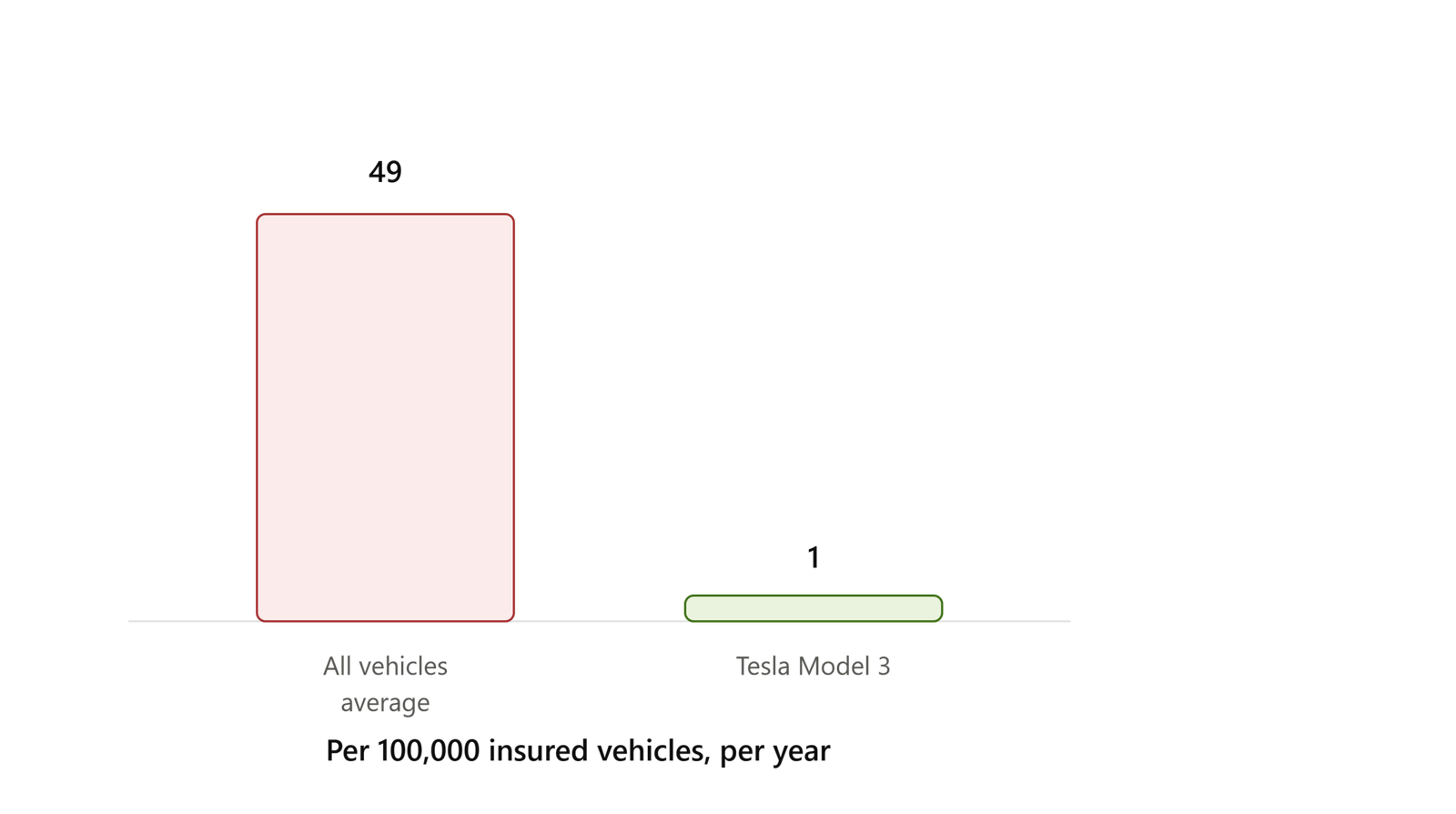
Here’s a finding that runs against most people’s assumptions: EVs get stolen far less often than gas cars. Only 1 out of every 100,000 insured Tesla Model 3s was stolen in one detailed analysis, compared to an overall rate of 49 out of every 100,000 insured vehicles across the market. Four of the six least-stolen vehicles in America are EVs. This guide covers why that’s true, how the claims process actually works if it does happen to you, and the specific theft methods worth guarding against anyway.
Key takeaways:
- EVs are dramatically less likely to be stolen than gas cars, with the Tesla Model 3 and Model Y, the Hyundai Tucson, and other EVs ranking among the least-stolen vehicles in comprehensive IIHS analysis of insurance claims.
- Theft is covered under comprehensive insurance, not liability-only policies, meaning if your policy includes only the state-minimum liability coverage, a stolen EV isn’t covered at all.
- The claims process requires a police report first, then prompt notification to your insurer with your VIN, license plate, and last known location, followed by a waiting period before the insurer settles the claim as a total loss.
- Keyless relay theft remains a real, growing risk despite EVs’ low overall theft rate, and physical deterrents like steering wheel locks and Faraday pouches are specifically effective against this particular method.
The surprising truth: EVs are genuinely hard to steal
This deserves to be the starting point, since it directly contradicts what most people assume about EV theft risk. IIHS analysis of vehicles with model years between 2021 and 2023, examining whole-vehicle theft claims as a percentage of insured vehicles, found the lowest theft claims coming from the Tesla Model 3 and Model Y, the Hyundai Tucson, the Volvo XC90, and the GMC Acadia. Overall, 49 of every 100,000 insured cars are stolen each year, but only 1 out of every 100,000 insured Tesla Model 3s was stolen in that same analysis, a genuinely dramatic gap.
A separate, broader dataset reinforces this: eight of the twenty least-stolen vehicles in comprehensive IIHS/HLDI data were fully electric, with theft claim frequencies more than 85% below average. In France specifically, EVs represented just 3% of stolen vehicles compared to 54% for gas-powered cars, one of the starkest illustrations of this pattern found in any market studied.
Why EVs are so hard to steal, mechanically
Understanding the actual reasons helps explain why this pattern is likely to persist rather than being a temporary quirk:
Traditional hotwiring simply doesn’t work. There’s no conventional steering-column wiring to exploit the way there is in a gas car, removing an entire category of classic theft technique from a thief’s toolkit.
Battery swapping isn’t a viable path to quick resale. Unlike stripping a gas car for parts, EV battery design, including the absence of swappable packs in most consumer EVs, makes that approach a non-starter for a thief looking for fast profit.
There’s simply less to exploit mechanically. A Tesla drivetrain contains roughly 20 moving parts, compared to approximately 2,000 in a comparable internal combustion engine, leaving thieves far fewer familiar mechanical systems to work with.
Parts traceability further erodes criminal profitability. EV components are more traceable than generic gas car parts, making stolen parts harder to sell without detection.
The technology itself is unfamiliar territory for most thieves. Most EVs don’t use traditional keys, they’re controlled through a phone or keycard, and that unfamiliarity alone deters a meaningful share of opportunistic theft attempts.
Garaging habits may play a role too. EVs are often kept in a garage or parked next to a home specifically for charging access, which may make them less visible, less accessible targets compared to a gas car parked on the street.
The real risk that remains: keyless relay theft
Despite the overall low theft rate documented above, one specific, technology-driven method remains a genuine concern worth understanding. In a relay attack, a thief stands near your house with a device that captures your key fob’s signal, while a second thief stands by your car with a receiver, the car detects what it thinks is the nearby key and unlocks, and the entire process can take under two minutes. This is one of the fastest-growing theft methods specifically targeting keyless entry systems, a category most current EVs fall into.
Practical defenses specifically effective against this method:
- A Faraday pouch for your key fob blocks the signal from being captured in the first place, storing your fob away from doors and windows specifically, since relay amplifiers can work through walls.
- A steering wheel lock signals that meaningful effort is required, and thieves overwhelmingly prefer easier targets, making this a simple, low-cost deterrent.
- A secondary immobilizer requiring a PIN sequence before the ignition engages stops relay attacks specifically, since capturing the key signal alone isn’t enough to start the car.
- Built-in security features like Tesla’s PIN to Drive cost nothing to enable and block unauthorized movement immediately, worth activating if your specific EV offers an equivalent feature.
- Dash cam and Sentry Mode-style recording, where available, creates a documented record usable for insurance claims, investigations, or court submission if theft or an attempted theft does occur.
Does having strong security features affect your premium?
Yes, potentially. Some insurers now recognize the lower theft rates and enhanced security technology in EVs through insurance incentives on EV policies, worth asking about directly when shopping for coverage, connecting to the broader discount guidance covered throughout our EV insurance discounts guide.
How the claims process actually works if your EV is stolen
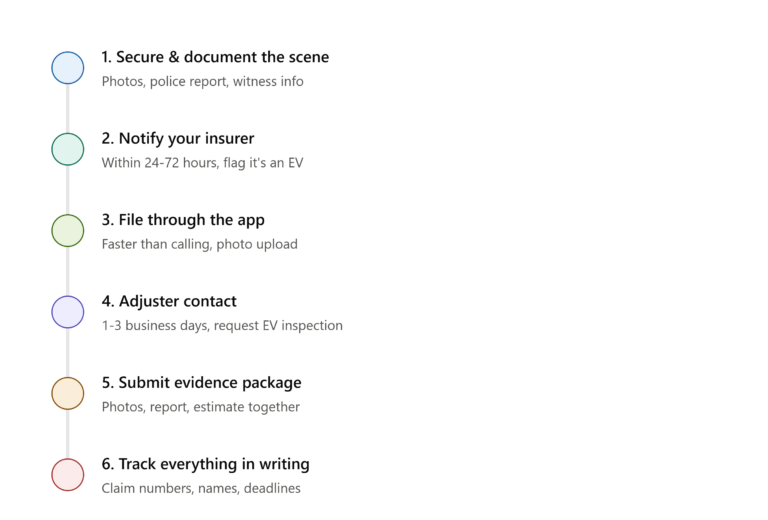
File a police report immediately. This is essential, your insurer will require evidence that you filed a complaint before investigating your claim, and the police report allows a criminal investigation to open, which helps verify the circumstances and, potentially, identify those responsible. Provide the vehicle identification number (VIN), make and model, license plate number, and any identifying features, along with the last known location of the vehicle.
Notify your insurer as soon as possible. Contact your insurance company or agent directly to start the claims process, providing the same VIN, license plate, and location details, along with a copy of the police report once you have it. Most insurers offer digital tools, a mobile app or online portal, to upload files and track your claim status in real time.
Confirm your specific coverage applies. Auto theft is covered under comprehensive insurance, protecting against non-collision events like fire, vandalism, weather, and theft. If your policy includes only liability coverage, theft isn’t covered at all, worth confirming your actual coverage level before assuming you’re protected, consistent with the comprehensive-versus-collision guidance covered throughout our broader coverage guides.
Wait for a recovery window before the claim settles as a total loss. Insurers typically wait a set period to see if the vehicle is recovered before paying out, since recovery changes the claim significantly, if your car is found, the claim could be adjusted or canceled, and your comprehensive coverage may instead cover any repairs needed from the theft, minus your deductible.
Have your title, lease, or loan paperwork ready. Your agent will likely request this alongside the police report number, and if you’re financing or leasing, this connects directly to the GAP insurance considerations covered in our dedicated guide, since a stolen and unrecovered EV is treated as a total loss for settlement purposes.
What can limit or deny your claim
Missing paperwork. Failing to provide necessary documentation, the police report, proof of ownership, can result in claim denial or delay, reinforcing the importance of assembling this documentation promptly rather than waiting.
Unauthorized drivers at the time of theft. If someone not listed on your policy was driving when the vehicle was stolen, and you hadn’t given them permission to use it, your coverage may be limited or denied, a genuinely important distinction from a straightforward theft-from-parking-lot scenario.
Reporting theft internationally: stolen EVs and export risk
Worth a brief mention for context, though less directly relevant to your claims process: stolen vehicles broadly, EVs included in some markets, are sometimes shipped abroad to markets where demand outstrips supply, meaning cars can vanish quickly after theft unless GPS tracking technology is fitted. If your EV has a GPS tracking device, let police know specifically, since this can meaningfully improve recovery odds compared to a vehicle without any tracking capability.
The bottom line
The data on EV theft runs genuinely counter to common assumptions: EVs, and Tesla models in particular, rank among the least-stolen vehicles in America, protected by a structural combination of unfamiliar technology, minimal mechanical complexity for thieves to exploit, and traceable components that erode resale profitability for stolen parts. The real remaining risk is technology-specific, keyless relay attacks, worth defending against with a Faraday pouch, a steering wheel lock, and any built-in immobilizer features your specific EV offers. If theft does happen despite these low odds, the process follows standard comprehensive-coverage claims mechanics, a prompt police report, immediate insurer notification, and patience through the recovery window before a total-loss settlement, with your specific coverage level determining whether you’re protected at all, a reminder that liability-only coverage leaves theft completely unprotected regardless of how unlikely it statistically is for your specific EV.
This article is for informational purposes only and does not constitute financial or insurance advice. Theft statistics, coverage details, and claims processes vary by insurer, vehicle, and location, and change frequently. Always confirm specific coverage terms directly with your insurer