Rental Car Reimbursement for EV Owners: What to Know
Rental reimbursement coverage sounds simple until your EV’s repair drags past the daily limit, or you discover the rental counter doesn’t actually have an electric replacement to give you. Both are real, documented issues for EV owners specifically, not just generic rental hassle. This guide covers what makes rental reimbursement different when you drive an EV, and how to structure your coverage so a routine repair doesn’t turn into weeks of frustration.
Key takeaways:
- The U.S. average rental period for a repairable vehicle currently runs about 15 to 17 days, and EVs, along with luxury and supercar models, routinely stretch longer due to parts availability and specialized labor.
- Rental reimbursement coverage typically has both a daily dollar cap and a total limit; if your EV’s repair runs long, as it often does, you can exhaust your coverage before the car is actually ready.
- Getting an actual EV as your rental replacement isn’t guaranteed, rental companies maintain limited EV fleets, and many treat electric rentals as a niche category rather than a standard offering.
- If you do get an EV rental, expect specific rules that don’t apply to gas rentals: no one-way returns, a guaranteed minimum charge level at pickup (commonly 70%), and loss-of-use fees if you don’t return it charged and on time.
Why EV repairs blow past typical rental reimbursement limits
This is the core issue, and it connects directly to repair-cost and complexity factors covered throughout this site. The U.S. average length of rental for a repairable vehicle sits around 15 to 17 days, already elevated compared to pre-pandemic norms. For EVs specifically, alongside luxury and high-end models, that timeline routinely stretches even longer. A few compounding reasons:
Parts availability remains the biggest wildcard. OEM components for EVs and luxury brands still face real supply chain delays, and if a single sensor, battery component, or specialized trim piece is on backorder, the entire repair stalls, sometimes for weeks beyond the initial estimate.
As covered in our comprehensive-versus-collision guide, EVs already take longer to repair than gas vehicles on average, which directly extends the rental period your reimbursement coverage needs to stretch across, and raises total claim costs in a way that specifically pressures the limits of a standard rental benefit.
Specialized labor availability compounds the delay. As covered throughout our repair-network and battery coverage guides, the limited number of shops genuinely equipped for EV-specific work means even a straightforward repair can queue behind other jobs longer than a comparable gas car repair would at a more broadly capable shop.
How rental reimbursement coverage actually works
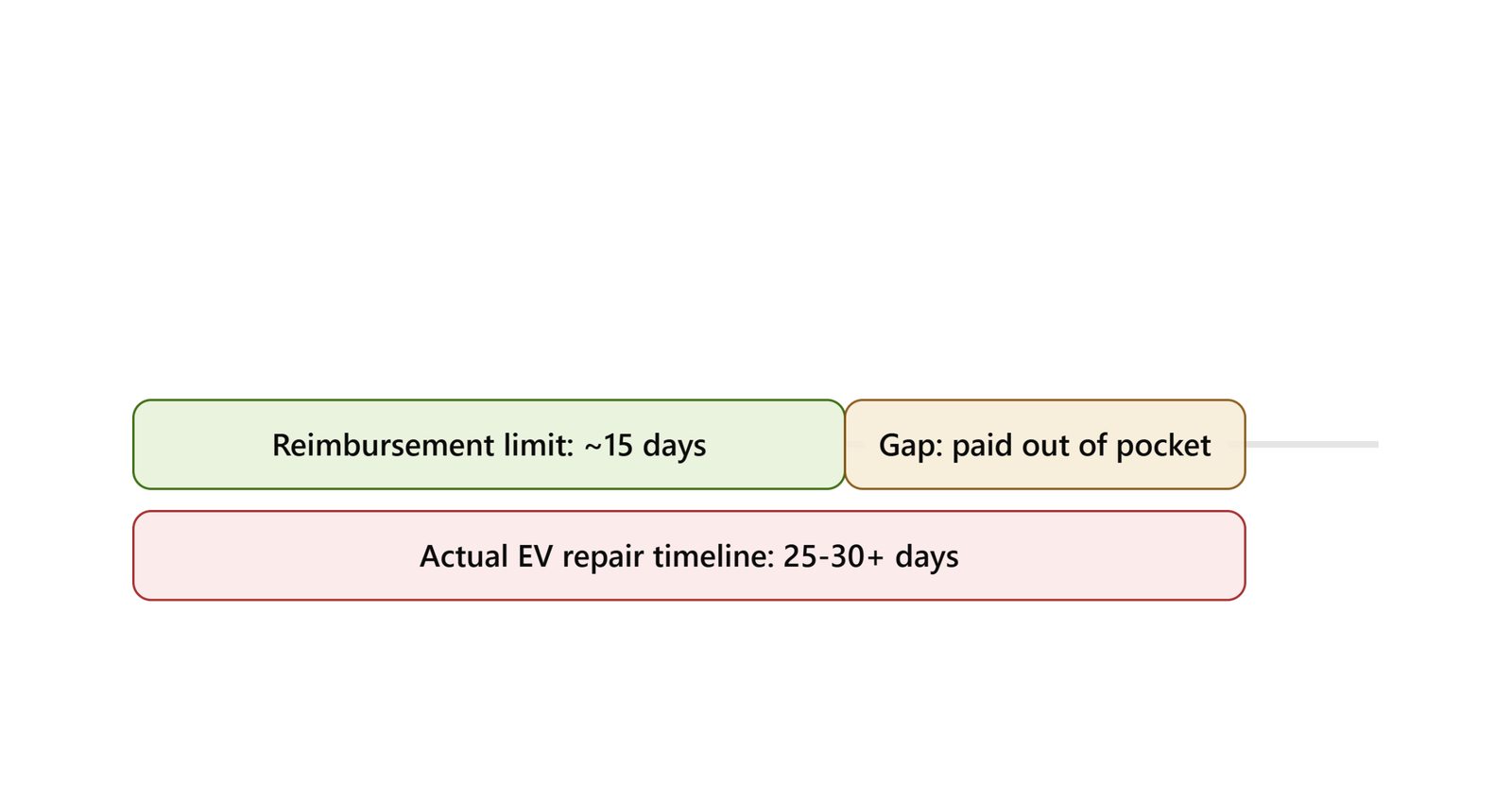
Rental reimbursement is typically structured with two limits working together, not just one: a per-day dollar cap (commonly $30 to $50 a day, though this varies significantly by insurer and the coverage tier you select) and a total dollar or day limit for the entire claim (commonly 30 days or a total dollar cap, whichever comes first). This dual-limit structure is exactly where EV owners run into trouble: even if your daily cap comfortably covers a rental’s daily rate, a repair that drags to 25 or 30 days, a realistic outcome given the parts and labor factors above, can exhaust your total limit before your actual vehicle is ready, leaving you paying out of pocket for the remaining days.
Practical implication: when selecting rental reimbursement coverage for an EV specifically, the total limit (in days or dollars) matters at least as much as the daily rate, arguably more, given how documented the extended-repair-timeline pattern is for this vehicle category.
The harder problem: will you actually get an EV as your rental?
This is worth understanding honestly, since rental reimbursement coverage pays for a rental car, it doesn’t guarantee the specific kind of car you’ll receive. Rental companies maintain relatively limited EV fleets compared to their gas vehicle inventory, and industry reporting has specifically noted that rental firms treat EV replacement supply as a secondary use case for their electric fleet, filling gaps for vehicles under repair, rather than building out EV inventory as a core rental offering. High-supply markets (major cities) tend to have meaningfully better EV rental availability than smaller markets, where you may simply be offered a gas vehicle regardless of your reimbursement coverage, since that’s what’s actually available at the counter.
If receiving a genuine EV replacement matters to you, whether for charging habit continuity, HOV lane access, or simply preference, it’s worth calling ahead to your specific rental location rather than assuming your reimbursement coverage guarantees an electric vehicle. Newer platforms specifically focused on EV rental and short-term subscription have emerged partly to fill this gap, worth researching as an alternative in markets where traditional rental companies have thin EV availability.
If you do get an EV rental: rules that don’t apply to gas cars
A few specific terms are worth knowing if your rental replacement does turn out to be electric, since they differ meaningfully from a standard gas rental agreement:
No one-way rentals. Due to the specific infrastructure needs tied to EVs, one-way returns are generally not permitted; your rental typically must be returned to the original renting location.
A guaranteed minimum charge at pickup, but you’re expected to return it charged too. Rental companies commonly guarantee at least a 70% charge when you pick up an EV rental, but returning it without adequate charge, or late, can trigger loss-of-use fees, charged at your daily rental rate for the gap between when you should have returned it and when you actually do, up to a documented cap in some rental agreements.
Range isn’t guaranteed. Rental companies explicitly don’t warrant a specific range for an EV rental, since actual range varies with load, driving style, climate, and terrain, worth factoring into your trip planning more conservatively than you might for your own, familiar EV.
Charging logistics become your responsibility during the rental period. Unlike your own EV, where you likely have an established home charging routine, a rental EV requires you to actively locate charging stations during your trip, worth planning around rather than assuming it’ll be as seamless as your normal routine.
How to structure your coverage given these realities
Prioritize the total limit over the daily rate when selecting rental reimbursement. Given the documented pattern of extended EV repair timelines, a policy with a lower daily cap but a longer total-day allowance may serve you better than one with a higher daily cap but a shorter total window.
Document everything if your repair timeline stretches. As covered in general repair-timeline guidance, keeping repair order updates, parts-tracking emails, and rental records supports your position if you need to argue for extended reimbursement or dispute a shortfall, since loss-of-use rules and what’s considered «reasonable» vary significantly by state.
Call your specific rental company location ahead of time if an EV replacement matters to you, rather than assuming your reimbursement coverage guarantees one. Confirm actual EV availability at the location your insurer or repair shop will be directing you to.
Consider whether a gas rental for the interim is genuinely a problem for you or just a preference. If your primary concern is simply having a working vehicle during repairs, a gas rental accomplishes that regardless of what you normally drive, and removes the availability uncertainty covered above entirely.
Ask your insurer directly whether rental reimbursement coverage explicitly addresses extended EV repair timelines, or whether you’ll need to negotiate an extension if your specific claim runs past standard limits, given how documented this pattern is for the vehicle category.
The bottom line
Rental car reimbursement works the same way structurally for an EV as for any vehicle, a daily rate cap and a total limit, but EV owners face two documented, EV-specific pressures on that structure: repair timelines that routinely stretch longer than a comparable gas car repair, risking your total limit running out before your car is actually ready, and genuinely limited EV rental fleet availability, meaning your «replacement vehicle» while your EV is in the shop may well be a gas car regardless of your own vehicle type. Structuring your coverage with the total limit, not just the daily rate, as your primary consideration, and setting realistic expectations about what kind of rental you’ll actually receive, prevents a routine repair claim from turning into an unpleasant surprise partway through.
This article is for informational purposes only and does not constitute financial or insurance advice. Rental reimbursement terms, limits, and EV fleet availability vary significantly by insurer, rental company, and location, and change frequently. Always confirm specific coverage terms directly with your insurer.