Tesla Cybertruck Insurance Cost: What Owners Actually Pay
The Cybertruck faces a genuinely unique pricing challenge that no other vehicle on this site does: it’s new enough that insurers simply don’t have years of claims history to price against. That uncertainty alone pushes rates upward, on top of every other Tesla-specific cost factor covered throughout this site. This guide pulls together real 2026 numbers and explains exactly why this particular truck is priced the way it is.
Key takeaways:
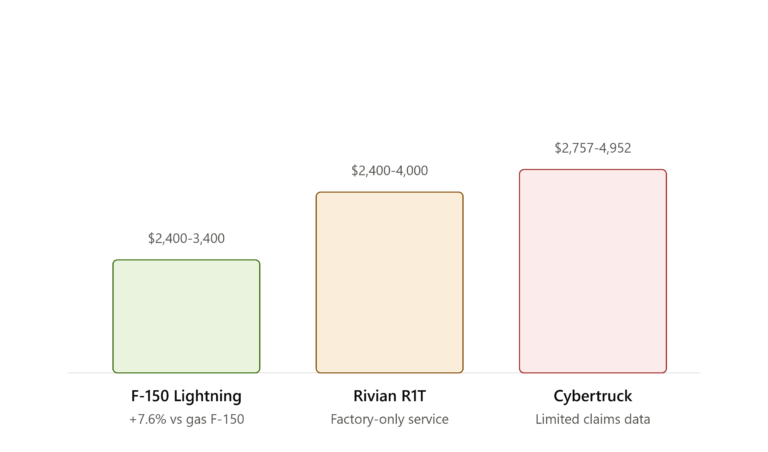
- Full-coverage estimates vary widely across sources, from around $2,757 a year up to nearly $4,952 a year, reflecting genuine methodology differences and, more than with other Tesla models, the sheer newness of the vehicle limiting reliable claims data.
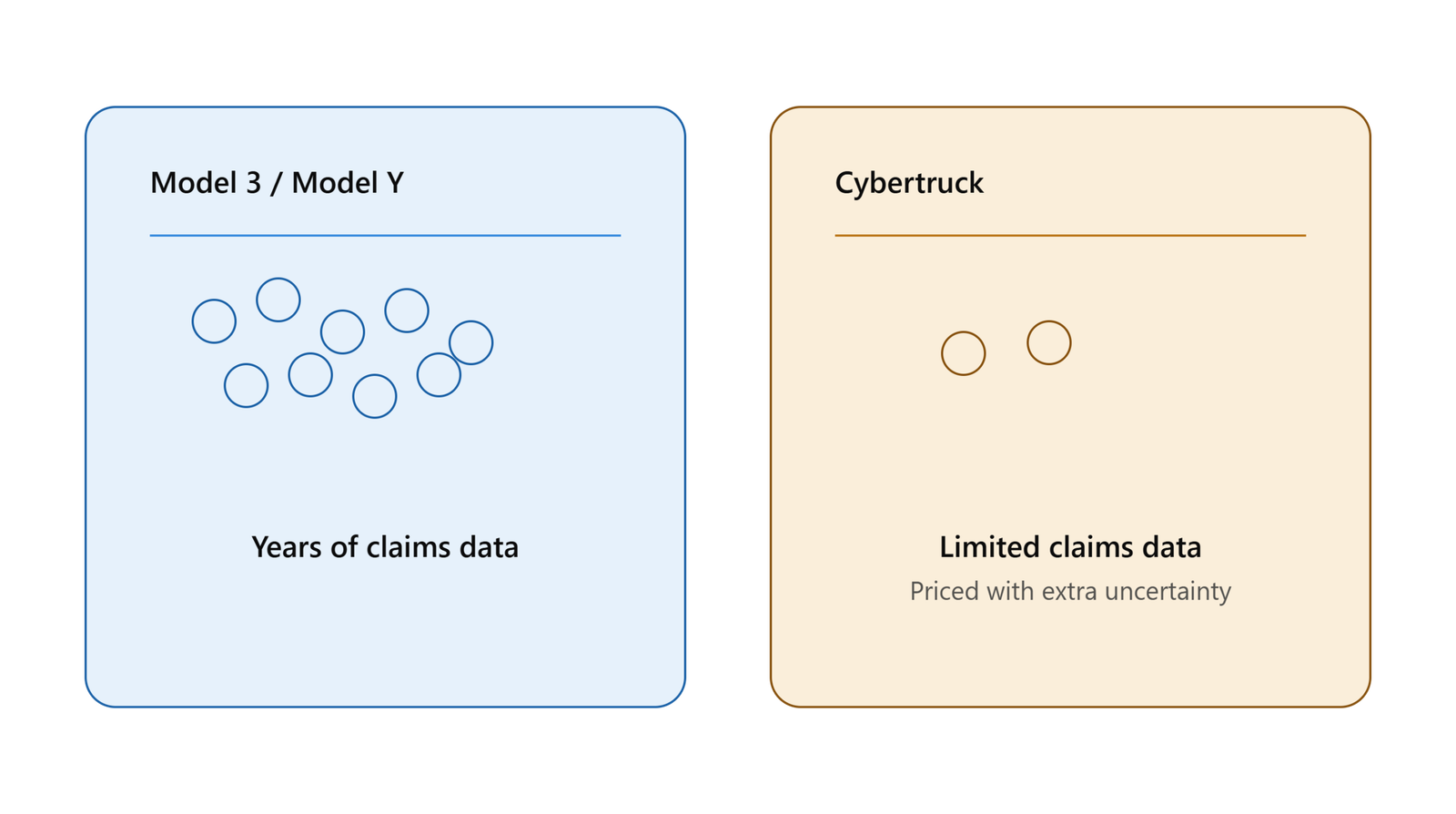
- Limited claims history is a distinct pricing factor for the Cybertruck specifically: insurers price in extra uncertainty for a vehicle they don’t yet have years of real-world loss data on, separate from its repair costs or stainless-steel construction.
- Hawaii consistently ranks as the cheapest state for Cybertruck insurance, while Michigan ranks among the most expensive, tracking the broader state-level patterns covered throughout this site.
- GEICO is repeatedly cited as offering the cheapest average Cybertruck rates, though full coverage still commonly exceeds $200 a month even at the cheaper end.
The real range, and why it’s wider than usual
Pulling together multiple 2026 sources gives a genuinely wide spread, wider than what we found for the Model 3 or Model Y:
- One detailed analysis puts full coverage at $4,415 a year ($368 a month), with liability-only at $1,130 a year ($94 a month).
- A separate source finds a notably lower average of $2,757 a year for full coverage, with rates starting around $119 a month.
- Insurify’s analysis lands in between, at $283 a month ($3,392 a year) for full coverage.
- One cost-of-ownership tool projects Cybertruck insurance at $3,603 a year, remaining flat across a 5-year ownership projection.
- At the high end, one source puts the average as high as $4,952 a year, describing it as roughly in line with other luxury vehicles.
This is a wider spread than we’ve seen for the Model 3 or Model Y specifically, and the reason connects directly to the limited-claims-data factor covered below, insurers are working with less real-world loss history for this vehicle than for Tesla’s longer-established models, which produces more disagreement between different rating models and data sources.
Why «limited claims data» is a genuinely distinct pricing factor here
This is worth understanding as its own category, separate from the general Tesla repair-cost story covered throughout this site. Insurance pricing fundamentally works by analyzing large pools of historical claims: how often does this vehicle get into accidents, how expensive is a typical claim, how often does a claim become a total loss. For a vehicle with years of sales volume and claims history behind it, like the Model 3 or Model Y, insurers have a comparatively solid data foundation to price against.
The Cybertruck simply doesn’t have that same depth of history yet. Insurers explicitly cite limited claims data as a factor pushing rates higher, alongside repair costs and expensive technology, reflecting genuine underwriting uncertainty rather than a proven, data-backed risk assessment. In practice, this means Cybertruck pricing today likely carries more of a built-in uncertainty premium than it will in a few years, once insurers have accumulated a larger real-world claims history to price against, similar to how the broader EV-to-gas insurance gap has been narrowing over time as the wider EV category has matured, as covered in our guide on whether EV insurance rates drop over time.
Why the Cybertruck is expensive beyond just being new
Layered on top of the limited-data factor, the same structural issues covered throughout our Tesla research apply here, often more intensely given the Cybertruck’s unusual construction:
Stainless steel exoskeleton construction is expensive and unfamiliar to most repair shops. Unlike the aluminum unibody construction covered in our Model S guide, the Cybertruck’s stainless-steel panels represent an even less common repair scenario for the broader body shop industry, likely compounding the parts-and-labor cost issues covered throughout our Tesla insurance research.
It’s genuinely a large, heavy, high-value vehicle. With an MSRP around $72,000 to $82,000 depending on model year and configuration, the Cybertruck carries meaningful total-loss exposure, the same replacement-value logic covered in our Model S and Model X guides.
It ranks poorly for affordability within its own vehicle category. One detailed ranking placed the Cybertruck 36th out of 40 pickup trucks for insurance affordability, noting that pickup trucks in general see higher premiums due to increased repair costs and frequent work usage, meaning the Cybertruck is expensive even relative to other trucks, not just relative to sedans.
Where you’ll pay the least, and the most
Following the same state-level pattern covered throughout our broader EV cost guides, Cybertruck rates vary significantly by location: Hawaii consistently posts the lowest average annual rate at $2,328, while Michigan ranks among the most expensive states, consistent with Michigan’s broadly elevated no-fault insurance costs covered in our state-by-state EV insurance guide.
Which insurer is cheapest for a Cybertruck
GEICO is specifically identified as offering the cheapest average Cybertruck insurance across multiple sources, though full coverage still commonly exceeds $200 a month even with GEICO, reflecting how the vehicle’s inherent cost factors limit how low any insurer can realistically price it. As with every Tesla model covered throughout this site, getting multiple quotes rather than assuming any single «cheapest insurer» ranking applies to your specific profile remains the most reliable path to your actual best rate.
Does Tesla Insurance make sense for a Cybertruck?
As covered extensively in our dedicated Tesla Insurance review, Tesla’s own Real-Time Insurance product uses a Safety Score based on mileage, driving behavior, and location, explicitly not factoring in age or driving record the way traditional insurers do. For a genuinely safe, low-mileage driver, this can produce meaningful savings on a Cybertruck specifically, though it’s worth weighing against the customer service and claims-handling concerns documented in our dedicated Tesla Insurance honest review before assuming it’s automatically the best option. Notably, Tesla Insurance isn’t currently available in California, where Tesla instead offers an alternative option that doesn’t track driving behavior.
Debunking a specific rumor worth addressing directly
It’s worth noting plainly: despite some viral claims to the contrary, insurance companies aren’t broadly dropping Cybertruck coverage, even though some individual owners have reported policy non-renewals. This distinction matters, isolated non-renewal decisions by specific insurers for specific risk profiles are different from an industry-wide refusal to cover the vehicle, and the wide range of insurers actively quoting Cybertruck coverage across the sources in this article confirms the vehicle remains broadly insurable.
How to actually lower your Cybertruck premium
Raise your deductible. Given how elevated the baseline premium already runs, a deductible increase provides proportionally meaningful savings, consistent with the deductible guidance covered throughout our broader EV coverage guides.
Enroll in a telematics program. Progressive Snapshot and Allstate Drivewise are specifically cited as viable options for Cybertruck owners, tracking driving behavior to lower premiums for demonstrably safe drivers.
Consider pay-per-mile coverage if you drive under 10,000 miles a year, following the same threshold logic covered in our dedicated pay-per-mile EV insurance guide.
Shop annually, not just at purchase. Shopping around each year can save up to 24% on Cybertruck coverage specifically, a meaningfully larger figure than the general re-shopping guidance applied to more established vehicles, reflecting how much rate variance still exists between insurers for this newer model.
Ask specifically about safety feature, good driver, multi-vehicle, and bundling discounts, all of which Cybertruck owners are likely to qualify for, alongside the growing availability of EV-specific discounts as insurers build out programs for this vehicle category.
The bottom line
Cybertruck insurance costs more than nearly any other mainstream vehicle on the road today, commonly landing between $2,757 and $4,952 a year for full coverage depending on the source, driven by a combination familiar from other Tesla models, high value, expensive and specialized repairs, and a factor genuinely unique to this particular vehicle: insurers simply don’t have the years of accumulated claims history behind the Cybertruck that they do for more established models, and that uncertainty gets priced directly into your premium. As the vehicle accumulates more real-world claims data over the coming years, expect this specific uncertainty premium to gradually narrow, following the same pattern the broader EV insurance market has shown since 2024. Until then, shopping aggressively, raising your deductible, and enrolling in a telematics program remain your most reliable levers for managing what is, for now, a genuinely expensive vehicle to insure.
This article is for informational purposes only and does not constitute financial or insurance advice. Insurance rates vary by insurer, state, model year, trim, and individual driver profile, and change frequently. Always get a personalized quote before making a purchasing decision.