Toyota bZ4X Insurance Cost Breakdown
The bZ4X carries one of the most trusted, reliability-focused badges in the entire auto industry, yet it still ranks near the bottom of its own small SUV segment for insurance affordability, $184 a year above the segment average. This is a genuinely useful case study in how much «it’s electric» outweighs «it’s a Toyota» when insurers price a policy. This guide breaks down the real numbers and exactly where the bZ4X sits relative to its gas-powered segment mates.
Key takeaways:
- Full coverage on the bZ4X typically runs $2,300 to $2,450 a year across trims, with $2,390 as a commonly cited average, and a broader realistic monthly range of $110 to $230 depending on driver profile and state.
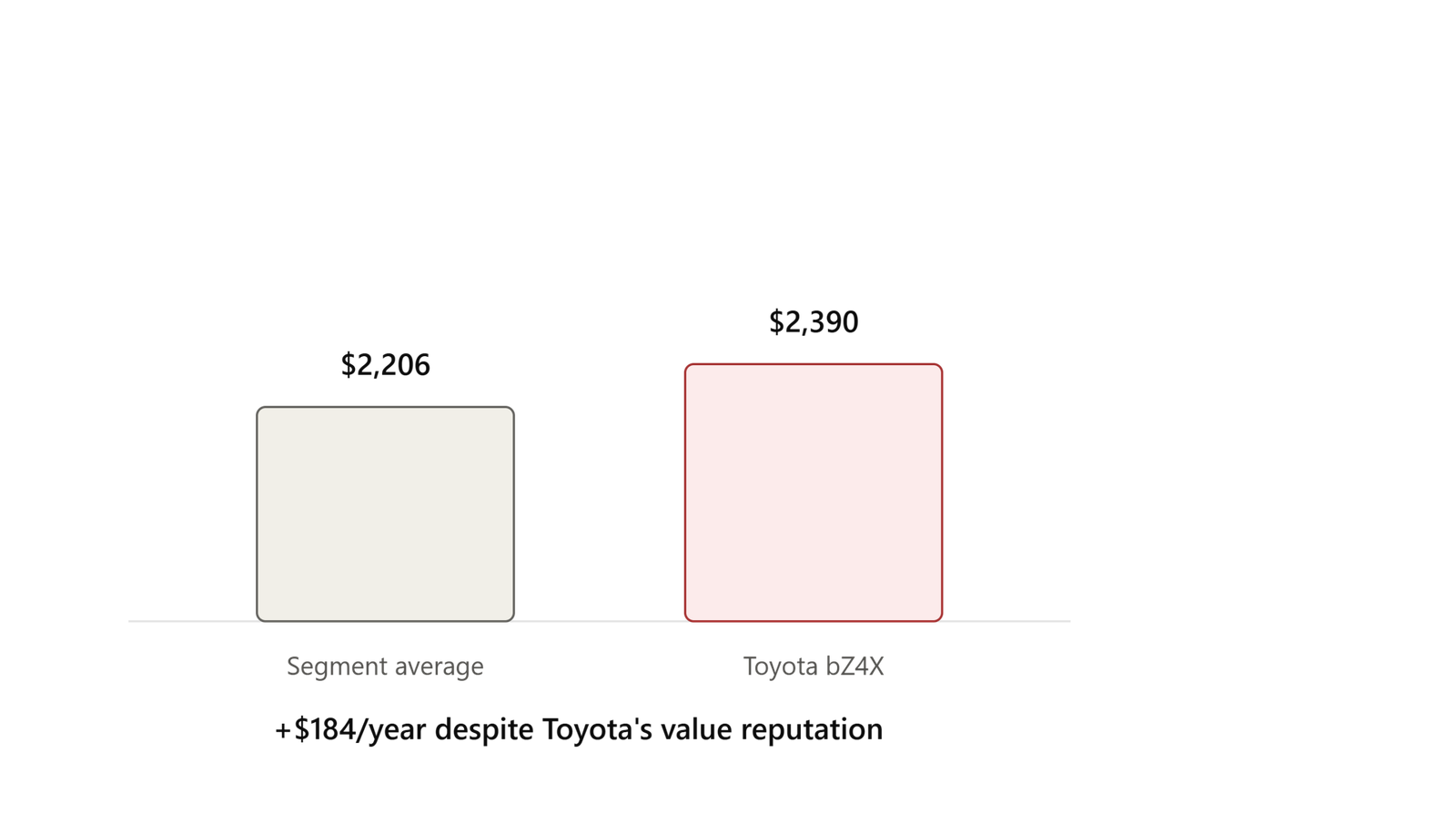
- Despite Toyota’s reputation for reliability and value, the bZ4X ranks 41st out of 47 vehicles in the small SUV segment for insurance affordability, running $184 a year above the segment average of $2,206.
- Standard Toyota Safety Sense technology and generally modest performance work in the bZ4X’s favor, keeping it well below luxury and performance EV pricing despite the EV-specific cost factors that still apply.
- Trim spread is genuinely modest here: the XLE trim runs cheapest at $2,300 a year, while the Limited AWD sits at the top at $2,450, just a $150 difference.
The real numbers
Pulling together multiple 2026 sources gives a genuinely tight, consistent range for this vehicle:
- One detailed cost breakdown finds an average of $2,390 a year ($199 a month) for full coverage.
- A monthly-focused guide finds a realistic range of $150 to $230 a month for a new or recent-model bZ4X, with excellent risk profiles in low-cost states coming in under $120 and high-risk drivers in expensive states seeing $250 to $350-plus.
- The Zebra’s data shows $1,272 for a 6-month policy ($2,544 annualized), with Progressive offering the cheapest rate at $125 a month.
- KBB’s cost-to-own calculator estimates a notably higher $2,996 a year ($1,248… likely a data display error in the source, but directionally consistent with the higher end of other estimates), reflecting different underlying assumptions about driver profile and coverage level.
Bringing this together: budget roughly $2,300 to $2,600 a year for full coverage as a realistic planning range, with $2,390 as a reasonable single-number estimate for budgeting purposes.
The genuinely useful finding: expensive relative to its own segment, despite the Toyota badge
This is the detail that makes this guide distinct from a simple cost rundown. Ranked 41st out of 47 vehicles in the small SUV segment, the bZ4X costs $184 more per year to insure than the segment average of $2,206. This tracks a pattern we’ve now documented across multiple mainstream EVs on this site, the Kia EV6 ranked 43rd of 47 in its segment, and the Ford Mustang Mach-E ranked 92nd of 256 SUVs, all landing in the more expensive tier of their respective vehicle classes despite being genuinely mainstream, non-luxury EVs.
The bZ4X’s case is arguably the most striking, since Toyota’s brand reputation is built almost entirely around reliability, value, and low total cost of ownership, yet its EV specifically breaks from that pattern on the insurance line item. This is a clean illustration of a principle worth remembering throughout this site: the «EV penalty» applies based on the vehicle’s actual repair-cost and claims profile, not the manufacturer’s broader brand reputation for affordability.
Why the bZ4X costs what it does
The same baseline EV repair-cost factors apply here as everywhere else on this site. Specialized battery technology, higher parts costs, and a still-maturing EV-specific repair network all contribute to the bZ4X’s premium sitting above its gas-powered small SUV segment mates, even though the vehicle itself is genuinely modest and mainstream.
Nationwide, the broader EV-versus-gas gap runs 15% to 50% higher depending on the study and model mix, and the bZ4X sits within that general pattern rather than being a specific outlier within the EV category itself.
What works in the bZ4X’s favor
Standard advanced safety technology helps offset some of the gap. The bZ4X comes packed with Toyota Safety Sense as standard equipment, not an extra-cost option, and the vehicle has earned strong crash-test marks from major safety agencies, both factors that help keep it from climbing into more expensive territory, similar to the safety-driven mitigation documented in our Volkswagen ID.4 and BMW i4 guides.
Modest performance keeps claim severity down. Unlike the high-performance EVs covered in our Tesla Model S and Lucid Air guides, the bZ4X’s relatively modest acceleration and power output don’t carry the same performance-related risk premium that pushes those vehicles toward the top of their respective ranges.
It sits closer to practical crossovers than to luxury models. The bZ4X’s overall positioning, closer to a RAV4 than to a luxury EV with sky-high repair costs, keeps its baseline pricing well below the Lucid Air, Tesla Model S, or Rivian models covered elsewhere on this site, even if it still runs above its own direct gas-powered segment competitors.
How trim affects the bZ4X specifically
This is genuinely one of the smaller trim-level spreads documented across our model guides. The XLE trim offers the cheapest insurance at $2,300 a year, while the top Limited AWD trim runs $2,450 a year, just a $150 difference, or about 6.5%. This is meaningfully smaller than the spread we found in our Tesla Model 3 and Model S guides, where performance trims carried gaps of hundreds of dollars a month rather than a year. Worth noting separately: AWD models generally carry slightly more hardware and power than their front-wheel-drive twins, so they’re usually insured a bit higher, all else equal, though this specific effect is modest for the bZ4X given its overall subdued performance profile.
Best insurers for a bZ4X
Progressive is specifically cited as offering the cheapest rate for the latest bZ4X model year, at $125 a month, consistent with Progressive’s broader strength for EV drivers covered throughout this site.
Beyond this specific standout finding, the general guidance covered throughout our broader model guides applies directly: get rates from at least three carriers, ideally mixing large national brands with EV-friendly newer entrants, since many drivers leave $150 to $300 a year on the table simply by renewing automatically rather than re-shopping.
A caution on marketing-driven low figures
Consistent with the pattern flagged in our Kia EV6, Rivian R1S, and other model guides, you’ll sometimes see headlines advertising «Toyota bZ4X insurance from $37/month.» This is typically a marketing figure tied to specific low-cost states, minimal liability-only coverage, and only the very safest driver profiles, best treated as a floor figure rather than a realistic expectation for full coverage on a new EV.
Why the insurance line item deserves real attention on a bZ4X purchase
One detailed cost breakdown frames this well: insurance is one of the largest fixed costs of owning a Toyota bZ4X, often landing in the same ballpark as fuel or depreciation for many drivers over a full ownership period. Viewed this way, shaving even $300 to $500 a year off your bZ4X insurance through smart shopping has roughly the same bottom-line impact as negotiating a lower purchase price or chasing the cheapest available electricity rate, but unlike the purchase price, insurance is something you can revisit and improve every single year.
How to actually lower your bZ4X premium
Get quotes from at least three insurers, prioritizing Progressive given its standout showing.
Consider the XLE trim over the Limited AWD if minimizing cost matters, though given the modest $150 spread documented above, this shouldn’t be the deciding factor if you specifically want AWD or the Limited’s additional features.
Ask about the standard discount stack. Multi-vehicle, multi-policy, and homeowner discounts all apply to bZ4X owners, following the general savings guidance covered throughout this site.
Re-shop annually rather than auto-renewing. Given the documented $150-to-$300-a-year opportunity cost of automatic renewal, this is a genuinely worthwhile habit specifically for this vehicle.
Confirm your coverage limits and deductible match your actual needs, rather than defaulting to whatever your insurer’s standard package includes, following the deductible guidance covered throughout our broader coverage guides.
The bottom line
The Toyota bZ4X presents a genuinely instructive case: a mainstream, safety-focused EV from a manufacturer built on a reputation for value and reliability, yet it still lands in the more expensive tier of its own small SUV segment for insurance specifically, a clear reminder that EV-specific repair and claims factors outweigh general brand reputation when insurers price a policy. Standard Toyota Safety Sense technology and modest performance keep the bZ4X well below luxury and performance EV pricing, and its trim-level spread is genuinely narrow compared to nearly every other model covered throughout this site. Progressive stands out as a specific value option, and the broader lesson, that annual re-shopping alone can recover $150 to $300 a year, applies here as directly as to any vehicle on this site.
This article is for informational purposes only and does not constitute financial or insurance advice. Insurance rates vary by insurer, state, model year, trim, and individual driver profile, and change frequently. Always get a personalized quote before making a purchasing decision.