Cheapest Tesla Model to Insure: All Models Compared
Most sources agree the Model 3 is Tesla’s cheapest model to insure, but not all of them, two separate 2026 analyses actually found the Model S taking that title instead. Rather than pretending this is settled, this guide presents the real, sometimes conflicting data across all five current Tesla models, and explains what’s driving the disagreement. It also covers one of the most counterintuitive findings on this entire site: a 13-year-old Model S worth barely $11,000 can still cost more to insure each month than many people’s monthly car payment.
Key takeaways:
- Most sources rank the Model 3 as Tesla’s cheapest model to insure, typically $2,000 to $3,153 a year for full coverage, but Compare.com and Insurify both found the Model S cheapest in their specific analyses, a genuine methodological disagreement worth taking at face value.
- The Model X consistently ranks as the most expensive Tesla across nearly every source, commonly $4,458 to $5,462 a year for full coverage.
- Tesla as a brand ranks 22nd out of 23 automakers studied for insurance affordability, with only hypercar and ultra-luxury brands like Ferrari, Bugatti, and Rolls-Royce costing more.
- Insurance doesn’t depreciate at the same rate as the vehicle itself: a 2012 Model S worth about $10,950 today can still cost around $231 a month to insure, more than a quarter of the car’s entire value, annually.
The full lineup, side by side
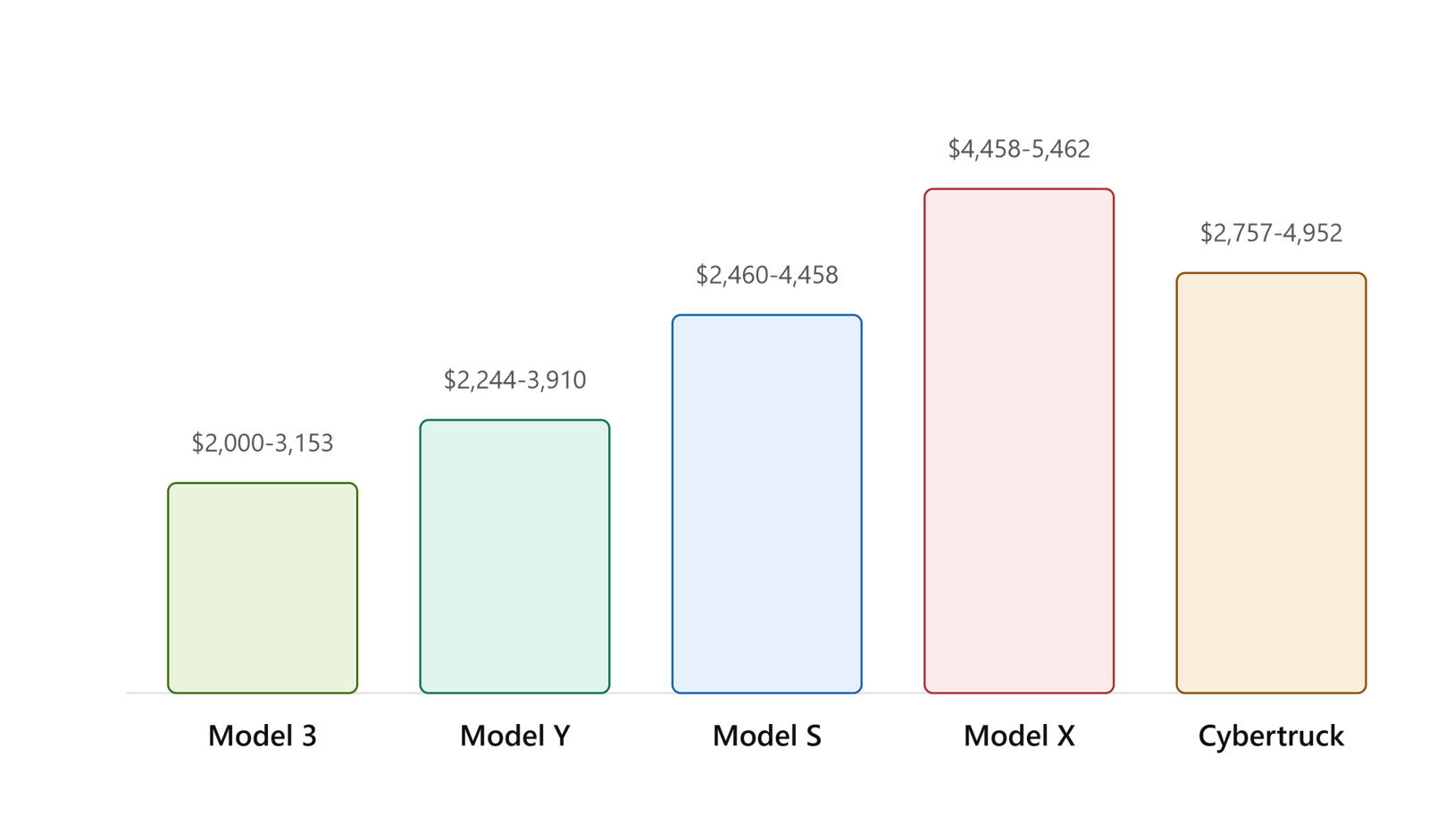
Pulling together every model-specific figure from across our research and this article’s sources gives the clearest possible comparison:
| Model | Typical full-coverage range | Notes |
|---|---|---|
| Model 3 | $2,000–$3,153/year | Most commonly cited as cheapest; Standard/RWD trims lowest |
| Model Y | $2,244–$3,910/year | Close to Model 3, sometimes slightly higher or lower depending on source |
| Model S | $2,460–$4,458/year | Two sources rank this as cheapest overall; wide disagreement |
| Model X | $4,458–$5,462/year | Consistently the most expensive across nearly every source |
| Cybertruck | $2,757–$4,952/year | Widest range of any model, driven by limited claims data |
Why sources disagree on the «cheapest» title
This is worth addressing honestly rather than picking a side. The large majority of sources, including detailed breakdowns covered in our dedicated Model 3 and Tesla Insurance guides, point to the Model 3 as Tesla’s cheapest model, driven by its lower purchase price, wider parts availability, and higher production volume. One detailed guide states this directly: the Model 3 is usually the least expensive Tesla to insure, smaller, lighter, and cheaper to buy than the rest of the lineup.
But two credible sources reach the opposite conclusion specifically. Compare.com’s real-quote analysis found the Model S as the cheapest Tesla model to insure at $205 a month, and separately suggested the Model Y’s relatively cheap rates might connect to its IIHS Top Safety Pick status for 2025. Insurify’s analysis similarly found the Model S cheapest on average among the models they track. Neither of these findings is fabricated or unreasonable, they likely reflect genuine differences in the specific driver profiles, model years, and trims each data source sampled, since, as covered in our detailed Model S guide, that vehicle’s pricing varies enormously by trim, and an analysis weighted toward older, higher-mileage, lower-trim Model S examples could plausibly average out cheaper than a Model 3 sample skewed toward newer, Performance-heavy configurations.
The practical takeaway: don’t treat «the Model 3 is cheapest» as an absolute law, get real quotes on the specific Model 3, Model Y, and even Model S configurations you’re actually considering, since the gap between them may be smaller, or even reversed, depending on your specific trim and model year.
The Model X: the one place every source agrees
Unlike the Model 3 versus Model S disagreement, every source reviewed for this article agrees the Model X sits at the top of Tesla’s pricing ladder. Figures range from $4,458 a year in one comprehensive comparison up to $5,462 a year in our own detailed Model S and Model X research, consistently the most expensive Tesla to insure regardless of methodology. As covered in our dedicated Model S guide, this connects directly to the Model X’s higher purchase price, larger and more complex body panels, and its distinctive, expensive-to-repair falcon-wing doors.
Tesla as a brand, in context
It’s worth stepping back to see where Tesla sits relative to the broader auto industry, not just within its own lineup. Tesla ranks 22nd out of 23 automakers studied for both minimum and full coverage affordability, with only hypercar manufacturers like Ferrari and Bugatti, alongside ultra-luxury brands like Rolls-Royce, costing more to insure on average. This is a genuinely extreme positioning, worth remembering whenever you see a specific Tesla model described as «the cheapest Tesla,» since even the cheapest option in this lineup still sits near the very top of the entire industry’s cost ranking.
The depreciation-versus-insurance disconnect, worth understanding deeply
This is arguably the most useful, underappreciated finding in this entire guide. Tesla vehicles depreciate quickly, but insurance rates don’t track the car’s value at the same rate. A concrete, striking example: a 2012 Model S, now worth around $10,950, still costs about $231 a month to insure, more than a quarter of the car’s total current value, every single year.
Why does this happen? As covered throughout our broader Tesla and battery research, insurance pricing reflects repair complexity and claim severity as much as, or more than, pure vehicle value. An older Model S still requires the same specialized parts, Tesla-certified labor, and battery-related risk assessment as a newer one, even though its comprehensive and collision exposure (tied to its lower current value) has dropped substantially. In plain terms: the repair-cost side of the equation doesn’t depreciate the way the purchase-price side does, and for an older Tesla specifically, that mismatch can mean insurance eating an outsized share of the vehicle’s actual worth. This is worth factoring seriously into any decision to buy a significantly depreciated used Tesla, the sticker price may look like a bargain, but the ongoing insurance cost may not follow that same discount.
Best insurers across the Tesla lineup
USAA consistently offers the lowest rates for most Tesla models according to MoneyGeek’s cross-model analysis, though restricted to military-affiliated members as covered throughout this site.
GEICO is specifically identified as the top non-military option for full coverage on the Cybertruck and Cyberbeast in that same analysis.
Travelers ranks first for all five Tesla models in a separate comprehensive comparison, combining low rates with a low complaint volume and an A++ (Superior) AM Best financial stability rating, scoring over 4.5 out of 5 across every model studied, with its highest score specifically for the Model 3 at 4.67.
American Family has the best rates for every Tesla model except the Model 3 in that same comparison, where Travelers takes the pricing lead specifically.
State Farm is identified as the cheapest overall provider when averaged across all Tesla models and model years in a separate analysis, at $36 a month for minimum coverage and $144 for full coverage, consistent with State Farm’s strong showing throughout our dedicated State Farm review.
Progressive stands out for its broader feature set relevant to Tesla owners specifically, including rideshare coverage (relevant given our dedicated rideshare EV insurance guide), mechanical breakdown insurance (connecting to our MBI guide), and a Deductible Savings Bank that reduces your deductible by $50 for every claim-free policy period.
How to actually choose the right Tesla for your insurance budget
Don’t assume the Model 3 is automatically cheapest for your specific situation. Given the genuine disagreement documented above, get real quotes on any model you’re seriously considering rather than assuming the general pattern applies to your specific trim and driver profile.
Factor in the depreciation-insurance mismatch if you’re buying used. As covered above, an older, heavily depreciated Tesla doesn’t necessarily insure proportionally cheaper, confirm your actual quote before assuming a used Tesla’s low purchase price translates into low ownership costs overall.
If you’re choosing between models primarily on insurance cost, the Model X’s premium is worth serious weight. Given that every source agrees it’s the most expensive, cross-shopping a Model Y or Model S against it makes sense if minimizing insurance cost is a real priority alongside your other needs.
Get quotes from Travelers, State Farm, USAA, and GEICO as your baseline comparison set, given their consistent strength across the cross-model research covered in this guide.
The bottom line
Across Tesla’s current lineup, the Model 3 holds the «cheapest to insure» title in most analyses, but not universally, with Compare.com and Insurify both finding the Model S cheaper in their specific research, a genuine disagreement worth taking seriously rather than dismissing. What every source agrees on: the Model X sits at the top of the pricing ladder, and Tesla as a brand ranks near the very bottom of the entire industry for insurance affordability, trailing only hypercar and ultra-luxury manufacturers. Perhaps the most practically useful finding here is the depreciation-insurance mismatch, a heavily depreciated used Tesla doesn’t automatically mean heavily discounted insurance, since repair complexity and claim severity, not just current market value, drive much of what you’ll actually pay.
This article is for informational purposes only and does not constitute financial or insurance advice. Insurance rates vary by insurer, state, model year, trim, and individual driver profile, and change frequently. Always get a personalized quote before making a purchasing decision.