Tesla Insurance vs Traditional Insurers: Full Comparison
Tesla Insurance promises something no traditional insurer can match: a premium that changes month to month based on how you actually drive, not your age, credit score, or demographic bucket. For genuinely safe drivers, that can mean real savings. But the full picture includes a customer service track record that’s genuinely worth knowing about before you sign up. This guide compares both sides honestly, pricing, mechanics, and service quality, so you can decide with the complete picture rather than just the marketing pitch.
Key takeaways:
- Tesla Insurance averages around $168 a month nationally versus roughly $215 a month for traditional insurers on comparable Tesla coverage, but the range runs from $119 to $435 depending on your Safety Score, model, and state.
- A perfect Safety Score of 100 can cut your rate by roughly 37% to over 60% off the base rate, while a single incident, even one that isn’t your fault, can raise next month’s premium.
- Tesla Insurance carries a 1-out-of-5 Better Business Bureau rating and faced California regulatory enforcement actions in 2025 over claims handling failures, a real factor to weigh against its pricing advantage.
- It’s only available in 13 states as of 2026, and outside California it excludes age, gender, credit score, and claims history entirely, a fundamentally different approach than every traditional insurer on this list.
How the pricing mechanics actually differ
This is the core structural difference, and it’s worth understanding before comparing dollar figures.
Tesla Insurance uses what it calls Real-Time Insurance, built around a Safety Score from 0 to 100 that’s recalculated monthly based on data the car already collects: hard braking, aggressive turns, forward-collision warnings, unsafe following distance, and forced Autopilot disengagements. Outside of California, Tesla explicitly excludes age, gender, marital status, credit score, and past claims history from its pricing entirely, relying almost exclusively on how you actually drive plus your mileage, ZIP code, and coverage selection. In California specifically, state regulations prohibit telematics-based pricing, so Tesla falls back to traditional rating factors there instead, though it still reportedly undercuts competitors by an average of 45% in that market.
Traditional insurers (GEICO, State Farm, Progressive, and similar carriers) price primarily using broader rating buckets: your age, driving record, credit-based insurance score where permitted, vehicle model and trim, and location, recalculated typically at each policy renewal rather than monthly. Several traditional insurers do offer their own telematics programs, Progressive’s Snapshot and State Farm’s Drive Safe & Save among them, which can deliver discounts of 10% to 30% for demonstrably safe driving, a real alternative if you like the behavior-based concept but want it from an established carrier.
The real numbers, side by side
Pulling together multiple 2026 sources:
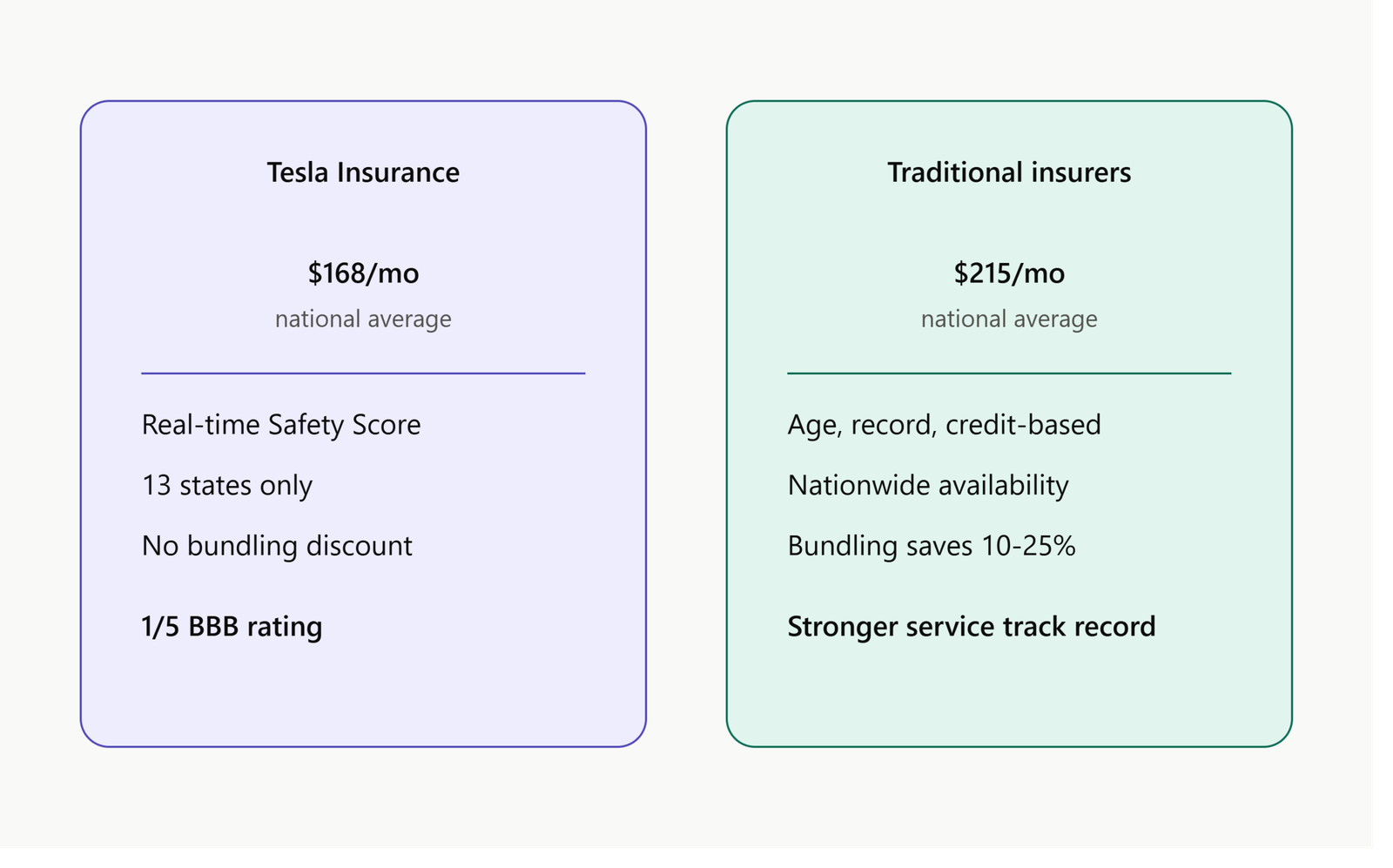
- National average: roughly $168 a month through Tesla Insurance versus about $215 a month through traditional insurers for comparable coverage, a gap of about $47 a month, or roughly $560 a year, in Tesla’s favor on average.
- Full range: Tesla Insurance quotes span from $119 to $435 a month depending on model, state, Safety Score, and coverage level, a wide enough range that the «average» alone doesn’t tell you much about your specific situation.
- Safety Score impact: a perfect score of 100 on a new Model 3 can bring the rate down to roughly $74 a month, more than 60% off the base rate of about $282 a month for the same vehicle with an unproven or lower score. Separately, moving from a Safety Score of 70 to 90 has been shown to save around $840 a year, or about $70 a month, illustrating just how directly your driving behavior translates into dollars under this model.
- California specifically: with telematics pricing barred by state regulation, Tesla still averaged about $187 a month there versus a $268 average among competitors in one analysis, suggesting Tesla’s advantage isn’t purely about the Safety Score, vehicle-specific underwriting plays a role too.
Where Tesla Insurance genuinely wins
Potential savings for safe, low-mileage drivers. Tesla itself estimates average drivers can save 20% to 40% compared to traditional insurers, with safe drivers seeing 30% to 60% in savings. If your driving is genuinely smooth and your mileage is modest, this is the single biggest reason to consider it.
No demographic penalty. If you’re a driver who gets penalized under traditional pricing for being young, having a thin credit history, or living in a ZIP code with elevated baseline rates, Tesla’s model (outside California) sidesteps most of that entirely and judges you on your actual driving instead.
Real-time feedback. Unlike a traditional policy where you find out your new rate once a year at renewal, Tesla Insurance shows your current Safety Score and projected premium directly in the app, giving you an immediate, tangible incentive to drive more cautiously.
Where traditional insurers still win
Customer service and claims handling. This is the factor most pricing-focused comparisons gloss over, and it deserves direct attention. Tesla Insurance currently holds a 1-out-of-5 star rating from the Better Business Bureau, and California insurance regulators issued enforcement actions against Tesla Companies in 2025 specifically over repeated failures to comply with claims handling laws. This isn’t a minor footnote, claims handling is precisely the moment insurance is supposed to work for you, and a documented pattern of problems there is a real cost even if it doesn’t show up in the monthly premium.
Bundling discounts. Traditional insurers like State Farm, Allstate, and Lemonade offer meaningful multi-policy discounts when you bundle home or renters insurance with your auto policy, commonly 10% to 25%. Tesla’s own program doesn’t currently offer bundling, a genuine competitive disadvantage if you’re trying to consolidate policies for maximum savings.
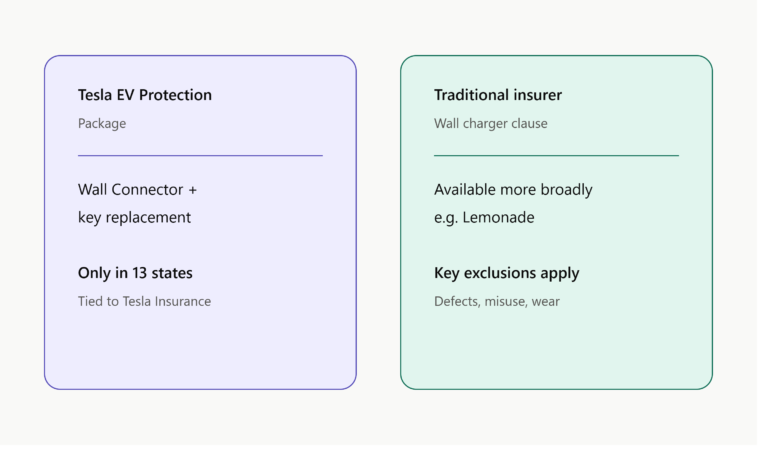
Availability. Tesla Insurance operates in only 13 states as of 2026: Arizona, California, Colorado, Illinois, Minnesota, Nevada, Ohio, Oregon, Tennessee, Texas, Utah, Virginia, and Washington, with additional states expected to launch over time. If you live in the other 38 states, including major markets like New York, Florida, Georgia, and Michigan, it simply isn’t an option regardless of how appealing the pricing model sounds.
Predictability and protection from a single incident. Because Tesla’s model recalculates monthly from real driving data, a single bad event, including one that genuinely isn’t your fault, has been reported to raise the following month’s premium by $10 or more. Traditional insurers typically absorb a single non-fault incident more gradually, and some offer accident forgiveness programs specifically designed to prevent one event from spiking your rate.
Coverage for non-Tesla vehicles in the household. Tesla does offer coverage for non-Tesla vehicles owned by Tesla owners in some states, but these vehicles don’t receive Safety Score-based pricing and are rated using traditional factors instead, meaning the core advantage of the product doesn’t extend to the rest of your household’s vehicles the way a single traditional policy easily can.
A side-by-side summary
| Factor | Tesla Insurance | Traditional Insurers |
|---|---|---|
| Pricing basis | Real-time Safety Score (outside CA) | Age, credit, driving record, vehicle |
| Rate updates | Monthly | Typically at renewal (annually) |
| Availability | 13 states as of 2026 | Nationwide |
| Bundling discounts | Not currently offered | Widely available, 10-25% |
| BBB rating | 1 out of 5 stars | Varies by company, generally higher |
| Best for | Safe, low-mileage drivers in eligible states | Most drivers, especially those valuing service and bundling |
| Household coverage | Non-Tesla vehicles rated traditionally | Consistent rating approach across all vehicles |
How to decide which is right for you
- Check if you’re even eligible first. If you’re outside the 13 currently available states, this comparison is moot for now, focus on traditional insurers and revisit Tesla Insurance if it expands to your state.
- Be honest about your driving habits. If you genuinely drive smoothly, brake gently, avoid aggressive cornering, and rarely trigger forward-collision warnings, the Safety Score model is likely to reward you meaningfully. If you’re not confident in that, a traditional insurer’s more predictable pricing may serve you better.
- Weigh the claims-handling risk seriously, not just the premium. A lower monthly payment is only a good deal if the coverage actually works when you need it. The BBB rating and California enforcement history are real data points, not just internet complaints, and deserve genuine consideration alongside the price.
- Consider a hybrid approach. If you like the concept of behavior-based pricing but want it from an insurer with a longer service track record, Progressive’s Snapshot or State Farm’s Drive Safe & Save offer a similar mechanism with more established claims infrastructure behind it.
- Get quotes from both before deciding. As with every comparison on this site, the only way to know your actual numbers is to request real quotes, since the averages above can shift substantially based on your specific model, state, and driving profile.
The bottom line
Tesla Insurance offers a genuinely different pricing model with real savings potential for safe, low-mileage drivers, averaging roughly $47 a month cheaper than traditional insurers nationally, with the very best Safety Scores unlocking even larger discounts. But that potential comes bundled with real tradeoffs: limited availability, no bundling discounts, and a documented, serious customer service and claims-handling track record that traditional carriers generally don’t share to the same degree. This isn’t a case where one option is simply better, it’s a genuine tradeoff between potential savings and service reliability, and the right choice depends on how much weight you put on each.
This article is for informational purposes only and does not constitute financial or insurance advice. Insurance rates, availability, and company performance metrics change frequently. Always confirm current details directly with Tesla Insurance and any traditional insurer before making a purchasing decision.